
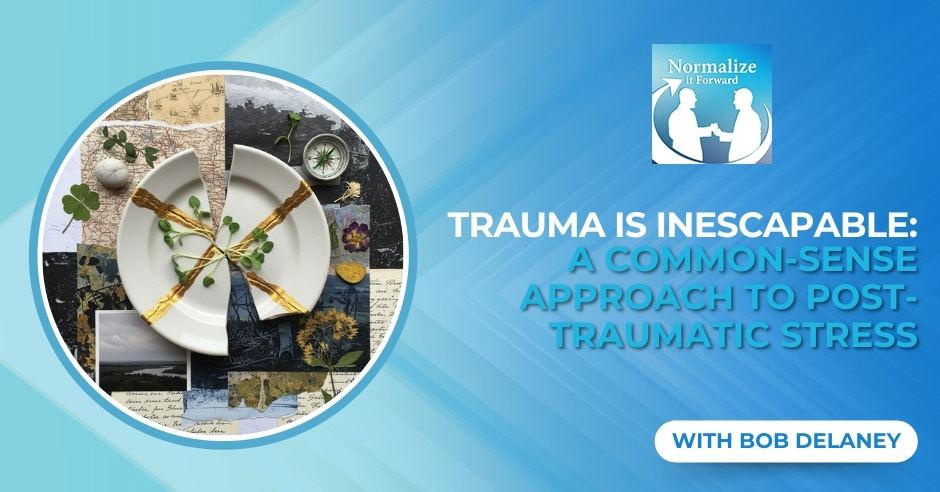
The path to healing from post-traumatic stress requires bravery, honesty, and a willingness to share your story. Bob Delaney‘s life truly reads like a movie script: he’s a former New Jersey State Trooper who spent three years undercover infiltrating the mob, and later became one of the NBA’s most respected referees, officiating over 1,500 games. His extraordinary journey has made him a leading voice on resilience and leadership, using his experience to help first responders, veterans, and athletes understand the human side of high-pressure lives. Bob discusses how the game of basketball became his therapy and how a common-sense approach is better than over-medicalizing the conversation. He reminds us that trauma is inescapable, and through his powerful Kintsugi analogy for healing, he proves that what is personal is universal.
Reading about mental health is hard. Let’s schedule a free consultation.
—
Watch the episode here
Listen to the podcast here
Trauma Is Inescapable: A Common-Sense Approach To Post-Traumatic Stress With Bob Delaney
Undercover Cop To NBA Ref: The Human Side Of High-Pressure Lives
We are here to talk openly about mental health and wellness. I have a fantastic guest. I’m super excited that everybody gets a chance to meet Bob Delaney. Bob, how are you, sir?
Good, Marc. Pleasure to be with you.
Thanks so much for being here, Bob. Bob is a fascinating individual and has done, honestly, the more I read about you, Bob, the more I think you’ve done you’ve lived a few lifetimes here. Bob’s life really reads like a movie script in some ways, but it’s all real. He’s a former New Jersey State Trooper who went undercover for three years, infiltrating the mob. Bob later became one of the NBA’s most respected referees, officiating over 1,500 games, that’s a crazy number, including multiple NBA Finals.
It’s what came after this that truly defines him. Bob has become a leading voice on post-traumatic stress, resilience, and leadership, using his extraordinary journey to help others understand the human side of high-pressure lives. Now he speaks to first responders, veterans, athletes, and everyday people about the power of acknowledging our story and healing through connection. In this episode, Bob reminds us that even those who appear calm under pressure have a story beneath the surface, and that sharing it can change their lives. Bob, welcome. How are things?
Thank you. Good to be with you.

Absolutely. Good to have you here, Bob. I have to say, reading through your bio and reading through all the different things that you’ve done, I guess I’m wondering, where would you like to start to tell us a little bit about who you are?
I think that you start from the beginning. I was very fortunate to have the first leaders in my life sit across the dining room table, Mary and Bob Delaney. I grew up an Irish Catholic kid in an Italian neighborhood in Paterson, New Jersey. The school, the church, that was the center of our lives, playing on the Little League teams and being involved there.
One of the things that happened to me early on, I was a pretty good athlete playing Little League baseball, and then the basketball team had tryouts and I didn’t make it. I got cut. Disappointment turns into motivation, and I became obsessed with getting better at basketball. I was probably a better baseball player than I was basketball, but I kept at it because I didn’t make the team I was with my friends. That was in seventh grade.
In eighth grade, I played, played in high school, was an all-state basketball player and baseball player in New Jersey. Played in college, and basketball was a big part of my life. The reason I keep saying this is that I found it to be therapy later in life. I joined the New Jersey State Police, as you said, in 1973. I followed in my father’s footsteps. He was a lieutenant in the State Police at the time. All my life, I never thought of being a trooper. It wasn’t until I was a sophomore in college that I saw it as a way to serve.
I looked at my father and his friends as hero types and didn’t think I had what they had in them to become a trooper. I was on the job about a year, and they try to make you feel good about yourself. You have this squad room with a little cubbyhole, like you’re back in kindergarten, with your name on it, as if you’re important. I walked in after two days off and it was a note to call Lieutenant Jack Liddy, Division Headquarters Criminal Investigation Section, Organized Crime Bureau.
Disappointment can turn into motivation. Share on XThis guy had more titles next to his name than I ever saw, Marc. I grew up Irish Catholic, which means I wake up guilty in the morning. I thought I had a problem on my hands, I thought I was in trouble. I had a conversation with the lieutenant, and after the conversation with him, he asked if I was interested in doing undercover work. I said, “Yes, sir.” Over a period of time, I learned that it was the first time that the FBI and New Jersey State Police and the President’s Organized Crime Task Force out of Washington, D.C., were going to join forces. I became one of those undercover guys.
I thought it was going to be a fun gig. They told me it was going to be six months. Every federal grant is written for six months, like we’re going to end organized crime in the State of New Jersey in six months. That didn’t happen. The six months became a year, a year became two, and it started going into the third year, and I just wanted out. We infiltrated the Genovese and Bruno crime families. I was living a lifestyle that was not my own. I’m living a dual life. I was made to look as if I was thrown out of the State Police. It was a very Sopranos-esque type life. While we’re not here to talk about undercover work, I have to share my story as to what took place.
While it was very good at putting away bad guys and we did, we put away a lot of bad guys but what happened to me was post-traumatic stress disorder. I didn’t know what was going on inside of me. I used to refer to it as an emotional rollercoaster, which is a common term. I actually would term it emotional violence inside of me. I was angry. I didn’t know what I was angry about. I was like a frustrated child that I would punch a wall and put a hole in a wall.
I’m not the guy that can spackle. If the car breaks down, I get out, I open the hood because I think that’s what you’re supposed to do. I have no idea what I’m looking at. I couldn’t fix it, so I’d just go down to Walmart or Kmart and buy a cheap painting and put it over that hole in the wall. How prophetic that was of what I was hiding and what was truly going inside the four walls of my house.
To the outside, I was being told I was this heroic type figure. I did heroic work. I was a brave guy. I felt none of that. I felt like the biggest hypocrite in the world. I’m getting all kinds of awards and recognition, and yet that’s not who I was. I was scared to death the whole time I was doing the undercover work. I had this emotional upheaval inside of me that I didn’t know how to handle. I became a student of post-traumatic stress, but I got lucky.
When I say I got lucky, one of the troopers that was assigned to my security detail after I surfaced from the undercover work had a background of psychology from Rutgers University. He could see some things going on inside of me. For something I wanted to get away from so badly, I kept going back into it. My undercover name was Robert Allen Covert, Bobby Covert. Catchy name for an undercover guy, but we weren’t trying to be cute or funny.
The birth records and death records are not cross-indexed in our country. If you go to the death record side, find a child that died at birth, same first name, same ethnic-sounding last name, same age grouping, that’s how we developed our persona. When I got this other trooper, his name is John Schroth, a detective in the State Police who had the background in psychology from Rutgers University started to see I wanted to get away from this so bad, but yet a couple of weeks later, I got the leather coat on. I got the chains around my neck. I got the pinky ring going.
If we can keep post-traumatic stress at post-traumatic stress, and not allow it to grow to the disorder, we'll have a better handle on finding ways to navigate the emotional upheaval we may be feeling as a result of things we experience in life. Share on XI’m kissing people on the cheek like I’m back with the wise guys, with the mob. He was the one who started to see something. We would be on a late-night surveillance. I had to testify in grand juries, I had to go on late-night surveillance and I had a security team with me. We stopped over for a drink. When I got on that environment, I started buying everybody drinks because that’s what Bobby Covert did.
Detective John Schroth said to me, “Hey pal, what are you doing? That’s not fed money anymore. That’s mortgage money. You’re hurting yourself.” As soon as he pointed the finger at me, I did the moonwalk. I got away from him. He doesn’t know what I’m going through. I don’t want to hear that. I was being paraded around. I testified before the United States Senate, I gave a briefing to Congress, and everyone wanted to hear about this undercover job.
I was speaking at the Jersey City Police Academy in New Jersey, and in the audience was Dr. Henry Campbell. Hank was my college psychology professor at New Jersey City University. He and I started doing some informal therapy sessions together. He was the first one to say to me, “Bobby, what you’re going through is post-traumatic stress disorder.” I pushed him away, said, “Hank, get out of here. I’m a trooper. I’m reading about this thing. It’s a military thing. It’s not me.”
Marc, this has been around forever. Sophocles wrote two plays about the warrior not knowing how to act after coming home from battle. After the Civil War, we called it soldier’s heart. World War I, it was shell shock. World War II, it was combat fatigue or battle fatigue. In the Korean and Vietnam wars, we referred to it as flashbacks. In 1980, it became post-traumatic stress disorder. From my view, we have over-medicalized it ever since because we scare people away from having the conversation.
Please don’t interpret that I’m saying we don’t need the medical side of the house, we do. We have tremendous resources. We just have to continue to build stronger bridges between those who are the resource and those who need the resource, and to have a more common-sense approach to it versus a diagnostic approach to it.
At times, like everything in our country, we swing things one way or the other. We have difficulty finding the middle in our country for some reason. It’s along the same line with this. PTSD to me is one of the most loosely used terms in our society, and it’s not fair to those that are dealing with it. I tell folks, “You don’t get PTSD if Starbucks gets your order wrong, yet we use that term so loosely.” Post-traumatic stress disorder is a diagnosis, and it is a medical diagnosis.
I work in the area of post-traumatic stress. My belief is if we can keep post-traumatic stress at post-traumatic stress, not allow it to grow to the disorder, that we’re going to have a better handle on finding ways to navigate ourselves through the emotional upheaval that we may be feeling as a result of some of the things that we experience in life.
From Undercover Trauma To NBA Therapy: Basketball As Inner Peace
I’m curious. I’m listening to just a snapshot of what you went through as a state trooper that created a lot of this. You entered into becoming a referee, and I thought, psychologically, what was that like? How did that happen?
The reason I told the story about the basketball in the front end, basketball was a big part of my life. When I surfaced from doing the undercover work, I couldn’t play anymore. In my junior going into my senior year, I got Budweiser-itis. I couldn’t jump anymore. That summer was a heck of a summer down the Jersey Shore, but all of a sudden, my abilities changed. When I came out from surfacing, I don’t know what it was, but the game was calling me back. I say that I was on a street that had no rules and boundaries, and then I had wanted to be around a game that had boundaries and rules.
I didn’t know what it was doing for me as I do now, releasing endorphins, attending to my hypervigilance because I had to look all over, all over those things. The game became therapy, and basketball was my therapy. I say to folks, when you’re going through tough times, find your inner peace. Your inner peace may be bicycling, or running, or quilting, or photography, whatever it is. For me, it was basketball. That to me is important is it’s an example of what inner peace can bring.
Managing The Game: 30 Years As The NBA’s Most Respected Referee
I don’t know if it’s possible to capture a 30-year career but talk to me about that, because I think about all of the greats that you were around, all of the personalities ranging from kind to, we’ll say, unkind, and everything in between. Is there a way to capture that, Bob?
Not being able to play any longer, I started to figure out I can get on a basketball court as a referee. There are only three groups of people that get to put their feet on a basketball floor, and it’s the players, coaches, and referees. I started refereeing little kids’ games. This is quite a while after I had surfaced, because I had was testifying in grand juries, everything was slowing down and it was not as concerning to the State Police for where my activities were.
One thing led to another and I was refereeing high school ball, and then I started refereeing summer pro leagues down the Jersey Shore, over in New York City, in different parts of the state. Somebody from the stands came out and his name was Darrell Garretson. He happened to be the director of officials for the NBA. He asked if I was interested. I think it was my demeanor as a state trooper and understanding how to find problems before they start and quell them that was attractive. This was 1984.
When you’re going through tough times, find your inner peace. Share on XBy 1987, I was hired into the National Basketball Association. I spent 25 years as a referee, and then 5 years as management, and during that time I was the director of officials and the vice president of referee operations. To your point, the game has changed a great deal, but interacting, it’s one thing to be able to call a game, it’s another to be able to manage a game, and to understand the personalities that are involved here. The higher the level that you go, the higher the personality.
I’m sure. I’ve got to imagine of all of the longtime referees in the NBA, you have to be up there on the list.
I started in ’87, like I said. I came off the floor in 2011 and ’12 to ’17, I was in the position up in management, in the front office. I retired and then Commissioner Sankey created a position, so I’m with the Southeastern Conference now as a special advisor for officiating development performance. The game continues to be my outlet. Parallel to this time, for 40 years, i’ve been doing this work with post-traumatic stress. Law enforcement, firefighters, first responders, then the military heard about me, I was tapped to do work with the military, spent time in Iraq and Afghanistan. While I was doing that, I always had basketball as my therapy.
Resilience & Small Wins: Why Simone Biles & Kevin Love Are Mental Health Heroes
You’ve talked about the game as your therapy and so many athletes over the years have come out publicly talking about how they’re impacted by different mental health and wellness issues. I guess I’m curious, just in general, how do you see athletics and how do you see the sport itself impacting people that way?
Thanks for bringing that up, because I think that my earlier statement about swinging from one side to the other and not finding the middle, when we first started really becoming societally aware of post-traumatic stress to the level that it is, we saw it as a negative. We were speaking about it in negative terms of things that were taking place with troops coming home from Vietnam, that were coming home from a war-torn battle situations. That’s what we equated it to, and then it was the reactions they were having.
Nowadays, I think that we talk more about resiliency and about that going through this, you can become even stronger as a result of going through some difficult times. I think we have to celebrate the small wins, and I use Simone Biles as an example. If you recall when Simone Biles said that she could not participate in the Olympics because she had twisties, and we all became educated as to what twisties meant. We were all like, “She’s up like 12, 15 feet in the air and then she can’t get her feet on.” We became understanding to what she was saying.
It’s one thing to call a game; it's another to manage a game and understand the personalities involved. Share on XThe 40-year-old living in the mother’s basement was still tweeting out some negative comments, but the overall society was very supportive. Think about 2 to 5 Olympics ago, she would have been vilified as being unpatriotic. We were not as aware or willing to be aware of some of the things that are changing in our society. That’s when I talk about celebrate the small wins. We’re moving the bar. This is not about eliminating post-traumatic stress or trauma, it’s learning how to interact with it and how to navigate it, and that to me is important.
I use an analogy. I ask people to imagine i’ve got the biggest balloon being held over my head. How do I get the air out? They take a pin and pop it, I get the air out, but I don’t have a balloon anymore. I let it go, it flies all over the room, it goes out the door, we don’t know where the balloon was. If we’re patient and willing to listen to sounds we do not want to hear as we turn it upside down and we let a little air out at a time. That sound may hurt your ears maybe you don’t want to hear eventually we get all the air out and we have a new balloon we can use again one day.
That’s us with trauma. That’s with us with our experiences in traumatic situations. We need to talk about it. I tell folks, i’ve written three books, i’ve had numerous articles, i’ve been on a lot of podcasts, i’ve got films that have been made, all my stuff’s not on the street, yet there’s some stuff that’s still in there. I’ve probably got 90% out, and I feel lighter, and I learned that the more that I spoke about it and spoke to someone and was able to get help coming back to me, all of a sudden, things got a lot better in my life.
Trauma Is Inescapable: The Power Of Peer Support & Getting Help
It’s funny, Bob, I just did an interview, and those really important three words, “I need help,” came out. To my young audience, I think that’s a real obstacle that notion of, “I don’t need help, I’m fine. I’m totally fine,” suck it up all those phrases that we hear. It’s like I don’t know too many people that don’t have traumas. I don’t know too many people that haven’t experienced things that, quite frankly, could be talked through.
It does make me wonder sometimes, like you said, years ago, how would Simone have been illustrated to us versus now? I think the Kevin Loves of the world and some of the other athletes in the NBA and the stand they’ve taken around wellness and the concept of, “I am who I am, and this is what I’m dealing with,” to me has been just immense. It’s been really impactful for young people.
I know young people will talk to me about it. When those things come out publicly, they’ll hear about them. Quite frankly, i’ll hear about this interview. Kids will see it and they’ll email me or text me or comment about it. I think a lot of it is for us being older than them to be able to say, “Here’s the path.” The path is, let’s talk about it, let’s deal with it, as you said, let the air out of our balloon. Get to a lighter place so that we can enjoy our life.
I’ve had conversations with Kevin. Back in the day when we started having these conversations within the NBA, David Stern, Adam Silver were very supportive of the message that I was doing and they gave me a title of NBA Cares Ambassador, so that they were supportive in sending me over to Iraq and Afghanistan in concert with the military and a lot of different locations.
I got my Master’s at Saint Mary’s College of California in Leadership, and then I studied at the Harvard Global Mental Health Trauma Recovery Program. We started our studies in Orvieto. Dr. Mollica is the director, and his words rang played in my head as you said what you were saying because he has a very simple statement as he starts every program. “Trauma is inescapable in life.” Trauma is inescapable.
Trauma is inescapable in life. Share on XYou also triggered in my mind about how we become judgmental of trauma. I don’t mean judgmental of me to you, but judgmental within ourselves. Someone else is going through something worse. We minimize what we’re experiencing. Our stuff is our stuff, and it’s not to be compared to what someone else is going through, it’s what we’re going through. The more that I came to grips with that and understood it, I was able to have a better approach.
One of the soldiers that I worked with lost both his legs in Iraq. We were at a post-traumatic stress program that I was sharing some thoughts with. He said to me, “You know what? Post-traumatic stress is like dieting. Some of us need to lose 5 to 10 pounds, some 10 to 20, and some of us are obese, and it changes on an hourly or daily basis.”
I said, “What a great analogy. I’m going to use it,” because i’ve been 5 to 10 pounds since I came out of the womb. At times i’ve been overweight, and it didn’t mean I stopped living. At times, it just meant I bought bigger pants. It’s finding ways to navigate and how do we interact with it. Our demeanor and our approach about how we do that just what you were saying is how can we feel lighter, how can we feel engaged?
My first peer-to-peer conversation took place with me in a mirror. Not just thinking the words, I verbalized it to that person about what I was speaking. I got lucky again. A guy by the name of Louis Freeh, who became the director of the FBI, was a street agent back in the day during my case. He was working another case in New York. He introduced me to that other undercover agent. His name is Joe Pistone. The world knows him as Donnie Brasco, and Johnny Depp played him in a movie.
Joe and I are still friends to this day, and we can still talk about what our experiences went through, and that’s what peer-to-peer is. Peer-to-peer is being able to speak to someone who has gone through a similar experience. We’re two old dudes now. The only place I can go undercover now is the senior citizen home and figure out who stole the yogurt. Being able to have someone to speak to is so important.
Peer-to-peer is being able to speak to someone who has gone through a similar experience. Share on XIt really is. I think we live in a world I’m really thankful for this we live in a world where there’s good people out there and there’s people that want to speak to you. You just have to get to that point individually where you want it and you acknowledge it. I think that’s a hard part, acknowledging it.
That is a great statement, and that’s something we have to be reminded of. I really believe there’s a lot more good than bad, and we’re getting inundated with negativity. You watch TV, you get inundated with the news. All of this noise that’s going on outside starts to bring inside of our own personal lives. Knowing that, there’s a lot of good people that are willing to help and have tremendous hearts.
Beyond The Uniform: Why Athletes Need To Say “I Need Help”
No doubt about it. I’m curious, I work with so many athletes that if I didn’t ask this, they’d probably be upset with me, what’s it like to be on the hardwood with some of those legendary players?
I was fortunate. I got to referee Julius Erving. He was ending as I was starting and then the Magic and Larry years, and all through Michael Jordan, and into the Bad Boys of Detroit, and all the way up to Steph. I refereed Steph’s dad, Dell. Little difference. Dell had to come off a screen to get an open shot, Steph just has to get on the court somewhere and Steph’s throwing it up. I remember him as a little kid in Charlotte sitting along the bench when his dad was playing, and I got to referee him for two years before I went into the office.
The greatest athletes on the planet are in the NBA, and their abilities are phenomenal. It’s still a job, and so you have to compartmentalize. You’re a fan of the game because you love the game, but when you go to work, it’s about making sure that the rules are enforced and that they stay within those guidelines of the rules.
It’s funny you should say that. I’ve also had the thought, too, with athletes, it doesn’t matter what level you reach, you’re still a human being. You’re still susceptible to everything, Bob, that you and I are susceptible to. I think that’s something that many of them have reminded us about in the last many years. Things like depression and eating disorders and anxiety and post-traumatic issues, they’re all susceptible to them as well, just like we are. I think it’s important, as much as some of those guys can shoot a three from the parking lot or jump out of the gym, they have extraordinary abilities, certainly, but they are built the same way we are emotionally.

I’ve worked with college athletes, i’ve worked with college teams, where I met with the entire team because the team had such a long losing streak. They were embarrassed to go into the dining facility at the university because they were reading everything that was online about how bad the team was. These are areas that are important to have conversations about, because these are true feelings.
One of the things that you also triggered in my mind is that the work I do, I started to realize I do a lot of work with folks that wear uniforms. Law enforcement, firefighters, first responders, military, health care community, they put on scrubs or they put on a lab coat, and then athletes. When we put on that uniform, we think we can leap tall buildings in a single bound, we can handle anything. That we are a little bit superhuman, or we’re being held on a pedestal because of the uniform that we wear and the position that we hold in society.
Understanding what you just said is so important. When the bell rings, every one of those professions does what they’re trained to do and what they have trained themselves to do. Yet when it’s over, it’s a human being that’s coming out of that uniform that we need to have the abilities to tend to and say it’s okay for them to say, “I need help,” or, “It’s not okay, I’m struggling right now. I’m in the deep end of the water and I just need somebody to help pull me out.” That’s okay to talk about that. It took me a while to get to that point, but when I did, my life changed for a lot better.
I want the young readers to really understand that, Bob, because we hear these stories where athletes unfortunately, some of them take their lives and we’re stunned when that happens. To me, it’s like, there’s people out there that need help, there’s people out there that have help around them. All they have to do and I’m making it sound simple, it’s not is to ask for it and to get it. To me, it’s there’s a lot of young people out there that need it and aren’t getting it. As you said, your life changed.
For your people in your audience, I’d ask them to Google Kintsugi. Do you know Kintsugi?
No.
Kintsugi is a Japanese art form. What do we do in our society when something breaks? We throw it away. In the Japanese culture, say a pottery dish, they put it back together with gold and silver glues. What I would offer to you is that while it looks different, it’s still operational, it’s still functional. While it may not look the same, it’s still beautiful. I would even argue it’s stronger because it’s been reinforced.
There is no testimony without a test, and what is personal is universal. Share on XI use Kintsugi and I put that photograph up when I present of that pottery dish with the gold and silver, that’s our humanity. That’s how we get broken, and I believe deep in our subconscious we feel that if we say we’re broken, we’re going to be discarded. When we come to understand that we can be put back together, we can be stronger. That’s the beauty of some of the challenges that come in life. There is no testimony without a test, and what is personal is universal. There are other people feeling what you’re feeling. That’s one of the things that I came to learn is that I’m not alone. There are other people feeling the same emotions I’m feeling.
No doubt about it. I think if you live life long enough, you start to realize life really is a rollercoaster. You’ve got your ups, you’ve got your downs, and as one of my mentors years ago used to say all the time, life is not a dress rehearsal. We got one chance here so you got to do what you got to do to live it and to enjoy and experience the happiness that you can have out of life.
I think one of the secrets to that, that I think a lot of adults have discovered, is getting the help when you need it. I don’t know where it came from, Bob but that concept of like, “I don’t need help, not me.” I’m thrilled to hear you talk about that. I think it’s I believe it’s our job as adults, older than young adults, to teach and to pass along those things that we’ve discovered in life and the little secrets and tips that took us a while but hopefully won’t take them as long.
I love hanging out with the young folks. You hang out with young folks, you stay young. We go to great lengths to understand cultures in our society. I really believe that each generation is a culture. We have to have a better understanding. You have to change with times. I used to get off a plane and look for a phone booth. Now I have a phone in my pocket. For all those who want to go look for the phone booth, be my guest. You got to stay current. Staying current means spending time with young folks.

Self-Care Is Not Selfish: Final Takeaways & Call To Normalize It Forward
I’m laughing, Bob, because you referenced Superman earlier and I’m remembering watching that with my son, and he jumped into the phone booth and changed and my son asked me, “What’s that?” I said, “That’s another story for another day.” I so appreciate you making the time. Bob, honestly, when I read your bio and heard about your background, I thought, “This guy has lived multiple lives.”
Probably the best thing that I read is you continue to help. You’re a helper, you’re a person who wants to pass along your knowledge and your experiences and your joy, and also very human, very honest to recognize not every day, not every moment’s fantastic, and it’s not that way for anybody. To me, you’re a role model in so many different ways. I appreciate you spending time with us.
Can I put you on the hot seat for one second one more second? I set up this show a couple of years ago to really spread the conversation and to really help especially young people understand how important it is to normalize wellness and mental health. One of the things that I ask of my guests is to nominate a friend, a coworker, a relative to keep that conversation moving forward so it doesn’t stop. Any thoughts as to who maybe I could interview next that you’d like to nominate?
Steve Shambam is a friend of mine, and I will send you his information and connect you. I really appreciate the opportunity to be with you. I would offer to you and your audience my hope for all of you is to stay healthy, stay safe, take care of one another, and take care of you, too. Self-care does not mean selfish. Self-care is about being the best you can be to make the world a better place. Truly an honor being with you, Marc.
Bob, I can’t improve on that. We’re going to finish on that note. I thank you so much. I look forward to getting in touch with Steve. I thank you for your time, your energy, and your positivity.
God bless you as well.
Thank you.
Important Links
About Bob Delaney
 Bob Delaney’s life reads like a movie script — but it’s all real.
A former New Jersey State Trooper who went undercover for three years infiltrating the mob, Bob later became one of the NBA’s most respected referees, officiating over 1,500 games, including multiple Finals.
But it’s what came after that truly defines him. Bob has become a leading voice on post-traumatic stress, resilience, and leadership — using his extraordinary journey to help others understand the human side of high-pressure lives.
Today, he speaks to first responders, veterans, athletes, and everyday people about the power of acknowledging our stories and healing through connection.
On Normalize It Forward, Bob reminds us that even those who appear calm under pressure have a story beneath the surface — and that sharing it can change lives.
Reading about mental health is hard. Let’s schedule a free consultation.