Normalize It Forward - Marc Lehman | Dean Daniel | Men's Mental Health


The true strength in men’s mental health isn’t toughing it out, but taking off the mask and choosing to fight another day. Marc Lehman sits down with former athlete turned passionate mental health advocate and founder of Unbeaten, Dean Daniel, who shares his raw and incredibly powerful journey through chronic pain, eight spinal surgeries, and multiple suicide attempts. As a proud ambassador for Tough To Talk, Dean opens up about the stigma surrounding men’s emotions, the devastating effects of silence on families, and the life-changing choice he made to live and help others realize they are never truly alone.

Reading about mental health is hard. Let’s schedule a free consultation.

Watch the episode here


Listen to the podcast here


Taking Off The Mask: Breaking The Silence On Men’s Mental Health With Dean Daniel

We are here to talk about mental health and wellness. I am here to welcome Dean Daniel.
 

Normalize It Forward - Marc Lehman | Dean Daniel | Men's Mental Health


Dean, welcome. How are you?

I’m good. Thank you so much for having me. I’m excited. I appreciate you for having me for this conversation.

I appreciate you being here. I’m going to run a quick intro to my audience, and then we’ll get into things. Dean is a passionate mental health advocate and a proud ambassador for Tough to Talk, an organization dedicated to breaking the stigma surrounding mental health and suicide. Don’t let me forget. I want to double back and hear more about Tough to Talk.

Through public speaking, podcast appearances, and community work across the UK and beyond, Dean uses his own journey, including living with chronic pain and its impact on his mental health, to show that vulnerability is strength and that speaking up can save lives. He’s the Founder of Unbeaten, a movement and apparel brand supporting mental health charities. More than just a brand, Unbeaten stands as a message of strength, solidarity, and survival, a reminder that no matter the challenge, we’re never truly alone. Thank you so much for spending some time with us.

My pleasure.

From Athlete To Advocate: The Start Of Dean’s Chronic Pain Journey

Dean comes from across the pond, as they say. I hope things are well over in England. I thought maybe we could jump in and talk a little bit about your story and where you’ve been. My audience will want to hear about that.

No problem. I’ll take it back to the start. I used to be a 200-meter runner. I was running for both club and country. I was living the dream. I was living the life that I was destined for. I wanted to make the Olympic Games. I wanted the medal at those games. I wanted to be the best that I could be. Unfortunately, after a successful start to my career, I had a nasty car accident. Unfortunately, I wasn’t able to run at that level any longer. As you can imagine, I was devastated by that news, but I thought to myself, “If I can’t make my dreams happen, then I want to help others achieve their dreams.”

I got into the coaching side and personal training side to help others get to where they wanted to go, if I couldn’t get to where I wanted to. I had a successful number of years doing that. I loved it. I loved seeing what I was turning people into, both from a physical and from a confidence and mental side. As we are all aware, the fitness industry, especially when we’re talking about the fitness side, works for both physical and mental capacity. I loved it.

One evening, which is when my story took a dramatic turn, I was training myself. I had gone to the gym. Unfortunately, I’d lifted too heavy with poor preparation. I didn’t sleep and wasn’t eating before that. I felt a sharp lower back pain. As those blokes do, we think, “We’ll battle through. We’ll carry on to the session,” but within about 5 to 10 minutes, the pain was agonizing. I had to finish the session.

I’ll cut a long story short. I got rushed to the hospital, and I had to undergo my first spinal surgery. This was back in 2018. This is when the journey started. Since then, I’ve had eight spinal surgeries. I’ve fallen down the stairs, top to bottom, maybe 5 to 6 times. I’ve developed something called vasovagal syncope, which is where your body is in so much trauma and so much pain that it switches off. I found that out.

Through one of my surgeries, I was on holiday with my young one. It was his eighteenth birthday. We all went through it to celebrate that. Prior to that, I was collapsing. I didn’t understand why. My wife had to conduct CPR on me one random day because I’d dropped down in the front room. We all were like, “What’s going on? Where does this come from? I don’t understand it.” She had to perform that. The defib was called for. The paramedics came. They rushed me to the hospital. That’s when I’d done my tests and checks and found out that this is what I’ve got.

The first time I understood anything to do with mental health was about then because I’d started to realize that I wasn’t the person that I wanted to be, and what I previously was. We went from that point to maybe 2 to 3 collapses a day, which was then preventing me from driving and preventing me from being a normal human being. I couldn’t leave the house without worrying about the embarrassment that I may collapse and an unfortunate stranger may have to find me, putting them through all that stress and strain.

My mental health started to deteriorate quite quickly from there. As you can imagine, it was a shock. Those blokes, as we do, especially within the UK, the stigma around mental health is so bad. I used to lock myself away in the bathroom, turn the shower on, and sit there crying. I then wipe my eyes, come back out like nothing has happened, and be this dad and this husband that I wanted to be. Deep down, I was dying inside. It was awful.

I ended up going on the holiday with my family. To be honest, at this point, my mental health was at rock bottom. Nobody knew. No one could see it, but I was fed up with the pain. I’d lived with this chronic pain for over eight years. I’d gone from a shell of my original self. I felt that I was a burden on my family. I wasn’t the husband that I should be. I wasn’t the dad that I should be. I wasn’t the friend that I should be. I started to deteriorate.

Before this holiday, I was in the hospital. I was on the top floor of this hospital. I looked out the window and I thought, “If I could jump out this window now, I would.” Physically, I couldn’t because I was still getting, at the time, wheeled to the bathroom and wheeled to wherever in wheelchairs and whatnot. That alarm bell started to ring at that point, like, “Hang on a minute. This isn’t right here. Something isn’t right.”  That’s when the mental health journey started.

The Stigma And Crisis: Crying In The Bathroom And Contemplating Suicide

I messaged my wife at the time and said, “I don’t feel well. If I could jump out of this window, then I would.” She contacted the hospital and everything from there. I got support whilst I was in hospital. For me, the alarm bells started to ring at that point. To be honest, I didn’t understand it because I’d never thought that mental health or anything would affect me or would hit me. This person, who was outgoing and a confident guy who was living his best life, however many years ago, has gotten to this point. I was like, “Why me?” I didn’t understand it.

I had another surgery, and I’d come out of that hospital. It was nine weeks altogether in this hospital. I got out and they said, “When you’re going to be in there, you’re going to be doing your recovery period.” I won’t go into too much about it because it’s in an illegal arena at the moment, so I’ve got to be careful about what I do and don’t say.

I was telling people, “My pain is high. My pain is alarming me. This is getting worse.” No one was listening to me, but I was told, “It’s okay. This is a process. This is a recovery stage. This is something that you have to expect. You’ve had a number of spinal surgeries that, unfortunately, are going to do this to you.” I knew deep down that something wasn’t right.

Since then, what we found out was that there were multiple medical failures. I was right. I was failing, which was pushing my mental health. I was right. It was true. Since then, I’ve tried to fight. I’ve had a number of further surgeries since that point. I hit rock bottom at one point. Back in 2023, I had had enough. I said to myself, “I can’t do this anymore. My life is not worth living.”

I looked at my family, and they were seeing me going through all of these issues. They were seeing me going through this pain. It was awful. I said, “I am not allowing this to happen anymore. I need to relieve them of the pain,” although I was struggling with it. It was going to be me who had to make a decision of whether I was or wasn’t here. I needed to make that decision because I didn’t want them suffering anymore because of how I felt.

The Last Holiday: Emergency Surgery And Heavy Medication Load

We then went over on that holiday for my son’s birthday. To be honest, not many people knew at the time, but that, for me, in my head, was my last holiday. I was going to make sure that my son had the best eighteen birthday and had the best holiday. After that, I was checking out. It’s hard because I look back, I didn’t want my son, my daughter, and my wife to be without their dad and husband, but I had to make that choice because I felt it was the best for them.

We went on holiday. I ended up collapsing over there twice. On the day that we were returning home, I collapsed quite badly on a restaurant table. I was rushed to the hospital. As I was coming around, my nine-year-old daughter was screaming, “Is Daddy going to Heaven?” I’m lying there, trying to talk, saying, “I’m here,” and then I blacked out.

When I woke up, I was in intensive care in a Spanish hospital. I won’t go into too much detail because we’d be here all day. I went in there, having been told that there were failings from the UK. We needed to do emergency surgery because issues were occurring, and I was losing sensation down my legs. I had to have emergency surgery in a foreign country and then got air-ambulanced home. For the second part of the surgery, it was a nightmare.

That’s crazy.

In turn, my mental health was spiraling because I’d heard all these things about what had been done to me and why I’ve been left like this. Having to leave my family in a foreign country and having to be this person that wasn’t me was horrendous. My medication was increased. I was on 36 tablets a day. I don’t know what you guys have in the States, but I was on the likes of Oxycodone to Panadol, Tramadol, Pregabalin, and Diazepines to name a few. High-end pain medications. It was turning me into a person that I didn’t want to be. I didn’t know who I was. Toward the end of 2024, I had had enough. I said, “This life is not for me.”

Everyone experiences pain differently, from different angles and life maps, but when you're in it, that sharp pain feels like yours alone and no one can take it away. Share on X

Before I say any more, I have to warn you and anyone who’s reading that there’s a talk of suicide. I had had enough. I stopped the medications. I said to my wife, “I can’t do this any longer. I can’t do it.” She said to me, “You’ll be okay. Let’s keep going. Keep fighting.” Deep down, I was crumbling inside. I was having this strong outer exterior of, “Look at me. I’m okay,” but inside, I was turning into mush.

I managed to get out of the house with high levels of medication and alcohol. I took myself out of the way and attempted my life on that occasion. It was at the point where I felt that nobody else needed me. Everyone was better off without me. Although they suffered at that time, in the long run, my perspective was that they would feel better down the line because they wouldn’t have to watch me go through what I was going through.

I should have been sectioned, but they took me to a hospital. I was found by a couple up in the woods. They called the police. I was then taken to a hospital. I had to do all the reversal treatments and whatnot. They wanted to section me, but because of my chronic pain and my back issues, they suggested, “Let’s not put him in that type of environment. Let’s take him home, but make sure that the house is a secure unit.” We did that, but in turn, that made my wife lose her job, which was more financial stress and a burden on me. I felt like that was my fault.

I was spiraling by this point. It got to the point where enough was enough. I tried to listen to the crisis team and to my family, but there was only me who could experience this pain. I always say this. My pain was my pain. Other people experience their pain as well from different angles and different means. Once you’re in that pain, you know that that’s your pain, and no one can take it away from you.

The Ultimate Act Of Despair: The Window Jump And Turning Point

I was saying to everyone, “Although you’re trying to help and you’re trying to speak to me, I understand it. I respect what you’re doing, but you haven’t got a magic wand to wave it away, and then I’m okay.” I was respectful to the team. The crisis team was amazing. They were here every day for me. They were supporting me, but it wasn’t enough.

One evening, I realized that the window was left open. We were on the top floor of our house, and the window was left open. I said to my wife, “Could you do me a quick favor? Could you nip down and grab me a cup of coffee?” I knew my intentions, and obviously, she thought she was going to make a cup of coffee. She went downstairs, and I managed to get up onto the window ledge, jump the window open, and jump out backwards in the hope that that would end the suffering that was me, the family, and everything would stop. I was hoping this would stop, and they could get on with their lives without me interfering. That was the turning point for me.

As you can appreciate, I woke up. I don’t know how, but I’m so glad that I did. I woke up, and it was like something out of a movie. There were flashing lights. There were sirens. I had my wife screaming and my family having a breakdown on the floor. I couldn’t move from my neck downwards. I could move my eyes. I thought, “What am I doing to my family here?”

The destruction and devastation that I was causing was horrendous. You can never take it away from that individual who’s going through that suffering and that pain, but you don’t see what it’s doing to the people around you and what it will do moving forward. I remember looking, and I thought, “I have to stop this. I have to fight. I can’t do this to them. It’s not fair,” and then I blacked out.

I woke up in the hospital. I don’t know how, but my mom was there. We’re such a close-knit family. My mom gave me the biggest cuddle, and she was crying. She was like, “Dean, you are here for a reason, the reason why you’ve survived this. You’ve had two attempts on your life. You fell down the stairs from top to bottom.” I fell down the stairs. I’ve gone through the wall at the bottom where my head has gone through. I’ve gone through all that. I’ve had all these medications thrown at me. I’ve had these vasovagal collapses in random places. I have damaged my wrists, my face, and my knees wherever I’ve landed. She was like, “There’s a reason why you are here.” I looked up and said, “Yeah, I know.”

I stayed in the hospital for two weeks. When I came out of the hospital, I lay in bed, and I was in agony. My wife said, “How are you doing?” I said, “I’m okay. I realized that I need to live, I need to change, and I need to make sure that I can help people from getting to the point I got to.” I get a bit emotional thinking about this bit. She said, “We’ve got CCTV up around our house. I need to show you something. Do you want to see it?” I thought, “I know what’s coming.” She said, “The paramedics had asked that we see the footage of the CCTV to see how you landed in terms of injuries and whatnot. Would you like to see it?” I didn’t know what to say, but I thought, “Let’s do it.”

She passed me the iPad, and I read it. I opened it up and I was like, “That was me?” It was awful, honestly. At that point, I turned to my wife and said, “This stops now.” She said, “What do you mean?” I said, “I’m going to change. I’m going to make a difference. I’m going to make sure that nobody gets to the point that I got to and that everyone can realize you can be a normal guy or a normal lady.”

From wherever you are in the world, you can quite easily get to the point that I got to, from the first alarm bells ringing to the thoughts that you next get to the point where you’re attempting your life. I look back and I’m lucky. I’m lucky that I’m still here. I’m lucky that I’m able to sit here and talk to you, meet some amazing people along the way, and help.

I’ve said that I will carry on going and make sure that I save as many people as I can. I used to say a bit of a cheesy word. If I could save one person, then that’s amazing. I’ve done my job, but there are so many people out there that are going through these struggles that I don’t want to save ten. I want to save as many people as I can.

No matter where you come from in life, no matter what area, your religion, your race, or wherever you’re from in the world, it can hit you. Mental health doesn’t choose its targets. It hits you, and it hits you hard. When it does hit you, we need to make sure that we’ve got the resources and support, and we know that we’re not alone.

Breaking The Stigma: Why Everyone Is Susceptible

I have a thousand questions. I’ve got to order them in my head. Number one, thank you so much for your honesty and your vulnerability in telling us your journey. I’m so sorry to hear what you’ve been through, but I want to thank you and tell you that we’re the lucky ones that you’re still here. People like you allow my audience and their families to understand that we are all susceptible. It doesn’t matter your background. It doesn’t matter how much money a person has. It doesn’t matter where they’re living. It doesn’t matter what school they’re going to. I want all people to understand, who are tuning in to a show like this, that we are all susceptible.

I have a good friend who runs a company, Same Here Global. I’ll give them a shout-out. Eric often says five in five. Meaning, the stat is 5:5. We are all susceptible. When a person glazes over that and says, “Not me. It never happened to me,” they run into more issues. Your story resonated with me on so many different levels. I can’t imagine any of my audience reading it, not having similar experiences, so thank you.

Thank you very much. I do a number of keynote talks around the UK and the world, wherever it takes me. I always say that I want people to relate to me. I’m no one. I always say this. I’m nothing special. I’m a guy from Teesside in the Northeast of England who has been through some dodgy cards or some bad cards but has come through them in the end. There were times maybe I shouldn’t have come through, but there’s a reason why I have. If I can do it, then so can anybody else because I’m nothing special. I’m just a normal guy.

I want people to be aware and help break the stigma around mental health and suicide. Share on X

There are people out there who will be reading this, thinking, “If he can do it, then so can I.” That’s what this is about. This isn’t about putting someone on a pedestal. This isn’t about making someone out to be a hero. That’s not me. I want to make sure that people are aware, and we break that stigma around mental health and suicide. I want to show people, “This is okay. Yeah. You are not alone.” We come together when we unite, and we talk more.

What you said about vulnerability is so right. When I do my talks, I always say, “I might as well stand in front of you all, strip off, and show you an open version of myself, like, ‘I’m completely naked here.’” I’m sure my vulnerable side is there. If that helps other people realize, “There is light at the end of this tunnel, and there is a way out,” then so be it.

I hear you. You mentioned men in particular. It’s so fascinating when I read about this online and how many men put that mask on. Your story about crying in the bathroom, so many of us have been through that over the years. We feel like we have to hide it. We feel like we have to wipe our tears away. If people are like, “Are you okay?” We’re like, “I’m fine. Everything’s fine,” and that whole thing. You’re not fine. What I want to push is getting young adults to understand that this is powerful. When you are not fine and you tell everybody you’re fine, you’re giving it more power.

It’s true. You’re feeding it.

Unfortunately, it’ll beat you. It’ll climb higher than you. I’ve got kids that I know that try to harm themselves, do harm themselves, fail out of school, etc. To me, it is recognizing this isn’t about strength. This isn’t about, “I’m a strong guy. I can handle it.” This is about being human. This is about how, in your circumstances, which are different from mine and different from other people’s, we are all susceptible. This thing can take us down.
 

Normalize It Forward - Marc Lehman | Dean Daniel | Men's Mental Health


I applaud your efforts, number one, for not only being open and honest and vulnerable with us, but also talking about your comeback story. To me, the mere fact that you’re still here and we’re talking, and we’ve had a chance to meet, I consider that a gift. To me, that’s amazing. Let me ask. I’m curious. You mentioned your kids. How old are your kids, if you don’t mind me asking?

Ten and nineteen.

Crucial Advice For Young Adults And Parents: Take Off The Mask

A lot of my readers are young adults, between those ages, in many ways. For young adults in the United States and around the world, the statistics for mental health are not great. I read 65% of kids in the US who need help aren’t getting it for lots of different reasons. There’s a lot of suffering that goes on in silence, a lot of mask-wearing, and a lot of pretending. I want to give you a chance because you’re talking, in many ways, directly to them and directly to their parents. That’s my audience. I want to give you a chance to talk to them and to let them know from your perspective what would be helpful for them to do to try to address things. What do you think?

Personally, it is to take that mask off and to realize that you’re not alone. You may lock yourself away in your bathroom, your bedroom, or something like that, or you’re trying to put that mask on to go outside. It’s okay to take that mask off and say, “Listen, so-and-so friend. I’m not well.” You can go to your parents and say, “I’m not feeling too well. Is this something that I need to be concerned about?”

When it happened to me was when my wife found me at one point, and I was hysterical. I kicked the dog bed. The dog wasn’t in it, thankfully. I screamed out. She came down the stairs one day and said, “What’s wrong?” I said, “I can’t do this anymore.” Although I didn’t want anyone to see that, it was fine to do that because that’s how you could then get the support. We went to the GP, who then referred me to the crisis team. If you don’t open yourself up and your emotions and allow those thoughts to be released, then you can’t follow that next process.

From a parent’s side, I look at it from the perspective of my kids. I look at my little one and what she’s been through in terms of seeing me. I can laugh about it now. She came in at one point, bless her, and her dad was on the floor. I was on the floor, at the bottom. I’d gone through the wall at the bottom of the stairs. I had a full-body head thing on from the ambulance. I was on a spinal board. My little one comes in, and she has to see all of this.

You’ve got to look out from her parents’ side. I look at the telltale signs if she’s reserving herself a little bit more. I’m watching what she’s watching on her iPad or a TV. I know she struggled a little bit. Sometimes, we would see that she is quite quiet in the corner of the room and quite upset. We would say, “Are you okay?” She’s like, “I’m fine.” She’s putting that mask on and thinking, “I’m okay.” My son was the same. He locked himself away a lot because he didn’t like to see me going through that.

It’s looking at those telltale signs as well and thinking maybe it’s having a conversation and sitting down. Whether it’s to your parents, your friends, or your children, open up and show them that there is support there. I’ll be honest. When you’re in that place, you feel that there’s no support. You feel like you’re on your own, and there’s no one else who’s going through it. Unfortunately, there are so many of us who are going through it. If I’d have known a little bit more than what I know now, it may have helped those thoughts.

When you're in that dark place, it feels like there's no support and you're completely alone, but the truth is so many others are going through it too. Share on X

That’s great advice. I mention it to a lot of kids that I work with, “If you Google it, you’ll see statistically that there are a lot of people going through it.” It’s amazing. You and I work hard to break through that stigma and get people to understand that this is way more normal than people realize. It can get pretty bad and affect a lot of people around them. I appreciate that.

The Daily Fight: Self-Care Through Ice Baths, Music, And Meditation

A gold standard suggestion of finding somebody to talk to. It doesn’t even have to be a therapist. It could be a coach. It could be a friend. It could be a friend’s parents. It could be anybody. Let somebody know, “I’m not doing so great. I’m not in a great spot.” In many ways, that opens the door to getting some assistance. I’m curious about the level of how you’re taking care of yourself these days. You brought us through your story through 2024. I’m curious how 2025 is going for you.

I’m still in a lot of pain. The surgeries that I’ve had previously took me to a point where there will be no further damage going forward from that area of the spine, but it doesn’t mean that the pain, the suffering, and whatever else has happened to my body from that will clear up or dramatically change. I’m still in a lot of pain. I’m not in the levels of 10, 11, and whatever else. I’m still in 7, 8, and sometimes 9.

I do a lot of my own treatments. I’ll go and do ice cold therapy. I’ve got an ice bath in the garden. I do meditation. I listen to music. There are certain things that take my mind away from that side. I never used to think, “I don’t believe in meditation. I don’t think that will work for me.” It’s amazing if you can find something that takes your mind away from those thoughts or that moment.

For me, it’s pain. If my pain levels get too high, my mind starts to revert back to that point where it’s like, “Here we go. Is this pain? Is it back to the point where I can’t go in anymore? Is it back to the point where I don’t want to be here?” I’ll go in the tub, and sometimes, I think, “What am I doing?” Especially in the UK at this time of year, it’s not the best of ideas. I’ll go in, and for those fifteen minutes, I will focus.

Through my athletics, I’ve always been competitive. I’ll always try to compete against myself and go, “I’ll do an extra minute,” or, “I’ll do an extra two minutes.” Before you know it, those thoughts are starting to gradually go to the back of your mind again and start to ease a little bit. Sometimes, I’ll go in the shower or in the bath and put some music on. It brings me down a little bit. Although this is getting, maybe getting a little bit much, that’s easy by one type of treatment, music, or whatever.

If you can find something that pulls your mind away from those thoughts, even for a moment, it can help. Share on X

Great ideas. From that, I take, and certainly, I point out to my audience as much as I can, that self-care doesn’t have to be anything extravagant. When you take a look at, “This makes me feel better,” and it’s not hazardous, then do it. It could be a simple walk around the block, an ice bath, or music. Music is huge. Music is amazing. It’s a big part of my world.

We can get to so many different genres, and those genres make us feel differently. There’s calming music and exciting music if we want to work out, if we want to do this, or if we want to do that. It’s using that to our advantage to be able to center and help us block out some of that noise and stuff that’s in our heads. I appreciate those suggestions. They’re helpful. I’m curious. Is your nineteen-year-old in school?

He’s at university.

What have his experiences been like? Is this his 1st year or 2nd year?

It’s his first year. He has moved away from the area as well. He has moved a seven-and-a-half-hour drive away. He said he wants to open up and live. He’s an amazing guy. He works hard. He will be successful in the future. He’s working in law.

Good for him.

The university he’s going to is supposed to be amazing. It’s hard for me because I’ve come to the point where I’ve come out of that awful, dark place. I appreciate life. I appreciate meeting people like yourself, being able to speak to people, and people listening. It has humbled me a lot. I always say this. Although I’ve been through that shit that I went through, I’ve had to go through that to be the person that I am now.

Mental health doesn’t just affect the individual — it affects everyone connected to them. Share on X

It’s part of your journey.

This is it now. This is a new me.

Good for you.

I realized that there is more to life. Your loved ones appreciate everything that’s going on around you, even if it’s something so silly. Once it’s gone, it’s gone. When he goes to university, I’m like, “Oh,” because as a family, we’ve had a rough 8 or 9 years. Now, I’m like, “This is the time that I want to be me. I want to be a dad and a husband.” At the same time, when he goes there, we’re on the phone every day, video calling.

I want the best for him. For him to go down there and live his life as both a student and as a young man who is opening his life, like, “I’m going to make a difference. I’m going to do that,” I’m here to see that now. I’m blessed and grateful that I am able to see him flourish in his life, whereas a couple of months ago, he was nearly doing this alone.

When we talk about stuff like that, that doesn’t necessarily mean that he would’ve done that because he may have felt that he needed to stay here. He needed to support his mom and the rest of the family. My actions at that point could have changed the way his life turned out as well. It’s important. Everyone who’s reading needs to realize that. It doesn’t just affect the individual. It affects the whole network around you.

Death Is Permanent: The Devastating Impact Of Suicide On The Whole Family

No doubt. You hit on something super important. I want to emphasize it a little bit. Those individuals who have gone down the road of depression and gotten to the point of considering or attempting suicide, I often will hear patients talk about a convincing discussion that goes on in their head of, “Everybody would be better without me. Somehow, me taking myself out of the mix would make their lives better.” I’ve never seen that, and I’ve treated families post-suicide. It’s a hole that never gets filled. Life is always much worse.

You make a great point when a person goes through that. We’ve got waves in our lives of crappy times and good times. When you’re in that bad place, if you decide, “I’m going to make this move,” that’s it. It’s over. There is no more time.  I appreciate you saying what you said because to me, your son has benefited from you being here still.

As a parent, I’ve had kids in college. I think about how there are two sides to that. He gets to go, and you’re missing him, but you’re also thinking, “That’s what he’s supposed to do. I’m so proud of him.” There’s so much to that that we could talk about for hours. I appreciate you saying that because there’s a lot of misunderstanding from people when they talk about this topic. Suicide, let’s face it, is so hard to talk about. Please, everybody. Understand that I’ve never come across, and I doubt I ever will, a person who takes their own life, and it isn’t dramatically impacting everybody around them.

When I had the crisis team in and they were coming to my house, they informed me of what would happen if anyone had died by suicide. Let’s say it was me. I don’t know the exact statistics, so don’t quote me on it, but I’m sure it was an excess of 80% chance that the children will follow in those steps. I don’t know the exact numbers, but I’m sure it’s high. For me, 1% is high enough.

I’m close, especially to my daughter as well. She’s a daddy’s girl. We are close. It sounds awful, but she would be the type that would, because we are so close. We’ve got such a close bond. We are, as a family or as a whole, anyway, but with how we are, I look and think she could have been another one of those statistics. That breaks my heart to think that. Although I would’ve taken myself out of this pain and suffering, there would’ve been a heck of a lot more coming to her, my son, my wife, and whoever else around if it worked.

After the crisis team spoke to me and after we’ve come out of it all, the mental health nurse comes over and speaks to you. I don’t know if you’ve got the same process back over in the States, but you get your own designated person to deal with you. It was quite surreal and quite emotional when she said it. They had a meeting. When she came out and she knew what I was doing, how I’ve improved, and how I’ve gone from that point to this point, she said, “I’m going to tell you something now, Dean.” I said, “What’s that?” She said, “We had a board meeting, and you were the one that we thought we would lose. There was no question and no doubt that we would lose you at some point.” To hear that was surprising.

Although things may look like everything is against you and everything is too much, it shows that it isn’t. You can make it through, like me. I’m grateful because everyone around me can see the difference in me. What happens within the family as well as the whole unit changes. I look back now, and they were probably walking on eggshells. They were concerned about how if I say the wrong thing, then my mind would go into another place.
 

Normalize It Forward - Marc Lehman | Dean Daniel | Men's Mental Health


Mental health never switches off. This is the thing. People think, “I’m over that now. This is okay. One day, I’m okay. The next day, that’s it. It’s gone.” With mental health, you’re still going to have these ups and downs. I call them blips. I had one not long ago in regards to pain. I fell down a hotel stair reception, and it affected me. My mind started going, “Here we go again, Dean. What have you done now?” It was a blip. I have to be kind to myself and go, “This is okay. It’s a blip.”

You said this earlier and touched on it. Once you make that decision, death is permanent. There’s no going back. Once you’ve passed, you can’t go, “I wish I hadn’t done that.” You’ve got to be so careful because once you make that decision and go, there’s no going back. It’s sad. We’ve got to stop people from getting to that point. Listen to your mind. Listen to your thoughts and feelings.

A lady once spoke to me. I’ve got myself on men’s mental health groups. She came in, and it was the men’s mental health group. We were like, “It’s fine,” and got talking. After the meeting, she came back. We were chatting about something, and she said, “I didn’t realize how talking to someone can make that much of a difference.”

She was telling me about her family and whatnot. She said, “I want to get the person to come down, sit in here, and do your mental health group with you. I said, “I would love that.” She said, “I don’t think he appreciates his life at the moment either. He has gone through whatever he has gone through, but he is at the point where he’s thinking life is life.” They need to hear some other truths from other people. They need to hear other journeys and stories to realize that life could be a lot different.

In my groups, I have people who have sadly lost people as well. They’re coming to learn because they think, “I wish I did this. If I’d have done this, could so-and-so still be here?” That alone is a burden and trauma to hold for themselves. It isn’t the case. That’s why I do my groups as well, because people can open up, listen, and say, “I lost so-and-so two years ago. Would it have changed if I had maybe done this?”

I will say not from a professional side, but from an experienced side, “It doesn’t matter what you would’ve said and done at that time.” My wife could have said the right things, which she did. She did and said the right things, but I still did what I did. I always like the other side or the family to see, “Don’t hold yourself accountable for anything because it’s that individual who, unfortunately, is going through it.”

No doubt. I go back to your mom’s words. You’re still here for a reason. It has become clear to me in talking with you what that reason is. You have an impact on people with your story and your rebound. I love how you said what you said. Mental health doesn’t go away. It’s a constant push, like lifting weights. You can’t stop. It’s part of your lifestyle. I like that concept a lot.

Continuing The Conversation: Dean’s Nominations for The Next Guest

Let me ask you. I want to put you on the spot for one second. With normalize it forward, when I put it together, my initial thought was that I want to keep the conversation moving. It’s so important. I met you through our mutual friend Shakka, an amazing artist out there in the UK. For those that don’t know him, look him up. He’s fantastic. I had the opportunity to meet some amazing people along the way. One of the ways that happens is I have the people I interview nominate a friend, a coworker, a relative, someone who you think would be helpful for me to interview next. Any thoughts as to who you’d like to nominate?

Yeah. I’ve got two. One would be my wife. What we were touching on there was that you see it from a different side.

I’d love to talk to her.

Everything that I’ve said in terms of making me feel like I was a burden and they were good without me, she’ll have the other side. When we did one of my talks a few weeks back in London in an amazing event called Ideas Fest, which was such an amazing event, she came in. She’s not been to many of my talks because it’s raw and emotional. I imagine that if the tables were turned and that was her standing on that stage talking, I would be exactly the same. She sat right in the front row. She was there, and she was sobbing. It was tough for her. One of the ladies who organized the event came out. I don’t know if you guys have got a TED Talk over in the States.

We do.

One of the guys had come in and was asking a Q&A after the talk. I had brought her into the conversation. She had done a bit of a talk, and I said, “What you should do is a TED Talk.”

The more we educate and talk about mental health, the more each generation will grow, heal, and improve. Share on X

That’d be great.

I was like, “You’re getting the story from both sides.”She’ll say, “I never felt like that. I’ve never felt like this. In my head, this is how it felt.” That might be a good way.

I would love to talk with her. That’d be great.

I’m an ambassador for Tough to Talk. That’s around breaking the stigma around men’s mental health, going into workplaces, and educating men from the ground upwards to show that we can show emotions. The more education we have, in the next lifetime, it’s going to improve. There’s an amazing guy called Steve Whittle. He has had his own journeys and his own story. I’m sure he will love to speak with you. He’s such a great gentleman. We are so aligned in what we do. That’s why I went to his organization and said, “I’ll be honored to be part of it.” He’s an amazing guy. Hopefully, you can get him for an interview.

I’ll get their info from you offline. I appreciate the nominations and hope to get them both on the show. That’d be fantastic. I  want to thank you again. I know you’re busy, taking the time to talk about these things. You scrunched it into a short period of time and did a great job telling us, because I know this is something that could be talked about certainly for many hours. You’ve been through a lot. I want to let you know, at least from my perspective, that I admire your strength and your ability to continue to push forward and help others. To me, that’s one of your superpowers. Keep up the good work. It was great talking to you.

That means a lot. Thank you so much for the opportunity. It’s been a pleasure meeting you and letting my story out to all your readers.

Our pleasure. Have a wonderful day. Take care.

Thank you. You too. Take care. Bye.


Important Links


About Dean Daniel

Normalize It Forward - Marc Lehman | Dean Daniel | Men's Mental HealthI am a passionate mental health advocate and proud ambassador for the incredible organization Tough to Talk, with a dedicated mission to break the stigma surrounding mental health and suicide.

My goal is simple but powerful: to be a voice for mental health. I amplify stories of resilience, promote access to vital resources, and inspire hope through honest, open conversations. By sharing my own journey including the challenges of living with chronic pain and its impact on my mental health I aim to show others that vulnerability is strength, and that speaking up can save lives.

Through speaking engagements across the UK and internationally, podcast appearances, online platforms, and grassroots community work, I strive to empower individuals to prioritize their mental well-being, seek support without shame, and understand that recovery is a journey, not a destination.

I believe in the power of compassion, education, and community to transform how we as a society view and treat mental health.

I’m also the founder of Unbeaten a movement and brand that will feature on clothing apparel, with proceeds supporting mental health charities. Unbeaten is more than just a brand. It’s a message of strength, solidarity, and survival. A reminder that no matter the challenge, we are never truly alone.


Reading about mental health is hard. Let’s schedule a free consultation.


Normalize It Forward - Marc Lehman | Jill Weinstein | Adolescent Mental Health


Navigating the complicated landscape of adolescent mental health requires empathy, support, and an open conversation. Marc Lehman welcomes Jill Weinstein, an LPC, mental health professional, and Clinical Director of Ignite, an adolescent mental health program at the Berman Center in Atlanta, who shares her insights from over 20 years of experience. The conversation explores the “big shift” of young adults leaving for college, the importance of proactive support—including managing legal shifts like FERPA—and the complicated, multilayered issues facing teens today. Jill and Marc also discuss reframing self-care as daily moments of awe and joy, the need for healthy relationships with social media, and the powerful role of community and connection in healing.

Reading about mental health is hard. Let’s schedule a free consultation.
Watch the episode here


Listen to the podcast here


Unpacking The Complicated Layers Of Adolescent Mental Health With Jill Weinstein

I’m super excited to welcome a fellow therapist, Jill Weinstein. How are you, Jill?

I’m good. How are you? Thank you for having me.

Fantastic. Thank you for being here. Jill is an LPC, mental health professional, and clinical director based in Atlanta. She is a licensed professional counselor with over twenty years of experience working with adolescents and families on issues like anxiety, depression, eating disorders, and OCD. She co-founded and serves as the Clinical Director of Ignite, an adolescent mental health program at The Berman Center, emphasizing holistic family-involved care and incorporating mindfulness, yoga, CBT, positive psychology, and experiential therapies. Jill, welcome.

Thank you so much for having me.

The Big Shift: Emotions When Your Child Leaves For College

Jill, let’s jump in. You had shared with me offline. You have two kids. One is heading to school. It made me think a little because my kids are a bit older. It made me think back to what that was like for me when my first one went off to college. That’s a big shift. A lot of my readers are probably in that boat or have been in that boat recently. What’s that like for you?


Normalize It Forward - Marc Lehman | Jill Weinstein | Adolescent Mental Health


It hit me the other day. I love my husband, but there is a different love with your kids, like physical love. I don’t think he will ever come back to Georgia. There’s sadness because I know this phase of life is over. He’s not going to live in my house again. There’s sadness with that, and then there’s an excited part of me to see him grow and where he’s going to go. He’s such an amazing kid. I love being with him. I love being with my kids. It’s all a bunch of emotion.

You’re speaking right to me directly, Jill. My son finished school in May. For everybody who needs a timeline here, we’re taping this in July. He’s heading to law school.

Congratulations.

Thank you. We’re here in Connecticut. He’s going to St. Louis. It’s the same vibe. We know that they’re going to do great things. That’s fantastic. We’re excited for them, but there is sadness that goes with it. I’m so pleased that you were able to communicate that, and we could share that a bit.

All my kids, I thanked them. I was like, “Thank you, because I would have never experienced this love without you.” I thanked my husband for giving them to me because I would have never experienced this love.

Unpacking The ‘Complicated’ State Of Adolescent Mental Health Today

It is a great way of putting it. It’s amazing. It is beautiful. As parents, it’s our job to be able to get them to this place and let them spread their wings. I appreciate you sharing that. Let’s jump in. Let’s talk a little bit about mental health and wellness. The integration of that and a lot of what we’ve been talking about already, as I’m sure you know, there’s a real surge in adolescent mental health, not in the right direction, particularly on college campuses. Integrating the two topics for a lot of parents, they’re not necessarily understanding what mental health and wellness are like for adolescents and teens as they’re growing today. Can I ask you the huge question?


Normalize It Forward - Marc Lehman | Jill Weinstein | Adolescent Mental Health


Yes.

How would you describe the mental health and wellness of teens today?

The first word that pops to mind is complicated. Everything feels more complicated. There are more layers to it. I think back to when I started the program several years ago. Those kids versus the kids who are joining my program now are very different. The kids now are more complicated and have more levels of issues and more dysfunction within the family. Several years ago, it was still complicated, but it didn’t feel like there was so much more going on. It was more straight anxiety or depression. Now, you have so many more layers.

Complicated covers it.

That’s the first word that popped into my mind. That’s what it feels like.

That’s a good segue. Tell us about Ignite, the program.

Thank you. I’ll give you the long story of it. Alyza Berman started The Berman Center. She had a client who was living in a sober living. The client wanted to come home for the Jewish holidays. The sober living was like, “No, you can’t.” Her parents brought her home anyway. The client ended up overdosing and dying. She found drugs online, overdosing and dying. It didn’t have to be like that if maybe some things were more in place.

Alyza was also working as a Clinical Director at another intensive outpatient treatment program and saw some of the unethical things that were going on in the mental health world. That could be a whole other show. She is very much like, “Jump in.” She had to do something. She started The Berman Center, an intensive outpatient treatment program for young adults, for those eighteen and over.

She wanted a place that is culturally competent. Anybody can come. It doesn’t matter who you are. You are more than welcome to come. She created this space based upon Jewish values, but you don’t have to be Jewish. It’s all about community and connection because that’s what heals people. Alyza and I have worked together forever. Our families are best friends. I was working at a private school in Atlanta. I saw an increase in anxiety and depression.


Normalize It Forward - Marc Lehman | Jill Weinstein | Adolescent Mental Health


At that time, these amazing kids would leave school. They would go to alternative schools, but they would never get their clinical needs met. At that point, I was like, “I feel like we need to do something for adolescents.” Each year, when I was working in the school, I could see the increase in anxiety and depression, and kids leaving school. She had this space. I came to her. I was like, “You have the space.” Her program at that point was only from 10:00 to 1:00.

I was going to create a program that was after school, because the pushback, sometimes working with families, is after school. They could still stay in school and would come to me from 4:00 to 7:00. She had this space. I was like, “Why don’t we do this for kids?” I jumped into it and created a program after school for kids, always being mindful that they are in school. We collaborate a lot with the school. We now have a partial hospitalization program that has an amazing school program that will help the schools and help the kids stay on track. It’s been amazing.

That’s unbelievable.

It’s pretty crazy.

You’re simplifying it, but I know better. There’s a lot that goes into this.

It’s a crazy story for me to think about. My therapist will say to me, “Jill, you created the program that you needed as an adolescent.” I struggled growing up with trichotillomania and OCD. Obviously, anxiety and depression go with that. I didn’t realize that creating this program, how healing it would be for me, and my own inner child. To be able to give to these kids is probably what I needed as a kid, and to create a healing space for them has been my life purpose.

You do some amazing things. I joke sometimes with my family and say my Christmas is in May because my program is mostly college kids. Every May, I get these pictures of kids who graduated. They’re in their gown. Their parents are smiling from ear to ear. Every single time, that was a kid who we didn’t think would make it, and they did. You just know. When you have a hand in that journey, it doesn’t matter how big or how small, you know that their life has changed. That’s amazing. I’m thrilled for you guys. I’m thrilled that there are so many adolescents being helped in your area. It is a huge issue.

Families that have their ear to the ground understand that. A lot of families get to college, for example, and do not recognize how big an issue. You were commenting on it earlier. I want to come back to it if I could for a minute. This world is moving so fast. For lots of us who have been to school years ago, we look at kids going to school now. We know it’s different. You’ve been through the journey. We know the intensity to get into the school.

Proactive Parenting: Tips For Managing College Transition Stress And FERPA

It’s unbelievable. When you get there, it’s maintaining that because there are lots of kids who don’t end up staying. You’ve had lots of adolescents and their families come through your program. When you think about tips, suggestions, or things that you find yourself saying to lots of families to help young people manage their daily stressors better, what comes to mind?

Especially kids who I’ve worked with, I don’t want to say they’re at greater risk, but there’s a big transition when you’ve been in a program for mental health. I always tell parents, “Be mindful of that because that’s a big struggle. It’s triggering. Things could come up again.” The benefit is that they have all these skills now. What I tell parents is to always have an open, honest conversation with their kids about going to college and having check-ins with them virtually. See what’s going on. Set up support at school, whether it’s through the college counseling, having a therapist that they can go and see, or virtually setting up that support for them and checking in with them.

Having those conversations is helpful. If they need accommodations, when it comes to schoolwork and things like that, it is about helping them put those things in place. I went to the pediatrician with my son. I have no say in anything. He has to sign the form so I can talk to the pediatrician. It’s making sure that you have all of that in place. If your kid has had a history of struggling, not to say they’re going to struggle, it’s just putting things in place. It’s scaffolding. It’s putting it in place. In case things do go on, you’re there to help.

You are being proactive.

It’s thinking ahead. Mel Robbins had a quick little thing about the first month of college. It is going to be hard. You’re going to run and run. You’re going to think it’s not right for you. All these feelings and emotions are going to come up. It’s knowing that. You don’t know your schedule. When you’re living at home, you know where you get your coffee or where your friends are. You have to reestablish all of those normalcies again. It takes time for that to feel normal. It is having those conversations with kids that it is normal to feel this way.

I can’t tell you how many kids have said to me over the years, “It’s been thirteen years since I’ve made new friends.” I want to throw in, too, in case, MamaBearLegal.com for families that are reading. It is a great site. If you’re interested in getting what’s called a FERPA, and I won’t go into the details, but as you were mentioning before, Jill, when kids turn eighteen, schools will not talk to you about financial, academic, and health stuff unless you have a FERPA in place. Go on there. Talk to your student about it.

If they agree, it’s a nice, easy way. I’ll give one example. A lot of families are shocked when they’re writing the check to the school, and then there’s an issue. It’s like, “I’ll call the bursar.” They call the bursar. They’re like, “Ms. Weinstein, it’s nice to talk to you, but you’re not the student. I can’t talk to you.” You’re like, “I pay the bill.” Little shifts and changes happen for us as parents and for them. I appreciate you bringing that up.

I agree. Have open conversations with kids and a recognition that the first few months, the first semester, are going to be challenging. It’s going to be topsy-turvy. I equate it to the learning curve at a part-time summer job. You don’t get everything down in an hour. It takes you a little bit to understand the job, everyone’s names, and all of that. This is on a larger scale. It’s going to take kids and parents.

As a parent, it’s hard. When I worked at a day school, new kids were always coming in. They start school in August. We start school early down here. It’s crazy. Some kids are already back in school. From August to October, I would always remember that around Halloween, most kids would find their groove and their friends. Those who didn’t, that’s when, as the school counselor, I would try to step in and do behind-the-scenes things to help connect them.

It’s probably the same with college. It takes some time, but then it’s also on the parents and knowing it. I know it’s going to be hard when he calls me crying or calls me upset. I know that I have to regulate my own emotions, take some deep breaths, and be like, “He will be okay.” Here’s the end. If it doesn’t work out, and if this isn’t the school for him, he’s not married to it. It’s very easy to find another.

It’s not prison. You can leave.

We’ll figure it out. That’s part of life. The biggest thing as parents is knowing you’re going to get those calls. It’s going to be hard. They’re going to feel left out. They’re going to be frustrated. How do we manage our emotions around those conversations, because it’s hard?

One of the hardest parts of parenting is knowing the tough calls will come — when they're frustrated, left out, or hurting — and learning how to manage our own emotions while supporting them through it. Share on X

I like what you said. You should err on the side of predicting they’ll happen. That’s typical. I’ll give you a piece of advice.

Yes, because you’ve gone through it.

A good friend of mine gave this to me. It helped. He has a couple of older daughters. He said, “This is what they’re supposed to do. This is what we’ve prepared for. This is the big dinner. We’ve prepared for this. As hard as it is not to have them in our house as much as we miss them, it allows them to grow in a way.” I can say this. I’ve had students who go to school locally and stay home. There’s nothing wrong with that. Commuting is fine. There’s nothing wrong with that. I’ve had A/B tests in front of me forever, my entire career.

I’ve watched kids go off to school before I did virtual work. They go off to school. I see them three months later. They’re different kids. They’ve grown and matured because they’ve taken care of themselves A to Z. I know it sounds silly, but doing your wash, bringing yourself to the dining hall, making sure you’re getting your work done, and all of that, it grows a kid up. I’m excited for you and your family. It’s an awesome journey. As I said, I’ve been through it.

Congratulations to you on law school. That’s exciting.

Reframing Self-Care: Finding Daily Moments Of Awe And Joy

Thank you so much. I appreciate it. Let’s shoot over to a different topic, but related. Self-care is a buzz phrase that you used a lot. I had my own definition of it, but I’m curious. You treat adolescents. I’m sure that’s a topic that comes up a lot. What does self-care mean to you?

I always think about and explain self-care. It’s doing something every single day. It doesn’t have to be an hour long, but something that makes you feel in awe. I go outside, and I look at the trees. I’m like, “That’s a beautiful bird.” That feeling of awe connects us to something bigger than us. It can come in different ways. It’s taking those few moments to find awe or joy. It’s so easy to forget about and to go through our days.

We’re so busy. We’re onto a million things, but it’s also then teaching your kids, which will help them in college, taking those little moments, whether it’s gratitude or that awe moment to ground yourself. You’re right. Self-care is big. When we talk about it, it feels like it has to be an hour. We need to go to the spa. We need to do all that kind of stuff. That part is great and amazing. It’s about doing the little things. It’s like why you brush your teeth. That’s self-care. If we look at mental health self-care in a different way, just like why we brush our teeth 2 to 3 times a day, it’s the same thing. You’re taking care of your body.

It’s a great point. I actually said that a lot to family. It’s funny you brought that up. When you and I talked offline before this, and you mentioned you were taking your kids out to lunch, you had that look on your face. Self-care comes in those forms where you’re like, “I’m spending some time with people I enjoy,” even if it’s moments. I love what you said. We’re role modeling that for our kids. That will teach kids in so many different ways, things like gratitude, appreciation, and slowing down. We’re all on this super fast-paced track.

You think about how COVID did teach us because we couldn’t go anywhere to slow down, but I don’t think any of us have held on to that. My kids slowed down, but I was still working and doing virtual. It was different. Not that I miss those times, but the slowness.

It was simpler.

I’m all for it.

Social Media’s Impact: Teaching Healthy Relationships To Teens

This may be a can of worms, but I’m going to ask you about it anyway. It comes up so much with me and the families that I work with. You mentioned COVID. Two huge things that have impacted anxiety and depression in teens in the last several years have been COVID and social media. I’m wondering, in general, about your experiences and your thoughts on the connection between social media and mental health.

I definitely think there is a correlation. I sometimes push back when we’re like, “Poor mental health is because of this.” I don’t. There are great things that come out of social media. It’s all in moderation. It’s like back in the day, when it was like, “No red dye or no sugar.” You’re going to have sugar. Nothing good. Your kids go to college. They’re going to sit and eat, or they go to a friend’s house, and they eat sugar all the time.

There are great things that come out of social media. It's all in moderation. Share on X

It’s teaching people how to have a healthy relationship with things, social media being one of them as well. If you sit and scroll for hours and hours, you don’t feel good. I understand it’s also a way to zone out. It’s having these conversations with people about what it is doing for your mental health and teaching them to have a healthy relationship. If I’m going on sites that show these super thin women, it is how I feel about myself, and having talks about it.

As adults, what are we modeling to our kids? If I’m getting home from work and I’m scrolling on my phone, they’re going to do the same thing. If I sleep with my phone at night, they’re going to do the same thing. It’s having those healthy conversations. Social media plays into it. When I was growing up, if there was a party, I had no idea. When there’s a party, and you’re not invited to it, it is about talking to your kids, “That feels hard. It feels bad,” and validating what they’re feeling.

You make a great point. In many ways, I jokingly call them adult pacifiers. As a baby, lots of parents will give their kids pacifiers to help them soothe. What I do with young adults is I watch some young adults misuse them. They’re overusing them. They’re using them in ways that, unfortunately, impact their actual socialness. You and I are sitting. We’re talking face-to-face through virtual means. I can’t tell you how many kids I role-play with going to college at eighteen, because I know that having these kinds of conversations is hard.

It’s almost like from our generation to theirs, the small talk of, “What’s the weather like? How are things going? What’s new?” That doesn’t happen much anymore. Those connections, unfortunately, I see them being impacted by social media. A young person said to me, “I’m going on a social media cleanse.” That’s the first time I’ve heard that phrase, but that’s great. I’ve done it myself. If you’re not sure individually how social media is impacting you, take a full seven days off.

You’ll see. You know. It’s learning where your boundary is. Where’s your line? What is it? It’s also funny to see what you thought. I get some great articles out of social media. You connect with people you haven’t seen in forever. That’s the positive. It’s the relationship. When you take a cleanse, I’m sure you’ll see.

It’s amazing. You also find that you didn’t miss much. You didn’t miss anything, actually.

No, you probably read more.

Old school, pick up a book. Good stuff. It’s been awesome connecting with you, Jill. I appreciate the work you’re doing.

Thank you. You, too.

Thank you. Those down in Atlanta, look up Jill and her program because it sounds like you guys are doing some awesome things with young adults. I could put you on the spot real quick before we finish and ask that. The way I created Normalize It Forward was that I wanted the conversation to keep continuing. I’ve had some amazing conversations, as I did with you, as well as with other individuals. What I usually ask is for someone to nominate a friend, a coworker, or a relative that you think would be helpful to interview next. Does anybody come to mind?

There are so many. One popped in, a former client, but I can’t break it.

It’s okay. How about this? How about you think about it? I’ll get information from you offline if there’s information I can get from you. We’ll get them on the show as soon as possible. How’s that? Sound good?

That sounds great.

You Are Not Alone: The Power Of Community And Connection

Jill, to give you the final word, is there any message you have for families? You’re talking to lots of families that are tuning in to this show. Is there any message you have for families, moms, and dads who are struggling with adolescence nowadays?

One, you’re not alone. I know it feels like you’re so alone, especially if your child is not on the traditional track. You’re not alone. It is for parents to seek out supportive people in their community, because sometimes, we struggle alone in isolation. You don’t need to be in isolation. There are those communities out there to connect to. That goes back to our program. Connection is the opposite of depression. It heals you tremendously. Find your support. You’re not alone. It’s like riding the wave. It feels hard, but you’ll get through it. Have your people by you.

Connection is the opposite of depression. It heals you tremendously, so find your support. Share on X

I would add one more thing to that, Jill. Not only are they not alone, but if the parents don’t believe us, google it. The statistics show that the majority of kids nowadays are struggling with mental health issues. When you think you are alone, Google actually has its positives. You can look it up and take a look. It’ll make you feel good that this isn’t something specific to your family. Lots of kids out there are struggling.

When you get to a point where you open up, sometimes you’re shoulder to shoulder at a soccer game, or you’re talking to a neighbor. You find out, “I had no idea they had those struggles going on in their house.” Lots of people don’t tell each other. When you make that connection, it is amazing. Jill, thank you so much for your time, your energy, your thoughts, and your expertise. It was awesome having you on.

Thank you so much.

Have a wonderful rest of your day.

Thank you.


Important Links


About Jill Weinstein

Normalize It Forward - Marc Lehman | Jill Weinstein | Adolescent Mental HealthJill Weinstein, LPC, RRT-P – Mental Health Professional & Clinical Director Based in Atlanta, she is a licensed professional counselor with over 20 years of experience working with adolescents and families on issues like anxiety, depression, eating disorders, and OCD.

She co-founded and serves as Clinical Director of Ignite, an adolescent mental health program at The Berman Center, emphasizing holistic, family-involved care and incorporating mindfulness, yoga, CBT, positive psychology, and experiential therapies.


Reading about mental health is hard. Let’s schedule a free consultation.


Normalize It Forward - Marc Lehman | Dr. Mariela Podolski | Mental Health For Teens


Rising rates of anxiety and depression among teens and young adults aren’t just statistics—they’re real stories playing out in families every day. Dr. Mariela Podolski, a Connecticut-based child, adolescent, and adult psychiatrist, joins host Marc Lehman to explore the forces behind this trend and what parents, students, and communities can do about it. With more than 20 years of clinical experience, Dr. Podolski breaks down how instant gratification, phones, and “toxic positivity” affect mental health; why delayed gratification and frustration tolerance matter; and how parents can model wellness through sleep, nutrition, movement, and purpose. Packed with practical tips on managing devices, scaffolding self-care, and normalizing help-seeking, this conversation empowers families and young people to build the resilience they need for school, college, and beyond.

Reading about mental health is hard. Let’s schedule a free consultation.

Watch the episode here


Listen to the podcast here


Practical Mental Health Tips For Teens And Parents With Dr. Mariela Podolski

We are here on this show to talk about all things mental health and wellness. I’m super excited to be joined by my friend and colleague, Dr. Mariela Podolski. Mariela, how are you?

I’m doing great. Thank you so much. Thank you for having me.

Thanks for being here. Mariela is a Connecticut-based licensed clinical psychologist with over twenty years of experience helping individuals and families navigate emotional wellness. Known for her compassionate, thoughtful approach, Dr. P specializes in trauma, anxiety, and life transitions. Working with adolescents, young adults, and parents alike, her work blends evidence-based therapies with a deep belief in the power of connection and storytelling. As a strong advocate for normalizing mental health conversations, she brings warmth, insight, and authenticity to every interaction she has, making her a perfect guest for the show. Welcome, Mariela. How are things going? How are you?

Thank you so much for having me and for those kind words. One correction, though. I’m not a clinical psychologist. I’m a child and adolescent psychiatrist and an adult psychiatrist.

My apologies. I read it, and I was like, “That doesn’t make any sense.” I knew you were a psychiatrist. Thank you for the correction. That’s very helpful. I will share with my audience that you and I share a number of patients, and have for years. Honestly, you’re one of my favorite colleagues to work with. Mariela is a super-talented doctor who is always very down to earth and considerate of her patients. Parents, in general, would be lucky to have you as their practitioner and have you treat them.


Normalize It Forward - Marc Lehman | Dr. Mariela Podolski | Mental Health For Teens


Thank you so much. Right back at you. I enjoy working together.

The Rise Of Anxiety & Depression In Young Adults: What’s Driving It?

I appreciate it. We’re putting our heads together on our favorite topic, which is mental health and wellness. The vast majority of our patients we work with are in high school and college, aged 14 to 23-ish, somewhere in that age bracket. I’m curious. I’m going to throw you a few questions. I want to pick your brain. My audience would be interested in hearing your thoughts on this.

First, let’s ask this. A lot has changed in our careers with young adults. Early on, when we began working with patients, things like social media were different. Even phones themselves were different. I’m curious from your point of view. The levels of anxiety and the levels of depression among young adults are on the rise. Even though we’re living in a world where it’s being talked about more and kids, in general, are more comfortable talking about it, the statistics or the numbers are moving in the wrong direction. From your point of view, why do you think that is?

That’s a loaded question. To answer that in the next 30 minutes will be impossible, so I want to try to summarize it in one. There are many factors. Social media and access to our phones are big contributors. I don’t want to diminish or dismiss it because I do think it’s the source, but for me, the bigger contributor to the rise in mental health is the immediate gratification. It’s not only in terms of social media.

Social media alone brings immediate gratification to the table. Kids or individuals in the world are looking for the likes, the sharing, the comments, and everything that has a little dopamine hit in our brains. It certainly causes that immediate gratification. I consider myself guilty of this, too. If I need shoes for tomorrow’s party and I don’t have time to go to the shoe store, I will order them online. They’re going to be at my house in less than 24 hours, guaranteed, and so on and so forth. That immediate gratification extrapolates to every aspect of our lives.

It’s not only about consumerism. It’s also about relationships. We want that immediate gratification with relationships. We have a very hard time being let down. There is this movement, to say it in some way, that I dislike a lot, which I named toxic positivity. There is no room for distress. We’re setting ourselves up for failure with this new way of living, which means everything needs to happen right here and right now. Two, everything has to feel good.

School & The Challenge Of Delayed Gratification For Teens

Well said. You did great with that answer. That was a great answer. It was a tough question. I agree. Along those lines, there’s one huge thing that we deal with all the time that is anything but fast and instant, and that is school. Kids are in school for a lengthy period of time. We see it all the time. Kids want things to happen fast for them. There’s no speeding up school. Here they are. They’re having to study for hours, or they’re having to do lots and lots of work. That goes against the grain in some ways in terms of what you’re describing. Everything is fast. Everything is immediate. Everything is moving super fast.

It’s hard to be a psychiatrist or anybody in mental health. I always joke about this, but it’s not a joke because it’s a true fact. Nobody comes to my office telling me how great they’re doing. Everybody who comes into my office has something to share that is not going well. With that in mind, what I see in my office is a lot of anxiety related to school.

Two things are tied together. It requires extra effort, patience, and learning those skills to be frustrated over and over again. Our world is less set up for that than it used to be. I work a lot with little kids and adolescents. I’m a mom, too, so I’m guilty as charged here. We have learned to save our children more and more. We email the teacher, and it’s like, “That wasn’t fair.” We do all of these things to save the day. We don’t allow them to get frustrated and tolerate the distress that comes with that.

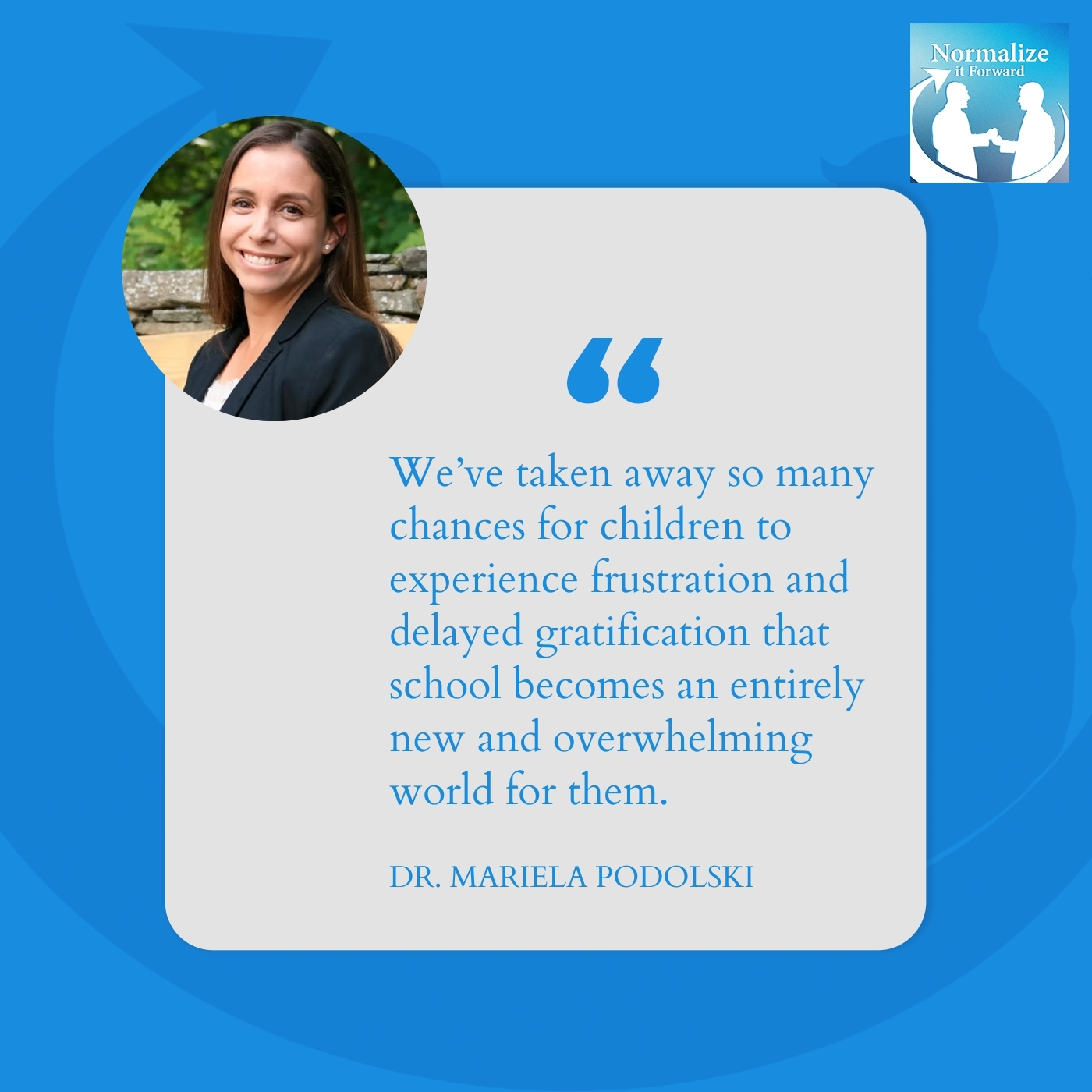
Going back to your question, which was about school and how difficult it is for them because it’s a long process, we have removed from their experience of growing up so many opportunities to experience frustration and delayed gratification that school becomes a completely new world, in which it’s very overwhelming. They come to our offices with this powerlessness. They don’t know the how-to. They can’t get through. It feels so important and so drastic if they make a mistake because they have not experienced that before. That’s my answer.

It’s a good answer. I read somewhere, and this is accurate, that as parents, we’re stealing their opportunities to grow self-worth when we jump in and do that. I understand why we do it. We do it because we want things to be smooth, we want things to go well, and we want our kids to be happy. Parents, oftentimes, when they do get involved in those scenarios, are impacting their kids negatively and disrupting the growth opportunity for them.

Parenting In The Digital Age: Managing Phones & Social Media

I see that a lot with college. When kids go to college, they make that jump. Parents aren’t allowed in, so kids have to do it themselves. It’s challenging. I’m curious. Talk to my parents for a minute, if you would, about phones because you have a sound viewpoint on this. I’m wondering. As a parent, let’s say, of a middle schooler and even a high schooler, what suggestions would you have in terms of management of these devices?

This is something that I have invested a lot of time in learning how to deal with in my practice because it is such a big problem. The first piece of advice that I have for any parent is to delay. Hold off until the very last minute before you provide them with a phone. When you do so, as a parent, I want you to think about that phone not as the child’s property, but as your own property. It doesn’t belong to the kid. They don’t pay the bill. They don’t know how to handle it. It’s the parents’ property.

With that said, before you give your child a phone, sit down and establish X number of rules that you’re willing to follow together. I learned this from a friend, not a patient or anyone. He told me that when he was thinking about giving a phone to his son, he came up with a contract. It was a contract with twenty items. He didn’t want to have all the power. He wanted his son to come up with some ideas in there, so he gave him the opportunity to come up with 3, 4, or 5 things that he wanted to have in the contract.

I did this with my own son. My daughter doesn’t have a phone yet. My son is a teenager. I did this with my own son, and it worked beautifully because we could negotiate. His first statement was, “I can use my phone for five hours a day.” I immediately was like, “That’s not going to happen. Let’s move it back.” We could negotiate a time that seemed to be right for communication with his friends and whatnot. He also put in there that he wanted to have a warning whenever I’m going to remove the privilege of having a phone, so he could tell his friends, “I’m not missing in action.”


Normalize It Forward - Marc Lehman | Dr. Mariela Podolski | Mental Health For Teens


That’s reasonable.

It’s a text message, like, “My phone is being removed. I’ll see you next week,” kind of situation. He has a heads up of, “You have five minutes to send all the texts you need to send, saying everything you need, and the phone is going away.” We developed this contract, and it has worked well for our family. For my patients, I started doing that, and it works very well. I have more advice for parents.

Please. I want to hear it.

I don’t want to make this a monologue because I could talk about this forever. In those rules, remember always that the phone is a privilege, not a need. It isn’t a need. Nobody needs a phone to survive. I didn’t have a phone growing up. You didn’t either because we’re in a different age group. Remembering that the phone is a privilege at all times is very important and helps you with that mindset. You have to decide what you are going to allow the kid to have on that phone. What apps are you going to allow? Are you going to have parental controls or not? For me, research is very clear.

Remember always: the phone is a privilege, not a need. Share on X

Social media is not helpful in the developing brain. There are a lot of risks that come with having access to social media, particularly for girls. What we know is that there is a higher risk of eating disorders. For boys, there is a higher risk of getting into pornography. There is a risk of gambling as well. For both groups, there is a risk of anxiety and depression. We can’t deny that.

What I tell parents and kids is, “This is not my opinion. This is what we know from research.” As a clinician, I can say that I am a firsthand witness to this being accurate, so I don’t doubt myself when I have to give this recommendation to the families. As a matter of fact, my son asked me, “Can I have whatever social platform is like, ‘When you’re sixteen, we’ll talk about it.’” It was like, “It’s not going to happen no matter how many times you ask because I know the danger. I see it here.” The constant comparison is not good for a brain that is not developed.

Remember, it is a beautiful thing how science works. When you’re an adolescent and you’re developing your brain, your limbic system is in overdrive. It’s all about emotions. You want to feel good, so you’re going to be seeking behaviors that are dangerous and have high reward. Your frontal lobe is underdeveloped, particularly because that’s the only way that could happen.

Those risky behaviors keep us alive. Back in the day, exploring, finding a better place to build a fire, or finding a better place for water required a lot of risk, less frontal lobe, and less rational thinking. That’s the way that we have allowed our species to survive. Adolescents have that. They have an overdrive limbic system in a very underdeveloped frontal lobe or executive functioning.

Introducing social media at that developmental stage is dangerous, because one bad decision can go online and stay there forever, harming someone for the rest of their life. Share on X

When you introduce social media in that developmental stage, it’s a dangerous place to be because you can make not smart decisions that go out on the internet and are there forever, harming somebody for the rest of their lives. Maybe they have very poor impulses when it comes to seeking that dopamine hit, like the likes, the comments, etc. Be careful. My summarized advice is that.

Beyond Screens: Essential Wellness Habits For Young People

It’s great advice. I know I’m pushing you to comment on these things. I know we could talk for hours about them. There are a couple of things you mentioned that I want to highlight. You and I have both seen in our practice over and over again the effect of some of this. For parents, it’s not like you can resist and give your child a phone when they’re 25. They’re going to get a phone at some point. The management post giving them that phone becomes our responsibility as those parents to stay involved.

Parents will ask me all the time, “Should I look at my child’s phone?” The answer is absolutely. You’re going to find things on there that will surprise you and shock you, and that allows you to have a conversation. There’s a lot out there. From our generation to this one, it is the ultimate comparison and harsh criticism that kids will get from pics, follows, likes, and all the other stuff that comes with it.

I’m curious. To segue out of phones for a minute, I want to ask this. One of the things we deal with all the time is general wellness for young adults. I know I’ve been working on better hydration, drinking water all the time, trying to get some movement in, and making sure that I’m taking care of my body and my brain. I’m curious. When you think about wellness with young people, what are your thoughts and suggestions? What do you think?

It has been maybe one month since I started using this term in my practice called “the boring things.” When patients come and tell me, “I have anxiety. I can’t do this,” and they tell me all of this rollercoaster of emotions, I stop for a second, and then I look at, “How are the boring things going in your life?” What I’m referring to with that phrase is, “How is your sleep? How well-hydrated are you? Are you moving your body? How much screen time are you using? How are you eating?” Nutrition is so important. I’m like, “What are you eating?” Last but not least is, “What purpose do you have in life?”

If we’re not connected to our community, it’s a big crack in our defense for depression and anxiety to come in. If somebody who doesn’t have a purpose is not connected in the community, is not a student, or is not working, they are not going to feel good about themselves. I call those the boring things. I have started to put a lot more importance on those in my life, too, but with our patients.

Inevitably, this conversation is going to lead back to some screen time. If you’re on your phone until 2:00 AM in the morning, your sleep quality is not going to be good. It doesn’t matter what you tell me. It’s not only because the timing is not right or it’s not within your circadian rhythm, but also because it is very clear that it’s not only that it’s postponing our sleep. It’s also that we’re changing the architecture of our sleep when we are on the phone for so much time, particularly before we fall asleep.

Also, we can’t say it enough. It’s a bigger conversation. We would have ten episodes that would last ten hours each. The quality of her food is not the same as it was before. We have to make a conscious effort to look for the food items that are going to nourish our body, but more importantly, our brain. A malnourished brain is a brain that doesn’t function well.

A malnourished brain is a brain that doesn't function well. Share on X

That is the concept of integrative psychiatry. You know that these are some of the things that I do. We pay attention to the micronutrients. What are the things in your brain that are missing in order for us to supplement those and provide you with better brain chemistry? All of that comes from Food Mart. That statement that we are what we eat was right. It’s from years ago, but some people still use it. Wellness is important.

The beautiful thing that we have in front of us is that it has never been easier to access things that can help you. Social media is not all evil. I don’t want you to think that. There’s access to so many people who have good advice and bad advice. Be careful. You can also find a lot of information at the tip of your fingers on what are good things for sleep, how you can meditate before bed, and other things that you can do.

I’m glad you said that. Let me go back to integrated medicine for a minute. One of the things that makes you special as opposed to other providers I’ve worked with is that your scope is larger. You look at these things, and there are things you’ve caught with my patients that I know other doctors would not have.

I want my audience to understand the difference between integrative medicine. We’re looking at other things. Other things involve wellness. Other things involve our nutrients. Other things involve our levels within our systems. If they are off or they are depleted, we are going to have issues. How many patients have we seen together who have had low B12 issues and whose energy levels have plummeted?

The other thing you mentioned that’s important to put out there is that there are positive sides to technology. We’ve got smartphones. We’ve got smart rings. We’ve got smart water bottles. We’ve got all of these things that allow us to measure stuff that helps us. When families are thinking about what you call the boring things and I call self-care, it is our basics of eating, sleeping, and exercise.

To me, one of the coolest parts about it is that we have access to changing these things. If we’re young people, we have a choice when we open the pantry. What do we have in there? What do we choose to eat? We have a choice as parents. What do we choose to buy in the grocery store? What do we bring home? We have a choice to be active or not be active. There are certain things in life that we don’t have a choice in. This, we do. Our wellness, if we’re wrapping our arms around it and letting our kids know, “That’s a message I am paying attention to as an adult,” we’re teaching that.

It doesn’t matter what type of parent you are. With all of the good, the bad, and the ugly of being a parent, because it’s not an easy job for anyone, our kids are going to learn what we teach them. There’s school and whatnot, but the foundation of our children is going to come directly from their most immediate circle, whether that’s their parents, their grandparents, or whomever it is that is taking care of and raising them. Making those choices is very important, and also acting by example.

I also work with eating disorders. One of the things that I teach families all the time is, “Before we talk about Susie or Johnny’s relationships with their own bodies, what is your relationship with your body? Are you a parent who is constantly cutting calories on their plate or is constantly talking about how they dislike their arms, their thighs, or whatever it is?” Kids learn by example, so we have to be mindful of what we do, good and bad.

Please ask for help before it is too late. Share on X

My parents never exercised in their lifetime, so exercise never came that easily to me. It’s something that I had to dedicate a lot of time to. Since I have been very mindful of that, it’s easier for my children. They do not imagine a world in which they’re not moving their bodies. We have the power of change, too, which is a beautiful thing. We, as parents, have the power of change to break cycles that we didn’t like from before and to normalize them forward. We do that for our children to get them in a better place.

Navigating The College Transition: Wellness & Responsibility

In many ways, we have. I see so many families normalizing the concept of mental health and general health. I’ve seen that, heard that, and witnessed that, which is great. There’s always room for improvement. Your point is a great one. We’re always teaching, and kids are often listening.

Let’s pivot to college for a minute. Many of my readers are either in or going to college. I’m curious. You see students, as do I, transitioning from high school to college. I am sure you have a lot of tips or suggestions. Any larger tips or suggestions that come to mind that may help kids with the jump into a college environment? What do you think?

I never experienced college. I’m not from the US. In my country, we don’t go to college. Culturally, we’re different. I went to medical school, but I lived with my parents, so it was completely different. I never had a “college experience.” From what I learned from my patients, when they are in college and in that transition, it often is very individualized. There are kids who go with a mindset of, “I’m going to have a lot of fun. It’s going to be great.” For others, it’s very anxiety-provoking.

Individualizing that transition is important. Understand that everybody who goes into this situation is living their own journey. It’s completely different than yours, but also, at the same time, it has a lot of sameness. It’s a new environment for everyone who’s there. Everybody is a little anxious, even though some of them show it more than others.

Where I see kids stable in college is when they are not able to do the boring things. They’re not able to have regular meals. They’re not able to sleep well. They’re not able to stay away from drugs and alcohol. They’re not able to take care of their wellness. That’s where I see them stumbling and not being successful. They get into trouble in one of these areas.

Their schedule got off, so they’re sleeping all day and are up all night, so they miss class. That snowball goes forward. Maybe they stopped eating at the cafeteria because of XYZ, and then they lost a lot of weight. They have to come home. Maybe they started drinking too much. That scaffolding of wellness will carry you through more than it’s evident to them. Hopefully, most of them had it at home, so it’ll be new for them not to have it. They have to be responsible with their sleep, diet, exercise, contributions to society, and everything else.

There is less awareness around mental health, and we, as mental health providers, need to do a better job of distributing this information. Share on X

You mentioned it. Do they have it at home? Some do, and some don’t. For those parents who are reading that don’t have that structure and aren’t working on that, that might be something to consider. When a kid does make that transition, whether someone shakes their hand and tells them all of this, they’re granted the responsibility of managing all of that. Some kids don’t do a great job. From your point earlier, that keeps them moving in a positive direction.

At 11:30, when their friend approaches them to watch a movie and they’re like, “I got to get my rest. I’m going to take a pass. Maybe we’ll do that in a couple of nights, but right now is not the right time. I’m going to go to sleep,” to me, it is that simple decision, which all kids have the ability to do. They say, “I’m going to take care of myself.” To your point, that keeps kids in a position to fend off things, in many ways, like anxiety and depression. Those are good suggestions.

I can’t leave this conversation without saying to please ask for help. If you’re struggling, please ask for help. Hopefully, you can ask for help before it is too late.

Breaking The Silence: Why Asking For Help Matters In College

That’s a great point. Let me ask you this, because it’s a huge issue. I research this all the time, and I see different numbers. I was looking into it, and it said that something like 60% to 70% of kids who need help in college don’t get it. In your opinion, why is that?

There is still a lot of stigma about mental health. Being vulnerable is not necessarily a strength for many. Also, there is this pressure of not wanting to be a disappointment to their parents. There’s that kind of narrative they have, like, “If I ask for help, it means I’m failing.” Quite the contrary, we want to help you before you fail. Ask for help early so we can keep that going.

There’s a lot of awareness in your world and mine because this is what we do, but for college kids who are getting there, they don’t even know their struggles, so there is less awareness. They might not know that the fatigue that they’re feeling, why they do not want to hang out with their friends, or why they have no interest in getting to know somebody might be a little bit more than just missing home. It may be depression. There is less awareness. We, as mental health providers, need to do a better job of distributing this information, like in this show, for them to have that.

That’s a great point for all of those reasons. I can only say to the young adults reading that your words are very wise. Sometimes, kids start to struggle, and they don’t necessarily recognize where that’s going to lead. It reminds me of swimming. You start to have trouble in the pool, and you don’t necessarily think you’re going to drown. You’re like, ‘Maybe I’ll be fine.” Maybe you won’t.

To me, my advice would be that the wise person, as they’re growing, recognizes we all need help. Think about it. We’ve got a lot of years in our careers. You and I talk to each other all the time because we need some advice, some direction, or some assistance. To me, parents need help, and kids need help. We all need help. The difference is admitting it.


Normalize It Forward - Marc Lehman | Dr. Mariela Podolski | Mental Health For Teens


It’s that fear of being vulnerable, which ties to one of my first statements. It is this idea that we have to live in the positive all the time.

That’s right. That’s in our lives.

It’s not. Having anxiety, fear, sadness, and all of these emotions are what make us human. We need to normalize them. We need to allow ourselves to be vulnerable and ask for help when it is needed.

The more young people tune into shows like this, the more they’ll hopefully realize that those are human emotions, and we all have them. It’s okay to struggle, but you’re not alone. You don’t have to struggle alone. In my opinion, it is pushing through some of that uncomfortability and saying, “I’m not sure exactly who to ask, so I’m going to try to talk to an RA,” or, “I’m going to try to talk to a professor,” or, “I’m going to call a therapist, a psychiatrist, or whomever and ask, ‘I don’t know if you work with this or not.’” I’ve had those conversations with patients over the years. It’s so valuable when young people do that because they get the answers when they ask. That’s important. Can I put you on the spot for a minute?

Sure.

I didn’t warn you about this. With this show, usually, what I ask of people who come on is a recommendation to keep the conversation moving forward. That’s where the name comes from. Give us a recommendation of an individual that you might know in your world, whether it be a friend, a coworker, or a relative, who would be helpful for me to interview next going forward on the show. Any thoughts?

Yeah. I have a great person for you. Her name is Rebekah Bardwell.

Who is Rebekah?

I met her years ago when we worked at the same institution. She is an LPC by training and had some more administrative roles at the time. She’s an eating disorder expert and a fabulous clinician. She has her own company called Bardwell Behavioral. She’s the lead there. She does psychotherapy. In particular, she does what I love, which is accelerated resolution therapy. She has clinicians working with her. She’s a fabulous person to talk to.

That’s fantastic. I’ll get her info from you offline. I appreciate the recommendation. I appreciate your time and energy. I know you’re super busy. I know you wanted to come on, and I wanted to have you on. We finally did it. We made it happen. This is great. Thank you for being here. I appreciate it. Have a great rest of your day.

You too. Thanks so much.

Thanks.


Important Links


About Dr. Mariela Podolski

Normalize It Forward - Marc Lehman | Dr. Mariela Podolski | Mental Health For TeensDr. Podolski completed medical school at the Universidad de Costa Rica in San Jose, Costa Rica. As her first attending job, she worked as a general physician in a rural area in the south east corner of Costa Rica. Excellent clinical skills were a must, given the lack of resources in the area at the time. This experience strengthened her medical knowledge, and she still utilizes these lessons in her daily practice.​

She pursued her Psychiatry Residency at the Institute of Living in Hartford, Connecticut. This was followed by a Child and Adolescent Psychiatry Fellowship at The Medical College of Wisconsin in Milwaukee, Wisconsin.

Dr. Podolski joined Eastern Connecticut Health Network after graduation, working in a Child and Adolescent Psychiatry Clinic in an underserved area from 2012 to 2015.

She has been working with Walden Behavioral Care, since 2012. Initially as a Consulting Psychiatrist for their Partial Hospital Program. In 2016, she assumed the role of Medical Director for their Inpatient Eating Disorders Unit at Rockville General Hospital. This role allowed her to expand her eating disorder knowledge, as she treated patients with extreme eating disorders that required specialized inpatient medical and psychiatric stabilization.

She continues to work hand in hand with Walden Behavioral Care as a consultant.

She has held academic appointments for the University of New England College of Osteopathic Medicine, and for the Quinnipiac University Frank H Netter School of Medicine.

Dr. Podolski is an active teacher and provides Eating Disorder lectures for psychiatry residents at The Institute of Living, University of Connecticut and for ECHN Family Practice Residency. She is frequently asked to present on the topic at different hospitals in the area.

She holds medical licenses in the states of Connecticut and Massachusetts.


Reading about mental health is hard. Let’s schedule a free consultation.
 

Normalize It Forward - Marc Lehman | Dr. Emily Gordon | Eating Disorders


Body image and eating disorders aren’t just clinical issues; they’re lived realities shaped by culture, technology, and family life. Drawing on nearly 25 years in private practice, licensed clinical psychologist Dr. Emily Gordon explores how perfectionism, social media, and comparison culture amplify these struggles — and how parents can support teens and young adults without adding to the noise. She mixes practical strategies with warmth, showing how boundaries, honest dialogue, and tuning in to one’s inner experience can become powerful tools for resilience and healing.

Reading about mental health is hard. Let’s schedule a free consultation.

Watch the episode here


Listen to the podcast here


How Body Image And Eating Disorders Affect Families And Youth With Dr. Emily Gordon

I am super excited to have Emily Gordon join us. Emily, how are you?

I’m good. Thanks.

Let me read a quick intro, and then we’ll dive right in. Emily is a licensed clinical psychologist with almost 25 years of experience. Dr. Gordon maintains a private practice in Natick, MA, where she provides therapy, supervision, consultation, and psychoeducation. She specializes in treating eating disorders and body image disturbances in adolescents, young adults, and women of all ages.

Emily often works with people navigating life transitions and parents looking to better understand and support their developing teen, and better care for themselves along the way. She enjoys speaking and writing about topics relating to eating disorders and body image, adolescent development, young adulthood, and parenting. In addition to our work with teens and families, Emily is also a parent to three teenagers. Emily, welcome. How are you?

I am good. Thanks. I’m glad to be here.


Normalize It Forward - Marc Lehman | Dr. Emily Gordon | Eating Disorders


From Practice To Parenthood: Dr. Gordon’s Journey And Expertise

Welcome to the show. We’re excited to have you. First, I’m going to flip-flop and start with the last thing I said. Three teens. Tell me. How old are we talking?

Two are young adults. I don’t know if I can say teenagers anymore. Teenagers are so much easier. I have 2 in college and 1 in high school.

Like me, you’re around this personally and professionally. This age bracket, that is. You and I treat similar-aged individuals. We treat middle school, high school, college-aged, and beyond. Why don’t we start off with you telling us a little bit about your practice?

I have an office here in Natick. I have a lot of experience treating adolescents with eating disorders. I work with people in a dynamic, relational, IFS-informed way. I integrate CBT and DBT. I try to take a perspective of trying to understand what is going on for someone and how they tune in to the inside and tune out all of the outside. I’ve increasingly been working on supporting parents and people navigating mid to older life challenges. I’ve enjoyed doing that as well. I’m working on a range of issues.

It sounds like you cover a lot of ground in your office and see a lot of different people for a lot of different things. Eating disorders are such a fascinating specialty. I have that as a subspecialty of mine as well. My background is in family therapy. I was drawn to it because there’s such a family component to every individual who suffers from an eating disorder. I’m wondering if we could start with the basics. Can you tell my audience a little bit about what an eating disorder is?

With eating disorders, part of what’s so interesting about them is that they’re so complex. They impact so many different areas of life and functioning. An eating disorder is a focus on food, body, and preoccupation. What truly categorizes an eating disorder is a fear of fatness or gaining weight and an inability to maintain one’s health, however we are defining health.

There is a lot of talk about what is disordered eating versus what is an eating disorder. There are a lot of people on diets. There is all sorts of noise out there about what’s the right thing to do, what’s the healthy thing to do, what we should be doing, what we should look like, and what we shouldn’t look like. There is certainly a preoccupation in our culture. An eating disorder marks itself as this intense preoccupation in a way that gets in the way of health and healthy functioning.

That’s a good definition. That’s a challenging question I asked. That’s a good way of saying it. Having worked in hospital settings in the past, where I’ve eaten with patients who are severely impacted by eating disorders, meals take on a whole new level of intensity. I have seen patients being tube-fed and so forth. I don’t think people understand how impactful an eating disorder can be.

That’s very well said and important. What we also have to know and recognize is that eating disorders are incredibly serious. They have one of the highest mortality rates of all mental illnesses. That’s because it affects your mood and also your health, like your physical body. It is incredibly serious. We can’t talk about eating disorders without talking about this cultural piece. When you sit with somebody, whether you are treating them, or a friend, or a family member, it’s a brain-based illness. There’s something that happens in the brain that feels irrational sometimes. That’s what you’re speaking to.

Social Media’s Shadow: Impact On Body Image And Mental Well-being

I’m glad you brought that up. Maybe that’s a nice segue to talk about our culture and how that impacts things. I have a funny feeling that you and I can talk about this for hours. I promised I’d only take a little bit of your time, though. When it comes to this, social media has had a major impact on what I’ll call the competition amongst people.

I’m on Instagram and TikTok regularly for my business, and even LinkedIn to some degree. What I see in the social media world from young adults and what they post is disturbing and sad. It’s been a little bit since you and I were young adults. I often wonder what that would be like for us because we didn’t grow up with social media. Young adults have this interesting perspective. They don’t know anything but social media. I’m curious. I’ll ask you a huge question.

That’s a huge question, and I’ll try to answer that or speak to some of the themes and things that come up.

It’s perfectly fine. It’s a big one. How do you feel social media impacts body image?

There’s the larger issue first of social media and our culture, even before we get to eating disorders. I know your audience here is the college kids and young adult population. We have this culture of achievement, perfection, and having to be successful. There is all this pressure on all of us. Adults and parents are stressed. College kids and young adults are stressed. High schoolers are incredibly stressed.

One thing I want to say when I go on these shows is that we’re talking generalities. I understand that for each individual identity or population, it’s hard to come up with these generalizations, but we’re going to do that anyway for the purposes of this episode. There is this larger culture of achievement and perfection, and then we get into social media, appearance, looks, body image, and what we call diet culture. You said competition. I think what also happens is comparisons. Biologically, we compare ourselves to other people. There’s competitiveness.

When we talk about social media, what you and I may have first encountered with social media, however many years ago that was, the social media of today is very evolved and different. What’s driving social media now are the algorithms. That has added a whole new layer of danger, quite honestly, when it comes to all sorts of things.

What we know is that social media platforms get paid. They make their money by keeping your eyes on their platform. They’re competing with other platforms. How do they do that? They do that by making you feel bad about yourself. That’s the marketing industry. That’s the diet industry. That’s the cosmetic industry. The forces that we’re up against are these financially deep ways that these companies have of making us feel bad about ourselves, and then pushing us to more and more extreme content.

I know we’re here to talk about body image and eating disorders, but that has other risks in terms of truth, facts, and politics. This feeding us of more and more extreme information keeps us on the platforms. It keeps us feeling bad about ourselves. It keeps us feeling like we’re not okay the way we are and that we need to change. The magic bullet is, “If I look better, or if I eat this and not that, everything will be great. I’ll feel good. I’ll be happy. I’ll be able to compete with that other person.”

You probably have heard this. In the eating disorder field, we say that it’s about the food, but it’s not really about the food. It’s about something deeper in the way that people are using the behaviors around food and body to help them feel better. That is a valid and essential piece of how we feel good about who we are in this world, where it’s always in front of us. There’s always something more. There’s always something better. There’s always something coming at us. There are all these messages. We’re afraid to put it down. Teenagers are afraid to put it down because they want to be connected to their friends. They’re afraid that they’ll miss out on something, or they’re not there. It’s challenging.

Eating disorders are not really about the food. It's about something deeper, in the way that people are using behaviors around food and body to help them feel better. Share on X

The “Fast, Cheap, And Easy” Trap: Social Media’s Influence On Youth

It is, on so many levels. I feel like we could talk about this for months. I have a theory that I call fast, cheap, and easy. When I look at young adults, I feel like they’ve been groomed for fast, cheap, and easy. If things aren’t brought to you fast enough by Amazon, they create Amazon Prime so that everything’s fast. The kids that I work with love to eat fast food because it’s fast, cheap, and easy. They don’t care if it’s unhealthy. They love to eat that.

There are certain things in this world that aren’t fast, cheap, or easy. I try to point out to kids that most things in life that are fruitful take time, like school, for example. School is not fast by any means for kids. One of the loops that social media ends up teaching kids, whether it’s on purpose or not, is, “You can do this thing. Take this pill. Drink this. Do this. Do that. You’ll feel so much better.” Kids will order those things. Kids will buy those things. They’ll take those things and then, after the fact, find out, “That’s not the case. I ordered an item from a business, and they’re trying to make product.” In this world, if we want to feel better about ourselves, it takes time.

It takes time, depth, and tolerance of being able to tolerate discomfort, feelings, and disappointment. You’re right. There’s this fast, quick, and easy mentality. We can’t fault teenagers for that because that is the world in which they have grown up.

Agreed.

I don’t know why this moment stands out to me, but I had a baby in my arms, and I was pushing the button on the Keurig coffee machine. I had this moment of like, “We’re screwed if my kid thinks that all you have to do is push a button and the coffee will come out.” Not to mention the whole farming industry and what it takes to get a coffee bean, but all you do is push a button, and you get a cup of coffee. That’s the world in which they’ve grown up, and it looks like everybody else is doing it. It looks like everybody else is happy and successful.

I had a fascinating conversation with someone who was talking about their feed. It made me think about not only the fast, quick, and easy, but also what is real and what is not real. There is this way in which when you spend so much time on your device or on whatever platform, it feels real, and yet it’s not real. It’s also not always true, and yet it’s very easy to think that it is. That’s another obstacle that we are up against.

When you spend so much time on your device or platform, it feels real, yet it's not always true. It's very easy to think that it is. Share on X

I’ve had lots of conversations with my teenagers. It depends on how long they’ve been intertwined with technology that they can understand some of these concepts, like when you talk about privacy, companies having your data, or where a screen belongs and where it does not belong. To me, the screen does not belong in the bathroom. Some people look at me like I have five heads when I say that. It depends on how old the kids are, what their experiences have been, how old they were during the pandemic, and what the family attitudes are around technology.

I agree. In many cases, I feel like when I talk to teens, these are what pacifiers are like to babies. They’re self-soothers. When you take a pacifier from a baby, it usually screams bloody murder. That typically will happen when a parent takes a phone from a kid. To me, that’s a little concerning because they’ve convinced themselves.

One of my ideas or something that I built my practice on and I fundamentally believe is that teenagers are pretty awesome. That’s why I love doing what I’m doing, and I love talking about what I’m talking about. It’s fascinating to me when you give a teenager an opportunity. I use the word teenager, but I mean teens slash young adults. To review, we know that teens are still developing. Their brains are still developing.

One of my supervisors once framed this for me in such a beautiful way. Even though somebody is 13 years old or 15 years old, they’re not 13 or 15 in every single way. Somebody who is 18 has some skills of a 9-year-old, some skills of a 12-year-old, and some skills of a 25-year-old. We’re talking about this wide range of skills and abilities.

We went away one time, and I kept saying, “We’re going to do a family day with no phones.” They finally looked at me and were like, “Do it already. Stop talking about it. We’re fine. Do it,” but I felt like I needed to prepare them. When you can ask them questions about what their experience is, what they notice, and what they think, it’s pretty awesome what they can come back at you with. I try to encourage those kinds of conversations.

Getting back to body image, I’m like, “What do you feel like when you open your feed? What’s in there? Who are you following? What are your friends posting?” We have a lot of rules in our house around what is okay and what is not okay. I’ll get a question, like, “Is it okay if I do that?” I’ll say, “What do you think? What do your friends think?” They’re like, “Is it okay if I ask my friends and I do this?” We’re having lots of conversations that are asking them to think and reflect.

Redefining Self-Care: Inner Wisdom In A Fast-Paced World

The theme of what you’re saying is so important, and that is parents need to be involved. They need to be having conversations with their kids. Whether it’s social media or phones, or both, they’re so impactful on kids. Sometimes, even picking their phone up and taking a look at their feed as to what’s in there can give you a sense of what they’ve been looking up and what the algorithm is sending them. That’ll tell you a lot. Let me pivot away from the topic of social media for a minute and ask this. Self-care is a buzz phrase that’s been talked about a lot in our field for many years. What do you think of self-care?


Normalize It Forward - Marc Lehman | Dr. Emily Gordon | Eating Disorders


Self-care is tuning in and knowing yourself. In order to do self-care, you have to know. You have to be able to identify and label your own feelings. One of the things I’ve been working on is neurobiologically with our nervous systems and regulating ourselves. Whether we’re in the world, on social media, or dealing with conversations, we get activated.

It is being able to regulate our nervous systems to identify feelings, to be able to tolerate feelings, to be able to know what relationships feel good and are benefiting us, and what relationships are not working so great, to be able to have boundaries, and to speak up for ourselves. It’s nice to go for a walk or have a massage. Those things are important, too, but it’s way deeper than that. Self-care is building relationships so that you have them when you need them, and being able to make decisions about keeping yourself feeling good and healthy.

That’s a great answer. I’d love for my young adults who are tuning in to take heed to what you said. There are lots of ways to do what you suggested. Probably one of the most important things I heard is paying attention to yourself and asking the question, “Am I happy?” You could be lying to the rest of the world if you want.

In order to answer, “Am I happy?” you have to say, “What does this feel like to me?” Sometimes, as teens are developing, they may not be able to have the words that go with a feeling. It is like, “Where do I feel that in my body? What am I feeling? What am I not feeling? What’s happening in terms of my behavior? What are my goals, and how am I doing at meeting those goals?”  It is asking yourself, “If my goal is to plan a soccer game, do well on a math test, or try out for a singing competition, am I taking the steps and making progress towards those things that I have identified as of value and meaning to me?”

Great point. What I was getting at was those teenagers who deep down know they’re not in a good place and are walking around with a mask on. Your point is very important. I would also point out the simplicity that we all have the ability to take those steps. Some kids may say, “I don’t want to,” or, “I’m feeling a little lazy,” or, “I’m not in the mood.” That’s fine, but we all still have the ability. I’m curious. I would love to put you on the spot. You seem like someone who could handle being put on the spot. I’m thinking of doing something new for my Instagram, and I would love to test it out on you. How about that? Can I do that? Is that good?

As long as you handle the technology part, because I tried something new on Instagram, and I failed at the technology.

College Transitions: What Parents Wish They Knew

No tech here. I’m just reading a question. I wanted to ask you a question as a mom. You’re stepping out of your therapist role and into your mom role. Having had two kids of my own go through college, I’m fascinated by what we learn as parents. Each year, there seems to be a good amount of learning. Let me read. As a mom who had kids go through college or even a couple of years of college, what’s one thing you wish you knew going into their first year?

My kids will tell you I can never take the psychologizing out of being a mom.

My kids tease me about it, too.

One of my friends had given me this advice, and I didn’t appreciate it at the time. As they’re getting ready to go, you feel like they’re leaving forever. The advice or feedback was that they come back, and you are building a new relationship. That has been important to remember. It’s also a lesson that’s related to something else I like to talk about, which is that change doesn’t necessarily mean bad. It’s different.

Change doesn't necessarily mean bad. It's just different. Share on X

One of the things I talk a lot with the kids I work with who are going to college is that there is a loss and a change. One of the things that we do a disservice to our aspiring college students is that we talk so much about, “These are going to be the best four years of your life,” or, “Aren’t you excited? You got into the school of your dreams.” We don’t talk about what it feels like to experience disappointment and what it feels like when we miss home. Those things are normal and okay. That’s something I wish I knew.

Those are good points. As you were talking about the transition and the loss, I think growth is hard. I also had a friend give me some advice, and it helped a lot. It was that they’re supposed to do this. As simple as that is, you forget that. You’re right. As a parent, there’s that loss and that sadness. It’s harder for families in some ways because our lives are the same, minus our kids. Their lives are new and exciting.

You’re on this precipice where you don’t know what’s coming. With a lot of things in life, we can look back and say, “It was okay. I got through it. I made it.” When we’re facing a precipice and we don’t know what’s coming, it can be scary. It’s also super cool to watch kids figure things out.

I agree.

It’s cool to watch them become themselves and find things. That is not to say that it’s always easy or that it’s always a smooth road, but to see them navigate, meet challenges, and find people and things that are so awesome is cool.

Empowering Students: Mental Wellness For College Life

I have one more question. This is more clinical, though. That was more for the moms. From our counselor backgrounds, when you think about kids that are reading this who are going off to college and their mental health and wellness, is there a suggestion you have for a kid that can help keep them balanced and managed heading off to school?

That is a great question and an important one. My advice would be similar to what I said, but tailored to a young person. It is that there are going to be ups and downs.

There will be ups and downs, and that is normal and expected. You're going to learn a lot about yourself. Share on X

No doubt.

That is normal, expected, and okay. I remember doing a semester abroad. I will never forget standing in the post office in a foreign country. At that time, we did not have cell phones or social media. I was trying to mail a letter home. I was in tears, and nobody would help me. Yet, those 3 or 4 months were the most amazing experience, not because they were easy, but because I saw, learned, grew, and did.

What I would say to students is, “There are going to be ups and downs. You’re going to learn a lot about yourself. You can do it.” Also, there’s so much support and help out there. It’s pretty amazing. There’s so much going on at these schools. There are so many people like you and me. It’s okay to want or need help. Everybody else doesn’t have it as together as you think they do.

That’s well said. I’m hoping my young adults are taking notes of your words. I would further that by saying I can’t tell you how many kiddos I’ve worked with that go off to school with maybe no anxiety or very little anxiety, and they come back with some challenges because growth is hard. The challenge can be high for some kids, but what you said makes so much sense and is so important. They need to realize there are people out there who can help and support.

In all different ways, whether that’s social, academic, health, or mental health. There are resources and support.


Normalize It Forward - Marc Lehman | Dr. Emily Gordon | Eating Disorders


Kids have to be willing to ask and realize, too. If you don’t believe us, look it up on Google. Statistically, there are a lot of kids out there struggling. Homesickness is, to me, a pretty natural thing that most kids will encounter. I love what you said in your comments. “You’re going to do this. You’re going to get through this, and you’re going to grow as a result.”

I always tell kids, too, “If it’s not working for you, that’s okay. Let’s figure out what will.” Sometimes, we have to go and try things. Sometimes, we need to change our roommate. Sometimes, we need to change our school. Sometimes, we need to change our major. Sometimes, we need to change our path. We can deal with anything.

I transferred when I was in school, and I’m so thankful that I did. It brought me to UConn. When I was at UConn, I met one of my mentors there who opened up the whole world of counseling.

I know you’re trying to wrap up, but that’s another thing. We do this to kids. They feel like they have to know their path and that they have to have it figured out. I don’t know why we need to have kids applying to majors.

It’s a little crazy.

How do you know it’s seven? You don’t know things until you try to do things. There’s this pressure to know and to be sure. We can’t know things. All we can do is make one decision at a time. We as parents, as professionals, and as a culture can try to take the pressure off that you have to know and figure everything out, and trust that one thing will lead to another. It may not be the path you thought. That’s okay. Maybe it’s a more meaningful path or a more satisfying one.

Finding Your Path: The College Journey And Beyond

I completely agree. When kids come into my office at seventeen, they’ll go out of their way to tell me, “I’m majoring in Neurosurgery.” I’m like, “That’s cool.”

Some people know. Somehow, I knew I wanted to be a psychology major. I don’t know how I knew. I didn’t know that I was meant to be a psychologist, but it worked out for me. It doesn’t always, and that’s okay, too.

Let’s face it. When kids are in college, they’re pursuing something that they’re going to do for the next 40 years. To me, it seems like a decision we should take our time making. Some of my readers might be wondering because I often, at the end of interviews, ask you to nominate a friend, a coworker, or a relative to keep the conversation moving forward. I want to let everyone know that Emily and I have chatted offline. She has made some amazing recommendations that I do intend to follow up on. I appreciate all of the suggestions you made and want to thank you for your time and your perspective. It has been wonderful connecting with you.

Thank you. I agree. I somehow had a feeling we would have lots to talk about. Maybe we can continue the conversation someday.

I would love that. Thanks again. You have yourself a wonderful evening. You take care.

You, too.

Thanks.


Important Links


About Dr. Emily Gordon

Normalize It Forward - Marc Lehman | Dr. Emily Gordon | Eating DisordersEmily Gordon, Psy.D., is a licensed clinical psychologist with almost 25 years of experience. Dr. Gordon maintains a private practice in Natick, Massachusetts, where she provides therapy, supervision, consultation and psychoeducation.
She is licensed to practice in the states of MA, FL and VT. Emily specializes in treating eating disorders and body image disturbances in adolescents, young adults and women of all ages.

Emily often works with people navigating life transitions and parents looking to better understand and support their developing teens and to better care for themselves along the way.

Dr. Gordon graduated from Northwestern University and earned her Psy.D. in Clinical Psychology from Ferkauf Graduate School of Psychology at Yeshiva University in New York.

She completed a Postdoctoral Fellowship in Child and Adolescent Psychology at McLean Hospital in MA, and was part of the team that started the Klarman Center for Eating Disorders also at McLean. Dr. Gordon has since supervised psychology trainees at both McLean Hospital and at the Boston Institute for Psychotherapy.

She enjoys speaking and writing about topics related to eating disorders and body image, adolescent development, young adulthood and parenting. In addition to her work with teens and families, Emily is a parent to three teenagers. You can find more about her practice at www.dremilygordon.com or on Instagram at www.instagram.com/dremilygordon.


Reading about mental health is hard. Let’s schedule a free consultation.


Normalize It Forward - Marc Lehman | Greg Kligman | Suicide Loss Support


Suicide loss support takes on a deeply human dimension in this conversation with Greg Kligman. He opens up about a decade on crisis lines and in survivor groups, explaining how empathy and presence help families carry the weight of traumatic loss. Listeners hear about the Survivor Support Program, why stigma and shame surround suicide, and how simple outreach can ease crushing isolation. Greg also shares the practices that protect his own wellbeing and offers practical ways anyone can contribute to a culture of compassion without burning out.

Reading about mental health is hard. Let’s schedule a free consultation.

Watch the episode here


Listen to the podcast here


Inside Suicide Loss Support: Healing Conversations With Greg Kligman

I am here to talk about mental health and wellness with a very excited guest, Greg Kligman. Greg, welcome to the program. How are you?

Thank you, Marc. I’m doing well. I’m grateful for the opportunity to be here and talk about a very important topic, among others.

From Amazon To Crisis Support

I appreciate it. Greg, why don’t we jump in? Tell us a little bit about yourself.

Why don’t I do it in the reverse order that people usually might do it? I’m going to start in reverse chronology with the most recent. I became a coach certified with the International Coach Federation. That was an outcropping of work I was doing before, which was at Amazon Web Services. I was there for about four years. I started on the employee engagement team. I transitioned into leadership development, where I started my coaching trajectory. I finished it after I left the company.

Before Amazon, I worked at a communication skills training company in a sales role. We were helping people learn how to be effective communicators on the spot, how to do presentation skills, and how to be an effective writer before computers came along and did everybody’s writing for us, which is maybe the case right now with AI and so on. Amazon was one of my clients. That’s what led to my transition into Amazon. All along at that time, I was doing what I wanted to focus on here, which is the volunteer work that I’ve been doing for the past ten years or so through the Distress Centres of Greater Toronto.


Normalize It Forward - Marc Lehman | Greg Kligman | Suicide Loss Support


I live in Montreal, which is my hometown. I moved back here a few years ago, but I lived in Toronto for about twenty years. There, I began volunteering with the Distress Centres of Greater Toronto, first on the crisis line. It’s called the crisis line. There’s nothing funny about it, but an actual acute crisis or the most serious thing we could ever face on the crisis line would be what we call a suicide in progress, where we have to get very active and quickly take control. That is such a rare occurrence, at least it was for me. I got maybe one or two calls in the two years that I did that work.

By and large, it’s people calling out of isolation, which is crushing. People want to reach out and connect with another human being. It was through that work that I got into the next stage of my volunteer work within Distress Centres of Greater Toronto, which is what I’ve been doing ever since. I stopped working on the distress line. I joined what’s called the Survivor Support Program, which is run by a gentleman named Alex Shendelman. As far as I know, not only is it unique in Canada, but it’s unique in the world, where volunteers specifically work with people who have suffered traumatic loss. It is mainly suicide, but there are homicide supports as well, which I’ve done a little bit of.

I’ve focused on supporting people who have lost somebody to suicide, starting off mostly working with individuals. Since then, I have focused mainly on working in groups. The participants have the choice. Do they want to be in what we call a one-on-one or in a group? Many people do both. It’s never one-on-one. It’s always a volunteer team. They pair a volunteer who has lived experience, who themselves have lost somebody to suicide, and somebody who has not. I’m the one who has not lost somebody to suicide. Since then, I’ve become part of their training to train new volunteers. It has changed my life in numerous ways.

It was that experience and the training I got in listening, empathy, and being supportive that I brought a lot of into Amazon. I created a workshop called the Language of Empathy, which was on how to lead with empathy. I also introduced a grief group. This was a serendipitous thing. It wasn’t part of my job description. My manager at Amazon said, “Greg, when you’re at Amazon, it’s not so much what you do. It’s what else you do.” They’re always welcoming new ideas to bring to the table. In that case, I launched a group for child and baby loss, which is not something I’d ever expected to be involved with. It’s not something I have personal experience with, but there was a need for it.

Certainly, there are a lot of overlaps in terms of how you support somebody going through that kind of grief, because grief essentially is grief. We’re all going to experience it eventually, if we haven’t already. Suicide loss has some particularities that are unique to that kind of grief, unfortunately. If I had to list three, it would be stigma, shame, and guilt. This is one of the unfortunate things about people who are dealing with having lost a loved one to suicide. In the many people I’ve worked with, I don’t know that I’ve ever met one who hasn’t blamed themselves in some way. “I could have, should have, what if,” and that kind of thing.

Grief is grief, and we're all going to experience it eventually. Share on X

The Profound Impact Of Suicide Loss: A Therapist’s Perspective

I’ve worked with some families myself that have been impacted by suicide. You’re right. It is a different type of loss. You’ve got quite a bit of experience. I want to frame this a bit for families. Suicide is a topic that nobody likes to talk about. It’s a topic that I think most people avoid talking about. It’s a topic that is out there. A bit about my background, Greg, I work with students across the country in various college settings and have been doing so for quite some time now.

It’s quite sad. Often, maybe a dozen times a year, I hear a story from a student. It’s always the same context as someone who took their own life on a particular campus. Maybe my student knows them. Maybe they don’t. The ripple effect of all of the people who are affected by that loss is tremendous. You’re right there in the middle of working with families that have been affected. What is that like? Can you describe that?

It’s many things. It’s a privilege to do it, but I’m not going to sugarcoat it. It’s some of the hardest conversations I’ve had in my life. What I’m offering in those conversations is mainly presence, empathy, and holding space for them to express themselves and to talk. It’s the stories I’ve heard and seeing what people live with every day. I have to say that when it is young people, I tell people grief is not a competition. Sometimes, people will be in a group, and they’ll say, “I just lost my brother. I didn’t lose my child.” It’s like, “You didn’t just lose your brother.” There is something particularly awful about young people who are drawn to that outcome. I’m not going to use the word decision because that’s a pretty contentious word to use. Is it actually a choice? They’re drawn to that outcome. It’s awful.

It is leaving people with a lot of pain. Awful covers it in terms of its impact. As we’re talking about this topic, I want families to understand, too, the why behind it. I created Normalize It Forward to be able to have these hard conversations and to be able to talk about these difficult topics, mainly so that we can avoid having to be in them and avoid having to experience them. There are young people out there who are hurting, isolating, and by themselves. They’re at risk. The risk is very real, Greg, as you know.

Could I give a quick message because you mentioned young people?

Yes, please.

Young people or less young people, anybody tuning in, if you’re having thoughts of taking your own life, please talk to somebody. I assure you. You’re not alone. It’s awful. You probably feel alone. You feel that nobody can understand what you’re going through. You might be right. You might be living with a level of pain that nobody can understand. I don’t want to say that’s not true, but there are people who care, who will listen to you, and who do want to help. Please do talk to somebody.

Volunteering For Connection: How To Offer Support And Empathy

Such an excellent point, Greg. I appreciate you putting that out there. I would highlight that over and over again. It’s amazing to me when young people do reach out. Not only are there people out there, but how many people out there care? There are a lot of people out there who care, and a lot of people out there who understand. One thing that always bothers me is when young people struggle by themselves because they shouldn’t be by themselves. You’re doing tremendous work, Greg. It’s amazing what you’ve done over the years. Tell my audience. How does a person get involved in something like this?

I suspect wherever you happen to be living, and I’m speaking directly to the audience now, there are probably organizations, community service organizations, and so on that are looking for people. Look up volunteering, helping, and supporting. See what’s out there. That’s how I did it. It started with a Google search. In my case, I knew it was something I wanted to do going back to when I was a teen. I remember that I called the distress line.

I don’t remember what I spoke about, but I do remember how I felt after the call. The only words I remember that the woman said to me during our conversation were, “That sounds hard, Greg.” Hearing those words that somebody was validating the fact that what I said sounds hard, even though I never met her, and she was a voice, had such tremendous therapeutic value that I felt somebody got it. People lose hope for many reasons, but one of the worst things is when you feel hopeless that nobody gets it, and there’s no help.

You hit the nail on the head. You also said this before we started recording. I want to bring it back to our conversation. I’m a licensed therapist. I’ve been doing this for 25 years. You don’t need to be a licensed therapist. You need to be a human being. You need to be a person who expresses empathy, care, and concern. You need to be a good listener. A lot of people fall into that category.

Thanks for bringing that up. It’s true. The Distress Center Program runs on peer support. You don’t need to be a therapist. Anywhere in your life, you’re going to have an opportunity to be supportive of people who are grieving. I want you to know, don’t be worried about saying the perfect thing because there is no perfect thing. There is nothing you can say that’s going to take the pain away. Take that pressure right off yourself. There are no such words that can do that. If you show that you care and you’re available to listen, even send a text saying, “Thinking about you. No need to respond.”

Don't worry about saying the perfect thing. There is no perfect thing to say that will take the pain away. So take the pressure off yourself. Share on X

That’s big.

It is to take the pressure off, but to let them know, check in. We hear that a lot. People feel that a lot of their community is going away. As you said before, people are very uncomfortable with the topic of suicide. People are uncomfortable with any version of death. It scares a lot of people because it’s waiting for us all, and we prefer not to talk about it. Suicide takes that to an extra level.

What do you possibly say to somebody who has lost a family member to suicide? “I don’t know what to say to somebody. There is nothing to say. I understand that people could put that on themselves. I don’t know what I’m going to say. I’m only going to make it worse if I say something, so I’m not going to say anything. I’m just going to let them come to me.” The heart is in the right place when one is thinking that, but the impression it could leave is, “People are afraid of me now,” or “They’re avoiding me.”

That could add to the loneliness that people feel when they’re dealing with this. I would urge people to invite conversation. Don’t force it, especially if it’s something that happened recently. People are taking their lives not only day by day. Sometimes, it’s minute by minute. A text showing, “I’m thinking about you. Available if you want to talk. No need to respond,” that’s important. Any extra pressure is an extra heavy weight at that point.

Youth Mental Health In The Digital Age: Social Media’s Influence

Let me ask your opinion about something because you’re around this a lot. The stats on mental health, especially for young people, are moving in the wrong direction. The suicide rates are up tremendously. From your point of view, is there one reason? Are there several reasons? What seems to be causing some of that?

Marc, this is strictly in the domain of my opinion because I’m not an expert in any of this. I would say social media presents a perfect life that is not attainable for a lot of people. I would say that bullying is very easy online. People will be mean online in a way that they wouldn’t if they were face-to-face. You can type something. I’ve seen with my own teen daughter that what goes on is that there will be these group chats that she gets pulled into. People will start sending screenshots of group chats to other people. These are teenagers.

Social media presents a perfect life that is not attainable for a lot of people. Share on X

Teenage is hard in the best of times, but social media has made it a lot harder. It’s so easy to be nasty to one another. I’d like to think it makes it easier to be nice to one another, too. It’s not all doom and gloom. From what I’ve seen, social media has made people more isolated and more likely to aspire to something impossible. They’re aspiring to something that even if they got it, it wouldn’t give them the satisfaction and happiness they think, the perfect lives, these influencers, and so on. There’s so much insincerity now. A lot of young people don’t know where they fit. Marc, I defer to your expertise on this. As I said, I’m just giving my opinion.

It’s a great opinion. I would add to what you said about satisfaction. I heard it from a young person in my office asking young people, “What would satisfy you? What would make you feel satisfied as a human being in the future?” Most of them don’t have answers. Most of them have no idea. It’s part of our journey in life to try to figure out what makes us happy. Unfortunately, some young people are searching down the wrong paths. Social media can be detrimental to some kids. It’s also done in privacy.

For us as parents, unless you’re aware of what your child is doing online all the time, there are probably some things that you’re not aware of. Some of it can get pretty awful or pretty terrible. As you said, Greg, I have the opinion as well that social media can be used for positive reasons. One of the things I do with my business is to spread the gospel, this type of stuff. It’s got its intentions. I will say this, and I don’t know if you see this with your daughter. It’s an intense world that we live in. It is way more intense, in my opinion, than when we were kids.

I often find myself, when I’m working with young people, thinking, “What would it be like for me if I were a sixteen-year-old or a seventeen-year-old now?” The qualifications in the United States to get into certain colleges have gone way up. It is the intensity of life. I remember when I was a kid. I love baseball. I play Little League. You play your game, you’d have your soda, you’d go home, and that would be it. Now, kids are playing three games a day. They’re in four different leagues. It doesn’t seem fun to me. It seems intense.

They’re being overprogrammed and so on. I totally get that. Also, when I went to university, it was never expected that getting a job would be easy. I can’t imagine what it’s like now when you go into university and you’re hearing through your other ear, “All those jobs you think you’re going to be getting, AI is going to be doing that.” What are you at? I can’t imagine the stress and the prices of everything. Real estate has gone up.

What is it like to be a teenager now? I’m going to go to university. I earned my way in. Am I actually going to be able to learn skills that I could earn a living with in the world when all I hear is that AI is going to be taking over so many jobs? What is it like to feel that the prices of everything are going up? The jobs are going away. Somehow, I’ve got to figure this out. I’m sure it was never easy to be a teenager, but I can’t help but think that nowadays, it’s got to be incrementally or exponentially harder than it ever has been before.

Prioritizing Personal Wellbeing: The Non-Negotiable Art Of Self-Care

I would agree. I see it every day. It’s definitely a challenge. Let me shift away from that for a minute, Greg, and ask within the vein of mental health and wellness. I’m always asking about self-care. I feel like that’s a buzz phrase that people throw around a lot. They mean different things by it. What does self-care mean to Greg?

Self-care is certain things to Greg. I also want you to know that self-care is an actual topic that we are very deliberate about when we do the support work, not only for people who are grieving, but also among the volunteers who are supporting people who are grieving. Self-care to me means being deliberate about it and not making it an afterthought. It’s realizing that life is hard. I’m doing hard things. I’m carrying a mental burden, especially for some of the co-volunteers who happen to be empaths. They face an extra burden. When I say empath, you have to be wired that way to be so in touch with your fellow humans.

Self-care means being deliberate about it—not making it an afterthought. Share on X

It is to be deliberate and realize that it’s hard. I’m going to realize that it’s hard. I’m not going to be ashamed of that. I’m going to budget time for myself to give myself pleasure and rest, whatever that is for me. If you’re an empath, dealing with a world like this, I urge you to take it seriously because you’re carrying weight that other people are not. To me, self-care is being deliberate about realizing that I deserve to recharge my batteries, and I’m going to figure out what that is for me. I’m going to make sure it happens. I’m going to do it unabashedly, without compunction and without shame. I’m going to make that happen for myself.

It’s so interesting. When I talk to some people who get the concept, they talk about self-care like it’s a pillar of your world. It has to be, in order to survive. Other people talk about it like it’s optional. The individuals who talk about it like it’s optional, oftentimes, become inundated with the stressors of life. I like the way you put that. That’s important. It’s carried out differently for different people. Some people play pickleball. Some people lift weights. Some people meditate. Some people write poetry. There are lots of different ways to take good care of oneself. The bottom line and the message you’re sending is a great one, Greg. You should take care of yourself. You should find a way or several ways to do that.

I don’t want to get preachy here, but I will for the next ten seconds if I have your permission.

Go ahead.

I want to disabuse some people of a possible belief they have that running on all eight cylinders or nine cylinders is a badge of honor, not taking vacations. We’re talking about young people doing homework until midnight every night. Good enough is good enough.

Good enough is good enough. Share on X

No doubt. That’s a great message to send. As a matter of fact, I find that those people often get sick, the people who run that way.

That doesn’t surprise me. I’m sure that underpins a lot of mental health struggles. People don’t give themselves any grace and don’t realize they have the right to ease back and honor whatever it is about themselves that gives them joy. They don’t have to always be firing, achieving, yearning, and striving. For what? You might get that pot of gold, but who are you going to be? How healthy are you going to be at that point? What are the values you’re living by here? Make your own mental and physical health a key value and a key pillar of your life. Work backwards from that. I am off my soapbox now.

Empowering Youth: Good Enough Is Good Enough

I like how you said that. You can’t say it enough. It’s important. I’m curious for a young person tuning in, Greg. Maybe they’ve never done that before. Maybe they’ve never prioritized it. Do you have any suggestions for a team?

When I got the expression, “Good enough is good enough,” I didn’t make that up myself. It was actually a therapist who was working with my older daughter. A number of years ago, she was very much a perfectionist. She didn’t see 95 on a test as an achievement. She saw it as she blew 5%. She’s probably a bad person because of that. She was driving herself to be sick. The message was, “Good enough is good enough.” Do your work. Try your best. We’re not saying don’t do that, but then ease off.

Honor the fact that you’re not a machine. You’re a human. You’re allowed to make mistakes. You don’t need to get 95. She happens to be academically inclined. My other daughter is quite a bit less so. In her case, we’re celebrating a passing grade. That’s fine. I told her, “I don’t care what your mark is. I just care that you worked hard and did your best. That’s okay. Live healthily.”

It’s funny. Young people lose sight of that so much. I joke that I have an occupation where I hang my degrees on my wall. In 25 years, I’ve been asked about it five times, three of which people wanted to talk about basketball. People don’t care. They’re talking to me about intimate things in my office. You would think they would care. I say that because kids put so much pressure on themselves.

This is what kids say to me in my office. “My grades will lead to my school, which will lead to my occupation, which will lead to my happiness.” I hear that sometimes from kids who are 15, 16, or 17 years old. I talk about it a lot because I want kids to understand that most of us in our generation, if we were in school and we were pursuing something, our path would change four or five times throughout the journey. It’s almost impossible to lay that out and stay with it all the way through.

I’d love to ask you, Marc. When kids or young adults talk like that, where is that coming from? Whose voice is that? I’m sure there are some people, it’s within that they’ve got this fire. Are they living somebody else’s life? Where’s that message coming from that is the trajectory to a happy, fulfilling life?


Normalize It Forward - Marc Lehman | Greg Kligman | Suicide Loss Support


It comes from a few places. For some kids, that comes from internally. For some kids, that comes from their parents. Some kids get it offline. They see an individual in their 40s or 50s with endless bank accounts and a big smile on their face. They think, “I have to be on a certain path to get into that occupational world.” What’s sad is nine times out of ten, the person they’re seeing isn’t real. The path is marketed specifically to engage them. Kids are too young to see that. It’s a great question about where it comes from.

I would say to you that, on the whole, kids chase happiness. That’s what they want. They want to be happy, but oftentimes, they do that in the wrong way. Putting pressure on oneself at 15, 16, or 17 years old, or putting immense pressure on them to the point where we have to put them in a hospital or something like that, is not the way to seek happiness. I like what you said earlier. It is recognizing when you’re putting your best foot forward. It doesn’t matter what the grades are. If you’re doing your best, that should be enough.

Beyond Formal Practice: Finding Your Own Path To Meditation

Results do matter, but at what expense? At what cost? I also want to ask you. You mentioned the word that stuck with me earlier when we were talking about self-care. You mentioned meditation. This is Greg’s opinion again. Some form of meditation can be one of the most important things you could do for having a contented, happy life. It doesn’t mean you need to sit with your eyes closed for hours or go to a retreat. What I mean is becoming aware of your own thoughts and the influence they have on you. What do you think of that?

Do you believe that meditation is something that should be encouraged with young people to notice, “What is the story I’m telling myself?” and to step back and realize, “That’s not me. That’s just the story. These thoughts, I’m watching it like a movie. You’ve got to do more. You suck if you don’t do this, or if you don’t get that new purse, you suck. I’ve learned, and it’s taken a lot of work and discipline, to hear the story and to see it for what it is. I can choose how to engage it, but it’s separate from me now. I’m not just living the reality of my story. I’m going to examine my thoughts and what I want to do about them.” How practical do you think that is as a tool for young people?

It’s very practical. I would say to you that meditation, in my eyes, comes in various forms. I’m sure there are people out there who are going to disagree with me. I like to get a bucket of balls, go to the golf course, and hit balls off the range. That’s meditative to me. It helps me think things through. A nice, long bike ride helps me think things through. When young people think of meditation, they think of one avenue. I think of lots of different behaviors that can be meditative. The point is always exactly what you said, which is being more aware of your thoughts and where they’re coming from. Do you, in fact, digest those? That’s never a thought that kids have. “Should I always digest it?”


Normalize It Forward - Marc Lehman | Greg Kligman | Suicide Loss Support


“Should I swallow this thought, spit it out, or let it fly by?” You also mentioned some other important things about golf or bike riding, which is also self-care. If you’re someone who knows that hitting a few balls or riding a bike is good for you, then do that. Carve out time and defend that time. Turn off whatever you need to do. That is your time. You have every right to do that. It pays dividends in your life. You’ll be a better, happier, more fulfilled, and content person. You’ll show up in the world better. You’ll be better for everyone.

Greg, that’s excellent advice. I’m hoping people are tuning in. I personally do that. I’ve met people who do that. We were talking about happiness earlier. That creates happiness. It creates satisfaction. I’m a better dad. I’m a better therapist. I’m a better person when I take care of myself. To me, if this world were filled with people who took that seriously and protected that time, we’d have more smiles on faces than we do now. It’s an excellent piece of advice. It is definitely something young people should digest, think about, and consider how they could do it. It’s unique to everybody, but it’s something special and important. When the world gets on us and sits on us, and we’re overwhelmed, we have to have a go-to or two.

No Time For Self-Care? Why You Must Make It

This is something that ties into the grief work, but it’s also a universal principle. Maybe it’s not so much one that affects younger people, but definitely their parents. I’m wondering how you would handle this when somebody tells you, “I don’t have that luxury. I have responsibilities to take care of people. What you’re saying is great. I see the value, but I don’t have the time. I have kids, I’ve got the job, and I cannot afford the luxury of focusing on me.”

I would say bluntly to make the time. The time doesn’t have to be an hour or two. It could be fifteen minutes. It could be ten minutes. There are times when I’m in my office and I’m stressed because I’ve seen a lot of patients. I go outside, and I take a walk for five minutes. That fresh air clears my head. Moving my muscles a little bit clears my head. It is necessary for human beings. When people say that, because I’ve heard that many times, it’s an excuse. That’s all it is. If we needed to, if God forbid, our doctor said, “Marc, you know what? You just had a heart attack. You have to do this now,” we will somehow find the time.

People might be waiting for a heart attack. That’s the challenge.

That’s a good place for us to end the conversation. Don’t wait for the heart attack. Make sure that you’re taking good care of yourselves. Please hear Greg’s words. They landed with me. I’m hoping they land with parents and kids out there as well. We all need to take care of each other, but we also need to take a look at how we’re doing with ourselves.

Greg, thank you so much for your time. I know you’re super busy. Please hear me say a huge thank you from Connecticut. The work that you’re doing is so valuable. I can only imagine those families needing that opportunity to be heard and to be present with. You’re providing that. Just know that what you’re doing is massive. For those families in need, it’s immense for them. Thank you so much for what you do.

It is a pleasure and an honor. So nice to talk to you, Marc. Thank you so much.


Important Links


About Greg Kligman

Normalize It Forward - Marc Lehman | Greg Kligman | Suicide Loss SupportA certified coach with the International Coach Federation whose path into coaching grew out of years of professional and volunteer experience. Greg spent four years at Amazon Web Services, beginning on the employee engagement team before moving into leadership development—where his coaching journey truly took off. Prior to that, he worked in sales for a communications training company, helping people sharpen their presentation, writing, and on-the-spot communication skills.
But what really grounds Greg’s work is his decade-long commitment to mental health advocacy. While living in Toronto, he began volunteering on the crisis line with the Distress Centers of Greater Toronto. Over time, he transitioned into the Survivor Support Program, where he has spent years walking alongside people coping with traumatic loss—primarily supporting those who have lost someone to suicide. Now back in his hometown of Montreal, Greg continues to carry this vital work forward, blending professional expertise with deep compassion.


Reading about mental health is hard. Let’s schedule a free consultation.


Normalize It Forward - Marc Lehman | Scott Simons | Daily Practice


Daily practice is the foundation Scott Simons uses to transform health, mindset and leadership, and he believes it’s the most overlooked key to resilience. In this candid conversation, the professional speaker, wellness strategist and purpose-driven entrepreneur shares how a mentor helped him turn addiction into a life of service and how starting health instead of only stopping bad habits creates real freedom. He explains how simple, repeatable habits like breathwork, hydration and movement can reset stress, rebuild the nervous system and spark clarity. Scott also opens up about his “Be Human” initiative, which helps people reclaim higher ground and connect through shared humanity, and he offers practical tools for young adults, parents and leaders to stay grounded and thrive in everyday life.

Reading about mental health is hard. Let’s schedule a free consultation.

Watch the episode here


Listen to the podcast here


Breathe, Move, Lead: Daily Practice Strategies With Scott Simons

Welcome to the show, everybody. I hope everybody is having a wonderful day and evening, depending upon where you’re located. I’m here with Scott Simons. Scott, thank you so much for being here. Scott is a professional speaker, wellness strategist, mindset coach, and purpose-driven entrepreneur who helps leaders and teams proactively elevate their clarity, resilience, and capacity to thrive.
Over the past twenty years, he’s delivered 300 conferences and workshops and partnered with over 350 organizations, inspiring thousands of employees to take ownership over their health and performance. His work blends the latest in behavioral science, performance psychology, and human-centered leadership into experiences that are energizing, evidence-based, and action-oriented.

He has co-founded four social impact ventures, all grounded in a single belief. Well-being isn’t a luxury. I love that, by the way. It’s a leadership strategy. The more proactive they are about it, the stronger they lead, connect, and perform. He has navigated addiction, mental health challenges, and the high-stakes pressure of building purpose-driven businesses from the ground up. His daily practice is the foundation that keeps him grounded, clear, and resilient. Every tool he shares is shaped by his journey.


Normalize It Forward - Marc Lehman | Scott Simons | Daily Practice


Scott, welcome.

Thank you for that intro.

From Addiction To Purpose: Scott Simons’ Journey

There’s so much here that I want to dive into. We’d love to ask what would be a good place for us to start. Tell us a little bit about Scott.

What ignited my journey into health and wellness was a mentor, Steve Sims. I met him when I was nineteen. I was in a drug rehab for three months in the woods here in Quebec. One encounter got me into a whole different direction in my life in terms of holistic health, that I have always been athletic, but never really the mind, body, spirit, the yoga, the meditation.

Steve was all about service. He taught me about servant leadership, serving health. I call myself a health servant. I serve health, which helps me serve health to other people as well, like my mission to inspire daily practice. I breathe in my daily practice to inspire others to do that. In 2004, Steve and I co-founded a community wellness center. That’s where we did meditation and yoga.

That’s when I got into those practices, more breath-based and personal development, and Carl Jung and Joseph Campbell and the Hero’s Journey and all that. We co-founded a school for Black youth, which then expanded into other ventures within the Black community. The story really started with a beautiful encounter with an amazing man whom I followed for about 25 years. He passed away two years ago.

Sorry to hear that.

I was actually holding his hand when he passed away, which was beautiful and sad at the same time. He introduced me to the breath, but he was all about palliative care and death and rebirth. I actually was able to witness that. He taught me right to his last breath, which is very symbolic of Steve.

It’s very powerful. I am so thankful you had someone like that in your world. Honestly, the more I talk to young adults, Scott, the more I think about the mentors I’ve had. I’m a family therapist, and so some kids that I work with heading off to school, they haven’t yet met their mentors. You talk about this gentleman as if he changed your life. I think our good mentors in life do. They really do set us on a course and open our eyes in many ways to certain things. I’m so grateful that you had time with him, and it sounds like he really developed a lot in you over the years.

I don’t know where I’d be, but definitely not here in this conversation without Steve.

The Power Of Positive Addiction: Starting Health

You said so much there, and I guess I wanted to ask because I think so much of my audience are parents or young adults. Nowadays, drug addiction is obviously rampant, and it’s changed a lot over the years. Even treatments have changed a lot over the years. I’m sure you’ve learned a lot. Everybody relies on certain things. You’ve got individuals in the AA community who swear by their values and what they believe in. There are a whole bunch of different ways in which people enter into recovery. I guess I’m curious to ask, what do you rely on?

The drug rehab I went to was based on AA, the twelve steps, which are amazing, and I have nothing against them. I did my best to stop the drugs and the alcohol. That was really difficult. It took me years. Even after coming out of drug rehab, even though I think coming out, I stopped everything for like ten months, and it became an anchor point because health is not a belief, it’s an experience. I experienced something there that to this day is an anchor point for me, 28 years later.

However, there was a point where I was just really struggling with stopping the people around me, the context I was in, my community was consuming daily, and drugs and alcohol are very accepted in our society. It’s hard to get away from, unfortunately. Until I really flipped it around and it said, “Instead of stopping the drugs, start health. Get addicted to health, which can be a positive addiction, which leads to independence and then interdependence.” If you’re dependent on whatever it is, a YouTube, the internet, fat, salt, it doesn’t have to be your phone.

It doesn’t have to be drugs and alcohol. We always think it’s that. Once you’re dependent, you cannot really achieve independence. The health practice, I got very much into it. I knew what to do. It’s theoretical, but awareness without action is just a waste of awareness. I brought action up to the level of awareness that I knew started to meditate daily, move daily, go to the gym, and took it very seriously.

After the practices, I didn’t feel like going back to those negative addictions. They kept me in that dependent comfort zone that I so wanted to get out of. Now, when I coach people, it’s “Don’t talk to me about losing 10 pounds or even the mental health issues or whatever it is, let’s focus on the daily practice. 1,440 minutes in a day. Let’s start with 1% of your day, so 15 minutes.” How can we keep that practice daily so that eventually you create momentum?

You start to create independence, and you taste what an authentic health-driven lifestyle tastes like. At the core of the true pandemic on the planet at the moment, which is uh stress, anxiety, mental health. It’s lifestyles that are built with unhealthy habits. How can we start to create new healthy habits? Once you start to taste that momentum, it’s really hard to turn back.

The true pandemic on the planet at the moment is stress, anxiety, mental health—lifestyles built with unhealthy habits. Share on X

It’s amazing. I made a simple change in my world. At the beginning of this year, I didn’t usually bring this on camera, but I will. I started hydrating and drinking the proper amount of water. Thinking I was drinking the proper amount, but I wasn’t. Now I am. It’s amazing the amount of energy and mental clarity that I get just from water. I’ve begun telling people about it because I think it’s a small shift, but it’s a shift that has a big payoff.

I love how you said that, 1,444 minutes a day. I love that. It’s that concept of we’re just starting one building block and moving into the next, and just creating some of that momentum. That’s a great way of putting it. I have so many young adults who don’t know where to start. They’re dealing with, whether it be addiction of any type, or they’re dealing with other large struggles. They’ll often come into my office, and it’s like they’ve got weights on their shoulders. They just like, “I don’t know where to start.” We find one place to start and build on that.

I think health is how people get healthy. Maybe also why people don’t get healthy, because they just don’t know where to start. You’re 100% right. We certainly live in a world where, if you really look around, you’ve got people that get it and they understand what they can be doing, and then maybe people that aren’t ready to get it. They’re not in a place just yet. Hopefully, they get there sometime soon. I’m curious, you’re shirt. It’s screaming for me to ask. Tell me about that. Be Human, what’s that?

Be Human: Reclaiming Our Humanity

Be Human is a project I started in 2018. I had just done the Al Gore leadership training on climate leadership. Of course, at that point, I had gone through probably 2 or 3 depressions. I was looking at my inner world, and it was dark. To be honest, it was violent. It was paralyzing. The voices in my head. I was looking around. I’ve been going to corporations since 2006. This archaic industrial system simply does not serve the planet or the employees.

I saw the dis-ease. I’d give ten-minute health breaks in companies to get employees to move. Employees would come to just cry because I was there. They’re solar, so I was a safe space for them. I didn’t even know them very well, but just a level of distress. They didn’t know where to go. I said to myself, “I think humanity is failing at the moment.” We can do so much better. It’s not that complex.

I started a club of human beings that wanted to be part of the solution, practice daily, be challenged, and be supported. I have a crazy network of wellness specialists that’s at the service of this club. It’s generally growing every single year. However, it’s human beings who want to reclaim higher ground so we can serve humanity. Hopefully, we’ll wake up and thrive again. I say that again, because I feel we have maybe pre-agricultural revolution or something, but I feel there was a time where humanity was thriving, and maybe it wasn’t that too far ago.

If I look back at the twentieth century, the human-to-human violence was crazy. I just feel that if we were human-driven, what does it mean to be human instead of robots or this or that? I feel the solutions are right there, right in front of us. However, we have to get out of that reactive state and more proactive state, tap back into these human circuits in the brain that aren’t primal and primitive that just want to say, “I’m right, you’re wrong. Blue against the red. This against that.” It’s very primal circuits. We have this executive functioning that we can connect to and lead from there, lead from the heart. It’s a grand vision.

Love and respect are at the core. Human to human conversations are part of the solution. Share on X

I love grand vision. That’s why I started the Be Human Club. We have Be Love, Be Joy, all kinds of things just to remind people. Some people would say, “What does it mean to be human?” I’m like, “Exactly.” Instead of having these monologues where people aren’t really, “let’s create a dialogue, create a conversation around what does it mean to be human?” I don’t have the answer necessarily, but I think love is at the core, respect. Conversations like this, for me, are a human-to-human conversation that’s part of the solution.

Unlocking Inner Wisdom: The Simplicity Of Breathwork

I totally agree. I love the fact that there’s dialogue around that. I think that’s amazing. We don’t ask that enough about what it means to be human, and even basic, small things on a day-to-day basis, doing kind things for each other. I feel like some of that’s been lost. I love that concept. That’s great. Tell me about breath work because I have to admit, as a therapist, I have the one-on-one knowledge of it, but it’s not something that you’ve talked about a few times already. I guess I want to ask, can you give us a sense of what you mean by breathwork?

The term breathwork now is very synonymous with the holotropic, that of Wim Hof. I don’t know if you know Wim Hof, breathing through the mouth and going into altered states. It’s absolutely amazing. It’s a technique in itself. What I call is maybe breath training or simply coming back to the wisdom, the intelligence, and the sophistication of the body. How I present it, especially in the corporate world, is that we breathe 20,000 times a day. The breath is what brings us back into the power of now. There’s this beautiful friendship between the diaphragm and your heart.

The heart rests on the diaphragm. We breathe 20,000 breaths that guide the hundred thousand heartbeats. When our breath is incoherent, stress, anxiety, fear, jealousy, envy, shame, guilt, those heavier emotions, that incoherency in the breath sends an incoherency into the heartbeats, which then sends an incoherency into all the systems in the body and automatically will go into fight, flight, or freeze. You know what that means.

The blood goes to the extremities, less blood in the organs, disconnected from the memory, really disconnected from our human potential. This used to happen for 2 to 3 minutes when we were hunting, but now it’s happening when we’re going onto social media. “I didn’t get enough lights. I’m not this, that.” We’re constantly in that state of fight, flight, or freeze. However, if we do come back to breath management, which is brain management, which is nervous system management, we tap into the now, and we tap into the inner pharmacist, and we can actually change the chemistry in our body with one conscious breath.


Normalize It Forward - Marc Lehman | Scott Simons | Daily Practice


Yes, there’s breath work and there are all these trainings, but what we really need to do is stop. That’s the first step. Stop is go, sympathetic nervous system, stress, performance-driven, optimizing driven light, stop, give the body the opportunity to breathe. The body knows exactly how to breathe to bring you back into homeostasis equilibrium harmony.

However, we simply need to give it the time and the space to do it. That can be three breaths, can be 5 minutes, 10 minutes, no need for a technique. If you want to close your eyes or if your eyes are really tired in North America at the moment, we have six muscles around each eye. We’re not blinking as much in North America because we’re looking at screens so much. Your eyes are pretty much the brain that was pushed through two holes.

We need to relax the eyes, which sounds weird, but if you can relax the eyes and relax your tongue, your tongue with fascia is connected to your heart. If you relax your tongue, you relax the heart and simply give your body the space to tap into its sophistication and wisdom. Do that once, twice, three times, whatever per day, it’ll totally start to transform your life.

I love that. I’m all about simple, basic techniques that help. I love what you said. We forget sometimes we’re all connected and everything in here is connected. If we are stressing our system, it’s coming from somewhere, first of all, but secondly, exactly what you said to just stop and take a moment. It is rare. We don’t do that enough. I could say I don’t do that enough. I think that people in general don’t. Can I put you on the spot for a second?

Yes, please.

Experience The Shift: A Guided Breathwork Practice

My young adults who are watching might wonder, “Breathwork, what is all this stuff?” Tell us a little bit about it. Can you maybe take them through a simple, basic set of breathing so that they can feel it, they can sense it, they can experience it?

Guiding five breaths or something like that?

Yes. just something really basic. I would love that. Thank you, Scott.

The first step is, hopefully, you’re not driving or anything, you’re in a safe space. If you can root down with the four corners of your four feet, just feel your foundation, your base. Close your eyes. We are relaxing the six muscles around the eye, which will relax the brain and the nervous system. If you’d like to bring one hand to the abdomen, one hand to the chest, we’re so connected to our phones, the technology of the phones, but we forget about the incredible technology in the human body.

The breath is what brings us back into the now. Share on X

We’re just going to feel how the body’s breathing now. Those 20,000 breaths, 20,000 inhalations, 20,000 exhalations that we often take for granted. Just a bit of gratitude for the intelligence that knows exactly how to breathe to bring you back into harmony. For these five breaths, I’d like us to breathe through the nose. Breathing through the mouth is like eating through the nose. It’s weird.

The nose was made to breathe. Start by exhaling through the nose and then take a deep inhale through your nose, and very gently exhale. You’re already changing the chemistry in the body. A gentle hold, relax the facial muscles, relax your inhalation muscles, your shoulders. 3, 2, 1, exhale. Inhale and exhale. Remember that beautiful friendship between your heart and your diaphragm. Inhale. Hold, relax, release, relax your tongue, and exhale.

Let’s do one more together. Inhale. Hold. Inhale just a bit more and bring a smile to your face, your heart, all the cells in the body. Fill your body up with gratitude. Even if you don’t feel like it, if you don’t know, just do it. Just fill your body up with gratitude. 3, 2, 1, and exhale. Keep your eyes closed for a few more breaths and witness how your body’s breathing is now. There is so much intelligence because you’ve given your body the space to tap into that wisdom, that sophistication. Excellent, you can open your eyes.

That is how it’s done, everybody. Thank you, Scott. That was awesome. I love that. I want to point out the simplicity. As you said, other than driving a car, you can pretty much do that wherever you need to do that. It’s amazing how often I have people say, “My phone’s acting funny, and I’ll just turn it off and turn it back on.’ We don’t do that for ourselves enough. Thank you. I really appreciate you bringing that to the table.

Can I just go just a little step further?

Please, yeah.

Tell me your favorite words. Steve was very much into etymology and the roots of the word. There’s inspire and there’s expire. There’s a word we truly destroyed, especially in the past few years, which is conspire like conspiracy theories and stuff like that. Con means with, and spirale means to breathe. Inspire, expire, and conspiracy mean to breathe together. I know the solutions to a lot of, let’s say, the challenges and the problems that exist on the planet at the moment.

One that I do know is truly part of the solution is this, the true conspiracy where 1 or 2 or more people come together to breathe together, to calm down the reactive primal primitive brain that’s very active, connect to the much more evolved human brain to find solutions that will serve humanity and serve the planet and this next seven generations, not that it’s the next four years, but the next quarter, the next four years. I truly feel that this work that we just did there, I don’t know how many people are going to be breathing together, but the ripple effect of that is at the core of the solutions that the planet urgently needs at the moment.

That’s awesome. I take from that breathwork is not just individual. Breathwork can be done with people. I certainly know plenty of my students that I work with who experience panic and panic attacks. If you’re a parent and you’re with your student and they’re experiencing those things, breathwork is grounding. It is amazing.

It is truly a reboot to be able to, as you said, Scott, very eloquently, to be able to give you a higher level of thought. That’s amazing. One of the things I ask a lot about when we talk about wellness is, “What’s in your bag?” Breathwork is, to me, something everybody can do, and you can do it just about anywhere. I appreciate you sharing that with us. Can I ask what else is in your bag, Scott? What else do you do to stay grounded?

Scott’s Toolkit: Meditation, Movement, And Cold Exposure

I’ve been working on my bag, or the toolkit, let’s say, for 25 years now. The next step in terms of breath would be heart coherence. The heart coherence practice is very simple. A thousand scientific studies on it. You’re inhaling for five, exhaling for five for 3 to 5 minutes, which brings all your systems into a coherent state. The benefits will last up to 4 to 6 hours. If possible, you’re doing the 5 minutes 3 times a day.

You can look for heart coherence or heart resonance practice very simply. I definitely look into that. The toolkit I use daily is meditation. I did Vipassana meditation, a ten-day meditation retreat in silence. I’ve done that three times. I practice on the mat. Let’s say we’re on my cushion, which is right here, the meditation cushion, but now I’m bringing much more into real life. I’m meditating with clients.

I’m meditating with other people, who don’t even know, affecting my state, which will influence their state. If you’re in a coherent high frequency state, if you believe in that, and it’s pretty evident that somebody’s in a low frequency state, you can feel how heavy it is. If you’re a high-frequency state, you can impact and influence that person. I’m constantly meditating on the possibility of staying in the now and in my posture and my coherence as much as possible.

One of my midlife crises was sports. One thing I took up was mountain biking again, and I started snowboarding at age 45. The other one is jujitsu. Jujitsu is learning how to stay calm in very stressful situations. I’m not saying that everybody should start jujitsu, but I’m just challenging myself to get out of my comfort zone in terms of sports.

The cold is a ruthless, ruthless teacher—pretty much liquid cortisol. Share on X

Good for you.

The ultimate one or another powerful one, and I’m blessed to be in Quebec, is cold showers or the cold. If you can manage your breath in the cold water, the cold is a ruthless teacher. It’s pretty much a liquid cortisol. If you can learn to go into the cold bath, the cold plunge, or cold shower and learn how to exhale throughout the experience, exhaling for 5 to 10 seconds, let’s say, because the exhalation is the parasympathetic response, the relaxation response. You’re practicing in the cold, how to stay calm in stressful situations.

When you get out of the shower, you go into real life, you’re like a ninja, like a Jedi, like a sensei of your nervous system, and you’ll be responding to life instead of reacting to life. That’s when you can truly start to take responsibility for your actions and responsibility over your energies. We all have that ability to respond. I’d say if you can have access to cold showers or cold plunges or lakes or rivers or whatever it is, practice as much as possible because it will rebuild your nervous system in an optimal way.

Fascinating. I love how you said that liquid cortisol. I’ve never heard that before. I think what you’re talking about doing is preparing and helping people understand that the more prep you have, when a situation does arise, you’ll be ready for it. That’s amazing. My broad takeaway, Scott, and I want young people to really hear this message, is that our mental health, our wellness, doesn’t just happen. We have to go out of our way.

We have to chase it. We have to do certain things that make us feel grounded, make us feel whole, stretch our bounds a bit, and put us in a zone where we’re able to be in the moment and assist. To me, like you, I feel like my mission in life is to assist and to help. I feel so good when I do that. I think that for lots of people who don’t have a lot of experience doing that, recognizing the value in just being kind, just small little things like offering someone friendship or an ear or a space or to be connected to.


Normalize It Forward - Marc Lehman | Scott Simons | Daily Practice


Those are all ways in which you ultimately help people, but you can help yourself as well. It’s a really good takeaway for young adults to hear. You have a mindset, Scott, that is a little different from people that I normally talk to, and I appreciate that because it helps me grow, helps me understand things that I don’t understand. Honestly, I want to try a cold bath, a cold shower, cold something after this conversation tonight, because it sounds really amazing.

I’ve never done that. I’m guessing a lot of my audience hasn’t either, but certainly it sounds, you give a great description and I think it sounds like something that could really benefit all of us in many ways. I’m curious, you go into businesses, and the businesses, I would imagine, do you travel all over for that, or is it mostly in Quebec?

Mostly in Quebec. I have been across Canada, and the services I’ll bring personally are that I taught yoga for ten years. As I mentioned, those ten-minute health breaks and then conferences are called Proactive Mindset. Just getting from that reactive primal state into a much more proactive state. We have a team of about 50 experts as well, including osteopaths, physio, nutritionists, and anything that can help the employee on site.

Out of those 168 hours a week, if you’re spending 40 to 60 hours sitting and working and not investing in your health, it’ll lead to this, once again, I said this pandemic of burnout and depression in the workplace. It’s eye-opening how disconnected people are from their bodies. I’ve been doing that since 2006. I’m an OG in the corporate wellness game.

Corporate Wellness Evolution: From Then To Now

Good for you. I’m going to ask you a big question than OG, because I’m curious. That’s a long time, and I’m curious how it has been in your observation, health and wellness change within businesses, within people, from then to now?

It’s a huge question. I’ll answer it as quickly, I guess, as I can. It was 2006 when I started. I felt at that point that companies were actually taking the health and wellness of their employees seriously. Still to this day, our best sales were in 2007. Of course, the biggest recession in a hundred years kicks in. The first thing that companies cut out is their health and wellness. It took us a long time to come back up. We were sailing again.

Of course, the pandemic hit, which completely transformed the workplace. However, now not just the HR person, but the CFO is starting to talk about health and wellness because of the costs of disease and medication and burnout and leaving the office for six months, whatever it is. Now that the CFO is starting to talk about it, health and wellness are part of the solution. Seeing that the awareness has gone up a lot, very aware of what we should do.

Companies are pretty much like they’re obese. They’ve got cancer. They’re just not into health and wellness. They know what to do, but they’re not doing it. The action is definitely not as high as they were. It’s so dependent, I’d say, on geopolitics, on the finance, and now the volatility in the world. We don’t need to get into politics and stuff, but it’s so volatile. People don’t know whether we are in a recession or not. That stress, I think, is causing companies to experience analysis paralysis.

They’re not taking the actions that they could take, the simple actions and the investments that would give them a crazy ROI to every dollar invested. Anybody would do that in the stock market, but when it comes to the workplace, because it’s so hard to quantify and even to seek, it’s just still not a reflex.

I think we’re heading in the right direction, but it’s going to take that next generation of young men and women that I feel is in your core card of target because they get it, to be honest. They don’t want to go into that archaic system that their parents were in. It’s just that the human is not in the equation. There’s really no benefit for them, I feel. They want to be part of that new wave.

They’re much more sensitive, and they’re much more awake, and they know that they’re addicted to their phones and stuff, and they want to get out of it. I think that’s where that conspiracy of our generation co-labor, collaborating with that generation to find a system that will serve all of us. That once again, I don’t see that happening as such tomorrow morning, but we’re definitely heading in the right direction

Discipline Equals Freedom: Advice To His 19-Year-Old Self

I guess that’s the silver lining to the next generation being more aware. That’s a great way of saying it. I had a good answer. It was a tough question, so I ended it well. I see that with my patients, even in terms of I’ve been practicing for a while and when I first started, the awareness was different from what it is now. Mental health, in particular, is being talked about a lot more through things like this podcast and other areas. It’s amazing.

I was telling you offline, it’s amazing how many emails I get regularly from young adults that are listening to these conversations, and they’re taking information, and parents probably are fairly unaware that they’re listening to some of these podcasts, but it’s good information. It’s good for them to have. It’s good knowledge for them to be pushing forward. I’m curious. It’s a therapeutic question, but I’ll ask anyway. The 19-year-old self in you, Scott, you go back. What advice would you give your young adult self?

I’ve never been asked that question. That’s definitely around commitment, around discipline. Discipline leads to freedom. There’s a real freedom in discipline. It took me a long time to figure that out. That to me is a daily practice of 1 minute to 3 hours, whatever it is out of those 1,440 minutes. I mean, the next generation is streaming for about three hours a day on average. Ninety percent of people in North America are doing less than 30 minutes of movement a day, and 50% are doing zero minutes of movement.

Discipline leads to freedom. Share on X

That discipline and understanding what’s on the other side of discipline. You mentioned earlier, and some people say that health and wellness might be easy or whatever, but regaining and reclaiming your health is not. The first three months are really tough. Hope people know that. However, on the other side of that, there’s gold there. There’s another community, other connections, a mentor, and we just need to get through those first three months.

I’d want to remind myself of that because I’d start and stop often. Of course, anything that’s breath-based. Nature, I wasn’t going into nature. Nature is such a beautiful ally in terms of health and wellness. Another one is that Steve would often say, “Depression is like walking through a forest at night.” It’s scary. That same dark and scary forest walking with, it doesn’t have to be your best friend, but somebody who trusts you, changes the whole experience, laughing through that same forest. Please don’t do this alone.

The one I’m talking about is personal development. Going inside, asking the deeper questions. Who am I behind the ego and the masks and the personas? What is my mission? What is my vision? All those kinds of deeper questions. Find your tribe. It can be one person, it can be five people. It doesn’t have to be 150 people. I have a starting five now with my mental health, and I reach out. I used to isolate a lot. Now I reach out and I’ll call them.

The second I start to doubt or fear, I feel that energy taking over of the ambivalence or the paralysis I was talking about earlier. Don’t go down the health path alone. Find somebody who’s walking the path with you or has walked the path with you before. Once you’re on the path, there’s no hierarchy. We’re just all on the same path together, and we need more people walking it.

I love it. There’s so much of what you said. It’s rich in suggestions, discipline equals freedom. I love that. I would ask my audience, especially my young adult audience, to think about what they are disciplined in. In your life right now, what do you consider that you have that’s disciplined? To me, hear Scott, hear me say things like, “When you connect with stuff like that, that health, that power you get from pushing through those three months, it’s really hard to put into words.” You did a great job, but it’s really hard to put into words what you get from that. Again, I wish I knew that when I was nineteen, but I didn’t.

We’re passing information, and that’s what this podcast is all about. I think in many ways you’ve taught us a lot. I appreciate all of your information, Scott. I feel like I could talk to you for hours about this, but you’ve been kind enough to give us some of your time. I really appreciate it. One more question for you. Normalize It Forward. The way I’ve created this system is that I like the conversation to keep moving forward. I usually ask my guests to nominate a friend, a coworker, a relative, someone who would be good for me to interview in the future. Any thoughts anyone has in mind?

The Power Of Your “Starting Five”: Don’t Go It Alone

Can I give you two?

Of course. Yeah, absolutely.

Two wonderful friends of mine who are on my starting five. People I call any minute, any day. Josef Kasz and Dunia Darwiche, two wonderful human beings who are part of the Be Human Club as well. Without them, once again, walking through the forest would have been very scary without these beautiful human beings at my side.

I so appreciate that. I’ll get their contact from you offline, Scott. I just want to highlight, I love that phrase, “My starting five.” I have a starting five myself, and I think in many ways, it takes a while. It takes a while to figure out who should be on that team. Again, young adults who are tuning in, think about it. Here are two adults who rely on that. It’s not a coincidence. That’s a really important system to have around you, and support is immense. You cannot get past it. It’s immense.

A quick thing on that, if I were going to the Olympics for mental health, facing up against all my demons, who would be my starting five? I’m on basketball, and sports are definitely my thing. I’d even probably have a 6/9 there.

There you go. Have as many people on that team as you can. I think in this world, we cannot go it alone. Scott, I appreciate your connection. I’m hoping that you and I can stay connected. You’re a wonderful individual and full of knowledge and information, and I appreciate your humanness. Keep up your work and continue doing what you’re doing. Thank you so much.

Thank you very much. Appreciate it.

Have a good evening, Scott. Take care.

You too.


Important Links


About Scott Simons

Normalize It Forward - Marc Lehman | Scott Simons | Daily PracticeI’m a professional speaker, wellness strategist, mindset coach and purpose-driven entrepreneur who helps leaders and teams proactively elevate their clarity, resilience, and capacity to thrive.
Over the past 20 years, I’ve delivered more than 300 conferences and workshops, partnered with 350+ organizations, and inspired thousands of employees to take ownership over their health and performance. My work blends the latest in behavioural science, performance psychology, and human-centred leadership into experiences that are energizing, evidence-based, and action oriented.

I’ve cofounded four social impact ventures including the Padua Community Wellness Center, DESTA Black Community Network, Organik Corporate Health, and the Be Human Club, all grounded in a single belief: well-being isn’t a luxury. It’s a leadership strategy. The more proactive we are about it, the stronger we lead, connect, and perform.

My talks spark more than inspiration. They spark action. Whether I’m speaking to C-suites, HR leaders, or entire organizations, I help teams move from reactive to proactive, taking responsibility over their health. We are building cultures where well-being drives results, not just relief.

This is more than theory, it’s my life’s work. I’ve navigated addiction, mental health challenges, and the high-stakes pressure of building purpose-driven businesses from the ground up. My daily practice is the foundation that keeps me grounded, clear, and resilient—and every tool I share is shaped by this journey.

If your organization is ready to go beyond wellness perks and start building a culture of presence, purpose, and performance, I’d be honoured to help inspire that shift.


Reading about mental health is hard. Let’s schedule a free consultation.


Normalize It Forward - Marc Lehman | Jake Miskin | Mental Wellness


Ever wondered how personal tragedy can ignite a powerful movement for change? Join us as we welcome Jake Miskin, the visionary screenwriter and producer behind the critically acclaimed film, Shattered Ice. Inspired by the heartbreaking loss of classmates to suicide during his own youth, Jake channeled his grief into a compelling narrative that tackles the unspoken complexities of mental health and community healing. In this profound conversation, Jake shares the deeply personal journey that led to Shattered Ice, a film designed to spark crucial dialogue, especially among young adults and athletes. Discover how storytelling can be a powerful tool for connection and why breaking the silence around mental health is more vital now than ever before.

Reading about mental health is hard. Let’s schedule a free consultation.

Watch the episode here


Listen to the podcast here


Shattered Silence: A Filmmaker’s Courageous Mission For Mental Wellness With Jake Miskin

I am so excited to welcome to the show, Jake Miskin. Jake, how are you, sir?

I am good. Thank you for having me.

Thanks for being here, Jake. Jake is a Screenwriter and Producer, best known for his debut film, Shattered Ice. Born and raised in Needham, Mass., Miskin attended Needham High School, where he experienced firsthand the tragic loss of multiple classmates to suicide during his teenage years. These personal experiences deeply influenced his decision to create Shattered Ice, a film that delves into the complexity of grief, mental health, and community resilience.

Shattered Ice premiered at the Sedona International Film Festival and won the Most Impactful Film award. Through Shattered Ice, Jake Miskin seeks to break the silence surrounding mental health issues, particularly among young adults and young athletes, and to inspire communities to engage in a meaningful dialogue that fosters healing and support. Jake, welcome in. How are you?

I am good. What an intro that was. Thank you.


Normalize It Forward - Marc Lehman | Jake Miskin | Mental Wellness


I’m excited to hear about it. It’s so funny, whenever I read intros, everybody responds the same way. They’re like, “Is that me?”

I was like, “I don’t know if that was me they’re talking about.”

Why don’t we just jump in? Tell us a little bit about Shattered Ice, how it came about, and obviously, how we can view it.

Normalizing Mental Health Conversations Through The Power Of Storytelling

Yeah. Shattered Ice is a feature film. It’s about 100 minutes. It’s about the impact of losing someone to suicide at a young age in the conversations that young men, young boys in particular, are trying to navigate or questioning or wondering how to have these conversations. The journey it takes that it takes a village and a community to come together to realize communication really hopes that it normalizes the conversation. Shattered Ice uses hockey as the way of entertaining the film and the audience. We truly believe that storytelling could heal and again, normalize the conversation.

I love the concept. You guys, in many ways, you’re doing similar things to normalize it forward, just bringing topics out around mental health and wellness that are hard to talk about. Let’s face it, even the word suicide, people don’t like using that word. People don’t like talking about the topic. It’s one of those things that’s out there in our community, and we don’t have a choice whether we address it or we don’t address it. It’s still out there in our community. Let me go back for a minute, because your inspiration around this sounds like it had a lot to do with your own growth as a youngster in Needham. Tell us a little bit about that, Jake.

Personal Inspiration & The Avoidance Of “Why” In Grief

Yeah, when I was in high school, we lost multiple students to suicide, classmates of ours in the community and everything. There was just a real dark cloud over that time. Even after graduation, there was multiple deaths after that as well. It really hit our family hard, and me, personally. Writing this really helped with my grieving process and creating stories and characters and a world where this could be told. Friday Night Lights, the show, was a big inspiration as well of how deep they highlighted a community, and that’s what I want to do with hockey and highlighting my experiences and conversations that I was trying to have growing up.

Pay attention to those around you. Check in with everyone and have real, meaningful conversations. Share on X

Yeah. I’m, first of all, so sorry for all of the losses you endured. It sounds like your community was hit really in a severe fashion, and I can only imagine. One loss is one thing. Multiple losses, there’s that ripple effect. As a therapist, I’ve been around this so much, and when I hear about a loss on a college campus, for example, my first thought beyond what a horrible tragedy it is, is what about that ripple effect? Who else has this touched that we don’t know about?

Sometimes, students will share with me, and it doesn’t even matter if they know the person. It’s a contemporary. It’s a type of loss that just hits a person in a different way than, say, a car accident or any other type of loss. I can only imagine how that must have hit your community, it sounds like, in a very deep, long, sizable way.

The question that everyone always ask is why. Through Shattered Ice, I never wanted to touch upon a reason or anything, and I made sure that this story doesn’t touch upon that, because you never know. As soon as you put a reason on it, then audience members will be like, “That’s not my friend or my daughter, or my son or my teammate.” Make sure that you pay attention to everyone and make sure you check in on everyone, and you actually have deep conversations. It’s okay to have those conversations and don’t feel like my feelings don’t matter and that people don’t care when I’m telling someone else.

Yeah, it’s huge. I think as men, we have particular difficulty doing that, but I love your message, and I couldn’t agree with it more. Just finding the words, pushing yourself to just say, “Are you alright? I’m really concerned about you. Even if you’re awkward, even if it doesn’t come off eloquent, even if you don’t want to, believe me, it’s way worse on the other side when someone has taken their own life.

Maybe it’s someone saying, “I need help. I’m having these thoughts as well.” Whoever you tell, it’s okay.

Jake, thank you so much for putting this project together, because I think that message right there that you just touched on, for so many, when they watch something like this and they walk away with that message, that could be a difference maker for a lot of people.

As you said in the intro, we had our premier out in Sedona, 2,500 miles away from how I wrote this film and the world it’s in. Usually, at these festivals, you have a Q&A afterwards, and it’s usually all about the filmmakers and the cast and audience members wanted to find out about their stories. Instead, the room was lifted and people wanted to share their own story and how they related to a character, and how the feelings that were brought out on screen is how they were feeling. It truly was incredible. One of the actors turned to me and said, “Mission accomplished.” This is starting a conversation that people are relating to it, unfortunately, but it’s good that Shattered Ice is being a tool to help spark that.


Normalize It Forward - Marc Lehman | Jake Miskin | Mental Wellness


It’s resonating. I’ll give a shout out to my good friend, Eric, who runs a great organization called Same here Global.

I know him as well. Eric’s awesome.

He talks a lot about 5 and 5, and the stat out there of 1 in 5 people have mental health issues, and how really, all 5 of us, 5 and 5, we’re all susceptible. When a person thinks, “Not me,” or, “Not my kid,” or, “Not my partner,” that’s when they let their guard down. I truly believe that we all have life circumstances, that if they add up in the wrong way, we’re all susceptible to real struggles. Looking out for your friends, looking out for your siblings, looking out for your family members, looking out for your coworkers. Looking out for people. I think it’s our job in many ways.

Let me ask, I think that the topic of mental health is so broad and, as you were mentioning with regards to Shattered Ice, with Normalize It Forward, I noticed as I started having show after show, people began asking me more and more questions. They began sharing more and more about their own mental health, whether it was anxiety or whether it was depression or eating disorders or bipolar disorder.

So many people out there don’t have an actual diagnosis. They just feel terrible or they’re inundated with worry and to the point where their life is sometimes unmanageable. I find that when people share those stories, they share with other individuals and they find, “A lot of people out there are suffering.” Statistically, a lot of people out there are suffering.

One of the large populations that I work with on a regular basis is college students. The mental health of college students is awful. It’s moving in the wrong direction. Anxieties are up and depression is up. Unfortunately, the suicide rate is way up. You’ve been entrenched with this project and this topic, so I just wanted to ask your thoughts on maybe why. What do you think?

The Negative Impact Of The “Chase” & Social Media On Mental Health

The way that you said that as well, this has been an eleven-year journey creating this film, and the people that I’ve talked to are shared what I’m doing, because without the whole community coming together and making this happen, listening to stories, this movie would never been told, and the story would never been told.

Throughout that journey, it’s the same thing with you. People, for some reason, talking about a movie or a story, it brings down the guard. They ended up sharing more with them, with their own life with me than they haven’t done before previously. I get what you’re saying with that, when people are asking you more questions and all that, but in the reason why, honestly, I don’t know. It could be a lot of factors with how fast times are moving now.

I know a lot of people just throw up social media as a thing, but that truly is a factor with having a device in your hand at all times. The worry of you’re falling behind. There’s a quote in the movie that the father who lost his son says, “The hardest thing is that you always feel like you’re falling behind the village, that people are moving faster than you are, so your anxiety builds up, or your worries build up, and you’re not fulfilling what you’re supposed to be fulfilling.”

I think it’s just comes with how fast our life is moving now, how everything is connected. We’re feeling even sometimes more alone than usual. Sometimes, you’re trying to get in contact with your mom or your dad or your sibling, but it takes a day or two to call the person back because your life is so busy. I think it’s just a multiple of factors, especially with college students and the majority of the life they’ve been living in.

In a world that’s more connected than ever, life moves so fast that we often end up feeling more alone. Share on X

Yeah, it’s an interesting point, Jake, and I want to expand on it for a moment because it’s I think this will resonate a lot with my audience. There seems to be this chase. There’s this chase for something. I’m not even sure what it is. I think people think it’s happiness. I’m not sure it is. I watch young people chasing getting into a certain school, getting a certain grade, getting a girl to date them, getting a certain job. It’s funny. When you watch someone do that and they attain what they’re looking to attain, you would think that they would savor that moment and enjoy what they’ve achieved. Nine times out of ten, they’re onto the next thing.

I’m guilty of that, too, through this whole process. A lot of people have asked me if I’ve taken a moment to enjoy this moment. I’m always thinking about the next thing because I don’t want to fall behind. You truly do have to take the moment and take in what is actually happening with you on that day or that week and decompress it all, too.

No doubt. I found myself saying that a lot to young people when they’re approaching graduation, high school or college, and really stopping for a moment and just recognizing what they’ve done. This is a huge achievement. For so many kids, they’re just onto that next item. I think if there’s one thing, maybe we can, as adults, try to preach a little bit even through our own actions more as role models is trying to be in the moment.

Try to recognize, “I’m having a cool conversation with a cool guy tonight. This feels great.” Being able to recognize if we help one person through our conversation tonight, that’s one more person out there that has received some assistance from our conversation. I will say this. I’m impressed continually how open young people are in terms of talking about mental health.

I will say that’s a huge difference. A lot more younger people are open to talking about it, which is incredible.

I think movies like Shattered Ice, you put that out, kids view it, and all of a sudden, as you said, their guard is down and they’re able to talk about things that they wouldn’t have chosen to talk about, but they’re talking about it now, which is great.

That’s what I really think narrative storytelling and seeing it on a screen or a film, I think there’s a lot more. Ted Lasso is a great example. Shrinking is a great example. Adolescents that just happened on Netflix is big show. It’s how storytelling really sparks the conversation in people, because getting thrown numbers in your face can sometimes even be harder to look at or a documentary where you know it’s a real story.

Sometimes, it’s harder to take in and you shut down more because you don’t want to be a statistic or that person on that’s telling you a real story back. When it’s a fictional character, you can relate to a character, and you have that comedy and that real heaviness. My friends and I are talking about Ted Lasso all the time and his struggles and relate and you’re relating to it, or all the character arcs of Shrinking and how they all have real issues, but they use comedy as a way to highlight them. It’s just like any other family out there that are going through this.

Shrinking, in particular, was written brilliantly. They dealt with some really challenging topics, and they did that through exactly what you just said. Really remarkable. I highly respect your field in that. It’s obviously not something I do. I think it is a really interesting vehicle and way for people to be exposed to topics and as you said talk about them, which is really remarkable.


Normalize It Forward - Marc Lehman | Jake Miskin | Mental Wellness


Still be entertained by it too because that’s the other thing with the stigma, when you say the word suicide, you instantly you turn away or like, “This is going to be a heavy topic,” but like you said, normalize it so it’s like you are able to talk about it and have the conversation.

Tell us, Jake, if people want to view Shattered Ice, how do they get a hold of it?

Yeah, so right now, we’re doing the film festival circuit, so we submit to all the film festivals across the country. We’ve gone into Sedona and we just announced that we got into the Berkshire International Film Festivals out in Massachusetts.

Congratulations. That’s great.

That’ll be happening in May 2025. We have a couple more festivals that we can’t announce yet. That would be in 2025. We’ll be doing private screenings throughout New England, partnering with organizations and hosting screenings with them, and then also doing a high school and college tour. We’re going on 10 to 12 campuses across New England to show the movie, have a Q&A afterwards, have a panel, and basically have the conversation that we’re having now, how storytelling is important. Obviously, our audience is student athletes, and broader into the whole community at the school. That’s our goal for 2025, our social impact campaign, and then hopefully, it’s in theaters ne nationwide in 2026, and you are watching it on Netflix or a streaming.

I know you’re in the middle of that process, so good luck with the rest of the year. I’m really excited for you guys and certainly, anything we can do in Normalize It Forward, or any of our socials to advertise for you, we’d like to help in any way we can. Going back to what you mentioned about athletes, and honestly, I meant to ask you this earlier but wanted just to touch on this.

Athletes in particular, they’re an interesting topic, an interesting group of people in that I find that when I’ve worked with athletes over the years, they have not only a persona to maintain, but there’s also certainly, in particular in sports, there’s also a, “I’m not going to tell my coach I’m struggling because I’m going to get playing time cut,” or, “I’m going to have this, I’m going to have that.” Without knowing much about the movie itself, I’m curious just your thoughts on athletics and how mental health and wellness intersects with that topic.

Sports As A Vehicle For Mental Health Dialogue

It’s great that you brought that up because the biggest reasons why I used hockey as the driving vehicle in Shattered Ice and the world that I want to build is create more stories using sport as that vehicle and talking point because sport is when athletes receive their first obstacle, their loss, their first loss, maybe their first friendship, their first win, their ups and down is a rollercoaster. Their journey in sport really brings out that innocence in people and their natural environment that they want to be in.

Unfortunately, on the mental health side of things, it’s right away stigmatized that these athletes have such a perfect world because you know who is struggling or who is the premier athlete right away. You get put into this box and you feel like the person who’s the star athlete is okay all the time because they’re performing well.

The person who’s either not playing as much, they’re okay. They must be hurting, they must be frustrated, annoyed. All of them need to be open with each other in such a big world that it doesn’t matter what sport you’re playing. There are some sports that are more in your face and you feel, but even individual sports, you’re so alone all the time.

Just like with Jarren Duran on the Red Sox, you’re sitting out in the outfield for nine innings straight by yourself and you’re talking to yourself. I’m so happy you opened up about his struggles. A lot of athletes do that. I truly think sports is a perfect avenue where people are related because even as kids, like I said, where you might have had your first heartbreak, your first loss, your first struggle, or your first love in your first friendship, or your first coach, your first mentor. There’s a lot of intersection going on.

Sports are a powerful avenue for connection. As kids, many of us experienced our first heartbreak, loss, struggle, love, friendship, coach, or mentor through sports. There’s so much intersection in those moments. Share on X

It’s interesting because I pay attention to when things like those stories break like the Duran story, I heard reactions to it. I can’t believe that happened to him as though he’s inhuman. I hear that also in the entertainment world, musicians. When musicians cancel legs of their tour because they’re having mental health issues, I can’t believe that happened to them. That notion of we’re all human beings and we’re all susceptible. We all have things that happen and we all have our own journey.

For me, I would like, as much as possible, for young people to understand, it doesn’t really matter who you are. It doesn’t matter how much you make for a salary, who you married to, or what you do for a living. Everybody has things that they struggle with from time to time, and even Red Sox players and musicians. I think that message is really important for young people to understand.

I like how you’ve done what you’ve done with Shattered Ice. I think it really allows for the topic to resonate with people, I’m sure, on a number of different levels. I can’t compliment you enough about what you’ve put together here and how hard you’ve worked on this. Again, kudos to you, guys. Good luck with the rest of the journey. Jake, if I can put you on the hot seat just for a moment and ask. In Normalize It Forward, we typically ask all of our guests to nominate a friend, a coworker, a relative, someone that you know who might be helpful for us to interview next on the show. Any thoughts?

I do. He’s a mentor of mine, and honestly, I wouldn’t be without him, getting me through this journey and helping Shattered Ice get made. His name is Tamlin Hall. He’s out of Atlanta, Georgia. He runs a nonprofit called Hope Givers. Their mission is to normalize the conversation through storytelling. He does a great initiative with students creating short films and getting into the high schools and having these live events. He wrote and directed a movie called I Am Holding On. That’s why I reached out to him in regards to his journey. He’s just been a mentor ever since, and I think he would be a great person to talk to.

Thank you so much for that nomination of him. I will certainly get his info from you offline and reach out and connect and hopefully, we’ll have him on the show. He sounds like a really interesting individual. I love the work that both he and you are doing out in the community. Again, keep it up. Anything we’re able to do to support, we’d like to. When Shattered Ice is around, get out there and watch because it sounds like there’s a lot to the topic that people would benefit from. Jake, thanks again. I appreciate it.

Thank you. This was awesome.

Thanks for coming out. We’ll talk to you soon.

Sounds good. Thank you.


Important Links


About Jake Miskin

Normalize It Forward - Marc Lehman | Jake Miskin | Mental WellnessJake is the Founder/Owner of Nehoiden Street Films. Jake spent the early part of his career in the sport industry world, until he took his leap into filmmaking.
Jake resides in Massachusetts with his wife Lexi. Jake believes Nehoiden Street Films will be a disruptor in the Independent Film space by combining authentic New England stories and mental health to help create powerful conversations.

Shattered Ice, his first film premiered at the Sedona International Film Festival and won The Most Impactful Film award. Jake graduated from Springfield College with a BS degree in Sport Management.


Reading about mental health is hard. Let’s schedule a free consultation.

Normalize It Forward - Marc Lehman | Brian Talarczyk | Mental Illness


Ever wondered what it really takes to face your deepest mental health struggles head-on and emerge stronger? Tune in for a powerfully honest conversation with Brian Talarczyk, author of I Am Not Bipolar. Brian shares his personal battle with mental illness, offering crucial insights on the importance of seeking help, navigating psychotic episodes, and reframing stress as a sign of growth. Discover his unwavering commitment to authenticity and how giving back to the community is integral to his own mental wellness journey. This episode is a testament to resilience, vulnerability, and the strength found in open dialogue.

Reading about mental health is hard. Let’s schedule a free consultation.

Watch the episode here


Listen to the podcast here


Unmasking Mental Illness: A Bold Journey To Healing With Brian Talarczyk

I am here to talk openly about mental health and wellness. I’m super excited to welcome my guest, Brian Talarczyk. Brian, how are you?

How are you doing? Thanks for having me.

Good. Thanks for being here. I appreciate it. Brian is a writer, a mental health advocate, and a Management Consultant, and has a passion for promoting mental wellness in one’s personal life and professional endeavors. Brian is the Managing Director of the Kravit Group, a tech advisory firm, and a Cofounder of Colchester Cares, a charity foundation serving the local community in Connecticut, where he lives with his wife and two children and their golden doodle, Sally. Brian, welcome.

Thanks, Marc. Nice to meet you.

Why don’t we start things off? Brian’s book, an awesome book, I Am Not Bipolar, was recently written and put out. I guess I want to ask you a general question. How are you feeling about the book being out in public these days?


Normalize It Forward - Marc Lehman | Brian Talarczyk | Mental Illness


I feel pretty good. It was a little nerve-racking at first to think about exposing the private parts of my life openly to everyone, but enough time has passed since a lot of those events occurred that I have a lot of perspective on things. I’ve grown up a lot, and I think it’s okay. I’m feeling pretty comfortable about talking with people about it. The more I talk with others about it, and the more people tell me about their stories and their sisters and their brothers and their uncles in conversations I never would have had about mental illness had I not openly shared my mind. That was part of the point.

Number one, I want to thank you for writing this. I want to thank you for putting it out there. I think it takes a lot of guts to write about yourself and write about your journey. If you didn’t get the title, I Am Not Bipolar by Brian Talarczyk. Certainly look it up. It’s a great book. I think you were very honest and very open in this book. As a therapist, I put together this show to bring mental health out there to the community and to get people to understand that, number one, we’re all susceptible. Number two, many people out there are suffering with their own battles.

Sometimes they’re suffering in silence. I think your stance of writing this book, this show, all sorts of things that are being done out there are helping people. They’re helping people understand that it’s okay. As a phrase goes, it’s okay to not be okay. It certainly means that people are getting the help that they need and being able to survive, stabilize, and live their lives.

We appreciate you as therapists. Those of us who struggle appreciate folks to help us, guide us through some of the challenges that we have, and have somebody else to talk to in some cases when you don’t have anybody else to talk to. That’s part of my experience as well, working with therapists. I’m glad that people are talking about it more. That’s the one thing that I am certain about related to mental illness and bipolar disorder. For a lot of reasons, people are talking about it more, and that’s a good thing. A show like yours and others, that’s a good thing.

As I was telling you earlier, a lot of my audience is young adults, and young adults are struggling. The mental health stats out there are not pretty. Anxiety is up, bipolar is up, depression is up, and eating disorders are up statistically. What I find regularly working with that population is that, oftentimes, kids are struggling by themselves. They’re not bringing friends in or support in, or parents in or therapists in, and things undoubtedly get much worse for kids. I guess I’m wondering, when you made the bold decision to go see a therapist, for the first time you did that, tell us a little bit about that experience and what you went through, the steps that it took, and the obstacles that were sitting in front of you.

The Decision To Seek Therapy & Overcoming Initial Obstacles

I was 27 years old when I was first diagnosed, and it came on the heels of a more severe manic psychotic episode, following which was a major depressive period. To answer your question about going to see a therapist, the decision was born largely out of fear. I started having suicidal ideations. I was in a very hopeless state. Yale New Haven Psychiatric Facility had connected me with a doctor in Virginia, where I was living at the time.

At first, I ignored going to him, denying that their diagnosis was wrong. When I got into that severe depressive state, I knew I needed to see someone. It was out of that, and then I went and talked to somebody. From there, it was time that got me comfortable with talking with somebody else about it.

To your question, it was very difficult to put myself in a car and drive to a therapist’s office and then ultimately admit that my brain functioned differently from others. There was something to this diagnosis that’s not a comfortable place to be. It took many years to accept that and feel comfortable even talking to a psychiatrist about it. That’s what was going through my mind. It was more out of desperation for me after one specific event than a series of symptoms of feeling anxious and depressed, and those kinds of things.

I know a big theme in your book was the passing of your father. Remind me, how old were you at the time?

I was 27 and he was 55.

I know that was one of the major events that set things in motion for you. What I wanted to ask around that time period, and as a therapist, I’m on the other side of this, and so I’m fascinated by this process, is a person comes into my office for the first time and they’ve been newly diagnosed. Let’s say they’re right out of the hospital. I’ve been doing this for a while.

This is not my first meeting. This is their first meeting. I have to take into account that this is overwhelming and maybe a little surreal, like, “Is this really happening? Now my life is going to be different because I have this lens to look through,” but in many ways different and good. It opens up opportunities, and I can be honest with people about this is why this happens. I wonder how big an obstacle that was for you?

The Impact Of Suppressed Grief & Understanding Psychosis

A big obstacle. It certainly was at first, like we were talking about. For me, it came on the heels of my father’s death six months prior before I had my first psychotic episode. In that time, I suppressed the grief. I ran away, thinking everything was fine. Yes, he passed away, but we’re all going to be fine. I didn’t talk about it with anyone. I didn’t talk with my family about it. I ran away from it.

It was through that suppression that triggered my illness surfacing for the first time. Even though I was 27, there were no signs of bipolar disorder or anything. It exists in my family, but it did not exist no signs with me in any way that I would’ve known. To your question, I feel like that exacerbated the situation, and walking in and seeing that psychiatrist for the first time was not just an exploration into dealing with my diagnosis, but also beginning to realize that the cause of this was the suppression of grief. That all bubbled up, and eventually, chemicals went the right way, and I found myself psychotic, and it happens. I think that piece of it, I focus on a lot in the book, because suppressing our emotions in any form isn’t healthy.

It sure isn’t. I think it’s also avoidance. It’s a natural tendency when we don’t have that muscle built up in our body. It’s like, “I don’t know what to do, so I guess I’ll just avoid it.” A lot of people end up doing that. You’ve used the word psychotic, I’m familiar, but I guess I’m wondering for my readers, can you explain that a bit? What do you mean by that?

Psychosis, for me, I can give you an example of my first psychotic experience. I hadn’t gone home to visit my family after my father passed away. I was living in Virginia at the time. I hadn’t gone home and talked to them like I normally would. I avoided being there, suppressing that grief. I left Thanksgiving dinner, and a lot of memories swirled around being in my childhood home and that kind of thing.

I went back to Virginia, and I started doing a lot of activities, your standard hypomanic activities, like running more than I normally would, forgetting that I ran, so running again, working feverishly on things that I could never finish because I didn’t know why I was doing them. It elevated to manic behavior. The psychotic part of that was transitioning from reality and what was happening around me to an abstract reality that I was creating.

The narrative of my psychosis was coming to believe that my father was still alive, that his death had been faked, along with a whole bunch of other things surrounding September 11th, because that happened during that time period, a few months prior. I went on a search to find my father. I went up and down the East Coast, looking for clues. I heard voices inside me that he was talking to me and guiding me. I fell into an abstract reality, something that didn’t exist.

I was operating in the real world, but my world was filled with terrorists chasing me, and everything became a metaphor of itself. There’s a white panel van over here, driving next to me with an American flag. Is that a terrorist? It was an abstraction after abstraction. Going from reality, it’s not reality. For about a week period, not even longer than that, operating there. I don’t know if that answers your question. That’s an example of psychosis. I’ve only had two of those episodes in my life, but they were both as doozies as those are.

It sounds scary. I appreciate you breaking that down for us. A lot of times in my office, I talk about psychosis as it can be delusions, it can be paranoia, or it can be hallucinations. Sometimes they are a combination of all three, and they’re caused by a variety of things. The premise I keep coming back to when I run into it with patients is that we believe our reality. If we’re thinking it, we’re believing it. As you said, you become separated from what is real, and that’s scary.

That’s scary because you’re in that zone. You don’t know how to stop. I appreciate your candor around this and the pure honesty around what this was like for you. I’m curious. I tend to ask this question a lot in my interviews, because I think it’s helpful for my readers to know, if you’re speaking directly to a college student, which in many ways you are right now, and they’re struggling, they’ve got something going on that is clearly above their pay grade and they don’t understand it, but it is out of control. Whether it’s excessively restricting their diet or cutting themselves or having lots of anxiety that they cannot control, do you have any general advice for that student?

The Importance Of Talking To Others

The most specific thing that comes to mind was the struggle I went through, and it took me a very long time to understand what I needed to do. That was to talk to others. I know that’s very direct and probably easy to say. It doesn’t need to be a therapist. If you can talk to a therapist, that is extremely helpful because they’re looking at it from a professional clinical perspective and can help you in other ways. Talking with someone and taking a pause and a time out from whatever you’re doing in your life, and realizing that your life and your health are much more important than what’s in front of you right now.

Whether it’s an exam or a date you’re going on, or I don’t know anything, even a class you’re supposed to go to that you can’t miss because the professor might fail you, or whatever the case may be. Nothing is more important than your mental health at that time. When you come to that space, step away from what you’re doing and talk to someone.

Nothing is more important than your mental health in that moment. When you reach that space, step away from what you’re doing and talk to someone—anyone. Share on X

It’s great advice. It’s interesting. I’ve given that advice before, and so many people will say back to me that they don’t understand. If I miss this class, my professor won’t understand. You know what, 9 times out of 10, they do. You hear something back in an email like, “I totally get it. My daughter has excessive anxiety. My cousin, my niece, my brother, I.” People get it way more than we think because, by numbers, a lot of people are suffering.

The numbers are skyrocketing. You look at the effects of technology and other things that are pointing to anxiety and depression increasing in folks. You’re right. On the other side of that conversation, from a professor’s standpoint is they have a family. They understand the stress of the things they need to do in their job. They’re grading papers. They might themselves have anxiety over not being able to do much. There’s humanity on the other side of that, not a relationship that’s superior, inferior. In that case, I would encourage students to talk to their professors and/or their advisors and make sure they know what’s going on. They probably will more than understand and be there to help you.

It’s great advice. I’ll add to that, not only are all of those things going up, but so is the suicide rate. It’s so disturbing to me that every couple of months, I hear about another person who took their own life, and in most instances, needlessly. A lot of times, it comes down to people saying things like, “I had no idea they were struggling,” because they didn’t tell anybody. As you said, there’s nothing more important than health and safety. I don’t care what class you’re in, I don’t care what job you have, I don’t care what you’re doing. There’s nothing more important. Great advice

When you’re in that space, for me, I never attempted suicide, but in the two major depressive episodes I had, I had so many suicidal ideations, and they were derived from a feeling of hopelessness. I lived alone at the time. In both those instances, that made things much more difficult. Even if I wanted to talk to somebody, somebody wasn’t there. What I would say to any of the other readers out there and parents, figure out how to be present. As a parent, you can’t pull somebody out of the hopeless rabbit hole. You won’t be able to do that, but be there and make sure that they know that the line of communication is open. From there, try to be there to help them.

I always say showing up is half the battle. Probably the other half is listening, but being there for your young adult is important. I think you said it well. You can’t force them to share about all of these deep, dark things that they’re going through. Trust me, the fact that you show the fact that you’re there, the message that that sends, and the opportunity that they have now, they have a mom, they have a dad, they have an aunt, they have an uncle, they have someone there that they can share with is huge. It’s really big.


Normalize It Forward - Marc Lehman | Brian Talarczyk | Mental Illness


I had a friend of mine, during my second episode, who didn’t know what to do, and was very concerned about me when I was in the hospital during my second hospitalization. He didn’t know how to respond to it. I was living on the north shore of Boston at the time, and he was in Connecticut, and he drove to New Haven to get famous Pepe’s Pizza. He drove up to the hospital in Boston and sat with me, and ate a pizza. I’ll tell you, to this day, I still remember that conversation. I remember sitting there with somebody who went out of his way to do this, and it meant so much to me. For the parents and students out there, it’s that experience that those who struggle don’t forget.

That’s a great example. I would also say that can be uncomfortable. I’ve been to psych hospitals, but most people haven’t, and so to go and visit a friend and sit there and be there, and the message that sends is, “I care about you. You’re important to me. I care about you and I want you to know that while you’re struggling in here, we’re thinking about you.”

I push parents to understand that concept. I have parents say to me all the time, “That’s going to be uncomfortable,” so what? Going to a funeral is uncomfortable, too, but we do that. We do that for good reason. Sometimes, you have to push yourself and be in those spots. I’m a big fan. I have a good friend I interviewed a while ago on this show who lost his son, unfortunately, to suicide. Ever since then, he has made it a point to tell his friends how much he loves them. It doesn’t matter if you’ve known him for a long time or a short time; he tells you because it’s important.

I think some things come out of these experiences that are very important for us to pay attention to. I wanted to ask because I know a big part of this book, or the writing of this book, was for your kids. I know that through the note that you wrote to them in here, it feels like a vehicle for them to understand their dad a little bit more. Tell me a little bit about that.

It’s dual-purpose. The first is the discussion around mental illness in my family. On my mom’s side of the family, bipolar disorder existed in that generation in the ‘60s, ‘70s, and ‘80s. When I grew up, it wasn’t discussed at all. Manic depression was what bipolar disorder was previously called. It was something you didn’t talk about. While it may be hidden now, back then, it was hidden. We didn’t talk about it.

The first purpose of addressing the kids in the book is to say, “This isn’t right. We should pass these things down. This is a genetic illness. This isn’t something that I chose. I inherited this. By the way, you may, too, one day. We don’t know, but I want you to know two things. One is we’re going to talk about it well in advance of if that were to happen.” Neither of my children exhibits any behavior associated with a mental illness right now, but that could change for me. It didn’t surface until I was 27. That’s the first thing.

The second thing is, as parents, we put ourselves on pedestals to our kids to say, “I don’t have these struggles. My life has been perfect. I’m your dad. I should hide what things that have happened in my life.” My mental illness experiences have made me challenge that a lot and to be like, “I think you should learn from a bunch of mistakes that I made, and there are plenty. I want to tell you about them.” The short letters to the kids are in the book. That’s where it was derived from.

That’s not a literary device. My kids are young now, but in a few years, they’ll be in middle school. I hope that they choose to read the book. I wanted to be honest with them through the book, leave them some notes to say, “This is what’s going on, and this is my relationship with you. It extends through this book, too.” It’s those two purposes it serves. The biggest being, I think kids should learn from our own mistakes as much as theirs. That’s where I’m at, especially with my mental illness experiences.

Kids should learn from our mistakes as much as their own. Share on X

There’s a human quality to you that’s special. You’re able to talk openly about your flaws, which we all have, by the way. I think speak to them honestly with your children. To me, that is such a huge leg up for your children because if you think about our parents’ generation, that never happened. They were just as flawed, if not more flawed.

I think that for this next generation of young adults, whether elementary, middle, high school, or college, for those kids to understand the advantage of the openness of conversation around this stuff, the advantage is that it’s no longer in the corner. It’s no longer not being talked about. It’s no longer, “We don’t know what the statistics are.” We do. We know what the statistics are. They’re not great, but we do know.

Just like anything, heart disease, diabetes, we know that if you’re getting help for it, the chances of it beating you are much less. We want to grab that control and be able to manage our condition, whatever our condition is. Funnily enough, I’ve had asthma my whole life, and I always tell my patients like, “It’s my job to take my inhaler with me to be careful about certain environmental situations that trigger it. I have to manage my condition, and if I don’t, it has no problem managing me.” I think that’s true for most conditions.

Managing Mental Illness & The Concept Of Self-Care

It’s true. For me, I usually leave a lot of conversations like this saying, “I might come across to you as someone who’s been able to be open around my own experiences or might come across as someone who has tackled his past and is moving forward.” The reality is that there’s no cure for bipolar disorder or any other mental illness. There’s only the ability to manage it. There are ways that I work to manage that every day.

A big one for me is overworking. I’m self-employed, and I take on so much client work like yourself at a time, and I have learned over time to never take on too much that I can’t do, because then, I’ll try doing it all at once. That’s what ended in not-so-good circumstances for me. I think there’s a list of things everybody needs to do to manage their own mental health. That list is very different for everyone. Everybody’s circumstances, everybody’s genetics, everybody’s position in life are very different. The most important thing, like your asthma, is to say, “There is something I need to do,” and never wake up in the morning and say, “I don’t need to do this today.” Remind yourself of that.

I put it in the basket of self-care. As we get older, we’re making sure we’re getting our annual visits to our doctors and our eye doctors and our getting our teeth cleaned and doing all the maintenance stuff that we’re supposed to be doing. I think part of self-care, as young adults get into adulthood, is them recognizing this is an extension. If you belong on medications, don’t let them run out. If you’re seeing a therapist and you need to continue, keep going. Continue to do that.

The self-care aspect of it is so important. As basic as this sounds, self-care comes down to us. If you decided one day, “I don’t want to go see my doctor anymore,” then you don’t. You’ll suffer consequences, but that is your choice. The self-care piece, I feel like the decision comes down to the person. I think that I try to get people to understand I’m a human being as well as a therapist. It’s like I make decisions every day to manage certain things with myself. I’m not perfect. I certainly make mistakes. The same goes for you, Brian. Our journey is we try to manage ourselves as best we can.

I talk in the book a little bit about my therapist at the time was pointing me towards my inner self, working with me to come up with ways to manage my mental health, but more was forcing me to have a conversation with myself in any way that I could. One of those was keeping a personal journal from which this book eventually evolved, dealing with some of the PTSD disturbances that I had from my psychosis.

The way I approach it in the book is, as somebody who needed therapy, I was looking for external guideposts. I was traveling through the woods and looking for other people and other things and medication to make me well again. My therapist and others in my life were pointing me towards my inner self. Having the conversation with myself about self-care and those things I needed to do, and not necessarily do this and everything will be fine for you. That took a long time to grasp hold of and understand. For me, it’s over a decade, which was at least nine years too many, but it’s true. The concept of self-care is at the forefront of maintaining mental health.

A lot of wellness comes from doing for others, not just yourself. There’s real power in being selfless—it creates a positive spiral of helping others and caring for yourself. Share on X

I can’t help but notice the picture behind you. Colchester Cares. Tell us a little bit about that.

Colchester Cares was one of the 500 wonderful ideas that my wife has had. I had to give her a plug here. We live in Colchester, Connecticut, and Colchester Cares is a giving group. It was formed in the middle of COVID. To sum things up, there’s a group of people, all the members of Colchester Cares come together once a quarter, and you can team up with a couple of people if you want. It doesn’t just have to be you, but everybody throws in $100 towards a pool of money.

Everybody raises causes that are needed in the town. It might be a Boy Scout who’s looking to rebuild park benches at one of the parks. It could be the fuel bank that’s looking to raise money because it’s October, or whatever it is. Everybody brings up causes, and then we distribute out the causes and everybody votes, all the members vote. We pool our money together. The top three causes are ranked to get a third of the money pool.

We do this every quarter. They’re called giving circles. It’s not uncommon. It was my wife’s idea to center it on our town. That was the piece of it. We were part of the Giving Circle in Southeast Connecticut. It served all of Southeast Connecticut. We’ve centered all of it on our town. We’ve grown to about 60 members now, and we’ve given out about $65,000 in money to the town in four years. It was my wife’s idea. I went along for the ride after.

We’ll give her credit. What a great idea. I love it.

It keeps us centered on the community. We have a wonderful community here in town, and it has connected us to a lot of people who do a lot of philanthropic things and make the town run. It’s always the same group of people that are managing the ball fields and the same group of people that are putting on the carnival and stuff.

That’s nice. Out of curiosity, because I feel like there is a connection here. Giving and giving back and taking care of people in your community, can you connect that to wellness? Give us a sense of how they relate.

A lot of wellness is doing for other people and not necessarily myself. There are some good vibes and emotions that come out of being selfless and helping others. It spirals into a balance of taking care of yourself and helping others, kind of thing. We all have that in our relationships and whatnot. There’s a balance associated with it. Ultimately, Colchester Cares and other things like that, my involvement in the local community sports, I’m involved with coaching Little League, those kinds of things. Giving back is a big part of my mental health. It helps me focus on someone other than myself and get myself out of my own thoughts sometimes.


Normalize It Forward - Marc Lehman | Brian Talarczyk | Mental Illness


Brian, let me ask you this. First of all, I appreciate you spending this time with us. I know you’re busy. I know you’re doing a lot of different things. Your book, I Am Not Bipolar, by Brian Talarczyk. Go check it out. I read the book. It’s a fantastic book. A really good read, and full of information that will resonate with lots of different people.

Brian, if I could ask you, in general, because you’ve got people out there, parents that are concerned about their kids, or you’ve got young adults that are concerned about themselves, and I guess I’m wondering a general piece of advice or information to get past that notion of, “I’m paralyzed, I don’t know what to do, so I’m doing nothing.” What do you think?

There’s an image on the front cover of the book that’s a seesaw. To summarize it all, to me, it is to think of your life not as being on the swin alone, but a happy and balanced life is, pun intended, sitting on a seesaw across from the people that you love, that you can talk to about your own mental health, and know that it’s very natural for there to be ups and downs in your life. Nobody’s life is ever Steady Eddie.

Even if it may seem to you that it is, that’s not how it goes. A balanced life is talking with the people across from you and making sure that your health is in check. Maybe their health is in check, and that’s true for any relationship. Parent, child, spouse, teacher, student, brother, sister, whatever the case may be. Stay in balance on that seesaw.

Great advice. I would further that by saying I was blessed with a big mouth, probably why I became a therapist, but a lot of people aren’t, and a lot of people are shy. A lot of people, culturally, don’t share openly. They’re introverted. I always tell people, find a way. Find a way, find your person or several people.

As you mentioned earlier, Brian, it doesn’t have to be a therapist, but find a trusted individual to share with because they’re out there, and they’ll help you. One of the best parts about your story, Brian, is that you got the help that you needed. You’re still on your journey, but the sun is shining and the future is bright. I’m thankful for that. I’m happy for you for that. I appreciate you spending the time with us.

Marc, thank you very much. This has been wonderful. Good luck in the future.

I appreciate it. You take care.


Important Links


About Brian Talarczyk

Normalize It Forward - Marc Lehman | Brian Talarczyk | Mental IllnessBrian Talarczyk is a writer, mental health advocate, management consultant, and philanthropist with a passion for promoting mental wellness in one’s personal life and professional endeavors.

Brian is the Managing Director of the Kravit Group, a technology advisory firm, and the co-founder of Colchester Cares, a charity foundation serving the local community in Connecticut where he lives with his wife, two children, and their spunky goldendoodle, Sally.


Reading about mental health is hard. Let’s schedule a free consultation.

Normalize It Forward - Marc Lehman | Shi Eubank | Limitless Potential


What happens when raw musical talent meets relentless entrepreneurial drive? You get Shi Eubank. This week, we’re thrilled to feature the multi-faceted country rock artist who’s not only captivating audiences with his unique sound but also inspiring with his incredible life story. From his early days fronting Savage After Midnight to building eleven roofing companies and a sunglasses brand, Shi’s journey is a testament to unwavering determination. But beyond the impressive resume, you’ll discover a man deeply committed to authenticity, mental wellness, and giving back. Prepare to be inspired as Shi shares his unfiltered insights on personal growth, the power of music, and why embracing your true self is the key to unlocking limitless potential.

Reading about mental health is hard. Let’s schedule a free consultation.

Watch the episode here


Listen to the podcast here


Journey To Authentic Living & Limitless Potential With Shi Eubank

I got a good guest. I know I always say I am super excited, but I am super excited to welcome Shi Eubank. Shi, how are you?

I’m doing great. It couldn’t be better to be on this with you.

Thank you for spending the time with us. I want to introduce you and tell everybody about you and some of the things that you’re doing. Shi is a country rock singer, songwriter, and producer from Memphis, Tennessee. He blends gritty Southern storytelling, hip hop cadences, and rock energy. He gained early recognition as the frontman of Savage After Midnight. He’s now a solo artist and has released independent singles, including Bar Back, None of My Business, and Sentimentals, which is a great tune.

His lyrics capture raw life experiences from growing up in poverty to personal resilience, rooted in authenticity and storytelling. Shi combines his raw musical talent with relentless entrepreneurial drive. He owns eleven roofing companies, a genetic testing firm, a river-tubing outfit, five cabins, a sunglasses brand, FAKE Apparel, and is collaborating on a distillery.

Charismatic and unapologetically bold on social media, Shi’s persona belies a deep respect for women. He emphasizes the powerful women in his life who guide and ground him daily. Beyond music, he’s committed to giving back. A forthcoming album will donate all proceeds to breast cancer awareness in honor of friends affected by the disease, which is very cool. With over 30 songs written, which I can’t wait to hear the rest of them, and new projects also underway, Shi Eubank is more than a country singer. He’s a multifaceted entrepreneur, artist, and survivor who continues to challenge expectations and live fearlessly. Shi, welcome. How are you?


Normalize It Forward - Marc Lehman | Shi Eubank | Limitless Potential


What a reception.

It’s good, right?

Yeah, it’s great.

You got your hands on a lot of different things. Honestly, I don’t know how you keep track of it all.

You go to bed writing down a list, and then you wake up every day and start checking things off the list and adding to the list. You keep going.

I love it. Many of my readers are young adults. One of the areas that many kids struggle with in terms of anxiety and depression is how to soothe themselves. I’ve found so many young people talking to me about music and the meditative quality and the spiritual quality, in some sense, of music. I wanted to know from an artist’s point of view how you see music and what kind of role it plays for you.

The Role Of Music & Storytelling In Memory & Healing

I suffer from short-term memory loss, so I don’t remember a lot of things. I’m constantly having to remind myself. Any of you guys that are out there that are feeling like you’re forgetful all the time, or you feel like less intelligent because you can’t remember things as well as other people, it’s a very normal thing. That’s why I go back to what I said. I make lists. Physically writing things down almost tends to work a little better than voice memos and things of that nature. As it transfers into music, when I hear a song, and I’ve always had this, it would jog certain parts of my memory and allow me to remember these things that I’ve gone through in my life. To be able to give that back to somebody is special to me.

I write my story as a way to remember them, but also to share those stories. Hopefully, if they impact somebody’s life, then maybe twenty years from now, when they’re riding down the street in a whole different state of mind, it can take them back to that place they once were before, whether it be happy, sad, or whatever, and realize that that was just a point in time. That didn’t have to be forever. That feeling didn’t last forever. It’s also good to be able to reflect. It’s good and healthy to be able to go back, take those things that you went through, those elements, and remember them to remember how you got to where you are now.

I love that. Your new song, Sentimentals, did that for me.

I went through some bad stuff with that one.

The outcome is awesome. I have to say, I love that song. I love your vibe. How would you describe it? Country Rock?

I don’t know. It’s Shi Country.

There you go. I like it.

I did rock for years. I went in to do the solo record. I was in the studio with my buddy Andrew Baylis. We were working on a couple of songs. I went in to track the songs, and I was like, “Recut that.” He was like, “What?” I was like, “My Tennessee is coming out.” He was like, “We’re keeping that.” I was like, “No, you’re going to recut that.” He was like, “We’re keeping that.” I was like, “No.” We did this back-and-forth banter. He was like, “You need to lean into this more and quit avoiding it like you have been your entire life.”

When I started doing music, country wasn’t the coolest genre to be in. Rock and roll was it, so you buried your accent. You buried your Tennessee, not shamefully, but you did. It wasn’t it. Fast forward to the future, and I had to understand that I’m at a different point in my life. I’m at a point in my life where I’ve got a lot of stories to tell, and I’ve got a lot of things to share. Country is a great outlet for that.

The way that country is written is more storytelling. It’s more fixated on the journey of whatever you’re going through. When I leaned in, I said, “I’m going to let these songs write themselves.” As we did that, I quit categorizing things. I quit putting things into a box and saying, “This is the way it’s got to be to be country,” or, “This is the way it’s got to be to be whatever it might be.” I started leaning in to tell the story and make sure it fits and suits your creative outlet.

It’s like what I said to you off here when we first started. I don’t like scripting conversations. I feel like they’re artificial. I don’t think they resonate with people. Your songs resonate with people. They resonate with me. Part of that is you’re leaning in, being honest, and being who you are. You could come off super polished, and I think that resonates less with people.

People have seen it for so long with all the gold chains, running around, and the exuberant things. I’ve obtained some of those exuberant things in life, but it’s not about the glitz, the glam, and the flash. It’s about the rawness, connection, and being honest.

Embracing Authenticity & Transparency

I appreciate it. Let me ask you this. I don’t get a chance to talk to artists often. Many of my young readers listen to the words. They listen to the music, and they’re soothed by it. I’m curious if you were to talk to your young adult self, your 18 or 19-year-old side, and offer some advice in terms of life. We’ve lived our years past that. I’m wondering what comes to mind.

The first thing I would say is, “Stop closing yourself off, boxing yourself in, and putting everything into this category.” Naturally, we do that as human beings. We’ve been taught as kids that everything is compartmentalized, almost. When you start to understand that there is life in the gray area and there is life in the honesty of “I made a mistake.” Be forthcoming with it because how you react to those mistakes is what creates the person you are. I would look back at myself and say, “Stop trying to hide as many things and start being more open and forward about your mistakes and about your journey. You’re going to be more respected for that honesty and transparency.”

Stop trying to hide so much. Start being more open and honest about your mistakes and your journey. You'll earn more respect through that honesty and transparency. Share on X

We always look at the past like it’s better than it was. We create this false sense of reality about the past that we’ve been through, because maybe we don’t want to go back through it emotionally, or whatever it might be. We always talk about, “The ‘80s were better. The ‘90s were better. The 2000s were better.” Today is better because I’m alive and I’m here.

When you’re doing that and you’re getting that pattern of not being honest and being real about the things that have happened, you create this false sense of reality. You also create this false sense of expectation of where you should be and what you should be doing. You’re like, “I’m not where I should be.” You are where you should be, but tomorrow’s a new day. How do you want to change that?

That goes back to being honest about the reality of where you’ve been. Stop trying to hide that piece of you. Don’t be ashamed. If you’ve been through something horrific, you don’t have to sit there and talk about it openly unless you’re asked, but you don’t need to shelter and hide it. It’s the reality of who you are and who you’ve become, and people will respect that.

I certainly do. By being honest about that and leaning into it, what you come to realize is that everyone has a story. You find that your story intersects with theirs somewhere. I appreciate that. It’s good advice for young people. I’m curious. The phrase mental health and wellness is a buzz phrase that’s being talked about a lot. The mental health of young people is not great. The anxiety numbers are up. The depressive numbers are up. I wonder. When you hear the phrase mental health and wellness, what comes to mind for you?

Mental Health As An “Exercise” & Reframing Stress

When you’re thinking about health and wellness, those two words, you’re usually thinking about something physical. It’s something you can feel and decipher through. You’re like, “It makes sense that I wasn’t feeling well.” For a lot of people, I don’t feel like they exercise their mental health and work on their mental health as they should.

I talk about this with a lot of young people in business that I coach. They can be older than me, but they’re young in business or young in whatever it is they’re going through. A few years ago, I had $1,500 in my name, and I was driving around in a 2004 Honda Accord with a headliner sagging over my head. I was laying tile on my hands and knees, making $12 an hour.

I went from that to deciding to make a change in my life and deciding to hold myself accountable. Through that accountability, I was able to decipher certain things and stop pushing blame off into other places, but put it back on myself. I didn’t let that blame swell and hold me down. I didn’t use it as a crutch. I looked at it and went, “I need to be stronger than that.” I identified it, exercised it, and worked on it.

I sold one of my companies for nine figures. I created this company to be able to afford to go and play music. In the same year I created this roofing company, I signed a record deal with Sony Red. I’m juggling this company, everything that I ever wanted, and this record deal, but I have no money. I was trying to figure it out.

Going back to the exercising portion, you have to take care of yourself physically for your health and fitness to be great. I feel like mental health is skipped out on in that aspect. I feel like a lot of people identify what it is, but they do nothing about it. I feel like it’s something that needs to be worked on for it to be strong. I feel like when people don’t work on it, they negate that piece of themselves.

Maybe working on it means surrounding yourself with people who aren’t going to put you down, and they’ll raise you up. Maybe working on it means positive affirmations to yourself. You get up in the morning, look in the mirror, and say, “I’m going to do this.” Maybe it’s creating small ways for you to win so that you gain the confidence that you need. You develop that mentality to grow, to move, and to surpass other things.

I don’t listen to anybody. If you tell me I can’t, I’m going to show you, but it wasn’t always that way with me. At some points in my life, it was, “Are they right? Am I a loser?” I grew up with nothing. I grew up in North Memphis in the hood, and we had nothing. I didn’t even know until I got older how much we didn’t have. I started to get outside of my neighborhood, as I was becoming a young adult, and I started to look at what everybody else had. I then started to feel bad about myself. I was like, “I’m poor.”

I started to go into this victim mentality and this crutch that a lot of people fall into. You have to work on your mental health like you work on anything else. Anything that you want strongly in your life, to me, needs to be a process that is worked on and needs to be something that you don’t avoid. You don’t just sit there and say, “This is the way my life is.” You are allowing your life to be like that. You’ve got to get out there and work on it.


Normalize It Forward - Marc Lehman | Shi Eubank | Limitless Potential


Well said. I have to pick up on something you said earlier. You were talking about building your self-worth, and that freeing you from judgment from other people. That is so important. You made it. There’s a transition from listening to everyone to listening to nobody and working on yourself. That’s worked out for you. It’s great advice. It’s quite a story. In many ways, your success should be a role model story for young people to recognize. One of the areas I talk a lot about in this show is social media. I find that so many young people are so obsessed with how they’re viewed on social media, who’s viewing them, who’s liking them, and who’s following them that they start to lose sight of themselves.

I agree.

I’m glad you brought that up. It’s a tremendous suggestion. The concept of how you internalize that and then shift it from listening to everybody to listening to nobody, and the change that comes out of that is huge for people. I appreciate you putting that out there. I’m wondering in terms of what you do as a musician. You’re around your businesses, and you’re around your music. You captured how they intersected when you sold a business, and it gave you the ability. I’m wondering. Where would you say your real passion lies?

The Drive For Music & The Fine Line Between Quitting & Resetting

100% music. Everything in my life is to be able to afford to play music. It doesn’t matter. It’s been a wild ride. We toured forever in a fifteen-passenger van. We toured around, playing with every rock band out there, from Sick Puppies to Shinedown to Papa Roach. You name it, we played with them. We shared the stage with them, as well as arenas.

We were driving around in a fifteen-passenger van. We were so broke. We were warming up raviolis in the motor of the van. It was going from that to going, “This isn’t it. I need to take a step back and punt.” That’s another thing. A lot of people are afraid to hit the reset button. They’re afraid that they’ve traveled this far down the road, and that if they let something go, it’s gone forever.

There’s a fine line between quitting and resetting. I had to take a reset. I was like, “Why is this not working?” My song sucked. We could get up there like Chuck E. Cheese and dance around on the stage all day long, but we weren’t connecting. I had to look at that, and then I had to look at, “How can I afford to push this music?” It takes money.

I was then like, “I want to be on the road. I know other artists out there are craving the same thing.” That’s when I built a roofing company. I built a community that was able to support each other. Guys would go out on the road. Other people would pick up their workload while they were gone and split commissions or whatever it had to be. I developed a system. It was selfishly made at first because it was so that my bandmates and I could go in, afford to be out on the road, and not be stressed out when we came home. Our lives were falling apart, and we were trying to pick them back up.

Good for you for doing that. It sounds like a rough way to live and a much easier way to live. It takes a lot of grit, I’m sure, to get there.

I would get up at 6:00 in the morning, get out there, and work construction until 3:00 or 4:00 in the afternoon. I would then get out, go to rehearsals, get out of rehearsals, take a nap, and go in at 7:00 or 8:00 at night to wash FedEx trucks until 1:00 in the morning. That was six days a week. The other days, I would pick up any odd work I could to build up the bank that it was going to take to start progressing.

Good for you.

You’ve got to have that drive. If you want to change, you can’t look at everybody else and what they’re doing because their path is different than yours. I went to 15 or 16 people, trying to get a loan. I was like, I can take $100,000 and turn it into $1 million. Loan me $100,000.” Nobody would give me the money. None of my friends was doing well for themselves. At first, I was like, “It’s because of my neighborhood where I came from, and where I grew up. It’s because I grew up in Raleigh. They don’t trust me. I’m some poor dirtball kid.”

You’ve got to have that drive. If you want to change, you can’t focus on what everyone else is doing. Their path is different from yours. Share on X

My aunt had told me this. She said, “If one person says something, it may or may not be true. If everybody has the same story, then it doesn’t make it true, but you should at least look into it.” Everybody was denying me. I had this victim mentality. I had to take a step back and go, “I’ve never turned $100,000 into $1 million. There’s no proof that I’ve done this or that I’m able to accomplish this. Why should they give me their hard-earned money?”

I went in and figured out, “How do I get a loan? What do I need to do for that?” I worked for two years to afford to do it. I put myself on a regimen. I ate off $5 a day at the same McDonald’s for 2 years straight. I did not falter from that. It was $5 a day, same McDonald’s off that Dollar Menu, same one every day for two years straight. Most people start their new year, new me thing. They work for about two weeks, and they let it go. You’ve got to dedicate yourself to change. Change isn’t always easy. It’s a change. It’s not always going to be comfortable.

They’re usually not comfortable.

This is something I tell a lot of people, too. I look at stress differently. The way I look at stress is I look at it as an indicator. When you’re a kid and your hands, knees, and ankles hurt, and you look up at your parents like, “My whole body aches,” your parents are like, “Those are growing pains.” It’s a physical stress. I can feel that, but I know I’m growing.

The way that I look at stress is if I’m stressed, I’m growing in some aspect. I’m watching this happen. I’m loading this plate. I’m putting the stress load on myself so that I can become something greater. I monitor it. That takes a little bit of that mental stress off me, being able to identify what I’m putting myself through. Does that make sense?

It makes a ton of sense. It’s a great explanation for young people. Growth in any area is uncomfortable. Your dedication and your story around commitment are admirable, certainly, but it also speaks to that’s what it takes. If you want to truly make a change, change doesn’t happen in two days. It happens in two years, eating the dollar menu. Let me ask you a question. You’ve been such a good egg about this. I created your intro through a lot of research I did on my own. I’m curious about breast cancer awareness. I felt like there’s a story there somewhere, and I’d be remiss if I didn’t ask you about that. Tell me a little bit about that.


Normalize It Forward - Marc Lehman | Shi Eubank | Limitless Potential


The Impact Of Women & Commitment To Breast Cancer Awareness

A lot of the most powerful people in my life that I’ve surrounded myself with are women. My best friend, Shannon Gunz, from Sirius Satellite Radio, when we didn’t have anything in our lives, we had each other. When nobody else believed in me, she was standing beside me the entire way. My previous manager, who is a great friend of mine, Tracy, was amazing in helping move things forward with me. My aunt committed suicide, but she was my best friend growing up. It is what it is. She was a huge part of my life.

I’ve been surrounded by all these positive women throughout the years. My right hand, Lisa Foster, I couldn’t operate without this woman. I could not function day-to-day without her. She is me. She knows more about me than I do. Breast cancer has been ravaging the lives of women forever. I want to do a record where all the features on it are all female features, and then we take all the proceeds from that and donate it all to breast cancer awareness.

I love it.

That’s in the works, too. We’re working on a ton of stuff, but that’s a passion project of mine that I’m not going to let go of until it manifests correctly.

Good for you. That’s awesome. That’s such a great description. You’ve had a lot of mentors, a lot of friends, and a lot of family in your world who are females. That’s a wonderful, charitable contribution to make. That’s an awesome story. You’ve mentioned your aunt. I’m curious. She sounded like an impactful individual in your world. Unfortunately, her life ended that way. I want to ask you a little bit about that. What can you tell us?

Learning From Loss

I’m completely open to talking about it. I have a song on the record called Juliet that’s going to be coming out, which speaks to it. My aunt was my best friend. She was obese. She lived with my grandmother. She only had sex once in her life. When she did, she got pregnant, and then that guy left her with a baby to raise. There was no father figure in my cousin’s life.

My grandmother and my aunt were more like sisters than they were mother-daughter. My aunt was always in my life. Everything that I did, she was my biggest cheerleader and biggest fan. In my failures, she picked me up, brushed me off, and stepped me back out there. She wasn’t the nicest at all times. Sometimes, she gave me that tough love, but it’s what I needed. She was my best friend.

Through the years, as you get older, you start to separate from your parents and some of your loved ones as you venture off. You’re becoming an adult yourself and figuring things out. She was having a hard time with that because my cousin was growing up, getting out of the nest. They were going through those tiffs, as mother and daughter do.

My grandmother got sick. She was in her later years of her life. The only asset they had was their house in Frazier, which is not the greatest area. They had to sell it to be able to try to take care of my grandmother. They moved into an apartment, and my grandmother passed away. My uncle also killed himself. That’s a whole other story. Her brother passed away. There was a lot of that going on and a lot of emotions.

After my grandmother passed and my cousin was out, she was by herself most of the time. Life was splitting things apart, and she was lonely. We’re young, and we’re growing into the adults that we are. She didn’t say anything. She held it all internally. She kept it to herself. We had no idea that she would do what she did. I feel bad that we didn’t check in more. That has been in my head. I don’t allow myself to beat myself up about it, but I can’t lie and say that it hasn’t emotionally struck me, feeling like I could have done more.

She started driving a short bus for handicapped kids. Due to her obesity, she had diabetes. That was the only thing that kept her going. It was the fact that she would get on this bus and help all these little kids through their elements. These were kids who were getting picked on at school. She coached them and said, “It’s okay.” She had a huge heart.

Since the diabetes kicked in and they took over, she started to go blind. She could no longer drive the school bus. She overdosed on her insulin and killed herself. It was pretty tragic. It taught me something. I didn’t go away from that with nothing. Everybody out here is looking at these Instagram people, and they’re like, “We have to be like this.” It’s messing with them mentally that they’re chasing this possibly unattainable goal in their heads.

Everybody out here is looking at these Instagram people and thinking, 'We have to be like this.' It’s messing with them mentally. They're chasing a goal that might be unattainable. Share on X

You also look at the other side of things. Maybe people are hiding things that they shouldn’t be, like my aunt. I’m getting chill bumps. She was one of the best human beings in my world and one of the most impactful in my world. I didn’t let her passing go in vain. It’s taught me a lot. Those are the things that I carry forward, like you show. I’m appreciative of being on this show. Thank you for letting me voice this.

We’re appreciative of you being here. She sounds like an amazing person. Suicide is a topic that comes up all the time on this show. I feel like so many people have been impacted by loss, and so many people have gone through their own story and their own journey. There needs to be learning. There needs to be a conversation.

One of my biggest pushes to create this show is to get out there and talk more about mental health issues. The fact is, most people have something they’re dealing with. To me, there’s no shame in talking about it, connecting with people, and letting people know, “I’m human. I have flaws.” We all have flaws. I’m so thankful you had the years you had with your aunt. We would’ve loved more, but I’m thankful she was such a wonderful human being in your world.

A lesson that we can all learn is to check on people even when you’re not sure if they’re all right. It could be throwing them a, “Are you all right? You don’t look good. Is everything all right?” We’ve got to get more comfortable with that. If someone is not all right, they have to get more comfortable with saying, “Shi, I’m not in a good spot. Can we grab a coffee or something?”

People will be there for you. I find it remarkable that I’ve heard stories over and over again over the years about that. People call a friend, and immediately, they put the brakes on and are like, “Let’s go. Let’s meet right now.” To me, there’s nothing more important than your safety and your health. I appreciate you telling that story. I’m hoping that young people read it. I know it is a little cliché when you hear people say, “You’re never alone.” You’re not. You shouldn’t be. There are good people out there, like you, who can help, listen, and be there.

I appreciate you spending time with us. I know you’re super busy. One thing I’ve learned by talking with you and me as a music listener is that you have this image of music artists and athletes, in particular, for me, and I don’t know why, that they’re not human, and they don’t have problems. You then come to find out they have as many problems as we do. I appreciate you being so down-to-earth about it.

In that vein, I wanted to ask. Part of the conversation of normalizing it forward is me continuing to push the conversation forward and continuing to try to have good people like yourself on the show that people will be interested in. People want to hear your story. They want to hear your background. They want to learn from you. I always ask people to nominate a friend, a coworker, a relative, or someone that you know that you think my reader might want to know. What do you think? Any thoughts?

I have a business partner of mine who has a very interesting story. He comes from the streets, drug dealing, and all that crazy background. His dad was part of the cartel. He has a very interesting story and would be amazing for the show, so that people could see that there’s a way out. He has gone on to do incredible things. He’s got multiple businesses running. I got him when he was 23 years old. He’s a multi-millionaire now.

I would love to talk to him. If he’s willing, I would have him on the show. It sounds amazing. It sounds like he has his own story, as we all do.

He’s got a wild story. It’s super relatable for people. There are a lot of people out there who hide what they’re doing or what they’ve done. It goes back to that sheer honesty, and then understanding that the road you’re on now isn’t the road you have to be on forever. Only you can change that.

I appreciate those words. That’s a good place for us to end our conversation. That’s great advice. It was super talking to you. It’s great to listen to all your new music. Honestly, you have a huge fan up in Connecticut here. I can’t wait for the rest of the songs to come out so we can all listen to them.

Let’s go.

Thanks again. Have a great evening.

Take care.


Important Links


About Shi Eubank

Normalize It Forward - Marc Lehman | Shi Eubank | Limitless PotentialShi Eubank is a country‑rock singer-songwriter and producer from Memphis, Tennessee. He Blends gritty Southern storytelling, hip-hop cadences, and rock energy.
He gained early recognition as the frontman of Savage After Midnight (S.A.M.)—-he is now a solo artist, and has released independent singles in 2025 including “Bar Back” and “None of My Business.” His lyrics capture raw life experiences—from growing up in poverty, to personal resilience—rooted in authenticity and storytelling.

Shi combines his raw musical talent with relentless entrepreneurial drive—he owns eleven roofing companies , a genetic-testing firm, a river-tubing outfit, five cabins, a sunglasses brand, FAKE apparel, and is collaborating on a distillery.

Charismatic and unapologetically bold on social media, Shi’s persona—belies a deep respect for women. He emphasizes that the powerful women in his life guide and ground him daily. Beyond music, he’s committed to giving back : a forthcoming album will donate all proceeds to breast cancer awareness in honor of friends affected by the disease.

With over 30 songs written and new projects always underway, Shi Eubank is more than a country singer—he’s a multifaceted entrepreneur, artist, and survivor who continues to challenge expectations and live fearlessly.


Reading about mental health is hard. Let’s schedule a free consultation.

Normalize It Forward - Marc Lehman | Greg Hudnall Jr. | Youth Mental Health


Fostering human connection and hope within schools is a vital step in addressing youth mental health. In this insightful episode, we delve into this critical topic with Greg Hudnall Jr., CEO of Hope Squad. We learn about Hope Squad’s innovative approach to empowering students to become active listeners and supportive peers, helping to normalize conversations around mental health and provide crucial connections. Greg shares his unique journey from corporate America to leading Hope Squad, inspired by his father’s dedication to suicide prevention, and discusses the alarming statistics surrounding youth suicide and mental health challenges. This conversation sheds light on the importance of peer-to-peer support, emotional awareness, and the need for communities to recognize and address mental health issues proactively. Greg also provides valuable resources, including HopeSquad.com, for schools and parents seeking to implement effective mental health support systems.

Reading about mental health is hard. Let’s schedule a free consultation.

Watch the episode here


Listen to the podcast here


Youth Mental Health: Fostering Human Connection In Schools With Greg Hudnall Jr. Of Hope Squad

We are joined by Greg Hudnall Jr. of Hope Squad. Greg, welcome to the program.

Thanks.

A bit about your background, Greg is the Chief Executive Officer at Hope Squad. By background, he spent a decade in corporate America at Kroger Co. and Johnson & Johnson in process improvement, marketing, and sales. Greg firmly believes that good personal mental health habits, active listening, and reaching out to trusted peers have the ability to save lives. When he is not at work, he enjoys hiking, exercising, and reading. A fun fact is that he has climbed 15 of Colorado’s 58 fourteeners. He’s been to 5 continents and lived in 4 different countries. His next bucket list item is Mount Kilimanjaro. Greg, welcome. How are you?

I’m good. Thanks. I’m looking forward to the conversation.

From Corporate To Compassion: The Birth Of Hope Squad

Tell us a little bit about Hope Squad.


Normalize It Forward - Marc Lehman | Greg Hudnall Jr. | Youth Mental Health


Hope Squad is a company. We say that we exist in order to foster human connection, community, and hope. We exist in order to help in that connection. We believe connections have the power to change lives. We exist as an organization. We work within a couple of thousand schools across the country. We help implement what we call the Hope Squad model and the Hope Squad Way, which is taking the peers that are nominated by their peers inside of a school and putting them together with some certified advisor or certified adults that Hope Squad certifies.

We have them work week after week and month after month of a school year in order to help exactly what your show says, normalize the conversation around mental health, and then be that active listening ear for their peers, notice dysregulation or things that perhaps are a little out of the ordinary, and to put their arm around their friends and peers and say, “Can we talk? There’s something going on in your life. What can I do to help?”

What a great concept. I love it. Having worked in the schools my whole career, both private and public at varying levels, what a great concept to bring to a school system and help kids understand mental health and help them understand their role around their peers. That’s fantastic. How long have you been with the company?

I’ve been with Hope Squad full-time for about a year and a half.

Peer Power: Normalizing Mental Health In Schools

I couldn’t help but notice you made a bit of a jump from corporate America to Hope Squad. I’m wondering what’s behind that.

Hope Squad started as an idea by my dad many years ago when my dad was in public education. He worked in public education for 30 years. He was a high school principal, and then he worked at the district office. He lost a couple of students to death by suicide. As a high school principal, he recognized the opportunity that the school system could and should do more.

When he was at the district office, he talked about making a change and trained as many adults in the school system and in the community as he could, and it didn’t impact the death by suicides. They realized something needed to be different and something needed to change. That something was focusing on the peer-to-peer component and the peer-to-peer power. We know that kids are more likely to talk to a peer than they are to an adult. That is what they’re hardwired to do at those ages, especially middle school and high school. As they do so, we want to make sure that the kids they’re talking to are the ones who are empowered and knowledgeable. They have the tools and resources in order to do so.

Kids are more likely to talk to a peer than they are to an adult. Share on X

That’s what my dad was trying to do many years ago. He worked on that when he retired from the school district, and continued to work on that inside Utah. He set up an organization, Hope Squad, in order to help take that to the country and to the world. I was ancillary involved prior to joining full-time. My dad has since retired and provided the opportunity to help take this to thousands of more schools across the country.

Youth Mental Health Crisis: Unveiling The Stark Statistics

What a fantastic concept. I want to back out for a minute and update the parents who are reading. I wonder sometimes as a therapist. You’re in the mental health space. We might take for granted that parents realize how bad an issue this is. I want to throw out a few statistics to illustrate it. First of all, I work with young adults, mostly high school and college-aged. In that age bracket, suicide is the second leading cause of death. To give parents a sense, that has climbed from number 12 to number 2. Anxiety and depressive symptoms are through the roof. They’re as high as I’ve seen in my entire career, both with high school and college students.

It’s unfortunate, but in my area here in Connecticut, I have come across four different scenarios where individuals have taken their own lives. It’s tragic. It’s so sad. There’s such a ripple effect that occurs. I’ve had students of mine tell me about another student that they don’t know too well, but they’re a contemporary of theirs. They hear these stories, and it’s triggering and disturbing for young people.

That doesn’t go away after a week or two. As adults, we think, “They’re back. They’re settled. They’re in their routine,” but it’s a big issue, as far as I can tell, in most communities that have been touched by this. I appreciate so deeply what you guys are doing. My guess is there are a lot of schools out there and a lot of parents out there who would want to get in touch. How do they do that? How do they get in touch with Hope Squad?

The easiest way is to go to our website, HopeSquad.com. There’s a big button right on HopeSquad.com in order to connect. We ask for a little bit of information, including your name and email, in order for us to be able to reach back out and start that conversation about what it looks like. You read a little bit about my background. Maybe it’s my stats degree that pulls at me, but I do want to hit on something.

The CDC does a regular Youth Risk Behavior Survey. I want to point out results from 2023, the same news and trends that you’re talking about, that perhaps put this in stark numbers for our readers out there about what we talk about. The Youth Behavior Risk Survey from the CDC said that 40% of high school kids reported feeling persistent sadness or hopelessness, and then their number is that 10% of kids attempted suicide.

When you look at a classroom of 30 kids, it’s 3 kids. Three kids in any given classroom across the United States had attempted to die by suicide. In almost any age group, from youth, suicide is one of the leading causes of death. These are the numbers that we’re dealing with as communities, as families, and as parents that we have to grapple with on a daily basis.

I’ll be honest. I’m 51. I would guess a lot of parents think, “That’s not happening in our town or in our community.” Yet, it is. There are statistics to prove it. There are examples to prove it, unfortunately. I wonder. What are your thoughts when you hear a parent respond in the manner of, “This could never happen here.”

It’s a tough conversation for the times that we talk with parents and families who have lost a child or a family member to suicide. The truth of it is that a lot of the time, we’ll hear from parents, “I couldn’t believe that it was happening to us.” In any tragic part of our life, when that moment, which can be avoided in many cases, comes to us, we often don’t know what to do. It’s that side of us that’s saying, “I can’t believe that this could happen to us.”

Being perhaps the data nerd that I am, looking at this from that side would be an attempt to say that it does happen in every society, and it does happen in every community across the United States. Being blind to it, perhaps, isn’t going to make the problem go away by not being able to talk about it. One of the reasons I love the name of your show is that we’re doing exactly that. We’re normalizing the conversation around mental health.

The CDC reported data is something that I hope we can attempt not to ignore. The reason we talk about it and plaster it everywhere is so we can start the conversation around how this data exists for kids. At the end of the day, it’s three kids that I care about more than the data of 1 out of 10 or the 3 out of 30 in this classroom. What I care about is those three kids and what they are feeling. Do they have a friend to go to and talk to? Do they have someone to talk to?

As Hope Squad, what we want to do is try to empower those kids, those schools, and those communities in order to have those conversations, and then, when and as needed or when appropriate, they’re elevating that to the likes of therapists and psychologists across the country. The system as a whole, we know, struggles in terms of having the resources to meet the needs. Not every clinical approach is going to help. Often, what we’re trying to do is at that grassroots level of having a peer and sitting down next to somebody, talking, having the conversation, and reaching out.

It’s so important. It’s interesting. I’ve been doing what I do for a while, and the show is fairly new to me. I enjoy learning and getting a different point of view from people. In one of my interviews, we were talking about the show A Million Little Things. I’m not sure if you’re familiar with the show. It’s one of my favorites. I was talking to the executive producer. He had asked me a question about what resonated with me.

It got me thinking about a scene in the first show when an individual was in the middle of trying to kill themselves. He had a mouthful of pills. Something tragic happened to a friend at the same time, and he spit them out. What got me about that scene was that for several episodes, he never told anybody. Here he is, looking to end his life, and he is holding this secret.

I can’t begin to tell you how many young people have come into my office over the years and told me something similar. When I ask them the question, “Who knows about this?” The answer’s always the same, which is, “You’re the only person.” I want parents to understand from this conversation as much as possible that there is a secretive nature to all of this.

Kids, even if they haven’t told you they’re struggling, they very well might be. The statistics show that many kids do. It becomes important to try to figure out a way to access those conversations. Your organization, through peers, does a great job of making that happen. I wanted to shift and ask you a little bit about the why. Why are these numbers so off the charts? Why are they so extreme? In your opinion, why have they gone in that direction in the last couple of years?


Normalize It Forward - Marc Lehman | Greg Hudnall Jr. | Youth Mental Health


Digital Disconnect: Social Media’s Impact On Youth Wellbeing

I’m no social scientist, so why is a tough answer for causation. Perhaps I’ll speak a little bit from correlation. I don’t know the full reason of the why. I’m sure it’s multifaceted. I’m positive of that fact. I do think that as we continue to live our lives around cell phones and away from the connection that we used to get, that helps drive perhaps feelings of isolation. We’ve never been more connected in a digital space, and we’ve never been more unconnected in a friendship or a relationship in a tangible way. That’s part of it. It’s one that’s concerning to me.

I have little kids. I think about Jonathan Haidt’s The Anxious Generation and the way that I want to try to approach my kids growing up with their access to social media, for example. I am not saying that the internet or cell phones are bad, but what are the tools and the way that we use them? Are we protecting our kids too much from the physical world and not enough from the digital world? How do we have a healthy balance from that?

As parents, we have the opportunity to look around and make sure that our kids are getting the connection that they need at those ages that we’ve talked about, middle school and high school. At the end of elementary, they’re hardwired to look to their peers for that connection. What is the way that they’re getting the connection? What is the way that we, as parents, are fostering that connection for these kids?

That’s very well said. There have been a lot more, on the principal level, restrictions on phones during the day in middle schools and high schools, which is great. I’ve seen many more kids with their heads up, walking in hallways and on campuses in 2025 maybe than I have in the last many years as a result of that. That’s not to be underestimated. That connection and that ability to have a conversation have a direct impact on the isolation many kids have felt over the years. It’s important for parents to understand that impact. I always say social media is like having a swimming pool. It can be a lot of fun, but you have to respect the hazardous side as well.

That’s a good analogy.

There clearly is a hazardous side. There are a lot of things out there. Honestly, the show became something I wanted to develop mostly because of these types of conversations that I feel like can help parents parent their kids and help them understand. There isn’t a playbook here, but there are plenty of resources out there, you being one of them and your organization being one of them, to help guide a sense of, “You may not have a lot of contact with depression, anxiety, or suicide, but know it’s out there. Know that even if your kids aren’t struggling, they’re around people who are struggling, and that can have an impact as well.”

Great point. The comment that I’ll make is you’re right. Some of those kids are going to be the ones who get nominated to a Hope Squad. They’re the ones who are the resource that other kids come to. One of the reasons we say that Hope Squad works so well in any community and any environment is that it’s not the adults who are choosing the Hope Squad members. It’s the peers, so it’s meant to be reflective of your community. It’s meant to be reflective of the community that it’s in.

We've never been more connected in a digital space, and we've never been more unconnected in a friendship or a relationship in a tangible way. Share on X

It is having a voice of that band student, that football player, or whoever it is that gets nominated to the Hope Squad because they’re a good listener. They’re the ones who then sit all year long with the trained advisor. They’re working on the content, the warning signs, and risk factors of suicide, and then are like, “How do I do a better job of recognizing disconnection? How do I practice reaching out to somebody? How do I overcome my own fear, put down my own phone, reach out to somebody that I haven’t seen for a couple of days or that looks maybe a little bit different than they normally do, ask a question, and make a connection?”

That’s so fantastic, the way in which you guys created this, going at it from a kid’s perspective and understanding. I was thinking, as you were talking, of the social hierarchy that a lot of schools have. There are a lot of peer opportunities in schools, but this cuts through all of that in a way that everybody is available to do this. It’s not so much about a need. It’s more about a want, and which of you kids wants to participate, learn these skills, grow, and feel like you’re helping or assisting in some way?

To be honest, Greg, most kids need that. When I say to kids, “Have you known somebody who has either taken their life or tried to take their life?” They do. Most kids have a list of kids. They’re living amongst that. They’re living in this world. It makes being a kid hard, in some ways. To flip it back to us as parents, it makes parenting those kids challenging as well.

Let me ask you a little bit more about parenting. You touched on social media. There’s so much around the dos and don’ts, if you will, of parenting and what we ought to be looking at versus what some parents are looking at. I’m wondering. Your organization must have a decent amount of contact with parents. Do you tend to get lots of support from parents or lots of parents not supporting you? What kind of feedback do you typically get from the parenting point of view?

First off, I’ll say that to be a Hope Squad member, you have to have a signed parent permission form. Any Hope Squad member in the entire country, every single year, has to return a signed parent permission slip. That’s the bar. At a minimum, parents are aware and are allowing their child to participate in Hope Squad. That’s number one.

Number two, it’s amazing the positive impact we get from parents. Once parents understand what we’re trying to do and the positive impact that it makes on their child and the school community, we have such a positive response from parents. If parents go to our website, they’ll see a video from a lady who is a Hope Squad mom and considers herself a Hope Squad mom. She starts out the video by saying, “Some parents are parents of band kids, and some parents are sports parents. We’re a Hope Squad family. We’re Hope Squad parents.”

Their kids all independently got nominated to be a part of the Hope Squad. She said it was a culture that they fostered within their home to make sure that their kids were reaching out and being aware of other kids. As she talks about that video, that is reflective of the majority of parents out there in response to their interaction with Hope Squad.

One thing we’ll notice is that as Hope squad members grow up, graduate high school, and move on to other parts, we’ll have them reaching out to us in later years in college and thereafter. You see that that influence extends far beyond school. I’m sure those parents, in the same exact way, are appreciative of the way that Hope Squad is providing beneficial mental health awareness, at the very least, to these kids long-term.

The hope is for kids who participate in Hope Squad or other great groups out there to become self-aware of their own emotions, so that they can take those moments to pause. Share on X

I love that. That’s fantastic. What a great culture to lay down for kids. The impact of that, honestly, you guys may not even necessarily know or hear about, but my guess is it develops exponentially in some ways in the future.

We hope so.

Empowering Emotions: Preparing Teens For College Transition

Let me ask you about one other question. As a therapist, I see a lot of high school kids late in high school transitioning to college. I’m wondering about your perspective on mental health and wellness, in general, of that population of kids.

Through the transition from high school to college?

Yeah.

It’s perhaps more pronounced, but almost no different than that change we see, especially if they change campuses. For a kid going from elementary school to middle school or middle school to high school, there’s a lot of that big change that happens. What I’m hoping is that kids who participate in Hope Squad or other great groups out there in a similar way are becoming self-aware of their own emotions, so that they can take those moments to pause.

When I was in school, we certainly didn’t talk about self-care. We certainly didn’t talk about mental and emotional awareness to the degree that we do. What I would think about with these kids is making sure that they are able to articulate their feelings. Brené Brown’s book came out with 83 or 85 different emotions. It takes me looking at those on a page in order to be able to articulate what those are.

There’s the opportunity as someone graduating from high school and going to college, and that fear or anxiety as you set yourself up in a new dorm room for the very first time. As parents, we look at that and we think, “This is a great opportunity. Look at all the great memories that I have.” Sometimes, we perhaps overlook and forget the anxiety that we had ourselves on that first day, settling into a new dorm room with new roommates, etc.

We are helping to normalize, which is the name of your show, the feelings that they’re having so that they can understand, “Feelings don’t own me and don’t control me. I get to decide what I do, but I’m going to recognize this feeling for what it is. At this moment, it’s perhaps a little fear, perhaps a little anxiety, or whatever it is. We can talk through it.”


Normalize It Forward - Marc Lehman | Greg Hudnall Jr. | Youth Mental Health


There are so many great points there, and I want to pull one out. At the very least, one of the things your organization does and does well is helping kids understand their emotions. Feeling an emotion is one thing. Acting on it is another. We all have felt fear. We all have felt frustration, stress, anxiety, and all of those things. Sometimes, kids will be paralyzed by those feelings. Others will see them coming and be able to take steps to shift away from it.

At the very least, we need to be aware, know that it’s there, and recognize that those are things that can have a major impact on us. I appreciate the thrust of what your organization does because, in many ways, the solution to helping reduce so many of these numbers and these statistics starts with this. It starts with that awareness.

That’s why we also operate in elementary schools with the primary purpose of trying to teach around that awareness of emotions.I have a 5-year-old. What better time to help kids to help them understand and then ask. When they’re in a moment when they need to ask for help in recognizing their own feelings, either they need a moment in the quiet corner or they need to ask for help with an emotion, what better time for someone to learn than in elementary school before they get to middle school or high school and they haven’t developed those skills?

They don’t know when to ask for help. They are reaching for other things, like cutting and something else, that perhaps is the less productive form of asking for help or reaching out for help. One of our main focuses and goals is trying to reach more kids in the elementary space for exactly this reason. They’re normalizing that conversation around mental health and mental well-being in the elementary level as they grow up in middle school and high school, and then it becomes part of the culture. It becomes part of the conversation.

It’s brilliant. That’s the way it needs to happen. As it’s done early that way, it becomes a normal part of what kids do, versus this being something new and different. It’s a brilliant move on your behalf. To me, the earlier the better, honestly. There are a lot of opportunities there. The way the show is set up is that I generally will ask for people to nominate a friend, a coworker, or a relative. Emma Benoit was so kind to nominate you. That’s the way we’re able to keep the conversation moving forward. Let me ask and put you on the spot for a minute. Is there anyone you’d like to nominate in your world?

I do. Before I do that, I want to give a shout-out to Emma Benoit for the gracious offer that she gave of nominating me. Working for the organization that I do, where nominations mean so much, I am grateful for Emma. She is such an inspiration. I worked with her for probably around a year, but I got to meet her for the first time a few months ago in Mississippi. I’m grateful for all that she does and the way that she does it, and even more than what she does, but the way that she does it. I’m grateful for the example she is.

I’ve known her for a couple of years. She’s in one of our episodes. I’ve done an interview with her already. She was amazing and, in many ways, a role model for young adults, and for them to look at how there is an opportunity here for change. She is a change agent. I feel like she’s a pioneer as a young adult, laying the groundwork for the future for so many different young people. Back to you.

To be clear, it’s also not just young adults. I aspire to be like Emma. If I can grow up and be a lot more like Emma, I’ll have succeeded in a lot of ways.

Well said.

Let me do a shout-out. I spent some time thinking about this, mostly because of Emma’s nomination. There’s a great organization out of South Dakota that’s called Helpline Center. The CEO of the Helpline Center is Janet Kittams. I want to give a shout-out to Janet and her organization for the way in which they run 988 inside of South Dakota and also for the way in which they help support Hope Squads throughout the state. She and her organization are doing, not just saying, helping to normalize the conversation of mental health and mental well-being, and supporting Hope Squads in the process.

I really appreciate it. As they say, it takes a village. It sounds like she’s doing some amazing work. For those of you who don’t know, 988 is a national suicide hotline available for individuals to contact if they are having thoughts and need support. I look forward to reaching out and connecting with Janet. Thank you so much for your time and all that you do at Hope Squad. Your organization seems amazing. I look forward to continuing to stay connected and continuing to work with young adults and assist them. Thank you.

It was a pleasure. Thanks.

Have a great day. Take care.

You, too.


Important Links


About Greg Hudnall Jr.

Normalize It Forward - Marc Lehman | Greg Hudnall Jr. | Youth Mental HealthGreg is the current Chief Executive Officer of Hope Squad.

He spent a decade in corporate America at The Kroger Co. and Johnson & Johnson in process improvement, marketing, and sales roles.

Greg firmly believes that good personal mental health habits, active listening, and reaching out to trusted peers have the ability to save lives.

When he’s not at work he enjoys hiking, exercise, and reading. Fun facts: he’s climbed 15 of Colorado’s 58 fourteeners. He’s been to 5 continents and lived in 4 different countries. His next bucket list item is Mount Kilimanjaro.


Reading about mental health is hard. Let’s schedule a free consultation.


1 2 3 5