
Normalize It Forward - Marc Lehman | Dr. Emily Gordon | Eating Disorders


Body image and eating disorders aren’t just clinical issues; they’re lived realities shaped by culture, technology, and family life. Drawing on nearly 25 years in private practice, licensed clinical psychologist Dr. Emily Gordon explores how perfectionism, social media, and comparison culture amplify these struggles — and how parents can support teens and young adults without adding to the noise. She mixes practical strategies with warmth, showing how boundaries, honest dialogue, and tuning in to one’s inner experience can become powerful tools for resilience and healing.

Reading about mental health is hard. Let’s schedule a free consultation.
Watch the episode here


Listen to the podcast here


How Body Image And Eating Disorders Affect Families And Youth With Dr. Emily Gordon

I am super excited to have Emily Gordon join us. Emily, how are you?

I’m good. Thanks.

Let me read a quick intro, and then we’ll dive right in. Emily is a licensed clinical psychologist with almost 25 years of experience. Dr. Gordon maintains a private practice in Natick, MA, where she provides therapy, supervision, consultation, and psychoeducation. She specializes in treating eating disorders and body image disturbances in adolescents, young adults, and women of all ages.

Emily often works with people navigating life transitions and parents looking to better understand and support their developing teen, and better care for themselves along the way. She enjoys speaking and writing about topics relating to eating disorders and body image, adolescent development, young adulthood, and parenting. In addition to our work with teens and families, Emily is also a parent to three teenagers. Emily, welcome. How are you?

I am good. Thanks. I’m glad to be here.


Normalize It Forward - Marc Lehman | Dr. Emily Gordon | Eating Disorders


From Practice To Parenthood: Dr. Gordon’s Journey And Expertise

Welcome to the show. We’re excited to have you. First, I’m going to flip-flop and start with the last thing I said. Three teens. Tell me. How old are we talking?

Two are young adults. I don’t know if I can say teenagers anymore. Teenagers are so much easier. I have 2 in college and 1 in high school.

Like me, you’re around this personally and professionally. This age bracket, that is. You and I treat similar-aged individuals. We treat middle school, high school, college-aged, and beyond. Why don’t we start off with you telling us a little bit about your practice?

I have an office here in Natick. I have a lot of experience treating adolescents with eating disorders. I work with people in a dynamic, relational, IFS-informed way. I integrate CBT and DBT. I try to take a perspective of trying to understand what is going on for someone and how they tune in to the inside and tune out all of the outside. I’ve increasingly been working on supporting parents and people navigating mid to older life challenges. I’ve enjoyed doing that as well. I’m working on a range of issues.

It sounds like you cover a lot of ground in your office and see a lot of different people for a lot of different things. Eating disorders are such a fascinating specialty. I have that as a subspecialty of mine as well. My background is in family therapy. I was drawn to it because there’s such a family component to every individual who suffers from an eating disorder. I’m wondering if we could start with the basics. Can you tell my audience a little bit about what an eating disorder is?

With eating disorders, part of what’s so interesting about them is that they’re so complex. They impact so many different areas of life and functioning. An eating disorder is a focus on food, body, and preoccupation. What truly categorizes an eating disorder is a fear of fatness or gaining weight and an inability to maintain one’s health, however we are defining health.

There is a lot of talk about what is disordered eating versus what is an eating disorder. There are a lot of people on diets. There is all sorts of noise out there about what’s the right thing to do, what’s the healthy thing to do, what we should be doing, what we should look like, and what we shouldn’t look like. There is certainly a preoccupation in our culture. An eating disorder marks itself as this intense preoccupation in a way that gets in the way of health and healthy functioning.

That’s a good definition. That’s a challenging question I asked. That’s a good way of saying it. Having worked in hospital settings in the past, where I’ve eaten with patients who are severely impacted by eating disorders, meals take on a whole new level of intensity. I have seen patients being tube-fed and so forth. I don’t think people understand how impactful an eating disorder can be.

That’s very well said and important. What we also have to know and recognize is that eating disorders are incredibly serious. They have one of the highest mortality rates of all mental illnesses. That’s because it affects your mood and also your health, like your physical body. It is incredibly serious. We can’t talk about eating disorders without talking about this cultural piece. When you sit with somebody, whether you are treating them, or a friend, or a family member, it’s a brain-based illness. There’s something that happens in the brain that feels irrational sometimes. That’s what you’re speaking to.

Social Media’s Shadow: Impact On Body Image And Mental Well-being

I’m glad you brought that up. Maybe that’s a nice segue to talk about our culture and how that impacts things. I have a funny feeling that you and I can talk about this for hours. I promised I’d only take a little bit of your time, though. When it comes to this, social media has had a major impact on what I’ll call the competition amongst people.

I’m on Instagram and TikTok regularly for my business, and even LinkedIn to some degree. What I see in the social media world from young adults and what they post is disturbing and sad. It’s been a little bit since you and I were young adults. I often wonder what that would be like for us because we didn’t grow up with social media. Young adults have this interesting perspective. They don’t know anything but social media. I’m curious. I’ll ask you a huge question.

That’s a huge question, and I’ll try to answer that or speak to some of the themes and things that come up.

It’s perfectly fine. It’s a big one. How do you feel social media impacts body image?

There’s the larger issue first of social media and our culture, even before we get to eating disorders. I know your audience here is the college kids and young adult population. We have this culture of achievement, perfection, and having to be successful. There is all this pressure on all of us. Adults and parents are stressed. College kids and young adults are stressed. High schoolers are incredibly stressed.

One thing I want to say when I go on these shows is that we’re talking generalities. I understand that for each individual identity or population, it’s hard to come up with these generalizations, but we’re going to do that anyway for the purposes of this episode. There is this larger culture of achievement and perfection, and then we get into social media, appearance, looks, body image, and what we call diet culture. You said competition. I think what also happens is comparisons. Biologically, we compare ourselves to other people. There’s competitiveness.

When we talk about social media, what you and I may have first encountered with social media, however many years ago that was, the social media of today is very evolved and different. What’s driving social media now are the algorithms. That has added a whole new layer of danger, quite honestly, when it comes to all sorts of things.

What we know is that social media platforms get paid. They make their money by keeping your eyes on their platform. They’re competing with other platforms. How do they do that? They do that by making you feel bad about yourself. That’s the marketing industry. That’s the diet industry. That’s the cosmetic industry. The forces that we’re up against are these financially deep ways that these companies have of making us feel bad about ourselves, and then pushing us to more and more extreme content.

I know we’re here to talk about body image and eating disorders, but that has other risks in terms of truth, facts, and politics. This feeding us of more and more extreme information keeps us on the platforms. It keeps us feeling bad about ourselves. It keeps us feeling like we’re not okay the way we are and that we need to change. The magic bullet is, “If I look better, or if I eat this and not that, everything will be great. I’ll feel good. I’ll be happy. I’ll be able to compete with that other person.”

You probably have heard this. In the eating disorder field, we say that it’s about the food, but it’s not really about the food. It’s about something deeper in the way that people are using the behaviors around food and body to help them feel better. That is a valid and essential piece of how we feel good about who we are in this world, where it’s always in front of us. There’s always something more. There’s always something better. There’s always something coming at us. There are all these messages. We’re afraid to put it down. Teenagers are afraid to put it down because they want to be connected to their friends. They’re afraid that they’ll miss out on something, or they’re not there. It’s challenging.

Eating disorders are not really about the food. It's about something deeper, in the way that people are using behaviors around food and body to help them feel better. Share on X

The “Fast, Cheap, And Easy” Trap: Social Media’s Influence On Youth

It is, on so many levels. I feel like we could talk about this for months. I have a theory that I call fast, cheap, and easy. When I look at young adults, I feel like they’ve been groomed for fast, cheap, and easy. If things aren’t brought to you fast enough by Amazon, they create Amazon Prime so that everything’s fast. The kids that I work with love to eat fast food because it’s fast, cheap, and easy. They don’t care if it’s unhealthy. They love to eat that.

There are certain things in this world that aren’t fast, cheap, or easy. I try to point out to kids that most things in life that are fruitful take time, like school, for example. School is not fast by any means for kids. One of the loops that social media ends up teaching kids, whether it’s on purpose or not, is, “You can do this thing. Take this pill. Drink this. Do this. Do that. You’ll feel so much better.” Kids will order those things. Kids will buy those things. They’ll take those things and then, after the fact, find out, “That’s not the case. I ordered an item from a business, and they’re trying to make product.” In this world, if we want to feel better about ourselves, it takes time.

It takes time, depth, and tolerance of being able to tolerate discomfort, feelings, and disappointment. You’re right. There’s this fast, quick, and easy mentality. We can’t fault teenagers for that because that is the world in which they have grown up.

Agreed.

I don’t know why this moment stands out to me, but I had a baby in my arms, and I was pushing the button on the Keurig coffee machine. I had this moment of like, “We’re screwed if my kid thinks that all you have to do is push a button and the coffee will come out.” Not to mention the whole farming industry and what it takes to get a coffee bean, but all you do is push a button, and you get a cup of coffee. That’s the world in which they’ve grown up, and it looks like everybody else is doing it. It looks like everybody else is happy and successful.

I had a fascinating conversation with someone who was talking about their feed. It made me think about not only the fast, quick, and easy, but also what is real and what is not real. There is this way in which when you spend so much time on your device or on whatever platform, it feels real, and yet it’s not real. It’s also not always true, and yet it’s very easy to think that it is. That’s another obstacle that we are up against.

When you spend so much time on your device or platform, it feels real, yet it's not always true. It's very easy to think that it is. Share on X

I’ve had lots of conversations with my teenagers. It depends on how long they’ve been intertwined with technology that they can understand some of these concepts, like when you talk about privacy, companies having your data, or where a screen belongs and where it does not belong. To me, the screen does not belong in the bathroom. Some people look at me like I have five heads when I say that. It depends on how old the kids are, what their experiences have been, how old they were during the pandemic, and what the family attitudes are around technology.

I agree. In many cases, I feel like when I talk to teens, these are what pacifiers are like to babies. They’re self-soothers. When you take a pacifier from a baby, it usually screams bloody murder. That typically will happen when a parent takes a phone from a kid. To me, that’s a little concerning because they’ve convinced themselves.

One of my ideas or something that I built my practice on and I fundamentally believe is that teenagers are pretty awesome. That’s why I love doing what I’m doing, and I love talking about what I’m talking about. It’s fascinating to me when you give a teenager an opportunity. I use the word teenager, but I mean teens slash young adults. To review, we know that teens are still developing. Their brains are still developing.

One of my supervisors once framed this for me in such a beautiful way. Even though somebody is 13 years old or 15 years old, they’re not 13 or 15 in every single way. Somebody who is 18 has some skills of a 9-year-old, some skills of a 12-year-old, and some skills of a 25-year-old. We’re talking about this wide range of skills and abilities.

We went away one time, and I kept saying, “We’re going to do a family day with no phones.” They finally looked at me and were like, “Do it already. Stop talking about it. We’re fine. Do it,” but I felt like I needed to prepare them. When you can ask them questions about what their experience is, what they notice, and what they think, it’s pretty awesome what they can come back at you with. I try to encourage those kinds of conversations.

Getting back to body image, I’m like, “What do you feel like when you open your feed? What’s in there? Who are you following? What are your friends posting?” We have a lot of rules in our house around what is okay and what is not okay. I’ll get a question, like, “Is it okay if I do that?” I’ll say, “What do you think? What do your friends think?” They’re like, “Is it okay if I ask my friends and I do this?” We’re having lots of conversations that are asking them to think and reflect.

Redefining Self-Care: Inner Wisdom In A Fast-Paced World

The theme of what you’re saying is so important, and that is parents need to be involved. They need to be having conversations with their kids. Whether it’s social media or phones, or both, they’re so impactful on kids. Sometimes, even picking their phone up and taking a look at their feed as to what’s in there can give you a sense of what they’ve been looking up and what the algorithm is sending them. That’ll tell you a lot. Let me pivot away from the topic of social media for a minute and ask this. Self-care is a buzz phrase that’s been talked about a lot in our field for many years. What do you think of self-care?


Normalize It Forward - Marc Lehman | Dr. Emily Gordon | Eating Disorders


Self-care is tuning in and knowing yourself. In order to do self-care, you have to know. You have to be able to identify and label your own feelings. One of the things I’ve been working on is neurobiologically with our nervous systems and regulating ourselves. Whether we’re in the world, on social media, or dealing with conversations, we get activated.

It is being able to regulate our nervous systems to identify feelings, to be able to tolerate feelings, to be able to know what relationships feel good and are benefiting us, and what relationships are not working so great, to be able to have boundaries, and to speak up for ourselves. It’s nice to go for a walk or have a massage. Those things are important, too, but it’s way deeper than that. Self-care is building relationships so that you have them when you need them, and being able to make decisions about keeping yourself feeling good and healthy.

That’s a great answer. I’d love for my young adults who are tuning in to take heed to what you said. There are lots of ways to do what you suggested. Probably one of the most important things I heard is paying attention to yourself and asking the question, “Am I happy?” You could be lying to the rest of the world if you want.

In order to answer, “Am I happy?” you have to say, “What does this feel like to me?” Sometimes, as teens are developing, they may not be able to have the words that go with a feeling. It is like, “Where do I feel that in my body? What am I feeling? What am I not feeling? What’s happening in terms of my behavior? What are my goals, and how am I doing at meeting those goals?”  It is asking yourself, “If my goal is to plan a soccer game, do well on a math test, or try out for a singing competition, am I taking the steps and making progress towards those things that I have identified as of value and meaning to me?”

Great point. What I was getting at was those teenagers who deep down know they’re not in a good place and are walking around with a mask on. Your point is very important. I would also point out the simplicity that we all have the ability to take those steps. Some kids may say, “I don’t want to,” or, “I’m feeling a little lazy,” or, “I’m not in the mood.” That’s fine, but we all still have the ability. I’m curious. I would love to put you on the spot. You seem like someone who could handle being put on the spot. I’m thinking of doing something new for my Instagram, and I would love to test it out on you. How about that? Can I do that? Is that good?

As long as you handle the technology part, because I tried something new on Instagram, and I failed at the technology.

College Transitions: What Parents Wish They Knew

No tech here. I’m just reading a question. I wanted to ask you a question as a mom. You’re stepping out of your therapist role and into your mom role. Having had two kids of my own go through college, I’m fascinated by what we learn as parents. Each year, there seems to be a good amount of learning. Let me read. As a mom who had kids go through college or even a couple of years of college, what’s one thing you wish you knew going into their first year?

My kids will tell you I can never take the psychologizing out of being a mom.

My kids tease me about it, too.

One of my friends had given me this advice, and I didn’t appreciate it at the time. As they’re getting ready to go, you feel like they’re leaving forever. The advice or feedback was that they come back, and you are building a new relationship. That has been important to remember. It’s also a lesson that’s related to something else I like to talk about, which is that change doesn’t necessarily mean bad. It’s different.

Change doesn't necessarily mean bad. It's just different. Share on X

One of the things I talk a lot with the kids I work with who are going to college is that there is a loss and a change. One of the things that we do a disservice to our aspiring college students is that we talk so much about, “These are going to be the best four years of your life,” or, “Aren’t you excited? You got into the school of your dreams.” We don’t talk about what it feels like to experience disappointment and what it feels like when we miss home. Those things are normal and okay. That’s something I wish I knew.

Those are good points. As you were talking about the transition and the loss, I think growth is hard. I also had a friend give me some advice, and it helped a lot. It was that they’re supposed to do this. As simple as that is, you forget that. You’re right. As a parent, there’s that loss and that sadness. It’s harder for families in some ways because our lives are the same, minus our kids. Their lives are new and exciting.

You’re on this precipice where you don’t know what’s coming. With a lot of things in life, we can look back and say, “It was okay. I got through it. I made it.” When we’re facing a precipice and we don’t know what’s coming, it can be scary. It’s also super cool to watch kids figure things out.

I agree.

It’s cool to watch them become themselves and find things. That is not to say that it’s always easy or that it’s always a smooth road, but to see them navigate, meet challenges, and find people and things that are so awesome is cool.

Empowering Students: Mental Wellness For College Life

I have one more question. This is more clinical, though. That was more for the moms. From our counselor backgrounds, when you think about kids that are reading this who are going off to college and their mental health and wellness, is there a suggestion you have for a kid that can help keep them balanced and managed heading off to school?

That is a great question and an important one. My advice would be similar to what I said, but tailored to a young person. It is that there are going to be ups and downs.

There will be ups and downs, and that is normal and expected. You're going to learn a lot about yourself. Share on X

No doubt.

That is normal, expected, and okay. I remember doing a semester abroad. I will never forget standing in the post office in a foreign country. At that time, we did not have cell phones or social media. I was trying to mail a letter home. I was in tears, and nobody would help me. Yet, those 3 or 4 months were the most amazing experience, not because they were easy, but because I saw, learned, grew, and did.

What I would say to students is, “There are going to be ups and downs. You’re going to learn a lot about yourself. You can do it.” Also, there’s so much support and help out there. It’s pretty amazing. There’s so much going on at these schools. There are so many people like you and me. It’s okay to want or need help. Everybody else doesn’t have it as together as you think they do.

That’s well said. I’m hoping my young adults are taking notes of your words. I would further that by saying I can’t tell you how many kiddos I’ve worked with that go off to school with maybe no anxiety or very little anxiety, and they come back with some challenges because growth is hard. The challenge can be high for some kids, but what you said makes so much sense and is so important. They need to realize there are people out there who can help and support.

In all different ways, whether that’s social, academic, health, or mental health. There are resources and support.


Normalize It Forward - Marc Lehman | Dr. Emily Gordon | Eating Disorders


Kids have to be willing to ask and realize, too. If you don’t believe us, look it up on Google. Statistically, there are a lot of kids out there struggling. Homesickness is, to me, a pretty natural thing that most kids will encounter. I love what you said in your comments. “You’re going to do this. You’re going to get through this, and you’re going to grow as a result.”

I always tell kids, too, “If it’s not working for you, that’s okay. Let’s figure out what will.” Sometimes, we have to go and try things. Sometimes, we need to change our roommate. Sometimes, we need to change our school. Sometimes, we need to change our major. Sometimes, we need to change our path. We can deal with anything.

I transferred when I was in school, and I’m so thankful that I did. It brought me to UConn. When I was at UConn, I met one of my mentors there who opened up the whole world of counseling.

I know you’re trying to wrap up, but that’s another thing. We do this to kids. They feel like they have to know their path and that they have to have it figured out. I don’t know why we need to have kids applying to majors.

It’s a little crazy.

How do you know it’s seven? You don’t know things until you try to do things. There’s this pressure to know and to be sure. We can’t know things. All we can do is make one decision at a time. We as parents, as professionals, and as a culture can try to take the pressure off that you have to know and figure everything out, and trust that one thing will lead to another. It may not be the path you thought. That’s okay. Maybe it’s a more meaningful path or a more satisfying one.

Finding Your Path: The College Journey And Beyond

I completely agree. When kids come into my office at seventeen, they’ll go out of their way to tell me, “I’m majoring in Neurosurgery.” I’m like, “That’s cool.”

Some people know. Somehow, I knew I wanted to be a psychology major. I don’t know how I knew. I didn’t know that I was meant to be a psychologist, but it worked out for me. It doesn’t always, and that’s okay, too.

Let’s face it. When kids are in college, they’re pursuing something that they’re going to do for the next 40 years. To me, it seems like a decision we should take our time making. Some of my readers might be wondering because I often, at the end of interviews, ask you to nominate a friend, a coworker, or a relative to keep the conversation moving forward. I want to let everyone know that Emily and I have chatted offline. She has made some amazing recommendations that I do intend to follow up on. I appreciate all of the suggestions you made and want to thank you for your time and your perspective. It has been wonderful connecting with you.

Thank you. I agree. I somehow had a feeling we would have lots to talk about. Maybe we can continue the conversation someday.

I would love that. Thanks again. You have yourself a wonderful evening. You take care.

You, too.

Thanks.


Important Links


About Dr. Emily Gordon

Normalize It Forward - Marc Lehman | Dr. Emily Gordon | Eating DisordersEmily Gordon, Psy.D., is a licensed clinical psychologist with almost 25 years of experience. Dr. Gordon maintains a private practice in Natick, Massachusetts, where she provides therapy, supervision, consultation and psychoeducation.

She is licensed to practice in the states of MA, FL and VT. Emily specializes in treating eating disorders and body image disturbances in adolescents, young adults and women of all ages.

Emily often works with people navigating life transitions and parents looking to better understand and support their developing teens and to better care for themselves along the way.

Dr. Gordon graduated from Northwestern University and earned her Psy.D. in Clinical Psychology from Ferkauf Graduate School of Psychology at Yeshiva University in New York.

She completed a Postdoctoral Fellowship in Child and Adolescent Psychology at McLean Hospital in MA, and was part of the team that started the Klarman Center for Eating Disorders also at McLean. Dr. Gordon has since supervised psychology trainees at both McLean Hospital and at the Boston Institute for Psychotherapy.

She enjoys speaking and writing about topics related to eating disorders and body image, adolescent development, young adulthood and parenting. In addition to her work with teens and families, Emily is a parent to three teenagers. You can find more about her practice at www.dremilygordon.com or on Instagram at www.instagram.com/dremilygordon.


Reading about mental health is hard. Let’s schedule a free consultation.
 

Normalize It Forward - Marc Lehman | Greg Kligman | Suicide Loss Support


Suicide loss support takes on a deeply human dimension in this conversation with Greg Kligman. He opens up about a decade on crisis lines and in survivor groups, explaining how empathy and presence help families carry the weight of traumatic loss. Listeners hear about the Survivor Support Program, why stigma and shame surround suicide, and how simple outreach can ease crushing isolation. Greg also shares the practices that protect his own wellbeing and offers practical ways anyone can contribute to a culture of compassion without burning out.

Reading about mental health is hard. Let’s schedule a free consultation.
Watch the episode here


Listen to the podcast here


Inside Suicide Loss Support: Healing Conversations With Greg Kligman

I am here to talk about mental health and wellness with a very excited guest, Greg Kligman. Greg, welcome to the program. How are you?

Thank you, Marc. I’m doing well. I’m grateful for the opportunity to be here and talk about a very important topic, among others.

From Amazon To Crisis Support

I appreciate it. Greg, why don’t we jump in? Tell us a little bit about yourself.

Why don’t I do it in the reverse order that people usually might do it? I’m going to start in reverse chronology with the most recent. I became a coach certified with the International Coach Federation. That was an outcropping of work I was doing before, which was at Amazon Web Services. I was there for about four years. I started on the employee engagement team. I transitioned into leadership development, where I started my coaching trajectory. I finished it after I left the company.

Before Amazon, I worked at a communication skills training company in a sales role. We were helping people learn how to be effective communicators on the spot, how to do presentation skills, and how to be an effective writer before computers came along and did everybody’s writing for us, which is maybe the case right now with AI and so on. Amazon was one of my clients. That’s what led to my transition into Amazon. All along at that time, I was doing what I wanted to focus on here, which is the volunteer work that I’ve been doing for the past ten years or so through the Distress Centres of Greater Toronto.


Normalize It Forward - Marc Lehman | Greg Kligman | Suicide Loss Support


I live in Montreal, which is my hometown. I moved back here a few years ago, but I lived in Toronto for about twenty years. There, I began volunteering with the Distress Centres of Greater Toronto, first on the crisis line. It’s called the crisis line. There’s nothing funny about it, but an actual acute crisis or the most serious thing we could ever face on the crisis line would be what we call a suicide in progress, where we have to get very active and quickly take control. That is such a rare occurrence, at least it was for me. I got maybe one or two calls in the two years that I did that work.

By and large, it’s people calling out of isolation, which is crushing. People want to reach out and connect with another human being. It was through that work that I got into the next stage of my volunteer work within Distress Centres of Greater Toronto, which is what I’ve been doing ever since. I stopped working on the distress line. I joined what’s called the Survivor Support Program, which is run by a gentleman named Alex Shendelman. As far as I know, not only is it unique in Canada, but it’s unique in the world, where volunteers specifically work with people who have suffered traumatic loss. It is mainly suicide, but there are homicide supports as well, which I’ve done a little bit of.

I’ve focused on supporting people who have lost somebody to suicide, starting off mostly working with individuals. Since then, I have focused mainly on working in groups. The participants have the choice. Do they want to be in what we call a one-on-one or in a group? Many people do both. It’s never one-on-one. It’s always a volunteer team. They pair a volunteer who has lived experience, who themselves have lost somebody to suicide, and somebody who has not. I’m the one who has not lost somebody to suicide. Since then, I’ve become part of their training to train new volunteers. It has changed my life in numerous ways.

It was that experience and the training I got in listening, empathy, and being supportive that I brought a lot of into Amazon. I created a workshop called the Language of Empathy, which was on how to lead with empathy. I also introduced a grief group. This was a serendipitous thing. It wasn’t part of my job description. My manager at Amazon said, “Greg, when you’re at Amazon, it’s not so much what you do. It’s what else you do.” They’re always welcoming new ideas to bring to the table. In that case, I launched a group for child and baby loss, which is not something I’d ever expected to be involved with. It’s not something I have personal experience with, but there was a need for it.

Certainly, there are a lot of overlaps in terms of how you support somebody going through that kind of grief, because grief essentially is grief. We’re all going to experience it eventually, if we haven’t already. Suicide loss has some particularities that are unique to that kind of grief, unfortunately. If I had to list three, it would be stigma, shame, and guilt. This is one of the unfortunate things about people who are dealing with having lost a loved one to suicide. In the many people I’ve worked with, I don’t know that I’ve ever met one who hasn’t blamed themselves in some way. “I could have, should have, what if,” and that kind of thing.

Grief is grief, and we're all going to experience it eventually. Share on X

The Profound Impact Of Suicide Loss: A Therapist’s Perspective

I’ve worked with some families myself that have been impacted by suicide. You’re right. It is a different type of loss. You’ve got quite a bit of experience. I want to frame this a bit for families. Suicide is a topic that nobody likes to talk about. It’s a topic that I think most people avoid talking about. It’s a topic that is out there. A bit about my background, Greg, I work with students across the country in various college settings and have been doing so for quite some time now.

It’s quite sad. Often, maybe a dozen times a year, I hear a story from a student. It’s always the same context as someone who took their own life on a particular campus. Maybe my student knows them. Maybe they don’t. The ripple effect of all of the people who are affected by that loss is tremendous. You’re right there in the middle of working with families that have been affected. What is that like? Can you describe that?

It’s many things. It’s a privilege to do it, but I’m not going to sugarcoat it. It’s some of the hardest conversations I’ve had in my life. What I’m offering in those conversations is mainly presence, empathy, and holding space for them to express themselves and to talk. It’s the stories I’ve heard and seeing what people live with every day. I have to say that when it is young people, I tell people grief is not a competition. Sometimes, people will be in a group, and they’ll say, “I just lost my brother. I didn’t lose my child.” It’s like, “You didn’t just lose your brother.” There is something particularly awful about young people who are drawn to that outcome. I’m not going to use the word decision because that’s a pretty contentious word to use. Is it actually a choice? They’re drawn to that outcome. It’s awful.

It is leaving people with a lot of pain. Awful covers it in terms of its impact. As we’re talking about this topic, I want families to understand, too, the why behind it. I created Normalize It Forward to be able to have these hard conversations and to be able to talk about these difficult topics, mainly so that we can avoid having to be in them and avoid having to experience them. There are young people out there who are hurting, isolating, and by themselves. They’re at risk. The risk is very real, Greg, as you know.

Could I give a quick message because you mentioned young people?

Yes, please.

Young people or less young people, anybody tuning in, if you’re having thoughts of taking your own life, please talk to somebody. I assure you. You’re not alone. It’s awful. You probably feel alone. You feel that nobody can understand what you’re going through. You might be right. You might be living with a level of pain that nobody can understand. I don’t want to say that’s not true, but there are people who care, who will listen to you, and who do want to help. Please do talk to somebody.

Volunteering For Connection: How To Offer Support And Empathy

Such an excellent point, Greg. I appreciate you putting that out there. I would highlight that over and over again. It’s amazing to me when young people do reach out. Not only are there people out there, but how many people out there care? There are a lot of people out there who care, and a lot of people out there who understand. One thing that always bothers me is when young people struggle by themselves because they shouldn’t be by themselves. You’re doing tremendous work, Greg. It’s amazing what you’ve done over the years. Tell my audience. How does a person get involved in something like this?

I suspect wherever you happen to be living, and I’m speaking directly to the audience now, there are probably organizations, community service organizations, and so on that are looking for people. Look up volunteering, helping, and supporting. See what’s out there. That’s how I did it. It started with a Google search. In my case, I knew it was something I wanted to do going back to when I was a teen. I remember that I called the distress line.

I don’t remember what I spoke about, but I do remember how I felt after the call. The only words I remember that the woman said to me during our conversation were, “That sounds hard, Greg.” Hearing those words that somebody was validating the fact that what I said sounds hard, even though I never met her, and she was a voice, had such tremendous therapeutic value that I felt somebody got it. People lose hope for many reasons, but one of the worst things is when you feel hopeless that nobody gets it, and there’s no help.

You hit the nail on the head. You also said this before we started recording. I want to bring it back to our conversation. I’m a licensed therapist. I’ve been doing this for 25 years. You don’t need to be a licensed therapist. You need to be a human being. You need to be a person who expresses empathy, care, and concern. You need to be a good listener. A lot of people fall into that category.

Thanks for bringing that up. It’s true. The Distress Center Program runs on peer support. You don’t need to be a therapist. Anywhere in your life, you’re going to have an opportunity to be supportive of people who are grieving. I want you to know, don’t be worried about saying the perfect thing because there is no perfect thing. There is nothing you can say that’s going to take the pain away. Take that pressure right off yourself. There are no such words that can do that. If you show that you care and you’re available to listen, even send a text saying, “Thinking about you. No need to respond.”

Don't worry about saying the perfect thing. There is no perfect thing to say that will take the pain away. So take the pressure off yourself. Share on X

That’s big.

It is to take the pressure off, but to let them know, check in. We hear that a lot. People feel that a lot of their community is going away. As you said before, people are very uncomfortable with the topic of suicide. People are uncomfortable with any version of death. It scares a lot of people because it’s waiting for us all, and we prefer not to talk about it. Suicide takes that to an extra level.

What do you possibly say to somebody who has lost a family member to suicide? “I don’t know what to say to somebody. There is nothing to say. I understand that people could put that on themselves. I don’t know what I’m going to say. I’m only going to make it worse if I say something, so I’m not going to say anything. I’m just going to let them come to me.” The heart is in the right place when one is thinking that, but the impression it could leave is, “People are afraid of me now,” or “They’re avoiding me.”

That could add to the loneliness that people feel when they’re dealing with this. I would urge people to invite conversation. Don’t force it, especially if it’s something that happened recently. People are taking their lives not only day by day. Sometimes, it’s minute by minute. A text showing, “I’m thinking about you. Available if you want to talk. No need to respond,” that’s important. Any extra pressure is an extra heavy weight at that point.

Youth Mental Health In The Digital Age: Social Media’s Influence

Let me ask your opinion about something because you’re around this a lot. The stats on mental health, especially for young people, are moving in the wrong direction. The suicide rates are up tremendously. From your point of view, is there one reason? Are there several reasons? What seems to be causing some of that?

Marc, this is strictly in the domain of my opinion because I’m not an expert in any of this. I would say social media presents a perfect life that is not attainable for a lot of people. I would say that bullying is very easy online. People will be mean online in a way that they wouldn’t if they were face-to-face. You can type something. I’ve seen with my own teen daughter that what goes on is that there will be these group chats that she gets pulled into. People will start sending screenshots of group chats to other people. These are teenagers.

Social media presents a perfect life that is not attainable for a lot of people. Share on X

Teenage is hard in the best of times, but social media has made it a lot harder. It’s so easy to be nasty to one another. I’d like to think it makes it easier to be nice to one another, too. It’s not all doom and gloom. From what I’ve seen, social media has made people more isolated and more likely to aspire to something impossible. They’re aspiring to something that even if they got it, it wouldn’t give them the satisfaction and happiness they think, the perfect lives, these influencers, and so on. There’s so much insincerity now. A lot of young people don’t know where they fit. Marc, I defer to your expertise on this. As I said, I’m just giving my opinion.

It’s a great opinion. I would add to what you said about satisfaction. I heard it from a young person in my office asking young people, “What would satisfy you? What would make you feel satisfied as a human being in the future?” Most of them don’t have answers. Most of them have no idea. It’s part of our journey in life to try to figure out what makes us happy. Unfortunately, some young people are searching down the wrong paths. Social media can be detrimental to some kids. It’s also done in privacy.

For us as parents, unless you’re aware of what your child is doing online all the time, there are probably some things that you’re not aware of. Some of it can get pretty awful or pretty terrible. As you said, Greg, I have the opinion as well that social media can be used for positive reasons. One of the things I do with my business is to spread the gospel, this type of stuff. It’s got its intentions. I will say this, and I don’t know if you see this with your daughter. It’s an intense world that we live in. It is way more intense, in my opinion, than when we were kids.

I often find myself, when I’m working with young people, thinking, “What would it be like for me if I were a sixteen-year-old or a seventeen-year-old now?” The qualifications in the United States to get into certain colleges have gone way up. It is the intensity of life. I remember when I was a kid. I love baseball. I play Little League. You play your game, you’d have your soda, you’d go home, and that would be it. Now, kids are playing three games a day. They’re in four different leagues. It doesn’t seem fun to me. It seems intense.

They’re being overprogrammed and so on. I totally get that. Also, when I went to university, it was never expected that getting a job would be easy. I can’t imagine what it’s like now when you go into university and you’re hearing through your other ear, “All those jobs you think you’re going to be getting, AI is going to be doing that.” What are you at? I can’t imagine the stress and the prices of everything. Real estate has gone up.

What is it like to be a teenager now? I’m going to go to university. I earned my way in. Am I actually going to be able to learn skills that I could earn a living with in the world when all I hear is that AI is going to be taking over so many jobs? What is it like to feel that the prices of everything are going up? The jobs are going away. Somehow, I’ve got to figure this out. I’m sure it was never easy to be a teenager, but I can’t help but think that nowadays, it’s got to be incrementally or exponentially harder than it ever has been before.

Prioritizing Personal Wellbeing: The Non-Negotiable Art Of Self-Care

I would agree. I see it every day. It’s definitely a challenge. Let me shift away from that for a minute, Greg, and ask within the vein of mental health and wellness. I’m always asking about self-care. I feel like that’s a buzz phrase that people throw around a lot. They mean different things by it. What does self-care mean to Greg?

Self-care is certain things to Greg. I also want you to know that self-care is an actual topic that we are very deliberate about when we do the support work, not only for people who are grieving, but also among the volunteers who are supporting people who are grieving. Self-care to me means being deliberate about it and not making it an afterthought. It’s realizing that life is hard. I’m doing hard things. I’m carrying a mental burden, especially for some of the co-volunteers who happen to be empaths. They face an extra burden. When I say empath, you have to be wired that way to be so in touch with your fellow humans.

Self-care means being deliberate about it—not making it an afterthought. Share on X

It is to be deliberate and realize that it’s hard. I’m going to realize that it’s hard. I’m not going to be ashamed of that. I’m going to budget time for myself to give myself pleasure and rest, whatever that is for me. If you’re an empath, dealing with a world like this, I urge you to take it seriously because you’re carrying weight that other people are not. To me, self-care is being deliberate about realizing that I deserve to recharge my batteries, and I’m going to figure out what that is for me. I’m going to make sure it happens. I’m going to do it unabashedly, without compunction and without shame. I’m going to make that happen for myself.

It’s so interesting. When I talk to some people who get the concept, they talk about self-care like it’s a pillar of your world. It has to be, in order to survive. Other people talk about it like it’s optional. The individuals who talk about it like it’s optional, oftentimes, become inundated with the stressors of life. I like the way you put that. That’s important. It’s carried out differently for different people. Some people play pickleball. Some people lift weights. Some people meditate. Some people write poetry. There are lots of different ways to take good care of oneself. The bottom line and the message you’re sending is a great one, Greg. You should take care of yourself. You should find a way or several ways to do that.

I don’t want to get preachy here, but I will for the next ten seconds if I have your permission.

Go ahead.

I want to disabuse some people of a possible belief they have that running on all eight cylinders or nine cylinders is a badge of honor, not taking vacations. We’re talking about young people doing homework until midnight every night. Good enough is good enough.

Good enough is good enough. Share on X

No doubt. That’s a great message to send. As a matter of fact, I find that those people often get sick, the people who run that way.

That doesn’t surprise me. I’m sure that underpins a lot of mental health struggles. People don’t give themselves any grace and don’t realize they have the right to ease back and honor whatever it is about themselves that gives them joy. They don’t have to always be firing, achieving, yearning, and striving. For what? You might get that pot of gold, but who are you going to be? How healthy are you going to be at that point? What are the values you’re living by here? Make your own mental and physical health a key value and a key pillar of your life. Work backwards from that. I am off my soapbox now.

Empowering Youth: Good Enough Is Good Enough

I like how you said that. You can’t say it enough. It’s important. I’m curious for a young person tuning in, Greg. Maybe they’ve never done that before. Maybe they’ve never prioritized it. Do you have any suggestions for a team?

When I got the expression, “Good enough is good enough,” I didn’t make that up myself. It was actually a therapist who was working with my older daughter. A number of years ago, she was very much a perfectionist. She didn’t see 95 on a test as an achievement. She saw it as she blew 5%. She’s probably a bad person because of that. She was driving herself to be sick. The message was, “Good enough is good enough.” Do your work. Try your best. We’re not saying don’t do that, but then ease off.

Honor the fact that you’re not a machine. You’re a human. You’re allowed to make mistakes. You don’t need to get 95. She happens to be academically inclined. My other daughter is quite a bit less so. In her case, we’re celebrating a passing grade. That’s fine. I told her, “I don’t care what your mark is. I just care that you worked hard and did your best. That’s okay. Live healthily.”

It’s funny. Young people lose sight of that so much. I joke that I have an occupation where I hang my degrees on my wall. In 25 years, I’ve been asked about it five times, three of which people wanted to talk about basketball. People don’t care. They’re talking to me about intimate things in my office. You would think they would care. I say that because kids put so much pressure on themselves.

This is what kids say to me in my office. “My grades will lead to my school, which will lead to my occupation, which will lead to my happiness.” I hear that sometimes from kids who are 15, 16, or 17 years old. I talk about it a lot because I want kids to understand that most of us in our generation, if we were in school and we were pursuing something, our path would change four or five times throughout the journey. It’s almost impossible to lay that out and stay with it all the way through.

I’d love to ask you, Marc. When kids or young adults talk like that, where is that coming from? Whose voice is that? I’m sure there are some people, it’s within that they’ve got this fire. Are they living somebody else’s life? Where’s that message coming from that is the trajectory to a happy, fulfilling life?


Normalize It Forward - Marc Lehman | Greg Kligman | Suicide Loss Support


It comes from a few places. For some kids, that comes from internally. For some kids, that comes from their parents. Some kids get it offline. They see an individual in their 40s or 50s with endless bank accounts and a big smile on their face. They think, “I have to be on a certain path to get into that occupational world.” What’s sad is nine times out of ten, the person they’re seeing isn’t real. The path is marketed specifically to engage them. Kids are too young to see that. It’s a great question about where it comes from.

I would say to you that, on the whole, kids chase happiness. That’s what they want. They want to be happy, but oftentimes, they do that in the wrong way. Putting pressure on oneself at 15, 16, or 17 years old, or putting immense pressure on them to the point where we have to put them in a hospital or something like that, is not the way to seek happiness. I like what you said earlier. It is recognizing when you’re putting your best foot forward. It doesn’t matter what the grades are. If you’re doing your best, that should be enough.

Beyond Formal Practice: Finding Your Own Path To Meditation

Results do matter, but at what expense? At what cost? I also want to ask you. You mentioned the word that stuck with me earlier when we were talking about self-care. You mentioned meditation. This is Greg’s opinion again. Some form of meditation can be one of the most important things you could do for having a contented, happy life. It doesn’t mean you need to sit with your eyes closed for hours or go to a retreat. What I mean is becoming aware of your own thoughts and the influence they have on you. What do you think of that?

Do you believe that meditation is something that should be encouraged with young people to notice, “What is the story I’m telling myself?” and to step back and realize, “That’s not me. That’s just the story. These thoughts, I’m watching it like a movie. You’ve got to do more. You suck if you don’t do this, or if you don’t get that new purse, you suck. I’ve learned, and it’s taken a lot of work and discipline, to hear the story and to see it for what it is. I can choose how to engage it, but it’s separate from me now. I’m not just living the reality of my story. I’m going to examine my thoughts and what I want to do about them.” How practical do you think that is as a tool for young people?

It’s very practical. I would say to you that meditation, in my eyes, comes in various forms. I’m sure there are people out there who are going to disagree with me. I like to get a bucket of balls, go to the golf course, and hit balls off the range. That’s meditative to me. It helps me think things through. A nice, long bike ride helps me think things through. When young people think of meditation, they think of one avenue. I think of lots of different behaviors that can be meditative. The point is always exactly what you said, which is being more aware of your thoughts and where they’re coming from. Do you, in fact, digest those? That’s never a thought that kids have. “Should I always digest it?”


Normalize It Forward - Marc Lehman | Greg Kligman | Suicide Loss Support


“Should I swallow this thought, spit it out, or let it fly by?” You also mentioned some other important things about golf or bike riding, which is also self-care. If you’re someone who knows that hitting a few balls or riding a bike is good for you, then do that. Carve out time and defend that time. Turn off whatever you need to do. That is your time. You have every right to do that. It pays dividends in your life. You’ll be a better, happier, more fulfilled, and content person. You’ll show up in the world better. You’ll be better for everyone.

Greg, that’s excellent advice. I’m hoping people are tuning in. I personally do that. I’ve met people who do that. We were talking about happiness earlier. That creates happiness. It creates satisfaction. I’m a better dad. I’m a better therapist. I’m a better person when I take care of myself. To me, if this world were filled with people who took that seriously and protected that time, we’d have more smiles on faces than we do now. It’s an excellent piece of advice. It is definitely something young people should digest, think about, and consider how they could do it. It’s unique to everybody, but it’s something special and important. When the world gets on us and sits on us, and we’re overwhelmed, we have to have a go-to or two.

No Time For Self-Care? Why You Must Make It

This is something that ties into the grief work, but it’s also a universal principle. Maybe it’s not so much one that affects younger people, but definitely their parents. I’m wondering how you would handle this when somebody tells you, “I don’t have that luxury. I have responsibilities to take care of people. What you’re saying is great. I see the value, but I don’t have the time. I have kids, I’ve got the job, and I cannot afford the luxury of focusing on me.”

I would say bluntly to make the time. The time doesn’t have to be an hour or two. It could be fifteen minutes. It could be ten minutes. There are times when I’m in my office and I’m stressed because I’ve seen a lot of patients. I go outside, and I take a walk for five minutes. That fresh air clears my head. Moving my muscles a little bit clears my head. It is necessary for human beings. When people say that, because I’ve heard that many times, it’s an excuse. That’s all it is. If we needed to, if God forbid, our doctor said, “Marc, you know what? You just had a heart attack. You have to do this now,” we will somehow find the time.

People might be waiting for a heart attack. That’s the challenge.

That’s a good place for us to end the conversation. Don’t wait for the heart attack. Make sure that you’re taking good care of yourselves. Please hear Greg’s words. They landed with me. I’m hoping they land with parents and kids out there as well. We all need to take care of each other, but we also need to take a look at how we’re doing with ourselves.

Greg, thank you so much for your time. I know you’re super busy. Please hear me say a huge thank you from Connecticut. The work that you’re doing is so valuable. I can only imagine those families needing that opportunity to be heard and to be present with. You’re providing that. Just know that what you’re doing is massive. For those families in need, it’s immense for them. Thank you so much for what you do.

It is a pleasure and an honor. So nice to talk to you, Marc. Thank you so much.


Important Links


About Greg Kligman

Normalize It Forward - Marc Lehman | Greg Kligman | Suicide Loss SupportA certified coach with the International Coach Federation whose path into coaching grew out of years of professional and volunteer experience. Greg spent four years at Amazon Web Services, beginning on the employee engagement team before moving into leadership development—where his coaching journey truly took off. Prior to that, he worked in sales for a communications training company, helping people sharpen their presentation, writing, and on-the-spot communication skills.

But what really grounds Greg’s work is his decade-long commitment to mental health advocacy. While living in Toronto, he began volunteering on the crisis line with the Distress Centers of Greater Toronto. Over time, he transitioned into the Survivor Support Program, where he has spent years walking alongside people coping with traumatic loss—primarily supporting those who have lost someone to suicide. Now back in his hometown of Montreal, Greg continues to carry this vital work forward, blending professional expertise with deep compassion.


Reading about mental health is hard. Let’s schedule a free consultation.
 

Normalize It Forward - Marc Lehman | Esther Brzezinski | Aging


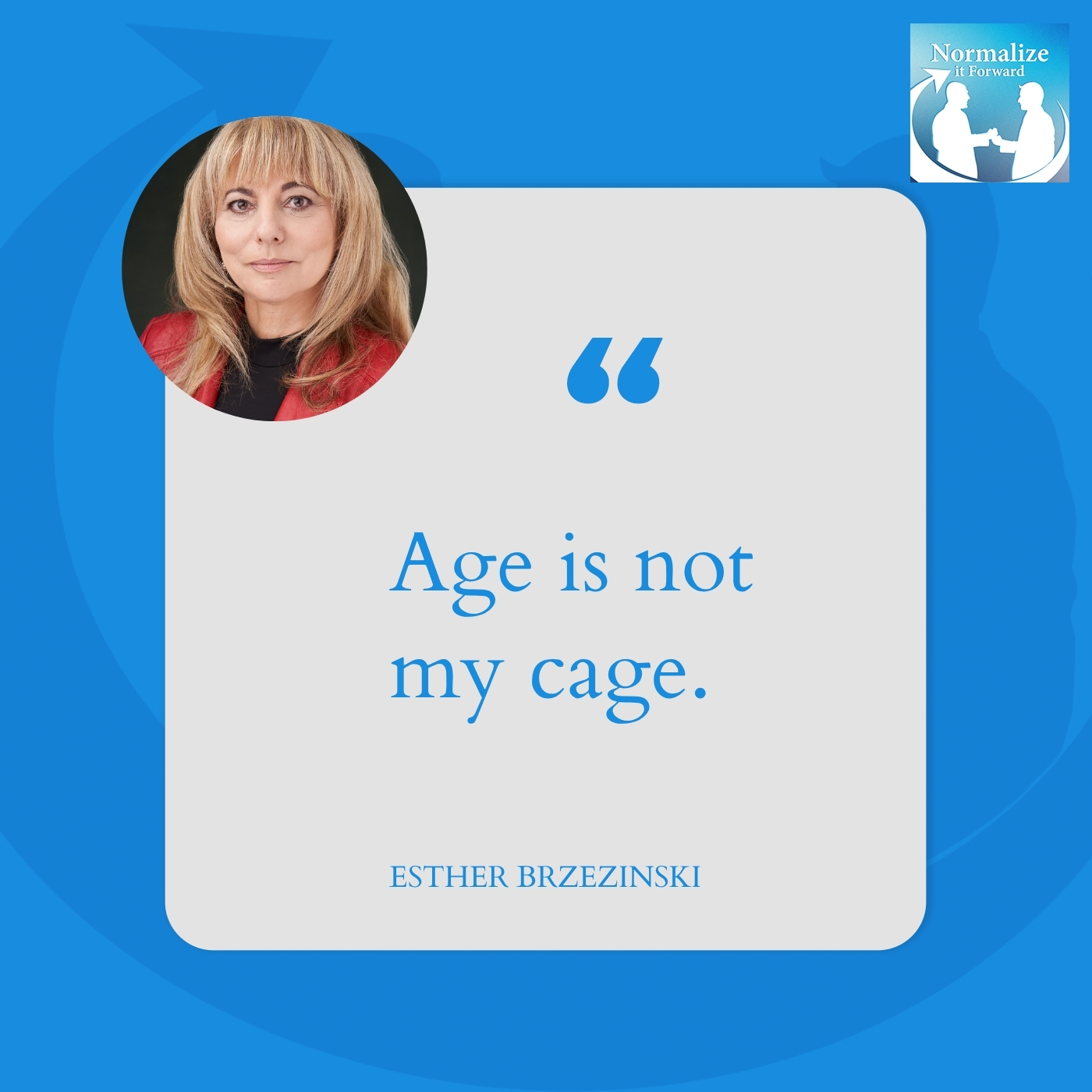
Redefining aging is about sparking joy and embracing every moment with infectious enthusiasm! This episode shines with the vibrant energy of Esther Brzezinski, a multi-talented actor, voiceover artist, and digital creator who’s showing the world that “Age is not my cage!” Hailing from Montreal, Esther’s got a booming online community—over 150,000 on TikTok and 110,000 on Instagram—all drawn to her authentic zest for life and message of positive aging. She’s not just lighting up social media; you’ll find her on screen in projects like “Jurnee’s Revenge” and “Goin’ Ape 2” and behind the mic producing podcasts, including her own “Esther’s Breeze.” Get ready for a chat filled with laughter and insightful nuggets as Esther spills the tea on self-care from the inside out, her adventures in raising neurodiverse kids, and how she’s smashing stereotypes one viral video at a time. This is an episode packed with inspiration, good vibes, and a reminder that life just gets better with age!

Reading about mental health is hard. Let’s schedule a free consultation.
Watch the episode here


Listen to the podcast here


Redefining Aging: No Cage, Just Vibrant Living With Esther Brzezinski

We are here to talk openly about mental health and wellness. I’m super excited to welcome into the show Esther Brzezinski. Esther, how are you?

I am doing well. Thank you so much for having me.

Thanks for being here. Esther is a dynamic actor, voiceover artist, and content creator from Montreal, Canada. She is a champion of the motto ‘Age is not my cage’. Esther is redefining perceptions of aging through her empowering presence on social media, where she inspires over 150,000 followers on TikTok and 110,000 on Instagram.

Her acting portfolio includes notable projects such as Jurnee’s Revenge and Goin’ Ape 2, showcasing her versatility and talent in the entertainment world. Esther is also a podcast producer and host, further amplifying her voice to connect and uplift others. With her passion for breaking stereotypes and embracing positivity, Esther is the spirit of resilience and creativity, making her an inspiring guest to be here on the show. Welcome, Esther.

Empowered Aging: Redefining “Golden Years”

Thank you so much for that incredible introduction.


Normalize It Forward - Marc Lehman | Esther Brzezinski | Aging


We’re excited to have you here. I would love to jump in and hear all about what you’re up to and what you’re doing.

I’m still very much involved with acting. I do a lot of short films, commercials, etc. I also do some voiceover work. I am working on another podcast. It has been a few years. I missed it. We’re working on it with three other women from different generations. It should be interesting. It’ll be a little different because it’ll be in a studio as opposed to where I was using StreamYard before, which was during the lockdown. That was what most people were using at the time. I’m looking forward to that as well.  I am continuing with my content creation as always, talking about ageism, positive aging, etc. You’re right on. My motto is ‘Age is not my cage’.

I love that. It’s fantastic. I’m intrigued by your new podcast. Where can people find it? Do we know yet where it’s going to be?

It’ll probably start off on YouTube. We’re going to start recording in February 2025. We’re coming up with a concept. We did a mock one already. I’m very excited about that.

Brittany speaks very highly of you.

Thank you.

I’m excited to interview you, talk to you a little bit about wellness, and get a sense of your viewpoint and how you see the different areas of mental health and wellness. I created this show to give voice to the conversation and to hopefully talk more openly about topics. I love your spirit about ageism. It’s a parallel mission.

I was saying to someone that mental health is a tough topic to talk about. I’ve gotten a number of comments from families saying they’ve tuned in to our shows, some with their kids, and it has allowed them to have those conversations. I’m super grateful for that impact throughout our show. I want to jump in and get your thoughts on things, if I could. One of the topics that we tend to talk about a lot here is self-care. Self-care is a big buzz phrase in our world that people talk a lot about. I’m curious what self-care means to you.

Self-Care From Within: A Mindset Of Adventure

I believe self-care comes from the inside out. I care about what I eat. I probably don’t exercise as much as I should. On the other hand, for me, it’s also always been the mindset. I’ve always, I believe, had a young spirit. Though turning 60 was mildly traumatic, but not so much, it was very much how I feel about life. I felt that the best was yet to come. I felt like it was another chapter, maybe the final chapter, or maybe part three, if we’re going to divide it up into thirds, childhood, adulthood, and then the golden years. I saw it as an opportunity to do all the things I’ve always wanted to do.


Normalize It Forward - Marc Lehman | Esther Brzezinski | Aging


I do have one adult child who’s living at home with me. My other adult child has been married for many years. She’s going to have her second child. All that to say, I had more freedom. I was able to go out into the world and explore areas that I was not able to before, being a young mother and then having all the responsibilities. Turning 60, and then turning 65 and retiring, so to speak, gave me a lot of freedom. I was excited about the future. That has a lot to do with why I appear to be thriving and have a young-ish spirit. It’s because I’m excited. I get to do all the stuff I always wanted to do.

Good for you. Mindset is powerful. I’ve met people who are in their 30s who appear to be in their 80s. If COVID taught us some things, one of those things is that we can’t depend on our future, so enjoy today. Enjoy what you have right in front of you because tomorrow may not be here, or tomorrow might even be better. It’s unpredictable that way. Your mindset is huge, and what goes into that. A lot of people talk about what they do in terms of behaviors, eating, sleeping, exercise, and those types of things that allow them that mindset. How do you have such a positive mindset? What are some of the things that you do to contribute to that?

I like to get into new projects. I’m very interested in networking and meeting new people. I like to keep up with what’s going on in the world. I’m very enthralled and fascinated by social media. It’s an incredible tool. I love my iPhone. Maybe there’s a mild addiction there, but all that to say it inspires me. I feel excited every day to see what’s new, see what’s happening, and what I am going to explore and find out.

That’s awesome. I love the spirit. I love the spunk. I love the energy. That’s obvious, as we’re talking, that that’s part of your daily mantra. I’m curious. You mentioned your kids. I know they’re grown, but in some ways, kids are always kids, no matter how old they are. Parenting is a topic that also comes up a lot on our show. Parenting is such a wide topic.

A lot of times, parents have challenges that are unexpected. I often refer to parenting as the hardest on-the-job training a person will ever have. We’re getting older and transitioning one of them to their own families. I’m curious. In terms of parenting, how would you say wellness fits into that topic? Where do the two collide for you?

Parenting Challenges & Triumphs: Navigating Neurodiversity

Parenting is probably one of the most challenging things that I’ve ever experienced. It takes an incredible amount of strength, endurance, and understanding. I’m also going to explain that my son, who’s 33, is Neurodiverse. He’s on the spectrum of autism. That has always been a struggle. When we first discovered that he had different wiring, it was a huge transition as a parent to accept that.

There was a poem at the time that was very popular. It was called Welcome to Amsterdam. You’re on the plane. You think you’re going to France, and then it takes a detour and you end up in Amsterdam. It’s pretty wonderful in itself. Even though it’s not what you expected, you learn how to navigate in this new location. This is what it was like bringing up a child who was on the spectrum. There were a lot of challenges there.

My daughter, who is 36, has a cousin disorder. She deals with OCD. She’s a very functioning adult with OCD. Parenting, for me, was challenging. I often felt like I was running a clinic. Honest to God. That was how I would describe that experience. They’re doing extremely well. My daughter is amazing. As an adult, she still requires support from her parents. The relationship changes. We’re more friends than mother-daughter.

Since she’s having her second child, she’s going to be depending on me in the sense that she wants me there at the hospital, she wants me to help with the baby, etc. Having grandchildren has also been a very amazing experience in itself. It’s a different type of love. It’s more pure in some ways. It’s been an experience. I have one child who’s grown and married with children, and then I have another one who’s still at home and has some struggles. I’m still deep in parenting, so to speak. Even though I’m 67, I’m in parenting mode.

A lot of people thought that once you turn 60, it’s over. That it's not important anymore. You couldn't be further from the truth. Share on X

I don’t know that it ever necessarily ends. It morphs into other things. Congratulations in advance. It sounds like a big day is coming for your daughter. I am wishing everybody well. What you said, I’m sure, resonates with a lot of our readers because many parents have kids who are either on the spectrum, are anxious, are depressed, or have OCD. I’ll have to look that poem up later. You’ve got me thinking about that. It sounds like an interesting topic.

Many parents have that experience of expecting this, and things shifted and changed as a result of those disorders. How does that impact the house? How does that impact your parenting? How does it impact your child? My guess is that a lot of my readers will have very similar thoughts and responses. That’ll resonate with them.

I appreciate you sharing that with us. I’m sure that came with a set of challenges that maybe you were unprepared for or not recognizing, but by itself, unique and special in developing their own paths. I’m pleased to hear that they’re both doing so well. I appreciate you sharing that with us. Out of curiosity, in terms of the topic of wellness, when you think about your kids growing, if a new mom or a new dad were to speak with you and say, “We feel like our son or our daughter has some impairments,” were there certain things you guys stumbled across that helped a lot?

I looked at it like I was going to do everything in my power to help my child, and then eventually, both children. I did a lot of research. It’s important to be extremely proactive. Though I depended on the medical system in some ways, I felt it wasn’t enough, and I had to delve deeper. For my son, I found an online program. He was part of the beta testing of it. It was Language Power Systems. I don’t know if it still exists. He became part of it. His language ability progressed one year ahead using this particular program.

This was something that my dad saw in the newspaper at the time when people still read newspapers. He cut out this little article that said something was happening at Rutgers University. They were developing this program. I contacted the researchers and then became part of the beta program. He also did it again a couple of years later. He has fantastic vocabulary, interestingly enough. He was language delayed, so it did help.

It is great to depend on whatever system you have going in your area, medical and whatnot, but be your own cheerleader for your child. Be proactive. You have to be super involved. Every school that he went to, we had to work with the teachers and the principals. We have to be very involved. That’s my experience and what I’d suggest.

It’s great advice. As a therapist, I’ve seen that, and I’ve seen the opposite with parents. It makes a huge difference. I am thrilled to hear that story about your son and how he advanced with his language skills. There’s so much out there that can help you as a parent and certainly help with the progression of whatever your child might be dealing with. There’s the power of the internet. There’s a lot out there, right?

Absolutely. This was in the ‘90s, so now there’s so much more.

Building Community: The Power Of Social Media

I’m curious. You had mentioned social media. I am on social media, too, for my business and other things. Social media has become integrated into our world in many ways. We’re advertised to it. Certainly, plenty of people use it for entertainment purposes. People have businesses on there, etc. I’m wondering. You talked about it in such a positive way earlier. When you think about the positive impact social media can have on both young people as well as parents, what comes to mind?

Community is the first thing that comes to mind. That’s what I discovered. The 50-plus community was there. Everything I spoke about resonated with people, and they weren’t necessarily creators themselves. Many were sitting back, watching, and engaging. It struck me how much people needed to hear what I had to say.

We inadvertently built a community. That’s the first thing, which is community, like-minded people, and similar interests. You could see that all over, even on Facebook. There are many communities on Facebook that have been very helpful, even in the acting world. When you’re starting out, there are many pages for whatever area you live in, looking for actors to be in independent films, etc. There’s a lot out there.

I feel like that word does capture it well, community. There’s a community for everybody and everything. That is one of the real positives that you get from social media. Those of you who are out there and haven’t experienced that, know that both Esther and I have. If you’re looking for support, that might be one area to consider. Certainly, I would say Facebook, Instagram, and TikTok, all three, offer that in spades. Often, we hear of all of the dangers associated with using them and all of the negativity associated with them, but we don’t hear about the positivity. I think there is a lot of positivity. I appreciate you throwing that word out. That captures it well.


Normalize It Forward - Marc Lehman | Esther Brzezinski | Aging


I’m happy to have done that.

Tell me. I’m curious. Your background’s interesting. I feel like everybody has a story or a journey. I’m wondering how your background and your journey develop. Can you give me a little bit of a sense of that?

A Journey Of Reinvention: From Psychology To TikTok Success

That’s an interesting question. I went all over the place. I have a degree in psychology. We’re going to go way back. I also have some post-graduate business courses. I ended up in the fashion industry. I did that for many years. I traveled. I was a buyer, a merchandiser, etc. I was always fascinated with psychology and understanding myself and others. It was the way that I was as a person. I was very analytical in trying to understand people. I often felt that I felt people. Maybe there’s an empath in me that I always had and didn’t understand.

After my son was born, I decided to stay home. I realized that he had some special needs, so I stayed home until he was about thirteen. I started my own business. I had a fashion accessory business for about twelve years. I had always had an interest in acting and had done a little bit in my late teens and early twenties. When all the lockdowns happened, I gave up the business. I was then going to be competing with Amazon, which didn’t make any sense.

I had started to do a little bit of voiceover work as my side hustle. Once I decided to end Esther B Accessories, which was my accessory business, I went all in for voiceover. I did it all online. I had taken a little bit of acting classes as well. I kept up with that. I also met a few people in my acting classes who were doing podcasts themselves. One of them approached me and said, “I think you’d be good as a podcaster.” I was shocked. I had no idea how to do this. I didn’t know what I would talk about.

Needless to say, about 48 hours later, Esther’s Breeze was born. That was a show where I interviewed creatives. It was actors, directors, singers, authors, and comedians. Comedians were my favorite guests. I did that for about a year and a half. At the same time, this person who pushed me to do that podcast asked me to do a podcast with them to co-host. It was a little thing that we did every week. It was called Noon Hour ‘Out of the Box’. We would talk about different topics, from betrayal to polyamory to stomach issues. It was all over the place, but we had an audience. It kept us busy. People were engaging with us because we would do it live. People were able to communicate with us while we were on the air. We did that.

During that time period, I was playing around with social media. We had the time. It was during the two years that we were pretty much locked down here, particularly in Montreal. One day, after going down the rabbit hole on TikTok, I decided, “I can do a video. Let me see. Let me try.” I had 70 followers. I knew a little bit about TikTok, so I did this aging filter video where I went on Snapchat. I said, “I’m 64 years old and people expect me to look like this.” It was an aging filter. I removed the filter and I said, “Instead, I look like this. This is what I look like at 64.”

I put my phone down, didn’t think about it, and did things around the house. I heard my phone ding. I had notifications on. I didn’t understand how to turn them off. I never needed to know before. I pick up my phone two hours later, and I have 300,000 views on this video. I knew I had something there. I was like, “Something resonated. Something worked. What is it? I’ve got to figure it out.” At the time, there was this platform called Clubhouse. I don’t know if you remember.

I remember it.

It still exists, but it was very popular during 2020, 2021, and 2022. I went on there, and I was seeking out a room about TikTok. I found one, went up on the virtual stage, and told them my story. There were very large creators in the room, and everyone gave me advice. This was a room that was, at the time, daily, so I would go in there and listen. Sometimes, they’d call me up and I’d speak. I learned a lot from being in this room, listening to big creators.

I started on my journey. I would post every day. I would study my analytics. I learned about algorithms and a whole bunch of stuff, like how to grab people’s attention in the first three seconds. I realized that’s what I had done with that video. I did it on TikTok and started to have some success. I put it on Instagram, Facebook, and YouTube, and it blew up. It worked. I kept the momentum where I would talk about ageism.

I always made sure to say whatever age I was at the time. I started at 64. Now, I’m 67. I made a point of saying, “I’m 64. I’m 65.” I also talked a lot about love, romance, and going out and having fun because I thought that was very important. I felt that a lot of people thought that it was over, that once you turn 60, that whole part of your life, forget about it. It’s not important anymore. You couldn’t be further from the truth. I talked a lot about that, and that resonated with people.

I got a lot of engagement and a lot of DMs, particularly from men who were saying, “I feel the same way. I wish my wife would feel like that,” or, “I’m a widower and I would like to meet somebody. I’m so happy to hear that women of our age group are interested because I always thought blah.” People have these preconceived notions, even people who are in the same generation, but it’s wrong, in my opinion. A lot of people seem to be in agreement with it.

Authenticity & Confidence: Thriving In The Spotlight

That’s wonderful. There’s so much there. I appreciate you sharing all of that. When you tell that story about removing the filter, you have confidence in yourself to say, “Like me or not, this is who I am.” That’s fantastic, number one. Often, people on social media don’t do that. They hide behind those filters and pretend. This feels very real, honest, and genuine. Clearly, people are connecting with the topic. We’re all getting older. I feel like it gave and continues to give a lot of people the ability to share and to talk about what it’s like to be this age or that age, depending. That’s awesome. I love that you’ve had such success on social media.

I would also say that from your story, one of my takeaways is to find your passion. If you don’t find it the first time through, that’s okay. Continue to look. Part of the life journey is to stumble a little bit and come across certain things that either you’re good at, you enjoy, or both. Sometimes, that involves parenting, and sometimes, that’s something separate from that. That’s certainly one of the things that I take from your journey.

It’s very much about passion because it was spontaneous. I was always fascinated with social media. It’s something that Ilove to do. I still find it amazing that it exists because I grew up in the ‘60s and ‘70s, and it was different. There are so many opportunities that you have now that didn’t exist so many years ago. It’s an incredible tool.

There are so many opportunities that you have now that didn't exist so many years ago. Share on X

That’s wonderful. Congratulations on your success through it. It sounds like it has grown nicely for you. I appreciate you sharing that story. For my young readers, I want them to understand that there are opportunities out there sometimes that you create on your own. Part of your story was getting mentored in the Clubhouse app and putting the time in. Granted, it was COVID, so what else were we doing? We were learning things.

Putting the time in and crafting something that’s meaningful and important to you is a good example of a success story and something that you felt and continue to feel passion towards. Thank you for sharing that. I appreciate that. Part of the show is that I ask people to consider nominating a friend, a coworker, or a relative to keep the conversation moving forward. If I can put you on the spot for a second, do you have anybody in your world who would be good for me to interview next?

This wonderful, amazing, intelligent, and beautiful woman called Monica. She’s a life coach. She’s also a wonderful friend. She has many nuggets of wisdom to share, so I recommend her. I nominate her.

Thank you so much. I appreciate it. I look forward to meeting with her. This is a chance for our audience to read an additional point of view and to get a sense of what wellness looks like from her perspective. Thank you so much for nominating her. We’ll bring her on the show. We’ll reach out to her. Thank you. I appreciate that. Also, thank you for your time. I know you’re busy, so I appreciate you making some time for us and sharing some of your thoughts and feelings all about wellness. Thank you.

It’s been my absolute pleasure. Thank you for having me.

You have a wonderful rest of the day. We’ll talk soon.

Thank you so much. Bye.


Important Links


About Esther Brzezinski

Normalize It Forward - Marc Lehman | Esther Brzezinski | AgingEsther Brzezinski is a dynamic actor, voiceover artist, and content creator based in Montreal, Canada.

A champion of the motto ‘#ageisnotmycage,’ Esther is redefining perceptions of aging through her empowering presence on social media, where she inspires over 150,000 followers on TikTok and 110,000 on Instagram.

Her acting portfolio includes roles in notable projects such as ‘Jurnee’s Revenge,’ ‘Goin’ Ape 2,’ showcasing her versatility and talent in the entertainment world.

Esther is also a podcast producer and host, further amplifying her voice to connect and uplift others. With her passion for breaking stereotypes and embracing positivity, Esther Brzezinski embodies the spirit of resilience and creativity, making her an inspiring guest to be here today on Normalize It Forward.


Reading about mental health is hard. Let’s schedule a free consultation.

 

Normalize It Forward - Marc Lehman | Monica Wizinski | Mental Health And Wellness


Mental health and wellness are more than buzzwords; they’re the very foundation of a life lived fully and joyfully. In this powerful and heartfelt conversation, we journey into the core of well-being with Monica Wizinski, a masterful professional coach who’s made it her mission to help people reconnect with their authentic selves. With her deep expertise in conflict resolution and a remarkable talent for listening between the lines, Monica guides us through the complexities of modern life, particularly for young adults navigating a world that’s constantly buzzing. We discuss the significance of crafting a personal “village” of support, the art of slowing down amidst the chaos, and the undeniable truth that self-care isn’t selfish—it’s a necessity. Prepare for tangible advice on managing the noise, discovering real joy, and embracing the power of presence in a world that insists on speed. Monica illuminates the path to finding your inner center and cultivating a sense of peace that radiates outward, affecting every aspect of your life. If you’re seeking a way to anchor yourself in this whirlwind of existence and build a lasting sense of well-being, this episode is your compass to a more centered, vibrant, and truly healthy you.

Reading about mental health is hard. Let’s schedule a free consultation.

Watch the episode here


Listen to the podcast here


Mental Health & Wellness: A Guide To A Balanced Life With Monica Wizinski

We are here to have an open conversation about mental health and wellness. We welcome Monica Wizinski. How are you?

I’m great. How are you?

Good. Thank you. Monica is a professional coach specializing in personal growth, conflict management, and organizational development. With a background in mediation and deep listening techniques, she’s dedicated to helping individuals gain clarity and enhanced communication and achieve a balanced work-life integration. Through her coaching practice, Monica offers a supportive environment for clients to explore their aspirations and overcome limiting beliefs. She’s active on social media, sharing insights and promoting self-healing and growth. Monica, welcome to the show. How are you?

I’m great. Thank you again. That was a great intro. I’m happy to be here to talk about mental health and wellness with you. It’s such an important topic. I feel that the more we talk about it, the better it is.

Demystifying The Life Coach: Navigating Change & Building Confidence

I agree. Let’s jump in. A lot of my readers may have questions as to what a life coach is. Do you want to take that on and let us know, or give us a sense?


Normalize It Forward - Marc Lehman | Monica Wizinski | Mental Health And Wellness


Sure. As a life coach, one of the things that is very helpful is to help guide people to navigate through change and transition and also help them develop concrete, practical tools about how they can have greater self-confidence in their life, how they can navigate challenges, and how they can improve their relationships with building communication skills.

It’s quite a vast field. Some of us coaches specialize in different areas. In my case, because I’ve worked a lot with conflict resolution and that kind of thing, I found it was a natural progression of moving people from conflict or uncertainty into a little bit more clarity and forward movement. A lot of this is based on self-leadership, which is something that I advocate for. I feel that with building the right tools and creating the right structure around ourselves, we can feel well supported to make smooth and easy transitions that help us move forward and elevate into what we want and what we’re looking for in our lives.

Building Your Village & Taming The Pressure Cooker

Thank you for that description. That was great. My head was thinking about a number of transitions. I suppose at some point, we could all use a life coach to help us.

We should all have a life coach. We should all have a massage therapist.

I agree.

I don’t like to say should, but the more support and the more infrastructure that you can create in your own life builds your village or your community. These are difficult times for so many reasons. It’s very fast-moving. There’s so much disconnect that’s happening. I feel that any movement that you can make towards a greater connection is important. Many years ago, people raised children in little villages. We had a family. Everyone was part of a greater community. How, in these times, can we build more community, more connection, and more support, and help each other?

The more support and infrastructure that you can create in your own life, the more it builds your village or your community. Share on X

That’s a great point. I feel like we need to get back to that in some ways. Everybody is siloed, and our mental health is suffering as a result of that. I’m curious. You’re located up in Canada. Down here in the States, the statistics on mental health, especially for young people, aren’t pretty. Anxiety is way up. Depression is way up. Suicidality is way up. Can you give us a sense? Are those numbers mirrored in Canada? Are they different in Canada?

I don’t know the numbers exactly. I even have clients who are university students who are looking for clarity and trying to understand how to deal with pressure and how to also regulate their family lives and their relationships. There’s so much going on, like hormonal stuff and everything. We have a lot of expectations because things are moving so quickly. We are placing a lot of pressure, often unnecessary pressure, and then there’s no outlet for how to cope or manage within that. It all starts with the family structure, so it starts young. It all begins there.

Sometimes, as kids are changing and they’re no longer babies anymore, and suddenly, they’re becoming adults, as parents, we don’t know how to cope. It’s difficult. We’re all always working. Everyone’s busy, and then everyone’s disconnected. We’re lucky if we’re getting a meal around the family together. We’re lucky if we’re sitting and having nice heart-to-heart conversations. We’re losing the simplicity of things.

Sometimes, it’s the little actions that make so much of a difference in a relationship. Whether you’re talking about a family relationship between parents, you’re in a professional setting in the workplace, or you’re in a relationship with your love partner, sometimes, it’s the little things of a little helpful hand, allowing people to know that you’re there and you’re present, and listening and being present.

We’re always about production, achievement, and moving forward, but it becomes very mechanical. It’s not coming from the heart. The heart gets missing in all of this, even though the heart is in the right place in most cases, We all want the best, but how do we move from that place of every day stuff, busyness, pressure, overwhelm, and stress into a place where there’s expansion, curiosity, and a little bit more stepping back and being open to understanding and hearing the person that we’re with in a relationship with? That could be a parent-child relationship. It could be in the workplace. It could be with your professors. It could be with your boyfriend, girlfriend, or anyone else.

Those are such great suggestions. On a large scale, we need to slow down. I present a lot to families online, teach classes, and so forth. One of the things I noticed that’s laced within all of my presentations is listening more than talking. My kids are 24 and 22. When they were born, I remember for a moment thinking, “I can take them home? You’re going to trust me?” As parents, we don’t know anything. It’s like on-the-job learning constantly.

Your point is good in that we’re learning how to do these things at every stage. When we get one stage down, we move on to the next one. Even more, there’s a lot of pressure on young people. It becomes, in some ways, our job at home to do what we can to relieve that pressure and give them some space to not feel so intense all the time and not feel like they’re chasing something. I’m not even sure what they’re chasing.

Self-Care As Self-Leadership: Finding What You Need Right Now

That’s making me think of something when you’re speaking about that. There is that responsibility that we have to the loved ones around us and the presence that we need to provide, but it also comes back a lot to our own selves. What I mean by that is there are so many amazing tools and tricks out there in terms of mindfulness.

Let’s say as parents, or if we’re going to even talk about our own selves and what we’ve all been through, and even for youth, for teens, or for anybody, it’s taking a moment to find out, “What do I need right now? Do I need to take a break from this situation? Do I need to step out? Do I need help? Do I need to take a breath for five minutes and come back to it? Do I need to explain myself?” It’s so tricky.

Using tools like mindfulness is something that is supportive in the process of slowing down. I know I go a mile a minute all the time, but I also know when to stop. I have scheduled stops and breaks with myself where I eat, do yoga, breathe, journal, connect with myself, get somatic therapy, or whatever it takes to be in touch with myself and what is happening. This is something that’s so accessible and available. I feel that as role models are in a relationship, a lot of it is role modeling also, so the other individual that we are in a relationship with can also feed off of that.

Beyond The Buzz: Real Self-Care For Mental & Physical Wellness

It’s a great point. It’s something I talk a lot about on the show, which is self-care. Self-care is something that, clearly, you and I do to give ourselves some room because if we are moving intensely throughout the day and we don’t do that, our own mental health and wellness suffer. That’s not only important for parents and partners, but it is also important for young kids to understand. If you are going to move intensely throughout your day and you don’t have any way to let the air out of your tires, at some point, your tires are going to explode.


Normalize It Forward - Marc Lehman | Monica Wizinski | Mental Health And Wellness


Turn it off.

You made some great suggestions. Breaks from technology are super helpful.

They’re important.

When you think of self-care, especially for young adults, what else comes to mind?

It is fitness and health, like eating properly and sleeping well, which also is related to the social media stuff. A lot of students are not taking the time to feed themselves. It could be simple things like having a little breakfast, getting in your meals for the day, and drinking your water. It could be all the basic stuff of going out for a quick jog and maybe joining something that raises funds for charity. You can run or you can support others. Be involved in tennis or play a sport.

Whatever it is, you need to have a physical outlet. It’s so critical. I realize that more and more as time goes on and the more and more people I speak to and coach. It’s that balance of physical, mental, and emotional that comes together in one whole picture. If one area is lacking and suffering, then all the areas are being depleted.

Feed your body. Do self-care. There are classes out there. There are retreats. When I was 17 and 18, I was going on meditation retreats. It was weird then, but now it’s not weird at all. Yoga was crazy back then. People were like, “What? You do yoga? What do you do? Twist yourself?” Now, there are 45 million different kinds of yoga, and everyone does it. It is about having mindfulness.

Mindfulness is any activity that allows for self-reflection, alone time, thoughtfulness, slowing down, having some soup, hot chocolate, or something on a cold day, and saying, “What do I need right now?” It could be talking to a friend and looking at who my close ones are and who the people are that matter. Sometimes, we spread ourselves all over the place. It’s like peanut butter on toast. We can’t be everywhere. We can’t do everything. We have to recharge, unplug at times like a battery, a computer, or anything else, and reset.


Normalize It Forward - Marc Lehman | Monica Wizinski | Mental Health And Wellness


It’s different for everyone. For some people, it’s external. They like to go out and do stuff, and that charges them. Other people like to do internal, quiet things like take a bubble bath and journal or something like that. It is whatever it is that feeds and nourishes you. It is finding how to come back to your reset and how to come back to your center, so you have a sense of mindfulness and you’re able to keep going on and take a break when you need it.

That could be the best definition of self-care I’ve heard. From my perspective, for young adults, it can’t be scrolling. It can’t be social media. It has to be something for themselves. I always tell young people, “Find one thing. Find a place to start.” Maybe it’s water. Do you know how many kids out there are walking around dehydrated? Get a decent amount of water.

That makes you so tired.

Get decent water intake for a week and tell me how you feel.

It’s a simple thing.

There was so much of what you said. I’m hoping my audience reads something and they’re like, “I’m going to try that.” There’s journaling, yoga, meditation, breathwork, water, and exercise. Exercise is huge. There are so many forms of it.

Who doesn’t want to love and take care of themselves? The problem with social media is that there’s so much pressure. There are expectations, comparisons, and competition. It is and it isn’t real, so it’s confusing. The one thing we can do in North America is to find your center and be your individual self. How do you stay in the center of the storm? How do you stay grounded?

Find whatever it is that feeds and nourishes you. Come back to your reset and center, so you have a sense of mindfulness and you're able to keep going on and take a break when you need it. Share on X

There’s crazy stuff happening on this corner. Someone is going through a lot as a friend, and you want to be helpful and supportive. Your parents are putting this kind of pressure on you. There’s this expectation to do well, succeed, and be successful. There are a lot of moving parts, so find your ground. Find your center and breathe. Maybe it sounds like hippie stuff, but it works.

The Chase Without A Target: Understanding The Modern Intensity

Whether it’s hippie stuff or not, it works. I’m curious. Like me, you work with students as well as what we’ll call post-students or employees in the field, if you will, out in the community. I’m curious about your viewpoint on this. In my 25-year career, I’ve noticed the intensity and the chase from young people getting worse. I’m not even sure what they’re chasing, I’ll be honest. Maybe it’s a better school or a better job. They think it’s happiness, but it’s not. They’re not chasing happiness. I’m curious. What have you noticed in your career? How has that changed in the last many years?

Everything’s so much faster. When you’re going fast, you have to keep up. I grew up in a generation where we played hockey on the street. We were running around to people’s houses. Everything was different. Now, we’re safety conscious a lot more, which is okay and fine, but there are a lot of measures in place. It’s more sophisticated and more complex. The whole world is more complex. The things that my younger children know about, I didn’t know about until I was much older. We’re being exposed to so much more information download, and there’s so much more consumption.

That is true.

The opposite of consumption is creativity or production. If I can get a little philosophical for a moment, it’s like waves, the contraction, expansion, consumption, creativity, and output. We all want the same things. From kids to grown-ups, we all want to be able to be seen, heard, valued, and understood, to share our stories, and to live in peace and harmony.

We all want the same things. From kids to grown-ups, we all want to be seen, heard, valued, and understood, to share our stories, and to live in peace and harmony. Share on X

That sounds great.

It’s all there, the extreme pressure, extreme uncertainty, and confusion. It’s a whirlwind. It’s a crazy world out there.

That’s well said. The pace is tremendously faster. I was reminiscing as you were talking about the way you grew up. That’s the way I grew up. That’s the way a lot of adults grew up. It’s not the way kids are growing up. There’s an intensity to the number of activities kids are involved in. A 4.0 is no longer good enough. It doesn’t stop. At some point, we’re going to have a 5.5 or a 6.5. I don’t know.

I watch the suffering that happens as a result. You’re asking kids to be perfect in some ways, and there’s no such thing. When you have a kid who’s doing three activities simultaneously or when you have a kid who’s trying to bust their butt doing well in school and they’re doing their best, but their best isn’t good enough, there’s suffering that happens.

Anxiety and depression are huge in our world. I’m watching kid after kid talking about it in my office. They’re talking about their friends who are suffering. A lot of parents are looking for, “What can we do?” One thing we can do is be mindful of that and realize we’ve got a little control over how much we sign our kids up for. We’ve got a little control over what our own expectations of grades and school are. I had a parent in my office, and it was so refreshing to hear. He said, “I don’t care about your grades. I care about how much effort you’re putting in.”

That’s beautiful.

He said, “If you’re doing your best, I’m fine with it,” which was refreshing.

It is nice to see that type of attitude, which is having a little bit more compassion, understanding, and easing off on the reins. There are a lot of these helicopter parents. Even if you were horseback riding or something and the rein is that tight, the poor animal is going to be acting up, and you’re not going to get the flow that you want to achieve.

I’m imagining. I don’t know. 99% of parents want the best for their kids, but how do you create that environment? What is their part in that? I feel a part of it is that step back, listening, and not bulldozing. You’re not rolling them down the hill and telling them what they need to be doing. We have to respect one another. Respect is almost a loss.

Don’t say that.

We’ve got to keep it going.

I hear you.

Simplifying Life: Reconnecting With What Truly Matters

We have choices. As a child or a parent, there could be a big conflict or a big difference where somebody wants this for you and sees with their own experience, wisdom, knowledge, and everything else what they believe is best. Then, there’s a blossoming whole person who has their own preferences and has had them since they were two years old. They liked tomatoes or didn’t like tomatoes. We have to step back, listen, be curious, and also take the moment to see how we can ask more questions and try to find common ground.

Those are all great suggestions. I walk the line. I don’t want to come off sounding like I’m blaming parents because I’m not. I’m a parent. What we’re doing is we’re making suggestions. Some parents want to know, “What can I do differently to assist?” Pulling back is hard or scary for some parents because they assume, “If I pull back, then my son or my daughter won’t step up.”

Mind you, I had a strict mother. My father was like, “You got 5 out of 10. You got half right. That’s incredible.” It was the glass half-full. She was like, “What? You got 9.5? What happened? Is there a problem? What have I done wrong?” At least I had that little balance there. It’s not about perfection. It’s about keeping progress happening and connecting with your child in simple things. It’s not always about serious conversations about where you are going in your life and who you are with. It’s not always the heavy stuff. It’s sitting around at the dinner table or watching a TV show and having a chit-chat.

It is allowing openness to be there so that they know they can turn to you in hard times. It is being there and having those conversations in the car when you’re driving to an activity and not always making it about, “How was school? What happened today?” They’re like, “I had a hard exam,” and you’re like, “I told you to study.” Stop and listen. Be mindful. Step back, be more curious, and say, “How did that make you feel? What would you have done better?” Ask more questions and stop feeding and telling. I feel like I’m against the parents, but I’m not.

It’s a great suggestion, though, because some parents will ask in such a closed way. They get a closed answer, and they’ll say, “My kid doesn’t talk to me.”

Be there and do stuff with your kids, too. We’re so busy. The parents work so hard. It’s tricky to balance all the stuff of life for all of us. Remember how you used to go cross-country skiing. Remember how you used to go fishing together. Do those things from time to time. If it’s art, then do that. Find some bonding activities that are not related to success, progress, perfection, and the future. Be present.

Be present and spend time. That’s a great suggestion. That leads to my next topic that I wanted to ask you about, and that’s time management. I feel like poor time management for a lot of young people leads to a lot of anxiety. A lot of adults could work on this as well. I’m curious. I’m sure that’s a topic that you’ve worked on with individuals. What have you noticed in the past that has been a helpful suggestion or tip around time management?

Time Hacks & Joyful Breaks: Conquering Procrastination & Finding Enjoyment

There are two ways. First of all, a lot of people will do all their little tasks first. You make a list, go through it, check things off, and then say, “Eventually, I’m going to get to this big thing. I have to do the dooming thing that is on my back that is the dark, dooming essay I have to write,” or whatever it is. It’s the reverse that’s true. Take the first 90 minutes of your day or even 1 hour with your tea and sit down, write, and do the difficult thing a little bit. It’s a drop in the bucket. Don’t leave it to the last minute. If you don’t want pressure, you know it’s going to happen.

A lot of it is scheduling things. There are calendars, tools, and so many apps out there that can help you. There are coaches who can help you. It’s also focusing on your day and when you’re most effective. If some people work well at night, after supper, they can plow through doing whatever it is they need to do. Other people are morning people, and they function in the day. Try to think about when you function best and schedule important stuff. You can do all the other things later, the quick things.

Those are great suggestions. Many of my students come to me and they’re self-disclosed procrastinators. I procrastinate. I get it. Everybody does, to some degree. We all know where that goes. We all know if we push something off, it doesn’t magically get done. We have to do it anyway. I like what you said, which is chipping away at it.

There are a ton of good task-related apps out there. None come to mind, but I’ve had so many people use so many different apps over the years. I suggest to my audience to think about whether there is something out there that you could use as a tool that might help keep you in check, chunk it up a little bit, and face that difficult item that we’re looking to avoid. Every student knows what that means. I would imagine in the working world, too. Those are the kinds of things that, if they haven’t been resolved, they come back up.

They do come back and haunt you. It’s nice to build that resilience up. Remember the amazing feeling you’re going to have when you know it’s done. That builds more and more confidence. Refer back to those episodes of those situations where you accomplished something great that was not necessarily easy to do and was big, and you did it. Refer to how you got through it. Referring to those reference points is also a helpful tool.

Let me ask. I know you’ve got kids. Do you have a couple of kids?

I have a boy and a girl.

As do I. Let’s eliminate them for a minute and ask this next question. Enjoyment. I feel like for young people, enjoyment is overlooked. They might even look at us and go, “They don’t enjoy life.” I’m curious. What’s your go-to? What do you enjoy on a day-to-day? If you have some free time, what do you enjoy?

Daily Enjoyment & Future Insights: Finding Happiness & Next Steps

I have to tell you that it is the most beautiful question because enjoyment is so overlooked on a daily basis. I get enjoyment out of being with my family. Being with my loved ones gives me a lot of joy. I also have to be in that state of mindfulness where my head is clear. What I do is I intentionally have to put my phone away. Even I, as an adult, put my phone away because otherwise, I want to text myself another reminder or say, “I have to check this quickly.”

Enjoyment is so overlooked on a daily basis. Share on X

Be here. Be now with the presence of these people, these humans that I love so much and that feed me on such a deep level. There are no words for it. It happens immediately. I get enjoyment out of being with my family. I get enjoyment from doing activities that recharge me. I seek that out. People that I find fun to be with, are very supportive, or are wonderful, cool people that I love being with, I will spend some concentrated, designated time with them. I know it’s very compartmentalized, but it has to be. I take that and savor all the diamonds from that. That charges me for a couple of days.

I love it. It’s compartmentalized because it’s strategic. You want to make sure that you enjoy life. For me, it’s music. I love music. Sometimes, I’ll combine that with going to a concert with my family, music with exercise, a spin class, or something like that. For me, that is an enjoyable thing. Even if I have five minutes to listen to a great song, I’ll do that because that creates enjoyment for me.

Everybody should have several go-tos. Those are things that create enjoyment for you. For my readers, I ask that you guys think about it. Think about what your go-to is. I would expect it would be different than ours, but I would hope that if you don’t have one, you’d find one. Enjoyment is something that is overlooked. Honestly, if they’re not strategic, they may not be focusing on it, which is problematic.

Last question. I’m going to put you on the spot for this one, but this is a good question to ask. Part of the show is I like to have the conversation continue to move forward, so I usually will ask my guests to nominate a friend, a coworker, or a relative who you’d think would be good for me to interview next. Do you have a sense of who you’d like to nominate?

I have three ideas. I’m not exactly sure which one.

You can nominate all three. That’s fine.

I’m going to nominate a gentleman named Scott Simons who works in health and wellness. He is a very interesting person who I know practices what he preaches a lot. He’s involved in building something called the Be Human Club. It’s growing. He’s an entrepreneur. He’s worked a lot with companies and individuals, providing meditation, yoga, retreats, and all things fitness. He’s had an interesting background, where he has a lot that he can connect to in terms of mental health.

That’s fantastic.

I also have a lady by the name of Randy Brandman. Randy Brandman is the School Counselor at St. George’s here in Montreal. She’s a wonderful experience. She works with youth as the school counselor. She’s a very wise, knowledgeable, fun, and relatable person. She’s also a parent. I can go on. I have a lot of contact, so I don’t know where you want to go with this.

I have another friend who is a life coach. He has formally and probably still does his work as a suicide prevention group leader and trainer for many years. He has dealt mainly with the recovery groups for parents who have lost a child and also with people who have been in deep depression, and is working with suicide. He’s veering a little bit more into coaching, but he also still has that. That’s been a volunteer position for quite a long time.

That’s fantastic. His name?

Greg Kligman.

I appreciate this. Let’s get them all on the show. That’s the way I look at it. They all have amazing perspectives. The more the merrier. We can continue to have this conversation. To me, it’s important that young people are reading about us adults talking about this and normalizing the topic because it’s here and it’s a part of their world. I appreciate your time. Those of you looking up Monica, it’s Monica Wiz for short. Would you want to give us your website and your information so people could look you up?

Yes. It’s MonicaWiz.com. I’m on Instagram, Facebook, and LinkedIn.

That’s fantastic. If you’re interested, reach out, certainly. Those of you who have an interest in connecting with us know where to find us on UAreHeard.com. Again, thanks for your time. I appreciate it.

Thanks so much.

Have a wonderful rest of your day. Take care.

Thank you. Bye.

Bye.


Important Links


About Monica Wizinski

Normalize It Forward - Marc Lehman | Monica Wizinski | Mental Health And WellnessMonica Wizinski is a professional coach specializing in personal growth, conflict management, and organizational development. With a background in mediation and deep-listening techniques, she is dedicated to helping individuals gain clarity, enhance communication, and achieve a balanced work-life integration.
Through her coaching practice, Monica offers a supportive environment for clients to explore their aspirations and overcome limiting beliefs. She is active on social media platforms, sharing insights and promoting self-healing and growth.


Reading about mental health is hard. Let’s schedule a free consultation.


Normalize It Forward - Marc Lehman | Olivia Healey | Social Anxiety


Many teenagers these days, despite their interconnectedness through digital means, are suffering from social anxiety. Their mental health is not that well, and panic attacks are becoming all too frequent. Actor and screenwriter Olivia Healey shares how she uses her storytelling skills to help young people deal with these challenges and become more open to creating genuine relationships. She warns about the dangers of social media, particularly its adverse effects on teenagers’ social skills and awareness. Olivia also opens up about her own experiences with social anxiety and how she overcame these inner battles to unlock her fullest potential.

Reading about mental health is hard. Let’s schedule a free consultation.

Watch the episode here


Listen to the podcast here


How Teens Should Handle Social Anxiety With Olivia Healey

I’m so excited to welcome Olivia Healey. Olivia, welcome. How are you?

Thank you. I’m so excited to be on your show. I’m doing well. How about you?

I’m great. Thank you for being here. I appreciate it. Let me read through your intro for a moment here. Olivia Healey first discovered her love of storytelling at the age of ten when she played Juliette in Madeline’s Christmas in Atlanta, Georgia. She pursued theater for six more years before realizing the depth to which she could take her craft in front of the camera.

Since then, she has appeared in various featured films, such as Grounded, The Family Plan, etc., and moved to LA to actively pursue her career in acting. Not only is Olivia an actor, but she is an average screenwriter as well. She has written over 60 scenes for clients in both LA and Atlanta, and wrote the impactful short film Breathe.

Breathe was screened in June 2023 and received praise from multiple recognized mental health organizations. Olivia has worked with the highly regarded Berman Center to screen Breathe and inspired their patients to express their anxiety through art. She looks forward to continuing her journey, bringing Breathe to more organizations in the hopes of reaching a broader audience. Welcome, Olivia.


Normalize It Forward - Marc Lehman | Olivia Healey | Social Anxiety


Thank you.

That’s awesome. I viewed it myself, and it was awesome. Breathe was tremendous. Those of you who haven’t looked up Olivia and haven’t looked up Breathe, please do. It is worth your while. I’m curious. Can I jump in and ask you a little bit about that?

Please do.

Finding Purpose In Screenwriting

Your acting career began young, right?

Yes, very.

You then began screenwriting at the same time or after? How did that come about?

After. It came about through necessity because I wanted to tape something to send to the casting directors and agents when I was starting out in the screen acting field versus musical theater. I wanted to play a mean girl, but I couldn’t find the exact mean that I wanted to be on TV and film. Thirty minutes before I went to my coaching, where I was going to tape this little clip, I decided, “I’m going to whip up my own script.”

I wrote myself a very mean girl scene that scared my cousins in Texas and used that to get my very first agent. I had such a blast with that that I decided to keep going from there. Since then, I wrote Breathe. I’ve written for clients both in Atlanta and Los Angeles for little scenes that they can put on their reels, like I did for casting directors. I’m writing a screenplay, which you’ll be seeing within the next ten years on a big screen.

You guys read it first. That’s cool. What is that about?

It is about an unlikely friendship between a high school senior and a man towards the end of his life, and they meet at a therapist’s office. It explores how two people at such opposite ends of life and living different lessons can learn from each other, and then from there, infect each other’s lives and impact people in each of their lives as well.

Dealing With Panic Attacks And Social Anxiety

Speaking of, I’m guessing you were in high school yourself. I would love to ask you a little bit about that. I work with young adults all day long. The premise of the show is to bring the conversation of mental health and wellness to the masses, get people talking more about it, and normalize that conversation so that people aren’t afraid to talk about topics.

I wanted to ask about your journey through high school, when you think about mental health and wellness around you with your peers, the aspects of mental health and wellness, and how it played out around you in your world in high school. I’m wondering. Can you tell us a bit about that?

Absolutely. First, I’d like to say that at the time when I was in high school, experiencing mental health for the first time, and I was conscious of it, I felt very alone. Upon reflection, I think about peers that I had who were probably going through the same thing. I’m glad that you have this show because a lot of people will probably open up more. Hopefully, grades of peers will open up more to each other, and hopefully, students going through what I went through won’t feel as alone.

Thank you.

It’s so important. I became conscious of mental health at a young age in fifth grade, secondhand through one of my best friends’ experiences, which I’m not going to dive into out of her privacy. I’ve never thought that it would affect me because she was going through depression and some suicidal tendencies. Towards the end of middle school and especially freshman year of high school, that’s when anxiety started to get me.

I will never forget the first memory of me having a panic attack. I’m sure a lot of people reading this might be able to relate. It all started because I didn’t know who I was going to sit next to on a bus on a field trip. That, for a high school teenager, is a nightmare. I remember sitting there having very cyclical thoughts about that. All of a sudden, my heart started racing. I felt like I was going to die, and I didn’t know what to do.I was texting my mom about it, and she didn’t know what to do either. Both had me googling up lavender fields and soothing images to try and do whatever we could.

From there, I realized that I had that scenario more often than I thought I did and that I had something a little bit deeper that I needed to look into and take care of. I had a hard time with social anxiety to the point where I self-isolated a lot. I would have symptoms such as the heart racing. I had a lot of skin flushing in my knuckles, my rosacea, and my cheeks. I would stutter a lot. I would get a lot of brain fog.

I would try to talk to somebody that I was a little bit intimidated by, and not know what to say at all, and then you go home, and you’re so hard on yourself. It wasn’t until I went to traditional and art therapy, and it wasn’t until I separated after COVID and did some online school that I had a lot of time to get to know myself. I understood my triggers and started to see that it didn’t matter who you sat next to on the bus. You grow up a little bit.

Good for you. I have so many questions. I appreciate you taking us through that. Probably my biggest takeaway from what you said is that so many people I’ve worked with have gone through something very similar. Even the buzz phrase, social anxiety, I feel like, whether it’s COVID or whether it’s growing up in this day and age with phones and everything else, social anxiety has become pervasive. It’s everywhere.

Many kids struggle. I was glad to hear you say you reached out to your mom because so many kids struggle alone. They don’t reach out to a parent. I was thrilled to hear you say that you had that individual as a support for you. Social anxiety is an interesting thing. There’s a development that happens from freshman year through senior year in high school of how you’re supposed to be.

Identity. Your peers have a large impact on that. You want your peers to like you. At the same time, you’re trying to learn about yourself. It’s a very hard time. I empathize with anybody going through that.

Impact Of Your Peers On Mental Health

Tell me more about that. I like what you said. Your peers have an impact on that. What do you mean by that?

I feel like, as a teenager or as a kid, we learn a lot through observational learning and mirroring. A lot of times, we don’t see our full identity at home, if that makes sense. That’s a part of who we are. We then go out into the world, and we want to find those other things that we connect with. A lot of times, we see that in our peers. If you like something that your peers do, and if you see somebody that you want to be friends with, you reach out to them or mirror them.

For somebody with social anxiety, if you reach out to this person and it doesn’t exactly go the way you want to go, it turns into, “We’re not going to be friends.” Instead, it turns into, “What’s wrong with me? I did something wrong. They don’t like me.” That’s not correct, but that is the physical response that you have. As I’m much older, I’m able to take a step away.

I was explaining this to my mom in acting terms. When we go on sets, we have takes. We shoot 1 take of 1 scene. If it goes poorly, it’s okay because you have a whole other take. As an adult, I’m thinking about social situations the same way. If I go to a coffee shop and I leave, and my friend felt a little bit more distant or didn’t laugh at the jokes that I make, and I didn’t feel like we connected as much as I wanted to, instead of leaving and immediately thinking the socially anxious thought of, “I did something wrong. This person doesn’t like me,” I try to let it go and be like, “Maybe that wasn’t my favorite take, but we’ll get them next time.”

That’s right. That is a good way of looking at it.

Usually, it does happen. You never know what’s going on in somebody else’s life, and it’s usually never about you.

You never know what is going on in somebody else’s life, and it is usually never about you. Share on X

That’s a good way of looking at it and a great piece of advice for young people to know. A lot of young people, when they head into high school, have that sense of self that’s negative. Immediately, when something doesn’t go well, they blame themselves. As you get older, hopefully, and certainly, in your case, it has happened, you turn positive toward it. It’s like, “Instead of blaming myself, I recognize, eighteen different things could have happened to this person before they saw me.”

The Negative Impact Of Social Media

That’s a good way of looking at the younger high school person and then the older high school individual in terms of social anxiety. Anxiety and depression, I feel like, are everywhere you turn. I don’t know what life was like with some of your peers that you were around in high school, but I feel like most kids that I work with, when I ask them what some of their friendships are like, kids are struggling with a lot of stuff. Do you see that? You recognize that?

Absolutely. I recognize that. I’ve also seen it start young, too, as far as 8 and 10-year-olds I know who are already going to therapy and having anxiety. It’s sad to see. A large part of that could be due to social media and online presence. You were talking about it in your episode with Sue, Dealing With Societal Pressures. The fact that you’re reachable all the time has a major impact on me. To see that start out so young, especially with school and friends, my heart breaks for kids and makes me grateful for the time I did have before phones. It became this large entity.

That’s a great point. I was thinking about that. I was talking about it with a patient of mine. They are about my age. We were reminiscing about playing on the playground when we were in elementary school, going out to recess, and how much fun that was. I bet you that if we drove by an elementary school, we’d see kids playing with their phones. I don’t know if kids are allowed to use them during recess or not, but it’s sad that kids have their heads down and they’re typing away.

You’re right. It’s happening at a young age. It’s important for parents to know that, too, as we’re talking. Some parents will read an episode like this and think, “How can I help my kid?” Lots of parents will try to restrict the use of these, so they’ll say, “We’ll give it to you a little bit at a time,” but these things are pretty powerful. Lids are going to find lots of ways to entertain themselves on it. Unfortunately, it takes away from this.

I have this theory, and I feel like I’m right. I tell everybody about it.

Let’s hear it.

I feel like the things that we are drawn to that we can’t help ourselves from doing as a kid are the things that we’re meant to do as an adult for our career, if we are so fortunate enough to chase our dreams. My brother and I are both examples of that. For me, it was me with my dolls or playing imagination with my friends. I didn’t just dress up my dolls. Instead, I would direct scenes with them. I would act with them. If I didn’t like this scene, I would take it back to one and I would reshoot it the next day.


Normalize It Forward - Marc Lehman | Olivia Healey | Social Anxiety


With my brother, he would sit. He had this thinking sword, and he would play with it. Now, he’s this incredible mathematician. I think about that because if we aren’t allowing our brains to be bored at that young age, or if we need to do something to feed that boredom and we’re reaching for our phones, we’re not allowing ourselves to discover those dreams and pursue that passion later in life. Instead, we’re already being affected by dwindling attention spans.

That’s a great theory. I love that, and I love that you used the word passion because that’s what it is. It’s our passion. I, too, have a story similar to where, from a pretty young age, I enjoyed helping my friends with their issues and their problems way before I became a licensed therapist. It fit hand-in-glove for me. When I figured out this profession, I’m like, “I get paid for this? This is unbelievable.” I agree with you.

I use that all the time with my patients. Discovering someone’s passion, which is different from yours and mine, and everyone has their own passion, becomes one of the ways that you seek happiness as an adult, if you’re able to discover that. It all goes together. The ability to be bored and the ability to be able to dream, play, and do those things when you’re younger gives you that concept. So I love that theory. We have to name that, like Olivia’s Theory.

Please do. You proved me right with your personal connection.

I talk about this a lot in my show. It’s no secret that the anxiety levels of young people, unfortunately, are at an all-time high. Unfortunately, the depressive symptoms and disorders are also at an all-time high. Suicidality is the second leading cause of death in young people. That has moved in all the wrong directions. Several years ago, it was number twelve. It has gained in strength. It’s unfortunate.

That’s one of the topics no one wants to talk about, but it is out there. We hear about it all the time, whether it’s public figures in the news or whether it’s private family, friends, or friends of friends. I hear about it way too often. I often ask my guests. We point to things like social media, phones, and other things as reasons why. I want to ask you. What do you think? What comes to mind when you think about why mental health is in the place that it’s in?

If I were to point my finger, I would point it at social media, to be honest. That’s when I saw it affect me and my peers the most. My generation is the Guinea pig generation for social media and how it affects young minds. I would also suggest that we are more open about talking about it than other generations used to be.

If we need to feed our boredom by reaching for our phones, we are not allowing ourselves to discover our dreams and pursue our passions later in life. We are just dwindling our attention spans. Share on X

I know my parents and I, and we’ll probably touch on this later, had a hard time connecting over this matter because it had been drilled into their minds not to talk about it. Maybe these things were already present, but we’re more open about them. We post about it on social media, so more people are more aware. I know that there are some people who believe this awareness may not be good because sometimes, if you suppress it, then we can keep moving on. I would disagree with that.

How Adults Should Discuss About Mental Health

I would, too. I’m glad you brought it up, though. It’s important. The premise of the show is to bring this conversation forward and to help not only young people, but adults as well. Parents who are in their 40s and 50s, like myself, grew up in a generation where it was somewhat taboo to talk about these topics, so we’re going to parent in that same way. How do we talk to our kids about depression, anxiety, eating disorders, bipolar disorder, and all that stuff if we can’t even talk about it amongst ourselves? You brought out an excellent topic. In some ways, I feel like kids teach parents when it comes to topics like this, right?

Absolutely. My parents and I have talked about that a lot. To plug my short film, that is who I created it for originally. It was not just patients with anxiety that are going through the same thing as me, but especially for systems. My mom and my dad are two of my best friends in the entire world. I saw how much they were struggling with the fact that they couldn’t understand. I saw how much it rocked their world. I felt like the only way words could help was by using adjectives, which never quite got to how I was feeling. To tell you the origin story of my film.

Please.

After many disconnects with my mom, and it was pushing us apart, I went to my therapist’s office and I told her, “I can’t connect with my mom. We’re having a hard time.” She said, “Are you looking at it from a descriptive point of view? What if we looked at anxiety as what it looks like to you, not how you can describe it with words?”

For some reason, something that clicked with me was this metaphor of a white room with four white walls where I wake up in it when I’m in a panic attack or a moment of high anxiety. I don’t know where I am, but I receive a note that tells me to look for a door, and there are no doors in this one. As I’m looking around, I keep receiving more notes telling me to go faster and that the clock is ticking, which does not help with the panic. The physical symptoms set in. I feel like I’m suffocating, and I pass out. The only thing that can get me out is focusing on breath, and then I leave exhausted. I never know when I’m going to re-enter that room.

I connected with that as a metaphor for my anxiety, so I drew a picture of that with my therapist. When I got home that day, I wrote that story out in short story form in my journal, and I had my mom read it. That was the first time in all the years that I’d been going through this paralyzing anxiety that I saw my mom understand, and she vocalized that.

That moment with my mom meant so much to me, and later my acting coach as well, who I wanted to understand me a little bit more. I wanted to turn it into a film so that it could be accessible to other people, so they could then share this with their support systems as well, and hopefully have that moment of connection. With art, when you’re looking at it or you’re listening to it through music, a lot of times, it can do what words simply cannot.

When you are looking at art or listening to music, it can usually do what words simply cannot. Share on X

I agree. What an awesome description. What a fantastic concept. I’m thinking as you’re talking that I have had so many patients try to explain a panic attack in my office to their parents. It’s almost like they shoot and miss. They try to describe it, and the parent is like, “I don’t understand that.” Your description resonates with me. It resonates because it’s your pain. It’s first-person.

It’s, “I’m looking for a door that’s not there, and there’s all this pressure that’s saying, ‘Come on. Let’s go.’” That feeling that a person has had, and many individuals I’ve worked with over the years have had, is not only hard to describe, but it’s hard to get through. Once it ends, the last thing you want to do is tell someone about it. You’re glad it’s over. Unfortunately, you may be going back to that room at some point. That’s powerful. I appreciate you sharing that. I’m hoping that people tuning in do look it up. It is an opportunity and a tool for parents to understand anxiety at a deeper level, specifically with panic attacks. That’s great.

Thank you. I hope so, too.

Anxiety Could Never Stop Anyone

That’s wonderful. I enjoyed listening to you. For young people, it takes a lot of courage. I always say courage is the opposite of anxiety. It takes a lot of courage to be able to talk about some of these things in a way that you’re helping other people understand you, and therefore putting people in your corner to be able to support you and assist you in the future. I appreciate all of that. It’s admirable that you’ve gotten to that level with not only your therapy but also your parents. For those kids who are in high school and are suffering, and they’re suffering in silence, I’m wondering if you could speak to them for a moment. What would you say?

You made me tear up because I understand. That’s the first thing I would say. Those memories still affect me, but they also make me proud of who I am. I would say to them, “You’re perfect the way you are with that struggle. You don’t have to end that struggle.” I remember when I was that age, whenever anybody asked me what my biggest wish was, it would be, “I hope I never have anxiety again.” That’s not true. I still wake up in that room sometimes. I have anxiety on the reg, but I am out in California living my dream, pursuing one of the scariest careers. I don’t let that anxiety stop me.

Your anxiety is going to be there with you, and that’s okay. There’s nothing wrong with you. Whatever your dream is, whether it’s academic, athletic, artistic, or inspirational, you can do it. That anxiety is not going to stop you. You’re already so strong, but the battle that you fight to understand yourself is so special, and it’s only going to make you stronger in adulthood.

Olivia’s Self-Care Regimen

Great message. You’re describing managing it rather than it managing you. I love that message. It’s a message of positivity. It’s a message of understanding. I know people reading will resonate with those words. I appreciate that. Let me shift for a minute and ask. Self-care is a topic that gets talked about a lot. It’s a buzz phrase used in my field. People define it in lots of different ways. I wonder. What does self-care mean to Olivia?

I am into skincare. Taking care of yourself externally that way is fantastic, but to me, self-care is listening to what your body and your brain need. If you’re an extrovert, that means to get away from people for a second and go spend time with yourself. That’s a form of self-care. I’m very much an advocate of exercise. I move as much as I possibly can. Right before this, I wanted to feel more confident and level-headed, so I went for a walk out in the sunshine and got those vitamins and that fresh air.

Self-care is listening to what your body and brain need. Share on X

Moms and dads who are probably reading this are probably going to clip this for their kids. I apologize to the kids for doing this to you. My mom used to tell me all the time whenever I was anxious to get outside. She was like, “Go for a walk,” and I never wanted to. Once I started doing it, I realized that she was right. I’ve used that to this day. Getting outside doing something that regulates your heartbeat is even more self-care than something that’s a little bit more vanity-based. Singing, for example, could be self-care because it regulates your breath, or something like that.

I agree. I love what you said. It’s amazing how many people I’ve asked about self-care, and how many people from all different backgrounds talk about exercise. Exercise is something I’ve always done in my own world. I’ve always believed it. It helps clear your head. I love what you said. You separated into vanity versus other things. Self-care is defined personally. It’s defined by that person.

One thing I heard a long time ago that stuck with me was at a gym. It was a billboard that I was reading as I was getting a drink of water and catching my breath. It said there was a study done. It was a study many years ago. It talked about how exercise for 25 minutes gave people a burst of the positive feel-good chemicals that we get for up to 10 hours. I thought to myself, “Organic, no side effects, nothing.” One thing that you can do for yourself to exercise give you that kind of jolt and burst, which I always found interesting.

That’s incredible.

Self-care is a big deal. I like what you said about getting outside. A lot of young individuals, especially depressed individuals, the last thing they want to do is get up and get out. It’s the first thing they should be thinking about doing. Make it personable. Put your earbuds in, listen to your favorite tunes, and go for a walk wherever you want. It’s important. If you don’t do it for yourself, probably no one else is going to.


Normalize It Forward - Marc Lehman | Olivia Healey | Social Anxiety


Something you said made me think of this, but probably other people with anxiety can relate to it. My anxious thought is that I have an expectation of how things should look. When I was in high school, I would call it very all-or-nothing. I’ve focused on taking care of this, so I’m a little bit different now, but before I did, I was focused on if I did a workout, it would have to be an hour and a half, or it would have to be this huge massive thing. If I went for a walk, it’d have to be a certain number of miles. Honestly, if you feel like you need to get outside but you can’t get out of bed, if you go out and scowl at the sun and you’re mad about it for five minutes, that could work, too. It doesn’t have to be a perfect thing.

I love it.

When people do that, not even young people, but adults do it as well, they go out, start to get in these routines, and set these hour-and-a-half expectations. You look at them and you’re like, “Who told you to do that?” They’re like, “I don’t know. It was me.”

Odds are you don’t have the energy, which is okay, or the time to do that hour and a half. If you look at your calendar and you’re looking at red dots of when you did everything, you’d be way less consistent than if you did fifteen minutes a day, even.

Get up and get out. I like how you said that. It’s words to live by, in many ways. Number one, I appreciate you taking the time and energy out of your schedule to talk to me and my audience. I know you’re busy. They offer an awesome point of view. In many ways, you’re representing young people, so I appreciate your point of view. You’ve had some great ideas. I always hope that when people read this, there are 1 or 2 things they pull out and they can take with them and use. You’ve given us lots to think about, so thank you so much for that.

Thank you for having me on.

Olivia’s Nominee For Next Guest

I appreciate it. I have one more thing to ask. I want to put you on the spot for a minute. Generally speaking, what I try to do is have all of my guests nominate a friend, a coworker, a relative, or someone you know who you think would be great to have as a guest in the future. Any thoughts as to who you’d like to nominate?

This is somebody that I had the privilege of working with in Atlanta, Georgia. That would be Jill Weinstein from the Berman Center. She is a female powerhouse. She runs her partial hospitalization program. She’s spoken for Teen Vogue. She’s done so many things. I would love to know about her on your show. She could give you a great point of view.

Fantastic. I’ll get her contact info from you offline. I appreciate you nominating her. I look forward to having Jill on the show. I appreciate you taking the time and energy to be with us and offer your perspective. I want to thank you again and tell you to have a wonderful rest of your evening.

Thank you so much.

Have a good one. Take care.

Bye, everybody.


Important Links


About Olivia Healey

Normalize It Forward - Marc Lehman | Olivia Healey | Social AnxietyOlivia Healey first discovered her love of storytelling at the age of 10, when she played Juliette in Madeline’s Christmas at the Horizon Theatre in Atlanta, GA. She pursued theater for six more years, before realizing the depth to which she could take her craft in front of the camera. Since then, she’s appeared in various feature films (Grounded, The Family Plan, etc) and moved to Los Angeles to actively pursue her career in acting.

Not only is Olivia an actor, but she is an avid screenwriter, as well. She has written over 60 scenes for clients in both Los Angeles and Atlanta, and wrote the impactful short film, Breathe. Breathe screened June 2023, and received praise from multiple recognized mental health organizations, such as The Georgia Psychological Association, as well as Anxiety Specialists of Atlanta.

Olivia has worked with the highly regarded Berman Center (featured in Teen Vogue and more), to screen Breathe and inspire their patients to express how their anxiety feels through art. She looks forward to continuing her journey bringing Breathe to more organizations, in hopes of reaching a broader audience.


Reading about mental health is hard. Let’s schedule a free consultation.

Normalize It Forward - Marc Lehman | Shannon ONeil | Mental Health


In today’s high-pressure world of youth sports, mental health is often overlooked. Shannon ONeil, a seasoned lacrosse coach with more than 15 years of experience, joins Marc Lehman to discuss the importance of mental health care for young people in sports. As the head coach at IMG Academy, Shannon has transformed the girls’ lacrosse program into a national powerhouse with a focus beyond winning. She emphasizes why it is vital to create a fun and supportive environment where young athletes can thrive and develop a deep love for their sport. Gain valuable insights on navigating

Watch the episode here


Listen to the podcast here


Balancing High Performance With Mental Health With Shannon ONeil

Everybody, welcome to the show. This is the show where we talk openly about mental health and wellness. We are welcoming in coach Shannon ONeil. Shannon, welcome. We are joined by Shannon. She is from the IMG Academy Lacrosse Program with fifteen years of experience leading young women to success on and off the lacrosse field at the high school and collegiate levels.

Shannon is a native of Newburgh, New York. She attended Villanova and became a two-time All-American and team captain there. She is still second in Villanova’s all-time Women’s lacrosse record books for total career points, assists, and ground balls. Shannon currently leads the girl’s lacrosse program at IMG Academy in Florida. In her first years at IMG, the program size has almost doubled.

The nation and the national team have risen from being unranked to 40th in the country. The team is hoping to break the top 25 rankings this spring, but she didn’t just move to Bradenton to win. Shannon’s mission since day one has been to create the best female high school playing experience in the world for young women who love to compete. She credits the program’s early success to two main factors, a persistent commitment to ensure her athletes have fun while chasing her biggest dreams and relentless pursuits to create an environment where young women learn to genuinely root for one another.


Normalize It Forward - Marc Lehman | Shannon ONeil | Mental Health


Shannon, thank you so much. Welcome.

Thanks so much for having me.

Of course, absolutely. Now that I’ve thoroughly screwed up your intro.

You’re good. That’s the worst part.

Rise Of Anxiety & Depression In Young Athletes

I don’t want to jump into the topic at hand. Mental health and wellness obviously has just incrementally grown and as I’m sure your occupational path of coaching has you around young people all the time. You probably cannot help but hear about and talk about and maybe even see some of the dramatic spikes in both depression, anxiety, and even other things on and off the field. Is that something that you’ve recognized over the years?

Yeah, we definitely have seen a spike. I had left the coaching world for a bit and came back into this world, and I would certainly say it’s different nowadays. I cannot quite figure out if there’s this awesome phenomenon that the younger generations. They’re really comfortable talking about mental health. I don’t know if it’s so much so that people are feeling more anxiety and other studies that say there are and I’m sure that is the case with social media and that thing. I really think that kids are just really comfortable sharing some of that sometimes. That piece I think is really cool and really neat.

Defining Self-Care For Young Athletes

I agree. I think that’s a really good positive spin on what’s happened. I totally agree. Over the years, I’ve noticed that tremendously with young people there’s just a comfort in this topic area. Certainly, kids talking about therapy, kids talking about getting help, and kids coming to people that are in their world that are trusted adults like coaches, like assistant coaches, like physical therapists, like people around them where they look for that.

They look for that ally and look for that conversation. That’s a really positive point, Shannon. I totally agree. I’m curious, I know as a coach, there’s so much more to your job than practices and games. I’m curious the phrase self-care gets thrown out, thrown around a lot. As a therapist, I talk about it a lot. When you think of self-care for your athletes, what does self-care mean to you?

It’s funny, we put into place, last year we put something new into place, it’s called a Protect Your Peace Pass. We actually physically give our kids tickets that are designed to help them wake up in the morning and just say like, “Today, I’m not feeling this.” We give them two passes a semester.

I love it.

Like this is what I self-care. It’s like, I think we’re pretty good at and coaches on the whole are getting good at identifying, “This kid might be struggling a little bit and reaching out and being proactive.” I think there are days that are just harder and more difficult for some reason, whatever that reason might be. We actually here in our program, we developed these to protect your peace passes that our kids have gotten pretty comfortable using those, which is great. That’s the whole point of them but that piece says to them like you literally just have to text the coaches and say, “I’m using my protect your peace pass today and there’s no explanation.”

There are no questions. It could be the day before a game. It can be the day before a test, whatever that thing might be that’s causing them extra stress and we give them a couple of passes that way. For me, like for our self-care stuff, that’s one thing. The other things we’ve put in place that I think are really helpful like we meet every day now. These kids are different. They do have anxiety. They’re anxious about what’s coming next a lot. I personally think it’s just a theory that because they have access to so much information all the time when they don’t know something, it really is anxiety-inducing.

We meet in a locker room every day, fifteen minutes before practice starts, and we literally go through everything that’s going to happen at practice. They don’t have to walk out to practice thinking, “We need to run today. How much are we going to run? What are we going to do?” We’ll draw up if we’re doing new drills or something. We’ll draw those up just to take some of that stuff off for them.

I think for me personally, like I did come back into this world. I’ve got fourteen nieces and nephews. I came back into this world because I had felt that shifting even in my own family. I just thought like, “What can I do to give back?” When we’re here every day, we get up every day. I have three other full-time female coaching staff members and we get up every day in the whole focus of our planning is how do we make this a wonderful day for these kids. Some of that is really focused on what is the best way for us to allow them self-care. There’s just some of that.

I love that. Predictability. That’s huge.

It’s huge.

Supporting Athletes Through The Recruiting Journey

You made me think of two things. I was thinking of grade school, and elementary school when they’d put the the schedule up on the board. Good for young kids. They know what’s coming and I think that’s true for older kids as well. I think probably brings their anxiety down, knowing what’s coming. The second thing I thought of, and this is tough, and I’m curious your thoughts on this, is recruiting. Recruiting is a process that is anything but predictable. You guys can help them with your half, but obviously the rest of the country in terms of where they’re recruited is a very unpredictable thing. I’m curious, I mean, that’s a huge topic, but I’m curious, what’s that like from your perspective?

It’s crazy. It is definitely unpredictable. I would say for sure it’s the biggest stress-inducing year. Our recruiting year in lacrosse is after sophomore summer. It’s right now for about twelve of our kids. It’s been a lot. I will tell you, it is as stressful for the players as it is for the families. We do a lot of work just helping everybody take a deep breath. The mantra we use a lot here is we don’t get you recruited, you get you recruited. That’s number one.

If people feel like they’re empowered to actually carve their own path, I think that’s also really helpful for young women to understand. Nobody can make a phone call and just drop an offer in your lap. This is such a wonderful time to be a female student-athlete. The opportunities that our kids have these days are off the charts compared to even 2, or 3 years ago. That’s really neat. We help them embrace like, “This is a wonderfully exciting time.”

Like you are getting opportunities that you have not been able to get for years. That’s really cool. I think one, helping young women or young athletes understand they own this piece. Like we can put you in the right positions. We can get you playing your best. When you show up and you play in front of college coaches you have to deliver and so you own that. That’s a powerful thing I think for our kids but it is not easy.


Normalize It Forward - Marc Lehman | Shannon ONeil | Mental Health


Again, we talk about what we do, what we can control and there are things we cannot control. Like you can control how hard you’re working. You can control a couple of things, but some things you cannot control. You cannot control what a college coach looks for in that particular year, or whether they need your particular position for that particular year, and all these sorts of things.

It reminds me a lot of regular college admissions. Sometimes for the first time, kids are getting rejections from schools they thought was a sure thing. I watch my own patients that I work with they’ll submit on November 1st and they’re just waiting and waiting. There’s literally nothing they can do at that point. They just have to wait and realize, “If I’ve done my job and I’ve put my apps out there, I’ll get in.” One thing I see, and I’m curious about your thoughts on this, is that a lot of young people, whether they’re athletes or non-athletes, they tie it to future happiness. If I don’t get into the right school, somehow my life is changed.

I think there’s two things going on that we fight against all the time. For us, and it is very similar to the general college admissions. Having a really tight, small list like you grew up saying, “I want to go here.” That is a real challenge in today’s world, whether you’re an athlete or not because the opportunities are just slimmer. Honestly, like everybody has really good grades. That’s where they’re headed.

I think that’s one thing going on like, “Can we get a broad list?” Tell me not what schools you want to go to. Tell me what you want out of a school. Do you want to be in an urban area? Do you want to study business? Tell me those things and we can get a list together that gives you an opportunity to be successful. I think that’s number one, that’s been helpful in that process.

The other thing, and this obviously, but like my favorite quote is, and we talk about this a lot with our kids, “Comparison is a thief of joy.” There is like, it’s too easy now to compare consistently like every day, waking up, seeing fifteen commitments, seeing twenty, “I’m better than her. I did this better than her. I went to a thing with her.” We really try to help kids focus on their journey and their own timeline because it’s intense for sure.

Comparison is the thief of joy. It has become too easy to constantly compare yourself to others. Share on X

It’s intense and it’s individualized. There are around 5,000 colleges out there. One would think there’d be more than one right school. I like how you said that. I think that’s really spot on what do you want to get out of this experience? I think that their answer is probably something that can be applied to a lot of different schools and a lot of different school settings.

I think it really shifts the conversation and we’re working on that here because I think the norm is to go out and say, “What are your top ten schools?” We do it in admissions and we do it for athletes and it’s like, “Really you don’t make the decision.” The college coach makes the decision. The admissions office makes the decision, so you don’t really get to just say where you want to go and get one of those opportunities. We work on that a lot. I think for a lot of our kids these days, just because of, I don’t know, lots of things you probably know better than I do, but this may be their first disappointment.

From their families, this might be the first disappointment they need to endure for their child. If you’re a parent, you understand that most parents really mean well. Like it is not, it’s a visceral reaction to watch your child hurt. That’s really what’s happening. You’ll hear people in sports talk about the parents this, the parents are crazy, the parents are this. If you’re a parent yourself of an athlete or a college-age student, you realize like really, they’re just hurting for their child and they don’t have control over the outcome either. That’s really hard for parents to get in line with. It’s hard.

How Young Athletes Can Manage Their Stress Levels

I think along those lines, Shannon, we so often we talk about things like anxiety and depression, and the opposite of unhappiness is happiness. What’s going to make their child happy, what they think is going to make their child happy is what they’re what they’re pushing for, which makes total sense. I think that along those lines, one of the things that I find myself talking a lot about in this show is how to make environments successful.

What is it that a young person needs to do? Staff can offer certain things like you were just talking about before, but not every student takes it upon themselves to use those things. Let’s put ourselves in their shoes for a minute. We’re a high-level athlete, we go to IMG Academy, we have great staff around us. What is it that we need to do as an athlete, as a teen, as a high school athlete to be able to manage our own stress levels? What comes to mind? What sorts of things would you say they should do?

I think the hardest thing and we’re reminding our kids all the time, this is actually the fun part. When you’re at IMG, you are at school with 1,500 teenagers that are chasing their dreams. It doesn’t mean they’re perfect. It doesn’t mean they’re perfect athletes. It just means they’ve got a goal and they’re chasing it, which is really cool. When you walk on this campus, you can feel that energy, which is nice. It gives you that energy as well. The thing I’m always reminding our kids about in particular is like, this is actually supposed to be fun.

If you’re showing up for, if you’re at IMG and you’re coming to practice and you’re dreading it and you’re saying, “We should be somewhere else.” That’s not actually what it’s supposed to feel like. For us, when you come to one of our practices, you will see my best players all the way down to the players that need the most development. You will see them dancing. You will see them singing in line. You will see them chit-chat, laughing, because that’s the energy that we bring as a coaching staff because I think that kids are at their peak performance and successful when they’re having fun.

Somewhere along the way, we’ve stripped that from them and we’ve made this a business. Sports at 16, 15, and 17 years old, that’s not a business. You’re supposed to be making friendships, building relationships, and getting coaching relationships that you’ll have for a lifetime. All the things that we had growing up. We do a lot of surveying here at IMG, and some of my earliest comments, my first year here, my second year here, the kids would write, “She’s great, but she’s old school.”

I would say, “Yeah, I’m old school. I believe in fundamentals. I believe this should be fun and I believe you should have your best friends on the team.” Those are the three things. Here, I am super competitive. You probably know I have four older brothers. I want to win as much as anyone else, but that’s not the pinnacle of where we’re headed right now. What we talk about here is you root for each other everywhere. I think for an athlete to be successful, even at the next level, and they just don’t know this yet, you have to be able to genuinely be a great teammate.

For an athlete to be successful, even at the next level, you have to be a great teammate genuinely. Share on X

You have to understand the power of how powerful is it for a team and a group of young women to know that they actually have 39, 40 kids that want what’s best for them? That’s crazy. That’s what we focus on here. We don’t always get it right. The kids don’t always get it right. I think at the end of the day, that’s what we’re striving for every single day. Like can you root for each other genuinely on the field, in the classroom, online, in your Snapchat, like wherever that might be. I think that helps kids be successful, honestly.

Such a positive vibe. I think the other piece that probably doesn’t get talked about much is this is temporary. Like athletics is not a forever thing. Having coached my son and over the years and been around sports, I mean, I feel like athletics mimics life so often. Like you think about in adulthood, how many teams do you work on all day? To be a good teammate, whether you’re on an actual team, an athletic team, or as an adult on some other type of team, I think you’re teaching these kids how to do that and the importance and the value of that, which is huge, Shannon.


Normalize It Forward - Marc Lehman | Shannon ONeil | Mental Health


Honestly, it’s what gets me up in the morning is why I came here. Also, we are having kids in the third grade worried about where they’re going to go to college or where they’re going to play in college. It’s like, we’re missing all of the development as a human because we’re so focused on that. I mean, we’re giving up family vacations for eleven years so that kids can go play college sports. You don’t have to do that.

That’s the other thing we do with our families here. It’s like, yes, there are important pieces to the puzzle. You have to play club in the summer. It’s a big recruiting tool, all of the things. Guess what? You can go to the beach for two weeks. We’re constantly like, we’re on the phone with our parents all the time. Like, “Do you think we should do, the parents will ask do you think we should do X, Y, Z?” Like, “She didn’t get into this thing. Great. Tell her congratulations. She didn’t get into that thing. She gets a weekend off.”

That’s honestly how I feel. I think my mission is to prove out that these girls can have fun, can take family vacations, and still can be elite athletes with all the opportunities that they would have had if they gave all of that stuff up. I just know it from personal experience. My son’s an athlete and we gave him a lot of vacations and a lot of time together and I would do anything to get that back. You don’t get those periods back. I guess it’s my mission to help families understand that they can reach their goals and still have some fun along the way.

I love it. I think it’s resisting that urge to be intense and of course, the urge to be intense just like quickly translates into anxiety and difficulties for kids, which makes their production go down, not up. I was laughing because as you said in third grade, I was like, “I was learning the rules to four square.”

I’m good at that game. Actually, I was really good at that game.

I’m in third grade and boy times have changed. I think that in many ways you’re such a good role model for these kids, because number one, you’ve achieved it yourself. Number two, you give them positive messages for them to take with them because they’re going to have intense coaches. They’re going to have intense teammates. No matter what you say or do, that’s going to be there at some point for them.

Impact Of COVID-19 On Student Athletes

Those are kids that have to decide, do I in fact embrace that intensity or am I able to really continue to enjoy the sport that I love while also enjoying life? Which is like a nice balance. I’m curious, I mean, you’ve been at IMG for a bit and I’m assuming you were there through COVID. I guess I’m wondering how would you say things have changed for kids since COVID has been less prevalent.

I came here actually the year that COVID stuff got lifted. I came on September of 21. It’s right at the tail end of that. I’m seeing what everyone else is seeing like it’s got used to being in their rooms and passing time in their room. We’ve got like, I don’t know if you’ve ever been here, but we have killer facilities here, honestly. That’s not a plug for IMG, I’m the same. Like we’ve got a pool here that would rival any pool these kids could ever swim in. The huge TV. You would think that they should be out there like they should be out hanging with their friends.

They have the time at night, they have all these things. I just say, I think the biggest impact of COVID is kids got really comfortable doing everything online, obviously, and texting. Again, we work on that. We have in-person meetings. Like when we have meetings, our kids put their phones up on the thing. They never have a phone with them. All the things to get better at communicating, I think is what we’re working on all the time. I think you see it. I’m sure in your work every single day. Again, it’s back to the comparison thing. Like we see it all the time. We just ask them to put their phones away a lot when they’re with us.

Addressing Suicide Concerns Among Student Athletes

I think it’s super helpful. I mean, we’re definitely seeing a trend. I think eventually it’d be nationally of high schools, really either banning phones or reducing phones and stuff like that. I think it’s wonderful. It gives kids a break. I’m curious, can I put you on the spot for a second and ask? I would imagine as a coach, you come across lots of different things. The one topic no one ever wants to talk about is suicide. Unfortunately, suicide is a very real thing. It is right now the second leading cause of death in young adults.

When you look at the population of like fifteen, so basically high school and college-age kids. It’s a topic that comes up and we cannot avoid it. I guess I’m wondering, if you had some words of wisdom or advice, if there was a player out there, maybe one of your players out there that had concern about a friend. Friend disclosed to them, “I’m really on edge. I’m thinking about this, this, and this.” What would you say to that one person? What words of wisdom would you offer to that student?

It’s a really hard one. We talk to our kids a lot about this. Like, best friends take care of each other. It’s emotional for me because we say this all the time in our office, “Not on my watch. I’m not going to go through that in my program.” We do talk to our kids about this. We do bring them in the office. If we think someone’s a friend of somebody that might be struggling, and we will say, “If you’re best friends, we need your help.” We can see lots of things, but we cannot always see the depth of what somebody’s feeling. I refer often. That’s all I’ll say.

We cannot always see the depth of what somebody is feeling. Everyone needs a little bit of support. Share on X

The minute I think somebody needs a little bit of support, I refer because I think it’s important and I’ve lost people in my life to suicide. I think kids are, they’re short-sighted. They’re getting disappointed or they’re not reaching their peak level or whatever it is that they want right now. Lots of conversations about that with our kids for sure but yeah, to the safety point. That’s what I tell my kids, “Often and early, you come to see me often and early if you think somebody’s struggling and we will see if we can get them to help.”

I love that approach. I love that approach that you guys are there and you make it really clear regularly because so often that’s not the case. I think that when students feel like they’re not, they don’t have that opportunity. They don’t seek it out. They don’t look for it but because these kids feel that from you guys, they’re definitely more inclined to come to you. As you said, this is way above their pay grade. It’s not something they’re used to at all.

They’re certainly short-sighted. When kids come across what they feel is insurmountable and these types of issues come up, they don’t realize that this is something that will pass, but it’s certainly something that they probably need some assistance getting through. Good for you guys for getting involved and having an aggressive approach toward it because it’s one of those things that you do have to push on because kids tend to have that mode of like, “I’ll take care of this myself.”

Yes, sorry to cut you off. I think it’s important for us just because in a boarding school environment, too, it’s like a college environment. We can see things in person that maybe a parent cannot feel over the phone or whatever that might be. I just feel like that’s why we’re aggressive about it.

I appreciate it. I think it’s amazing what you guys do. Shannon, listen, thank you again for taking the time today. I know you guys are super busy. The topic of mental health and wellness is near and dear to me, obviously, and certainly want to have that open conversation and dialogue with people like yourself just to be able to get point of view and perspective. I feel like once these shows go off live and kids are reading to them, my hope is that even if there’s one tip or suggestion or hint that kids pick up on, then we’ve done our job. Thanks again for making the time and really appreciate you being here.

Thank you and thanks for everything you’re doing. I really appreciate you having me.

Absolutely, have a great day, Shannon. You take care.

You too. See you.


Important Links


About Shannon ONeil

Normalize It Forward - Marc Lehman | Shannon ONeil | Mental HealthShe joined the IMG Academy lacrosse program with 15+ years of experience leading young women to success on and off the lacrosse field at the high school and collegiate levels. A native of Newburgh, NY, Shannon attended Villanova University and became a 2-time All-American and team captain. She is still second in Villanova’s all-time women’s lacrosse record book for total career points, assists and ground balls.
Shannon currently leads the girls’ lacrosse program at IMG Academy in Bradenton Florida. In her first three years at IMG, the program size has almost doubled, and the national team has risen from being unranked to 40th in the country. The team is hoping to break the top 25 rankings this spring season. But she didn’t just move to Bradenton, FL to win.

Shannon’s mission since day one has been to create the best female high school playing experience in the world for young woman who love to compete. She credits the program’s early success on two main factors; a persistent commitment to ensure her athletes have fun while chasing their biggest dreams and a relentless pursuit to create an environment where young women learn to genuinely root for one another.

Normalize It Forward - Marc Lehman | Sue Lemke | Societal Pressures


In today’s fast-paced world, young people often find themselves bombarded with a huge ton of societal pressures. When these become too much to handle, their mental health gets overwhelmed and pushed to the limit. Marc Lehman discusses how to address this alarming problem with educator Sue Lemke. Together, they explain how to help the youth get rid of the fear of missing out and reduce their obsession with their cellular phones – two of the leading causes of mental health issues. Sue also explores how the COVID-19 pandemic vastly changed the social skills of students today, which has led to higher risks of anxiety and depression.

Watch the episode here


Listen to the podcast here


Dealing With Societal Pressures With Sue Lemke

Introduction

Welcome everybody. We have on the show a super special guest, the show that openly talks about mental health and wellness and various topics that surround it. We are welcoming Sue Homrok Lemke. She’s an assistant superintendent of teaching and learning in Simsbury. She’s also a lecturer and adjunct professor of educational leadership at Central Connecticut State University working with aspiring administrators.

She began her career in special ed, becoming an adept practitioner in public schools while also developing models for alternative education. As a school administrator, she held various roles at both the building and district levels, including human resources and pupil services. Sue is passionate about ensuring all students succeed in their learning while experiencing connection and a sense of belonging. She resides in Connecticut with her spouse, Eric, and her two daughters, Maleita and Maeve. Sue, welcome.

Thank you. It’s great to be with you.

In addition to all that, she’s just a wonderful person who has helped many students including my own daughter over the years. I’m super excited to have you on the show and to tap into your wealth of knowledge, Sue. From really a variety of areas, I think that as an administrator nowadays, you’ve seen a lot, you’ve been around a lot, and I’m sure thousands of IUPs and PPT meetings, and seeing things from different angles. Part of what I really hope to talk to you about is just the trends of what we’re seeing academically with young people nowadays. We’ll get into it. I’m super pleased to have you here. Welcome.

Thanks for having me.


Normalize It Forward - Marc Lehman | Sue Lemke | Societal Pressures


Working In Education

Of course, absolutely. Let’s start off. Sue, in education, you’ve been in the classroom and you’ve been out of the classroom. Can you give us a sense as to just give us capture your career a little bit in terms of where it once was and where it is now?

In my teaching capacity, I was a special education teacher. Although I had experiences at the elementary level, I found most of my teaching career at the secondary level, at both middle school and high school. When you have a background in comprehensive special ed, you have dabbling in many kinds of different topics and disabilities and how they play out in the classroom environment. I found myself honing in and specializing with students with emotional difficulties. They were just my jam.

Usually, there’s no one characteristic or a set of characteristics because they’re all individualized and unique. I found students at that point in my career, and this was 25 years ago, where students had incredible intelligence or often not in what we would call mainstream classrooms at that point in time because of their behavior, because of their manifestation of what was going on internally with them. Their difficulty with expressing themselves in a way that was socially acceptable in a public school setting. I found myself really getting excited and passionate about that population.

They are extremely funny and kept me on my toes. I believe with certain teaching into a certain skillset, they could absolutely be successful in a general education environment. There were some cases that just wasn’t appropriate at that point. I became very invested in alternative education. For students who weren’t demonstrating success in general education, a typical hour of the day public school environment. How do we think of school differently? How do we build knowledge and skills in our kids in a different way that was out of what traditional school looked like?

I was able to co-facilitate an alternative education program where the actual schooling happened late afternoon and early evening with supported work experiences during the day for students. Enabled them a smaller environment with very specific teach into certain skills in a way that they could be successful. That really became more of my specialty in that secondary environment. I had an incredible principal at the time. She said, “You really should be thinking about how to share your influence on an administrative level.”

Interesting or not, I was always pretty good at school. I could figure out the code and the games and what I should do and shouldn’t do and when I should do that and when I shouldn’t do that. I went back to school and received my administrative certification and left the district where I was at Northwestern Connecticut, and moved into a building-level administrative role. I was there for a couple of years and now have been in the same district for almost twenty years now. It’s exciting work for me.

What I love about education is that it’s never boring. It’s always a set of new challenges and problems to solve, but I think the most important part is that we do that in partnership. We do that in partnership, certainly with other educators, certainly with the students that we’re working with. Their parents, their families, outside practitioners like you Mark, and community members. It truly takes all of us pulling together in the same direction with good communication and understanding because we all want the same thing. No matter what seat we have, that’s what we want for our child. If we’re looking at it through a parent aspect, it’s our student as an educator, it’s a citizen. If it’s a community partner, we want them to be successful.

We have put cell phones in kids’ hands, which are far more complex than their brain development. Share on X

I think that’s amazing. I can honestly say, I was just thinking about other people I’ve interviewed for the show. You’re unique in this way Sue and I’ve worked directly with you and I’ve seen your impact. One of the things that you just do so naturally and so organically is you get students to believe in themselves.

Societal Pressures

I think that so often we see young people that have been beaten down by the system and made to feel a certain way. When you treat somebody equally like they’re a human being and they’ve got some amazing talents, we all have talents and it’s just a matter of drawing them out, right? You’re so good at that. You really are really excellent at that. I’ve watched you do it. I know many kids over the years have benefited. I’m curious, just because you’re around kids all the time, and you probably have this happen.

I sometimes find myself using their lingo and I’m like, “What’s going on?” I’m like, “I’m around kids all the time too, that’s why.” We’ve seen these trends. We’ve seen these trends with things like depression and things like anxiety, where certainly on the high school level and definitely on the college level, they’re trending in the wrong directions. We’re seeing suicide rates go up. We’re seeing anxieties go up and lots and lots of kids are depressed. I guess I’m curious when you think about your opinion as to maybe why this has happened over the last, let’s say, 5 to 10 years, roughly, what comes to mind?

I think first and foremost, it’s the societal pressures that kids are facing. Certainly, when I speak with people from our generation and previously, it’s okay, we’ve always had pressures. They’ll make an argument that in many cases, things are easier for kids. I’m not so sure. I think that technology, I think that it’s a blessing and a curse at times. I think that we have tools that we put in kids’ hands, meaning their cell phones which are far more complex than the brain development of those holding those phones.

Students did not have access to the world because of the internet. Instead, the world now has access to them 24/7. Share on X

I think that that adds pressure that when we were growing up, and even at my beginning years as an educator, students didn’t have access to the world, and the expectation the world would have access to them almost in a 24/7 format. I got to go home and shut down and focus and work on the task at hand without a notification beeping on my phone or without worrying about what this group of friends was doing and where they were, “I wasn’t there and I was missing out.”

Kids talk about this fear of missing out. It’s very real. We had the ability to be able to say, “No, that’s over there.” It’s really compartmentalized. I don’t know if kids have that level of flexibility and quite honestly, that piece that we did. That worry manifests and I believe increased anxiety and increased depression. I have seen that as an increase and certainly have a couple of other ideas there as well. Anxiety and fear are often coupled together and we get to this point sometimes where we’re worrying so much about things that we cannot control, that it starts taking over and it starts being intrusive in our day-to-day functioning. That I see is hugely different than I did when I started my career.


Normalize It Forward - Marc Lehman | Sue Lemke | Societal Pressures


I totally agree. It’s funny, I’m smiling, because sometimes I’ll say to kids like if Sue were my friend in middle school and I wanted to get ahold of her, I’d use my rotary phone and I’d call her and I’d probably talk to her mom and Sue was busy. I’d leave a message and maybe Sue would get back to me the next day. When I tell kids nowadays this, they’re looking at me like I’m crazy. There was a piece that came with that we just expected. I’m not going to get in touch with Sue right away. By the way, if Sue’s busy, she’ll call me when she gets a chance.

Maybe when she gets a chance is like next week, like it’s not right away. You compare that to what kids have now. When kids shoot each other a text, if it’s been longer than 10 or 20 seconds, there are these assumptions that get made. As you said, I think there is a driver to stress and anxiety with regards to that. I see it all the time. We haven’t even touched on social media. We’ll get to that in a minute, but I think for kids there’s that constant pressure, the pressure of I’ve got to communicate. I’ve got to socialize. I’ve got to connect. I’ve got to do this. I’ve got to do that. They lose track of like, “No, you’re supposed to be doing your work or no, you’re supposed to be relaxing. No, you’re supposed to be having dinner with your family.”

I don’t have to be on all of the time. I think that there’s a perception that if I’m not hooked into my phone or that again, something is going on without me, or there’s a better experience that’s happening that I’m missing out on instead of prioritizing what’s right in front of me, which might be a meal or my family or rest or just a break.

Young people are hooked to their phones because of the fear of missing out of whatever is happening. They do not prioritize what is happening in front of them anymore. Share on X

School Policies On Phones

That brings me to the next topic then. I want to ask your thoughts on this because we’re seeing these trends happening. I don’t know if they’re quite happening and seem very yet, but these trends of schools considering banning phones during the day and like these different ways they do it and different breaks they get. I know certain teachers will have the kids put their phones in cubbies and stuff like that. I guess I’m curious your thoughts on doing that and how you see that happening maybe even in Simsbury.

I think both at the middle school and high school this year, there’s been a reboot relative to cell phones and the policy. I have two girls, as Mark mentioned, as you mentioned, they’re 13 and 11, and they’re both at our middle school in Simsbury. They both have cell phones. That was the rule that they weren’t going to get them until they went to middle school. Certainly, we have very specific parameters at home about that.

They’re very well aware they don’t own the phone, Dad and I do. Therefore it’s subject to different filters and I can take that at any time and I can do spot checks and I will do spot checks and all of those things. When the recommitment to the cell phone policy, and I’ll just speak at the middle school for a second came out, which means as soon as you walk into that building, it’s in your locker locked in a way.

These very specific actions, not in a punitive way at first, but it’s this very stepped-out process of just what will happen if you choose to do that and have been very impressed with our administration for setting the context of the why, giving some data and information about yes. Cell phones can be valuable tools within certain contexts, but they can also be incredible distractors to the learning process.

Cell phones can be valuable tools within certain context, but they can also be incredible distractors to the learning process of students. Share on X

What that data has looked like in research and how that’s playing out in the middle school. We were asked as parents to all go over this recommitment to the cell phone policy. We were asked as parents to sign saying that we understood as well as our kids and they had to sign too saying we understand and it’s for good reason and I have to say it’s going exceedingly well.

That’s fantastic.

Similar things at the high school they have to be off and away. There are conversations legislatively around putting some practices and mandated policies into play here. We want to make sure that we’re always responding in a way that’s appropriate for our community and in our schools, but that’s informed decision-making. It is hopefully in collaboration with our families as partners and setting up the imperative way that we don’t want to cause a further distraction to the learning environment.

We want to teach kids how to be present. We want to reinforce how we talk with each other and have dialogue without the distraction again, of worrying about what we’re missing out on. The only thing that we should be focused on here and now is this interaction with each other or this new content that I’m learning about and how to make that engaging.

I love it. I have to say too, I think beyond the academics, the other thing that I noticed with it, I’m on a private school campuses this year consulting and they’ve got very similar policies that no phones are allowed out, especially outside of the classroom on campus, is that kids are walking with their heads up and they’re looking at each other. I know that sounds so simple and so basic, but when I as a counselor sit with a 17 or 18-year-old kid going to college, and I’ve got a role play on how to dialogue and how to have a conversation, how to look people in the face.

The reason that’s happening is because kids have their head down all the time. I think an offshoot real positive that could come out of this is that kids start to socialize a little bit better. Kids start to look at each other in the face and have dialogue and say, “What’s up? What’s going on?” Instead of like giving you the grunt. They’re actually having conversations with each other, they’re having conversations with adults, which I think is so important to their overall wellness and well-being. It’s one of those things that you have to have.

Impact Of The Pandemic

Certainly, and I think there was another challenge in the educational world during COVID. We went to a platform that was predicated on technology and clicking in and being on a device to ensure that connection. That served an appropriate purpose at the appropriate time. Now we have to reteach some of that human interaction. You and I are on Zoom right now and making this dialogue happen, but how do you do that?

How do you do that in both? What does good interaction, and human interaction look like? How do I read cues? How do I read when something I’ve said has struck a chord positively or not so positively? How do I get that feedback and adjust one way or the other as a person? These are skills that sometimes we’ve assumed in the past. I always say it’s okay. You just haven’t been taught yet or that teaching hasn’t stuck yet. It’s our job to do that as educators.

I don’t mean to open a can of worms when I say this, but it’s like AI. Like there’s positive benefits to it. When it first came out, we branded it as evil, because kids were using it for not-so-good purposes, but it’s become one of those tools that isn’t going away and that can benefit kids in certain regards. I think that virtual is very similar. I was on a few weeks ago with a gentleman from a small island in Greece.

It was an amazing interview. I had so much fun. There’s no way I would have been able to interview this guy unless we had a brochure. I feel like there are benefits that we get and we just have to look at those human interaction things that you were talking about in terms of looking people in the face, in terms of reading body cues, in terms of having a conversation, you need to be able to do that in person. You need to be able to do that routinely because whether it’s friends, whether it’s staff members in school, whether it’s teachers, parents, girlfriends’ parents, or professors in college, it doesn’t matter.

Self-Care For Young Adults

You’re going to be around people forever. You need those skills. I’m thrilled to hear that I’m a big fan of managing cell phone use during the day. I think it’s good for kids. I think it gives them a break. It’ll be really interesting if there are some studies done over the next couple of years as to how that impacts things. We’ll see. I wanted to shift and just ask you about another topic that I think comes up a lot, self-care. Self-care is a phrase that’s thrown around a lot. I have my own definition, but I guess I’m wondering when you think about self-care for a young adult, what does it mean to you?

For me, it means how do I develop tools and systems and boundaries and structures so that when life gets hard because life will get hard. I’m ensuring that I’m taking care of some of my basic needs like sleep and eating and exercise. As well as some more developed skills and coping mechanisms to get through hard and to do hard differently or to do hard better, and to not always worry about stopping when something gets difficult because you’re not going to be able to do that realistically.

When that shows up, when that fear shows up or the heart shows up, I have skills to be able to navigate. That self-care, sometimes practicing those skills, sometimes making sure that I am living out those boundaries for myself and with others and actively practicing them and doing things that are fun and trying to give very specific time and space for balance.

I love that and I love what you said and I think it’s funny. I think back to when I was a teenager you had this thought process of life’s always going to be good. I like how you said that. You have life is a rollercoaster. You have your ups you have your downs. There are health things that pop up, there are financial things that pop up, and there are emotional things that pop up. I think self-care to me is one of those things that we can touch, we can actually tangibly choose to do.

That means if it’s midnight and you come across a great movie, do you sit there and watch it and you’re exhausted the next day or do you just go to sleep? I think we’ve all been there. We’ve all been in that spot. For me, it’s more usually the New York Yankee games. You got to figure out what’s best and what your body needs. I think that eating is the same way. I cannot begin to tell you how many young people I come across that’ll come to my office at 5:00 at night and they haven’t had a meal yet. They’re having their first meal at night. They haven’t had breakfast.

They skip school lunch because they don’t like it. It’s like, “Your body needs nutrients.” Sort of deciding for a young person, deciding and saying, “There are certain things in life we cannot change.” We can choose to get good rest. We can choose to eat decently and you don’t have to eat perfectly all the time, but I think as long as you’re getting your nutrients in, your brain needs that to be able to take it in. You and I think have a very similar view of exercise and just physical fitness. I think just for so many kids who come into my office who are inundated with stressors, inundated with anxieties, taking a walk in your neighborhood even can be so beneficial just to clear your head.


Normalize It Forward - Marc Lehman | Sue Lemke | Societal Pressures


100%.

There are certain things that I think young adults and us older adults do, I should say, “Me.” You’re not older, right?

I am. It’s okay, I know you’re being gracious, but I am. I’m right there with you.

I think we’re just built the same and we need to relieve that stress. I think when someone puts their shoes on, puts their earbuds in, they go for that walk, they can tangibly touch that relief valve and just give themselves some of that opportunity to be a happier individual. I love how you said that. I think self-care is such an important topic for young people. Can I go back to COVID for a minute? You mentioned COVID.

Pre-COVID Vs. Post-COVID

COVID is such a big topic. I think obviously it impacted so many families in so many different ways. I’m thankful we’re now talking more openly about health and wellness. I feel like everywhere I look, there’s been a conversation about it. When you think about the students you have contact with regularly pre-COVID and the students you have contact with now post-COVID, what would you say is one of the bigger changes you’ve noticed?

That’s a really good question. I’m noticing more I think I’m noticing more pre, different during, and getting back to some of those pre’s again, a return to that. I’m seeing a skillset of students being able to have a better baseline, again, of how to have these social interactions that don’t seem so isolationist, quite honestly. I can enter into a collaborative situation and have some foundational skills. We’re seeing some of that as a gap. When I talk about education, sometimes I talk about the concept of windows and that there are developmental windows that we take advantage of and teach into as the brain literally is formulating.

We missed out on some of those windows in some places and spaces with COVID. Just the interaction component, the human interaction component during, it was prolonged for some people. Not in all cases, but students, for example, pre-COVID with issues around social anxiety. That’s hard being around people and negotiating these different environments really hard. During COVID, some of those students with that presentation, they were living their best selves, and they were feeling successful because I didn’t have to worry about the nuances of these different environments that I was stepping into as a teenager, as a school-aged kiddo.

Many students lived their best selves during the pandemic because they did not have to worry about the nuances of dealing with different environments. Share on X

This jam of being on a screen and dialing in and being isolated in many ways works very well for my disability because that’s easier for me than having to do this other. I would say that that was a big piece that I was very cognizant of. For these windows that may have shut a little bit, how do we prime back open and teach those skills that kids don’t have yet? I’m a big proponent on that word yet because I think it is a mindset. I think that we can always do better and be better for ourselves and for each other and get smarter about a lot of different things. I think that’s very much a malleable construct in my mind.

I think you’re right. I hadn’t thought of that, but that’s a really good point around social anxiety. I think for some of those kids, I mean, I’ve had a number of kids over the last couple of years say to me, COVID was my brightest moment. Like I loved COVID because it just worked for them and then to have to shift out of that. Some of the kids, as you know, just wouldn’t go back to school. They would school refuse. It does make sense. I mean, it was such a huge shift for so many, not only kids but families in general, for so many different reasons.

A Look At Stats

I’m curious about your thoughts on something. I look up stats from time to time and the stats on college campuses are oftentimes as few as 11% of kids that need help actually get it. The number is way lower than we’d want it to be. With some of the stats out there, as high as 70% to 80% of kids having mental health issues on campuses. When I look at those stats on the high school level, they’re a bit better, but not by much. I guess I’m curious in general, why would you say so many kids out there that need help? Don’t get it.

I think a couple of things. I think first and foremost, there is a fear of looking different. If I express that I need X, then I’m also making an assumption that my friends don’t, that other students don’t, and I look different. As students are trying to figure out who they are, that’s a really scary thought. I keep that in. We’ll take it through the lens of anxiety because we see a lot of anxiety. I have these internalized thoughts, these internalized fears, and instead of sharing them with a trusted adult, I hold on to them.

I actually think that what I’m experiencing is not normal. I don’t want to run the risk of putting myself out there and exposing my unnormal kinds of thoughts, feelings, and behaviors. That’s why I think that shows like these are so absolutely imperative and to get out and to normalize these conversations to say, “Listen, fears, worries, completely okay. That actually makes you human. Everybody has fears and worries.” When we have to maybe do something a little bit different, they start having strength that gets in the way of doing things that you love to do.

Whether that be being with your family or friends or playing sports or doing something that you really love doing. We just have to talk about what’s getting in the way. Sometimes kids think, “I have this fear, I have this fear of X.” I have to remove whatever is causing that fear. Let’s take dogs. I try to work around and never see a dog and never be in places where there are dogs instead of saying, “What am I going to do when I run into a dog? How do I develop the tools to pivot around and figure that out?” I do very much believe in some pedagogy of a woman named Lynn Lyons.

She is in what I believe is an expert in anxiety and she talks about anxiety being this insatiable beast and that when you try to remove what’s making you worry or anxious, anxiety will always replace it with something else. I remove the dog and then I’m fearing that something else. Instead of saying, “Anxiety is a really normal part of being a human.” What do you do when it shows up? What tools do you have to pivot around it and keep going?

How do you have a plan B? Sometimes the plan B doesn’t work and that’s okay. Like things will happen. I went a little bit out of a bird walk and I apologize for that, but why don’t students access help? I think that they’re worried about looking weird or strange or that they will be different or their fears or their feelings won’t be validated. They become the other. I’ll just hold onto them. This is just me. It’s not a big deal. I can handle it without having conversations to rely on again, trusted adults or in some cases, even an expert to say, “Let’s talk through this more.”

Students refuse to get help because they are worried about looking weird or fearing their feelings being invalidated. Share on X

I think it’s an excellent point. I remember reading somewhere online where there was a conversation, back-forth conversation around anxiety and someone made the point of when did we decide that instead of tolerating things, we just eliminate them. If I don’t like to fly, then I guess I just don’t go anywhere. If I don’t like dogs, I guess I just don’t go to like ten of my friends houses versus learning how to tolerate it. A lot of times in my office, that’s the emphasis of we need to look at this as a very normal, natural part of life.

If we can learn how to tolerate it, think of the world we just opened up. I’m thinking about social anxiety because it’s so pervasive that so many kids have come out of COVID more socially anxious than ever. Again, some kids are just like, “If I just stay in my bedroom, forever?” Versus like, “Let’s figure out a way around this.” I think you make a great point. I really want my readers to read your point, which was excellent. That is, there’s help out there. There are ways to do this that don’t involve eliminating things in your world.

It doesn’t involve limiting things in your world. What’s interesting about the statistics going up is instead of kids looking at it as I’m weird or I’m different, they’re actually in the majority now. Kids that have anxiety, when you look at stats, many stats show that kids are way above 50%. They’re in that majority grouping now. I try to point that out to kids. It’s like you were referencing junior high before. It’s like being in junior high and going through puberty and pretending like nobody in the building is going through it. Everybody in the building is going through it. I try to say that to kids to say, “You don’t realize it, but in a room of like 25 kids, there are probably eighteen kids that are super anxious about things.”

Episode Wrap-up

Being able to let your guard down and realize that is important because that leads to kids actually getting some help and really being able to successfully master some of the tolerance surrounding you. Sue, you and I could talk all day long. I don’t want to go on and on because you’re such a super busy individual and I appreciate you making the time. I’m going to put you on the spot one more time though. Let me ask you this.

As far as normalizing it forward goes, the way I’ve conceptually set it up is I’ve asked people to nominate a friend, a coworker, or a relative if you have somebody in mind that you think would benefit my audience to be interviewed. I would love to get your thoughts on someone maybe that you’d like to nominate. What do you think?

You can put me on the spot and that’s okay. Quite honestly, the first person that comes to mind and it’s in more of a professional capacity is Justine Ginsberg from the Farmington Valley Health District. She has to this point, there is so much need out there relative to mental health that they’ve focused all of her time and effort on this topic. She really wants to work to partner with students and families and practitioners and community members and educators to do exactly what we’re doing which is to normalize these conversations, get resources in people’s hands and share it’s okay. There are ways, there’s helpers out there and she’s certainly one of them. That’s the person that comes to mind for me, Mark.

That’s awesome. We will get her on the show. She sounds amazing. Again, I appreciate your time, Sue. I can only say if your family’s out there and kids are out there and you’re lucky enough to engage with Sue and to benefit from all that you’ve done with people, you’re a lucky individual. Thank you so much for what you do. I just appreciate you making the time to be with us. Thank you.

I always appreciate you working with us and collaborating for kids. Thanks, Mark.

My pleasure. Have a wonderful evening. Thanks again, Sue.

Thank you.


Important Links


About Sue Lemke

Normalize It Forward - Marc Lehman | Sue Lemke | Societal PressuresSue Homrok-Lemke is the Assistant Superintendent of Teaching & Learning in Simsbury, CT. She is also a lecturer/adjunct of Educational Leadership at Central Connecticut State University, working with aspiring administrators.
Sue began her career in special education, becoming an adept practitioner in public school, while also developing models for alternative education. As school administrator, she held various roles at both the building and district levels, including human resources and pupil services.

Sue is passionate about ensuring all students access rigorous learning, while experiencing connection and a sense of belonging. She resides in Connecticut with her spouse, Eric and their two daughters, Maleita and Maeve.

Normalize It Forward | Tyler Ganus | Time Management


Baseball player-turned-coach Tyler Ganus shares valuable insights about time management and how it can lead to achieving peak performance. Discover various strategies on using your time accordingly to strike the right balance between athletic and academic success. Explore the importance of having an unbreakable mindset and positive work ethic during your college years. Learn how to navigate failure without getting stuck and maintain a positive outlook. Plus, discover practical self-care tips to elevate your lifestyle and save you from anxiety that often leads to self-sabotage.

Watch the episode here


Listen to the podcast here


Time Management And Mental Health With Tyler Ganus

Introduction

My name is Marc Lehman, and this is Normalize It Forward. We are here welcoming Tyler Ganus. He is a baseball alumnus from Harvard Westlake, the University of Oregon, and Northwestern University. He’s left a legacy in each of these programs, embodying the phrase do it with passion, or not at all. I love that. He has enjoyed being an energetic spark plug on the field. On the field, some of his accolades include Team USA Silver Medalist, 2023 Pac-12 Champion, 2023 Rawlings Batting Title Awardee, and currently, he is going into his final year of collegiate ball at Northwestern. In the classroom, he has attained summa cum laude from Oregon and Northwestern.

Congratulations, that’s huge. Being a six-time Dean’s List honoree, he successfully earned his undergraduate degree in music in three years and completed his first graduate certificate in sports communication this past year. He’s excited to continue helping young baseball players with his own ten-week coaching course while pursuing another graduate certificate in technology and entrepreneurship. Welcome, so nice to have you here, Tyler. How are you?

Thank you so much for having me. I’m pumped to be here. Let’s get going.

Awesome. We were chatting just a few minutes ago, and I was just explaining to you a little bit about Normalize It Forward. As a family therapist, having worked with so many young people, and also as a coach to my son who played baseball for years, I counted once, I coached nineteen seasons of his baseball over the years from very little to high school. I’ve just been around athletes and athletics really my entire career.

I would really want to get your perspective on athletics because athletics have really changed a lot, even in the last couple of years on the collegiate level, in many different sports. I’m curious about your thoughts around athletics for young people. I know it’s a huge topic, but give me your thoughts. What do you think?


Normalize It Forward | Tyler Ganus | Time Management


I think that’s a great starting point. Athletics for young people, I think it’s everything. For me, being able to jump into baseball when I was pretty young, around four years old. My dad also coached me early on in my career, and it’s been awesome. Just to meet friends, number one, number two, to have someone to compete with and be united under a common goal. From a young age, you learn what that’s like, collaborate with other athletic kids and try to go win games. I think it’s really fun. Also, I think big for work ethic too. I think from a young age, especially in this age, there’s so many talented athletes across all sports.

I think the earlier that you get into it, the better. I think you find out pretty quickly that you need to work really hard, have a great work ethic, and have a really good mindset in order to stick with it, continue to improve, and eventually get to the next level, whatever that may be. Whether it’s a travel team early on, middle school team, high school team, college ball, and so on, I think it’s great to start young for sure.

I think you hit the nail on the head. I think with athletics, there’s a formula of you’re blessed with some talent, you’re blessed with some work ethic, and then you put all the energy into it. I see some kids that have the goal of just wanting to be on the field. I have some kids that want to win. I have some kids that want to get to the next level, but I think there are so many things you get from sports. I’m really glad you mentioned that ethic piece, because I think that ethic piece translates to other things off the field.

A hundred percent. It’s interesting too, as a student-athlete in college, I think you really get to experience that because you’re playing a sport in college and you have to be great in the classroom as well. That’s something I work on a lot with my mentorship programs, where I’m able to coach a lot of young athletes, specifically baseball players, and just say, “You’ve got to be good on the field, but you’ve got to be good in the classroom too.” You’ve got to understand what it takes to get an A or B in the class, be super professional, and get your work done. It’s definitely translated to a lot of different areas in my life, personally, just starting with athletics from a pretty young age. It definitely can relate to a lot of areas, like you said.

That’s awesome. Let me ask, because this year, one of my new adventures is consulting in a private school, Avon Old Farms, in our area. It was George Springer’s school back in the day in high school. We were chatting about him. Often, I meet kids that are going to these schools in high school, and they’re very talented kids. They’re clearly going to go play college baseball. I guess I’m curious because you’ve done it. Any thoughts, any suggestions for those kids?

I could go on for days on this. I think that the work ethic piece we’ve already touched on is number one. When you’re in high school, one of the best things you can do to prepare for college athletics is create a really strong work ethic. Paired with that is also an unbreakable mindset, what I like to call it, this unwavering belief in yourself as a player and student-athlete, and not letting comparisons of other players or what coaches, other players, or scouts think of you creep into any of that and break that down.

The two pinnacles for me are definitely that mindset and the work ethic piece. I think when athletes can start there and really work on that in high school and they get to college, things are as easy as they can be. When you come in as a freshman, it’s that whirlwind year, and you’re figuring stuff out. In the midst of getting your bearings, I think if you have a little bit of that foundation built, it makes it a lot easier.

I think I asked you a tough question, but you gave a great answer. That is a tough thing to consider. I was just thinking, I’m a huge fan of baseball, and baseball in particular is a sport where the greatest player ever had a batting average of 400, and so that is less than the majority. In many cases, you have to learn how to fail. You have to learn how, and how to come back from that.

I think if I could just jump in, I think that’s an awesome little mini segue because I wanted to touch on that in our time. I think that’s a huge piece. Any baseball player out there, if you’re young and you’re listening to this, it’s a game of failure. At the college level, I’ve had success, some of my teammates have had success, and we’re still failing 60%, 70% of the time, which is crazy. You do that in class, you fail. Anywhere else in life, it’s unheard of. You’ve got to just keep going and stick with it, continuing to just improve and grow and understand that failure is a part of the process. Everyone goes through it, and the more you can embrace that, the better off you’re going to be for sure.

Failures are part of the process. Everyone goes through it. Learn to embrace it and you will be better off for sure. Share on X

I’m glad you compared it to the classroom, because even this past week, I found myself talking to my freshman students that have gone off to college. Some of them are like, “I just want to get A’s.” I’m like, “I get it. I know you want to do well, but realize that at this age, you are going to fail in order to grow. That’s part of the process.” If you think about it, going way back to tying your shoes or anything else we did when we were little, you always fail at first in order to grow. Some kids will eliminate that. They’re like, “I want to start off,” then they have to deal with the difficulty that comes along with not starting that way. I really appreciate that.

I think in many ways, one of the reasons why I love athletics is that athletics really do parallel life. It works for young people, certainly schoolwork in the classroom, and then eventually, occupation. I’m guessing too, Tyler, two big topics, but time management and self-care must go into being a college athlete and being a young person to balance that, because the amount of hours that you spend with workouts and practices and games in some ways is more than that. How do you balance that in terms of time?

It’s a great question. It’s ironic too, because I don’t know if you know my whole background, but that’s probably the number one question I get asked the most in interviews and podcasts and from whoever. Growing up, I was born into, like, an entrepreneurial mindset. I had a ton of different passions that I really wanted to pursue at a young age. It took a lot of time management. Obviously, in college, just being a student-athlete takes a lot to begin with. When I grew up in Los Angeles, I started acting professionally when I was two years old. I did that all the way to the end of high school, super intensely on the side. I also studied classical piano, music production, the recording artist life, if you will, did a lot of competitions with the classical piano stuff all the way through the end of high school.

On top of that, you obviously have baseball and a really rigorous school program too, at Harvard Westlake, which was the school that I went to. That’s really tough for people that know that school, and so it’s a lot, for sure, to manage. I say that as a preface for how I manage my time. It’s all about preparation. It’s all about the night before, the week before, the month before. The more you can prepare and block out your days of “I’ve got a test on this day, that means I’ve got to study a day before, maybe a week before, and make sure I have this assignment done.”

The more you can get ahead with your communication with your professors, your teachers, directors, whatever it is, to be like, “This is my schedule. It’s crazy, but I want to stay ahead of the curve. Here’s what I’ve got. I wanted to make sure you’re aware of this before we dive in this week, so we can all be on the same page.” Little things like that go a very long way in terms of professionalism and in terms of stress levels, especially with mental health in general. Instead of figuring out your days on the fly, where you don’t know what you’re doing, that can cause a lot of stress. In order to combat that, prepare an extra night before, on Sunday, before your week starts. Plan out your week, whether it’s with a pen and paper or with an online calendar. I prefer the online version.


Normalize It Forward | Tyler Ganus | Time Management


Plan out your week, what do you have scheduled? That way, as you go about your days, everything’s already done for you. You can go throughout your days with less stress and really know, “I know this comes next. I know when I’m eating. I know when I’m waking up. I know when I have my free time. I know when I’m going to hang out with my friends. I know when I’m going to do my assignments.” In general, I think to tie it all back together, the biggest takeaway is preparation is everything. Plan ahead as much as you can, and it will give you less stress on the back end.

I love it, and I want to highlight for my young people, listen to Tyler. He knows what he’s talking about. The simplicity of organization reduces anxiety, having a plan. Many of my students go into the week with no plan, and they’ll walk out of a class midday on a Monday with no sense of what they should be doing. They’ll either take a nap, go smoke some pot, or go goof off. They don’t really have a plan. For them, because there’s no plan at 12:00 noon, if they goof around for a few hours, it doesn’t seem like a big deal, until later when their buddy’s saying, “Do you want to watch Monday Night Football?” and they can’t because they’ve got to go do work. I love what you’re saying.

I think that if there’s any one thing, I’d love young people to really hear loud and clear is plan the night before. Have a plan for that next day and get a good sense. I even heard you say plan for some free time. Fine, if you’ve got three hours in the afternoon and you don’t have anything planned, that’s fine. Just have that sense of “I’ve got some free time. I can go hang out. I can do this. I can do that.” I love that. I think there’s a distinct connection between good time management and less anxiety. I think what you said was really wise. As an athlete, there are so many kids progressing into college athletics, as an athlete, you have no choice.

Self-Care

You either get really organized, or you’re going to get super overwhelmed, and then, of course, your productivity will go down. We don’t want that to happen. Great suggestion. Mixed into that, I’m curious about self-care. Self-care is a phrase that’s thrown around a lot. I have my own definition of what I think of when I hear that, but I’m curious, when you hear the term self-care, what does that mean to you?

Great question. I think it’s putting yourself first. I think that’s a great way to put it, for me personally. It’s making sure that you’re okay before you give to others, before you interact with others, before you engage with others. It’s making sure that you’re good. For me, I’ll just piggyback off of that. Self-care is huge for me. Meditation, mindfulness, visualization, journaling, all of that stuff has been really big from a young age. My parents taught me that when I was pretty young, which I’m very grateful for because I’ve made that a staple of my life. It’s really helped me stay calm and manage my time, in a sense, be able to give back to other people, but really, more important than anything, just keep my mental health steady and keep it healthy.

Make sure you are okay before you give or interact with other people. Share on X

I think that there are so many tools out there that you can use to make sure that you’re doing okay. Whether it’s literally buying a journal, writing in it for a couple of minutes a day at the end of the day or something like that, or in the morning, maybe writing some gratitudes down, or doing a meditation, or taking a walk and just observing things around you. As simple as that, a few deep breaths. There are so many different things that you can do that don’t take a lot of time, truly. Every single day, just building that habit out to where you’re constantly framing your mindset in a way that’s more positive than negative, and constantly just making sure that you’re good. That’s the key. I think if you check in with yourself at least once a day and do something quick like that, it’ll go a long way.

I think those are all awesome suggestions. One thing that I pull out from what you said is you have to actively do something. That’s not going to just happen. Taking a few deep breaths before you go to bed will help a bit, but if you set aside a little bit of time, it doesn’t even have to be a lot. Nowadays, everybody’s carrying one of these. Lots of people have earbuds. Sit down for five minutes. Listen to a meditation. If you’ve never meditated before, listen to one. Some great apps out there, I don’t know if you’ve heard of Calm or Headspace or any of the others. A lot of the young people that I talk to use those. I think the journaling concept is awesome. Really amazing.

This is great because I think it ties into something I wanted to ask you about. That is, in my career, I’ve been doing this for 25 years, I’ve seen trends. Unfortunately, some of the ones I’ve seen in the last 5 to 10 years have been trending in all the wrong directions. Anxiety is way up. Depression, way up in young people. The suicide rate is also way up. These days, it’s reported around, I think it’s the second leading cause of death in young people. It’s a scary word no one ever likes to talk about until there’s a tragedy, and then you can’t help but talk about it. I think that most people I’ve talked to your age, they’ve been around. They’ve known people that have either taken their own lives or tried to.

It’s just a reality of our world in that I look at the severe side of mental health as it involves that. I guess I’m curious in general, Tyler, this is your age bracket we’re talking about. I guess I’m wondering, when you hear anxiety and depression are way up, why do you think that is?

Putting me on the spot here.

It’s a big one, I know. There’s a lot of reasons, but I’m just curious.

Social Media

Good question. Honestly, I think a lot of it is social media. My brain goes to that first. I think a lot of people are spending time on screens more than ever, unfortunately, and not necessarily outside or taking care of their mental health. If you’re watching things that are entertaining, that are maybe dark, that are more negative, even if it’s slightly negative, you’re constantly reprogramming your brain, your subconscious mind, to attract that. Unfortunately, that leads to more negative thoughts. It leads to more negativity overall, and it’s not good for anyone. Unfortunately, I think social media, as great as it is in a lot of ways to stay connected and to stay entertained and to have another method of communication, if you will, on there, I think that’s great.

If you are watching mostly negative content, you are constantly reprogramming your subconscious mind to attract negativity. Share on X

There are definitely some scary sides of it. I think the more people can be a little bit more aware of how much time they’re spending, maybe setting a reminder. I know Instagram just put in, over the past couple of years, basically a reminder function where you can set a reminder ten minutes after you use an app, like ten minutes straight, they can pop up and say, “You’ve been using the app for a little bit, maybe time to get off” or something like that. I think utilizing tools like that will be really powerful to maybe help combat something like that. I think that’s where I’ll leave it for now. I think that we don’t need to get any more in-depth into it. It’s just to be a little more aware of your social media time.

That’s a big one. I think social media, you hit the nail on the head. There’s positives and negatives, and I think that I’m fascinated by the whole algorithm thing in that you go, and you look at one of these videos that’s a little dark, and you don’t even have to work to find more dark videos. They just get sent to you. Not even really a whole lot of thought, you’re pushed in one direction or the other. One of the concepts I talk about a lot, and it certainly has some athletic backdrop to it, is the defensive side of someone just defending their day, meaning no plan. They hop into TikTok scrolling and YouTube scrolling, and their day goes, like they don’t get their work done.

They’re not really on top of their mental health versus being offensive-minded, having a plan, and really saying, I’m going to take control of my day. I’m going to get good rest. I’m going to do one thing different this week than I did last, so that this week I’m feeling a little more human, a little bit more in control, even if it’s just drinking more water. Just making that one decision to say, offensively, I’m going to grab the bull by the horns and do this, because guess what? If you don’t, no one else is. As you get a little bit older, you start to realize, like Tyler’s the one making decisions for Tyler, and so is Marc’s making his own decisions. You have to take that and realize, like, it’s up to me as an adult in this world.

A hundred percent.

I agree. Social media is a tough one. There’s a lot of real negative things on there. One of the biggest reasons, Tyler, I created Normalize It Forward is I really felt like because of the statistics and the way mental health is for young people in particular, it really helps to get open conversation and dialogue like this. I appreciate, number one, you taking the time to sit with me and have this talk. You’ve made some great suggestions and given, hopefully, our listeners some really good ideas of things you’ve used or other people that you’ve known have used, and just really good thoughts in terms of easy things to consider. Those that haven’t considered journaling, pick up a journal and just give it a shot.


Normalize It Forward | Tyler Ganus | Time Management


Start writing some of your thoughts out and see if that helps, and guess what? If it doesn’t, try something else. There’s a lot of options and opportunities out there for us. At the end of the day, our mental health, it’s ours. It’s ours to maintain and have some conversation about. I like to try to encourage young people beyond listening to a podcast like this, talk to your friends, find out what they’re doing, and find out what seems to help them and what seems to work, because I think the more we can talk openly about these things, the more we can be successful. Again, I so appreciate you taking the time. I know you’re busy, Tyler, so I appreciate you doing that. Can I ask one other favor of you? I’m going to put you on the spot with this one.

Sure, go for it.

Nominate Someone

Normalize It Forward. The whole concept of it is that I want the conversation to continue. I usually ask toward the end of our interviews if you have someone you want to nominate, a friend, a coworker, a relative, someone in your world who you think could be helpful for me to interview next, to have more of a conversation about mental health. What do you think? Any thoughts, anyone in mind?

Totally. I have a bunch of baseball teammates that I can definitely reach out to, for sure, and get you guys in contact.

Awesome. I would love to do that. We’ll get that offline. I look forward to connecting with them, Tyler. Again, just so appreciate you taking the time. Thank you so much.

Of course. Thank you so much for having me. Appreciate it.

Great talking to you. Have a great day. Take care.


About Tyler Ganus

Normalize It Forward | Tyler Ganus | Time ManagementA baseball alumnus from Harvard-Westlake, the University of Oregon, and Northwestern University, he has left a legacy in each of the programs. Embodying the phrase, “Do it with passion or not at all,” he has enjoyed being an energetic spark plug on the field.

On the field, he is a Team USA Silver Medalist, 2023 Pac-12 Champion, 2023 Rawlings Batting Title Awardee, and is currently going into his final year of collegiate baseball at Northwestern. In the classroom, he graduated summa cum laude from both Oregon and Northwestern while being a 6x dean’s list honoree.

He successfully earned his undergraduate degree in music in 3 years and completed his first graduate certificate in sports communication last year. In his final year at Northwestern, he is excited to continue helping young baseball players with his own 10-week coaching course while pursuing another graduate certificate in Technology Entrepreneurship.


Normalize It Forward - Marc Lehman | Stephanie Szostak | Interactive Playbook


There is no single approach to taking care of your mental health; you do what works best for you. To help people determine the most effective ones for them, French-American actress Stephanie Szostak created the interactive playbook SELF!SH. She joins Marc Lehman to share how this collection of different practices helped elevate her mental fitness, eliminate imposter syndrome, and live a truly authentic life. They also discuss how young people should properly navigate social media, spend more time on their self-care regimens, and escape the pressure of having everything figured out.

Watch the episode here


Listen to the podcast here


Interactive Playbook For Mental Fitness With Stephanie Szostak

Welcome everybody. We are welcoming an extra special guest to Normalize It Forward, the podcast that talks openly about mental health and wellness. We are here with Stephanie Szostak, who is a French-American actress best known for roles in Devil Wears Prada, Iron Man 3, and the ABC hit series A Million Little Things, also my very favorite show of all time. She speaks on being an outsider, overcoming failure and mental fitness, and living with authenticity. Ten years into her career, Stephanie suffered from imposter syndrome, which pushed her to address her mindset and develop a personal playbook as a daily practice of mental fitness.

Her book, Selfish: Step Into a Journey of Self-Discovery to Revive Confidence, Joy, and Meaning, which, by the way, is phenomenal, steps into a journey of self-discovery to revive confidence, joy, and meaning, and offers a template for others to create their own unique playbook to cope, grow, and elevate their mindset. As a part of her commitment to mental health, she has donated half of her proceeds from Selfish: Step Into a Journey of Self-Discovery to Revive Confidence, Joy, and Meaning to the mental health organization Give An Hour and is actively working on launching the Selfish app later this year. Stephanie, welcome. How are you?

I’m good. I’m excited to speak with you, Marc. It’s amazing what you’re doing.

Writing The Book

Thank you so much. We are super excited to have you here, and I think you offer a viewpoint that is very unique, and I love what you’re doing as well. Selfish: Step Into a Journey of Self-Discovery to Revive Confidence, Joy, and Meaning is a book that I’ve begun myself and looked into and read about half of it so far. I’m taking my time with it, but it is such a spot-on awesome self-help book. I don’t know if that’s quite the right category, but it’s such a unique book that I really want my listeners to think about going out and getting. Tell us more a little bit about Selfish: Step Into a Journey of Self-Discovery to Revive Confidence, Joy, and Meaning and how that came about.

I like that you used the word self-help because it’s a little bit of a dirty word, I think, but it is self-help because it’s an interactive workbook for you to discover more about yourself, and it’s eight self-reflective exercises. I didn’t make them up. Actually, one of them I made up, the one about joy. They’re versions of exercises that I’ve done through the years that were given to me by therapists or coaches, but all exercises that really I’ve benefited from and that brought me aha moments, helped me be more at ease with who I was, and have more clarity and more confidence in hard moments. The reason they were put into a book was because when I went through my journey of well-being, whether it be meeting with therapists, reading books, or listening to podcasts, I found so much content that was helpful. My challenge was, “How do I remember it?”


Normalize It Forward - Marc Lehman | Stephanie Szostak | Interactive Playbook


I created what I call a playbook, which is a digital place on my phone. Every morning, I hit play on it. There’s my soundtrack, the music. It’s a little slideshow. After three minutes, it’s a great reminder and start of the day to get in a good mood, to remind myself of what helps me respond, and of what inspires me. I like to say, you know how we have iTunes or Spotify for music? We can curate our own playlists for different moments in our lives. This is curating different playbooks for different moments of your life. You can have a joy playbook. You could have a playbook for every day. You could have a playbook before you go on set or before you take an exam.

I love it. What a great idea.

When I explained this concept, people always were like, “What do you put in your playbook?” I looked at my own, and I realized a lot of this content came from these exercises. The workbook is meant for people to have a foundation, a starter point. Every answer to each exercise that you not answer, but insight that you discover, you will put in your playbook. At the end, you’ll have a great little foundation there.

Self-Care

I love it. I think that there’s so many levels to it. I’ve always said, honestly, my whole career, I’ve always said selfish gets such a bad name. When people have to take care of themselves, sometimes there’s that fine line of like, “Are you being selfish?” There’s that negative connotation. Yet we’re supposed to go to the doctor every year. We’re supposed to get our eyes checked. We’re supposed to get our teeth cleaned. Those self-care habits are really a part of not only being a human being but certainly a part of trying to keep one’s mental health stable. I talk to students about that all the time, the importance of taking care. I’m curious, when you hear the phrase self-care, what does that mean to you?

First, the title Selfish. I just want to give a little shout-out to The Big Brands because they’re a local branding company, and they’re the ones who came up with the title amongst others. They had different names. When I saw it, it jumped at me because it was so counterintuitive. Also, because it had the word self in it and because I could then play with it and say that it’s about taking time for yourself every day.

Self-care, to me, means anything that is going to serve me well. It could be physical things. It could be things for my mind. It could be spiritual things, creative. It’s just things that fuel or build energy within, things that refuel me. I don’t know if you’re asking what specific practices I do, but I think that’s almost irrelevant because we are so different, every one of us. There are so many things out there that you can do for your own self-care, and it’s about finding what works for you.

I think that’s the important part, finding what works for you, because what works for you may not work for me. What works for me may not work for you. Yet, working with students all the time, I hear about so many different ways students chill out or cool off or clear their head. There are certainly themes. There are certainly themes that they can go to. It’s really interesting how young people don’t see how important that is. Do you know what I mean?

Yeah. I think maybe what would be helpful is, instead of saying self-care as a practice, it’s what gives you this feeling after you do it, that you’re like, “I feel like myself.” I feel this opened, open feeling, as opposed to constricted. We all have these two things. For me, there’s a spectrum. I can be judgmental, angry, pessimistic. At the other side of the spectrum, I find myself sometimes trusting and just, like, centered, grounded. What are those things that help you shift on the spectrum?

I love that. I love that because it really takes away the focus on how you get there and just the goal. The goal. We all like being there. We all like that feeling. There are so many different paths to getting there.

Realizing that you do have the agency to get there, the getting there is not external, that we can play a role if we have a little bit of awareness. I think that’s the key. Everything starts with developing self-awareness, understanding what our triggers are or the moments where we lose this groundedness, and then discovering what helps us in those moments.

Everything starts with developing self-awareness and understanding what our triggers are. Share on X

Creating Balance

In comparison to young people, obviously you and I have a few years over college kids. We have learned that. We’ve made our mistakes and we’ve stumbled, and we’ve figured out what does help us. I like the word you use, agency. We have agency over making those decisions to say, “I’m going to just throw some earbuds in. I’m going to go for a walk. I’m going to listen to my playlist,” let’s say, and that will help me shift and be in a better zone. Because we all get pessimistic, we all get negative, we all get in that. No one likes that. We’re not a good family member. We’re not a good individual when we feel that.

I’m so happy you remind me that our audience is young people because, going back a few decades, when I was in college, I had a really tough time. I came from France, and I so came to America, had huge culture shock, didn’t know the language well, didn’t know humor. I felt really isolated and didn’t have a sense of belonging, so much so that I actually cried every day. I want to say, sometimes we want to be in that space. I remember being in my room and listening intentionally to sad music. There’s a fine balance about staying in that space too long. It’s not serving you well, but also you don’t want to be like, “I’m not feeling this,” and not taking the time to acknowledge what you’re going through.

I like the word coexisting. We could have sadness, we could have pain, suffering, and find within that, make space for small moments of joy, or taking a walk, or listening to music. “I’m going to try to listen to music that makes me feel good.” Maybe the music that reconnects me to a really cool memory that I had. I love this idea of taking time when we don’t feel good but making space for light as we are in that space.

As a human being, we’re going to feel both. I think what you just said about how you felt when you moved to the States and started school, so many college students are feeling right now. Many of them have started their semesters, and many conversations have been had, even by myself in the last few weeks with new freshmen, where you’re wondering, “Did I make the right choice? I’m not making friends. What is this all about?” We live in a bit of a world where, especially young people, think things happen instantly. “I’m going to make friends. I’m going to learn the new culture. I’m going to learn the new life. Everything’s going to happen in one day,” when it really doesn’t. It takes time.

We have to show ourselves a little bit of grace to say, “It’s going to take me some time.” How I get through that is really what you said earlier, which is finding some opportunities, finding some decisions to take some breaks, maybe not sit in my room and cry all day. Maybe I need to be able to get out and take some walks and give it a chance because, to me, college is not for everybody, but it is an amazing journey for a lot of young people these days.

I’ll share a little bit of my story because it’s also not linear for a lot of us. I came to the College of William and Mary to play golf. I was playing on the golf team. On paper, all that is like, “How wonderful.” Every day, I was completely lost. I remember going in the hallways and people being like, “What’s up?” Looking up to the ceiling and being completely confused by what they were saying. If I saw people a second time, they’d say again, Hey, and I would say nothing because I already saw you. Why should I say “Hey” again? That’s not part of my culture. People were like, “You’re so rude. Why don’t you say, Hey,” and I was like, “What?”

I decided to go back. I also, at home, had an older brother who struggled through heroin addiction. That wasn’t something that I wanted. He was not using anymore, but he was sick. He had hepatitis C and cirrhosis. I didn’t want to share this home trouble with anyone because I felt that that was going to make me be different. I was already feeling different enough. To me, it seemed like everybody was all happy and had it all figured out. They all went to dinner all together in a crowd, and there I was with my tray by myself. Eventually, I decided to go back home for sophomore year abroad. I went back to Paris as a year abroad and felt like a loser for doing that. My brother passed away when I was home that year.

I’m so sorry.

Thank you, but it was actually amazing because I was there with him. I also met my now husband, who was American in Paris. Eventually, I went back my junior year to William and Mary and graduated. It wasn’t like, and I played golf again and had the best experience. There’s no one way to do things. I just want to say for anyone who’s listening to this, young people, listen to your intuition. It takes time to find your tribe. Maybe it’s not a big crowd tribe. Maybe it’s just 1 or 2 people, but like you said, have grace for yourself. It takes time.

Listen to your intuition. It takes time to find your own tribe. Share on X

Social Media

So important. I appreciate you sharing all that. It’s funny how life works out. You have the twists and the turns. You go back home for some nurturing, and you end up meeting your husband back home, which is wonderful. It’s funny, too. I had the thought when you were talking about the crowd going and you feeling alone. I had the thought of like, that’s magnified because of social media. We have young people that not only are feeling that, but they’re also looking at their phone.

It seems like everybody is going to parties every night and having a grand old time. “I’m the only one who’s not.” I think your words are so important, Stephanie. I think that concept of, number one, statistically speaking, they’re not the only one. There are a lot of kids struggling out there. Number two, realizing this is going to take time. It’s not something that can be rushed. There are thousands of ways to make this work and figure their journey out. I appreciate you sharing yours. I think everyone’s got a story and how they got there.

What you just said about social media and basically seeing people’s highlight reels all day long also makes me think, I’m an actress. I actually have a highlight reel that I send to directors, or my agent sends to directors. When I look at it even me, I’m like, “Holy crap. Look at all this.”

You’re impressed by yourself.

By the work. I’m like, “That’s a lot.” I say that is actually 5% of the work that I do because the other 95% is the behind the scenes. It’s me in my living room doing an audition tape with my husband and not hearing back. It’s being rejected. It’s not having work since last November. You have no job. It’s oftentimes feeling like I’m going from rejection to rejection and failure to failure. Remembering that all of us are highlight reels is very different from the behind the scenes, from the reality. There’s something that helped me in the moments in my career, the dry moments. I heard a coach, I think it was a football coach, say, “Treat moments in life, like setbacks, as the athlete treats the offseason.” They’re not playing. They’re not in the season, but what are they doing? They’re working on their skills. They’re practicing. They’re becoming stronger.

Treat setbacks in life just like an athlete treats the off-season. Share on X

I remember when I heard that, I was like, “This is so great. I’m in my offseason season. What can I do to better myself?” It’s like, “Maybe I don’t know what, but what do I want to feel? What do I want to work towards?” You just take those steps to find somebody who can help you. Maybe it’s just taking on a new hobby, learning something new. I think that’s a very helpful thing to also keep moving and not just stay stuck.

I love that. I have to say, I use the word authentic in my introduction of you. You’re a very authentic person. I can tell when we talk, you’re very honest. You’re able to touch on things that a lot of people will just hide. To me, I think that one of the refreshing parts of that, Stephanie, is that we all have these sides to us. We all have these difficulties that we struggle with. Just because young people don’t necessarily see it, let’s say, through social media or through TVs and movies, it doesn’t mean that these people aren’t human beings and these people don’t have very similar struggles.

Getting Grounded

I appreciate you sharing all of that with us. I find your story fascinating and really helpful to hear about. I’m curious, when it comes to the different things that have helped you along the way in your journey, get to authenticity and get to feeling so grounded, lots of times people will reference mind-body wellness experiences, therapy, different types of assistance, maybe alternative assistance. I’m wondering, what have you found to be helpful in your own journey?

First, what pushed me to start my own journey was really a moment in my life where I felt so lousy, and it was related to my career, and it was the opposite of authenticity. I was so worried about what other people were going to think of my work not being good enough that it impacted not only my performance, but it impacted my relationships and my well-being. It was so bad. I felt so bad. My self-value was all tied into my career and how successful I was or not. That’s what pushed me to seek and search.

I think the beginning, it’s weird. I picked up this book by Deepak Chopra. I would have been embarrassed if anyone had seen me do that because I was like, “Self-help? What is that? I’m an athlete. I know how to compete. I’m in charge. I know how to basically take care of my mental game.” There is a book by Deepak Chopra, and it was called The Seven Spiritual Laws of Success: A Pocketbook Guide to Fulfilling Your Dreams (One Hour of Wisdom), but it was spiritual laws. There was something that grabbed me. When I read it, the way he spoke really hit home with me. That’s just me. I think it’s almost like dating, when you find a therapist, it’s like dating. You have to find your language. This spoke to me for the time that I was at. He spoke a lot about concepts that I had not really experienced, like gratitude and trust and surrendering and giving, but just being really conscious about doing these things every day.

I made myself flashcards every day before I went on the set. I focused on giving to everyone, and it was like maybe a compliment, maybe a smile. As I was doing that, it got me out of my own head, first of all. I started noticing other people on set that were, they were doing it. I was like, “You guys are superstars.” That’s why you’re super, from the actual movie stars to the people in the crew. That made me feel more connected to others. That was the beginning for me. I started a gratitude practice, which I have to this day. I use a five-minute journal. It’s every morning, finding three things that I’m grateful for. Even when we are not having good times in our life, you actually realize you can find things to be grateful for.

There’s another practice that I learned later, when something bad happens, my husband had a health scare, we were like, “Can we find three things to be grateful about this?” We did. All of a sudden, it shifted our perspective from “Why is this happening? We don’t want this to happen. Let’s shift our perspective.” Self-discovery came after that, which was journaling with specific questions to understand more of what filled my heart, what kind of life I wanted to live, what being authentic meant in the first place. If you had told me that before, I would have been like, “I have no idea.” It turns out a big part of being authentic for me is embracing not having it figured out and being okay with all the vulnerability.

That was really hard. It’s not an easy thing to be vulnerable. It also doesn’t mean that you’re going to talk to everybody and just empty your dirty laundry to everyone or whatnot. Even as a student, having the courage to raise your hand and say, “I don’t understand this,” or if somebody tells a joke and you don’t understand, being like, “I don’t get it.” You can practice being authentic by doing things that are a little uncomfortable, like being a little vulnerable, a little bit every day.

I love that you use that word practice because it really is a skill that you have to work at developing. I’m going to repeat something you mentioned because I feel like it should be on a t-shirt, embracing not having it figured out, like being okay with that. The bottom line is none of us have it figured out. We all walk around like we do. I think that that piece, for so many people, causes a lot of inner angst. Being able to get to that place where you could laugh at yourself a little bit and realize, “If I answer a question wrong, I still tried.”

There’s an attempt there. Maybe it was funny. Maybe the answer was funny, but I still tried. Not taking life super seriously and realizing that part of life, I would say a big part of life, is learning along the way and recognizing, we weren’t born knowing how to tie our shoes or how to brush our teeth or how to comb our hair. We had to learn all of those things. Why would this stuff be any different?


Normalize It Forward - Marc Lehman | Stephanie Szostak | Interactive Playbook


Also, we’d be insufferable if we had it all figured out.

That’s right. It would be definitely hard to be around. I appreciate you saying that, especially for young people. There is that notion of, like, for some reason, a lot of young people think they should have it all figured out. I think as you get further into adulthood, you really start to recognize, not only don’t I, but most people are on this journey.

I would even say that’s the beauty of life because, I think, if you’re young, or maybe it’s hard, but like from where we are, if I look back, I’m like, “What? I would have never imagined this.” I studied business. I never took an acting class until I was 29 years old. You don’t know what life is going to throw at you. You also don’t know what one way, that cliché of one door closes, another opens. I remember after college, I thought I was going to go into sports marketing. I interned at this big company. It was called Advantage International, now it’s something else, but it was one of the big three. I interned on a golf tournament in New Rochelle, had the best internship. I got along well with people, and I was convinced it was going to lead to a job. The big boss called me into his office and he said, “You were so great. We love you. Blah, blah, blah. I’m so sorry, but I’m not going to give you the job. You’re going to be bored, and I won’t be able to give you something better soon enough.”

Who knows if that was true or not. What I heard was, “We didn’t like you. You don’t belong here. I’m just making things up to make you feel fine about yourself or a little better about yourself.” I was devastated. I also felt like, “How could I be so wrong in my judgment, thinking I was going to get this job?” You know what? That job led me to do a marketing job at Chanel. That led me to become a model at 26, which I never would have even wanted to do, but somehow that happened. That led me to a theater class at 29, to discovering my passion in life. Life is so weird. It’s never too late to try something.

Awareness

That’s a good segue to this. I have to say, one of the things that I’ve so enjoyed about this and making some lists that go on here is there’s a part in here that talks about who you admire and why. One of the people that came out for me was similar to you. I have my own story. I didn’t know what I wanted to do until I was a junior in college and felt lost. I was a communications major. I hated it. I went to see my advisor, and my advisor, who was a sweetheart, turned out to be a family therapist. I thought I’d have a twenty-minute meeting. We had a three-hour meeting. She handed me her textbook of her class. I went home. I’m not a reader, but I went home, and I read that thing cover to cover, stayed up all night reading the book. I came to her class the next day, and I said, “Give me more.”

It was my own discovery of my passion and a recognition of, like, there was something about this topic that moved me. I really enjoyed it and wanted to know a lot more. I think that for young people, you can’t really plan that. I think a lot of young people, I had someone say to me yesterday, as a senior in high school, seventeen years old, says to me, “I don’t really know what I want to do.” I’m like, “That’s funny. I didn’t either at seventeen.” I think for a lot of young people, they think they’re supposed to. No one ever really says to them, “Here’s my story. I didn’t discover this until I was 29. I didn’t discover this until I was 25.” To take that pressure off, I think, is amazing.

You hear that word success. I use it because I want to redefine success. Success is finding your own life, is following your own path. It’s having also the awareness, when you hear your advisor say something, and you realize, “This is moving me, to say, I want more. Let me explore this.” That takes courage because to say, as a junior, “I’m going to shift from communications,” that takes courage.


Normalize It Forward - Marc Lehman | Stephanie Szostak | Interactive Playbook


SELF!SH

It did. I think that awareness is such a big part of that, to understand what passion is, which I think a lot of young people aren’t even really clear on. When you think about, “This is something I would consider doing for the next 50 years. I’d enjoy a lot of it,” there’s got to be some passion involved in that. Stephanie, let me shift back to this for a minute because I want to give our listeners an opportunity to hear about this. Tell us a little bit more about Selfish: Step Into a Journey of Self-Discovery to Revive Confidence, Joy, and Meaning, and you had mentioned before that there’s an app coming out, and I just want to hear more about where this has come from and where this is headed.

In a nutshell, Selfish: Step Into a Journey of Self-Discovery to Revive Confidence, Joy, and Meaning is a playbook for everything that elevates your mindset. There’s a workbook, the actual book that is an interactive workbook that you answer questions to, will help you discover the content to put in your own playbook. This content is meant, you will discover, I’m not telling you what to put in there, but you will arrive to stuff that revives confidence, joy, and meaning, hopefully. The app, this is the only reason I’m doing this, is because I needed this tool. It doesn’t exist anywhere. We have access to so much great information, whether through you, books, podcasts, even social media. We can have accounts that inspire us. I’m sure a lot of your listeners take screenshots on their phones of things that inspire them. I did the same. The problem was I never looked at those screenshots again, or they were scattered.

If you go to SelfishPlaybook.com, you can download the beta version of the app. I use it every day. It’s in beta because we’re still improving it. It’s basically, imagine your Instagram grid, but it’s private. It’s for you. In there, you’re going to put all the stuff that inspires you and the wisdom that you come across, things you’re grateful for, your goals, whatever it is you’re working on. You can create different grids or different playbooks. For me personally, I have one that is before I go on set. I know my son is like, you can have one before an interview, a job interview, or before a test. I have one that’s just about nature inspiration. Although I love to go in nature, and so I take pictures and I put them in there. If I watch it, you can hit play, and then it plays as a slideshow with music. There’s a science that shows that when we mix meaningful words, images, and music, we create an emotional experience, and that boosts our mood. It helps us learn and remember.

You could have one with your takeaways from Marc’s session in there and just watch them. What I try to do is watch it every morning before I go on social media, before I look at the news, before all the noise comes and hijacks my mindset and gets me in reactive mode. I take just three minutes to remind me of the stuff that serves me well.

Such a healthy habit. How often do we do things mindlessly? We pick our phone up right when we get up, and we look through our emails or social media. This is such a healthy habit to insert. I love the concept. It’s simple. It’s a tool. It’s with you all the time. You can grow it. You can grow it into multiple.

You can archive things that you’re like, “I don’t need this anymore.” You archive it.

Guest Nominee

I love it. Let me ask you, we had talked a bit offline, so the concept of Normalize it Forward is, obviously, we want to continue to have these conversations and be talking openly about the topics of mental health and wellness. Typically, I ask for a person to be nominated, an individual, a coworker, friend, or relative to be nominated. You were kind enough to nominate, I’m going to screw her name up, forgive me, Dr. Trina Clayeux from Give an Hour. Tell us a little bit about Dr. Trina.

Trina is the CEO of Give an Hour, which is a mental health organization that I came to know through A Million Little Things. What they do is they have a network of mental health professionals who give an hour of their time to people who need mental health resources. They also work with populations who’ve suffered from human-made trauma. They work a lot with veterans.

They will go to this base that they’re working with and assess the needs of the population and then give them education and skills. They also train peer support groups in those populations so that, when the work is done, there’s community, and somebody who’s maybe suffered from human-made trauma and feels now that they’re in a place where they can help somebody else can do that. I think a lot of us, we need mental health professionals, but we can also benefit from shared experience. Human to human.

We need mental health professionals, but we can also benefit from shared experience. Share on X

Episode Wrap-up

What a great organization. Thank you so much for nominating her. I look forward to reaching out and getting her on the show. Just want to thank you. Thank you for your time, your energy. I know you’re busy, and I appreciate you just making some space and talking to our listeners about all of these topics that are so important. For those of you that are looking to get an awesome read, please get out there and get Selfish: Step Into a Journey of Self-Discovery to Revive Confidence, Joy, and Meaning. It’s a fantastic book. I’ve learned a lot myself just from the half of what I’ve done in it so far. Get out there and take a look. Again, Stephanie, thank you so much for your time. I really appreciate it.

Thank you for all you do. Thanks for having me, Marc.

Appreciate it. Have a wonderful rest of your day. You take care.

You too.

Thanks. Bye-bye.


Important Links


About Stephanie Szostak

Normalize It Forward - Marc Lehman | Stephanie Szostak | Interactive PlaybookStephanie Szostak, is a French-American actress, author, speaker, and Give an Hour ambassador. She speaks on being an outsider, overcoming failure, mental fitness, and living with authenticity. She is best known for her roles in The Devil Wears Prada, the ABC hit series A Million Little Things, Iron Man 3, and Dinner for Schmucks.

Szostak left her native France to study business and play Division 1 golf at The College of William & Mary. At twenty-nine years old, she left the corporate world behind to gave the acting world a try. Ten years into her career, Stephanie suffered from imposter syndrome which pushed her to address her mindset and develop a personal Playbook as a daily practice of mental fitness.

As part of her commitment to mental health, she wrote SELF!SH, offering a template for others to create their unique Playbook to cope, grow, and elevate their mindset, with half of her proceeds going to Give an Hour. Szostak is actively working on launching the SELF!SH app in Q4 of 2024.


Normalize It Forward | Jeff Calhoun | Student Athlete


Every student athlete is burdened with the task of balancing work and play. They are expected to perform well in their academics and in the court, and most of the time, this pressure takes a huge toll on their mental health. Marc Lehman explores the right way to provide support to student with former basketball player and current coach Jeff Calhoun. Together, they emphasize the importance of normalizing conversation about mental health among young adults and how they should connect with their elders and fellow students about it. Jeff also explains why taking moments of tranquility is extremely needed in this constantly interconnected world that does not seem to know how to take a break.

Watch the episode here


Listen to the podcast here


Pressures Of A Student Athlete With Jeff Calhoun

In this episode, we are welcoming Jeff Calhoun. Jeff, thank you so much for joining us. I appreciate it. Jeff, in your college years in the early ‘90s, I know you had played for UConn for your father for several years and sustained a number of injuries over time. I certainly want to chat with you about that in a bit. Jeff spent the last several years as Senior Vice President at Wheels Up, a private aviation company. In 2023, he co-founded a company. Jeff, what’s the name of the company?

REAL SLX.

It’s a sports, lifestyle, and experience club based in New York City. Jeff also does some work for ESPN as a spotter in the booth during college football games and is the assistant coach of the men’s basketball team at the University of Saint Joe’s. Personally, Jeff is married with three daughters. Jeff, thank you so much for taking the time to join us. How are you?

I’m great. It’s good to see you again. We go back a long way.

Athletic Background

It’s lovely to reconnect and hear about all of the things that you’re doing. Jeff, I started this show to give young people the message of how important it is to talk about mental health and wellness and work at not avoiding the conversation. As you know, there’s so much going on with young people. Let’s go back for a minute to your younger and my younger days at UConn as an athlete coming up through the high school and the college system and your dad as a coach for many years. I want to ask, point of view-wise, what was that like many years ago being an athlete, both in high school and college? Are you able to capture that for us?

I was always very driven to advance my basketball career. I grew up in a basketball home and always had a dream of playing for my father. There’s a lot of pressure we put on ourselves to exceed. It’s one of those things. We all tend to focus on the losses, not the wins, which can be challenging, especially at that age. It hits kids at different places.


Normalize It Forward | Jeff Calhoun | Student Athlete


There was a pressure I put on myself for a long time where I knew I was one of the better players certainly in high school and things like that. As you get to a place like UConn, you’re not just playing, say, college sports but you’re playing the highest level of college sports. The struggles change, the pressure intensifies, and the expectations are difficult sometimes to meet. Balancing those can be a challenge.

Jeff, with the original son-coach combo, over the last few years, we were witnessing amazing things at UConn with Andrew and his dad. I can’t help but think as a fan, I’m excited for the year but I’m thinking about that word pressure. There’s an expectation here of wins and the National Championship. That couldn’t be a higher expectation for those players.

Pressure And Anxiety

It’s an immense pressure and expectation. I got to imagine for a young person, that pressure is above your pay grade at that age. It’s hard to understand. With NILs and everything, there’s a lot of finances involved as well. That’s an interesting segue. We talk about mental health and certainly on college campuses, anxiety and depression are at an all-time high. You’ve got three kiddos and have been through the college years with them as have I. It is a little scary as a parent to hear how intense it is.

Bridging those two points, for me, was always difficult. There was an added pressure certainly growing up in stores as my dad’s son. I was a recruited high school athlete. I had other options to go places similar to UConn. I knew going to UConn that it was going to be difficult. It’s funny. The things I thought would be a problem, maybe relationships with teammates and things like that didn’t end up being the problem. Things I didn’t see coming became a little bit more challenging for me.

As you look at what kids go through, I look back and feel very fortunate in some ways to not have had to deal with social media, some of the expectations, the internet, and all of these things where these kids can’t turn it off and they don’t have solace that I could find, whether it was going home, going to a friend’s house, or whatever it was. It could find a little bit of an oasis of calm and get away from it as best you can. Whether you’re an athlete or non-athlete student, there’s no escaping it. It never stops. It never gives you the ability to turn it off. I certainly have seen it with my kids how difficult it is.

You bring out a great point, which is peace in your day. We can certainly talk about how that happens. For lots of people, whether they’re young adults or older adults, we all need peace in our lives. Our phones are on all the time. We do have the option of turning them off. We just overlooked that option a lot. I try to point out to my patients, at least, the advantages of things that you can get on phones like meditative apps, for example. I can’t tell you how many college students I’ve worked with over the years who use Headspace, Calm, or other meditative apps. It’s great for kids to pop their earbuds in, listen to, and feel that peace. You’re right. It is hard, especially as an athlete. Athletes are constantly moving and always going.

It’s the pressure of a bad game or, “This isn’t going as well.” That’s typical. That happens to everybody, even the best players. Ray Allen and Donyell Marshall, who I played with, had their struggles. That’s not different for them than it was for me. There’s an audience out there who has a voice as to what’s going on with you and how you’re doing. It’s not always a kind or supportive voice. There are those people out there. I don’t want to overlook that but it’s easy to find the negativity.

It’s also easy for these kids to feel the pressure of it all, whether it’s the people they grew up with, their family, or the fans of the team. There are bumps in the road and you’re figuring it out. We live in a society where the results are expected and the criticism comes quickly. It’s challenging for these kids. As you added, also the money coming in on NIL. It’s dialed up where people feel more entitled. I’m sure kids feel much more pressure because they’re getting paid.

We currently live in an analysis society where results are expected and criticism comes quickly. Share on X

I have to imagine the non-athlete or the typical kid who goes to school. I’ve been consulting at a private school in the area and I’m watching as my high school students are filling apps out. They’re transitioning to go off to college. With the non-athlete typical college kid, there’s still a ton of pressure and competitiveness around what school they’re going to. The concept of, “Are you going to be happy there,” seems to get lost. I asked that question. It’s almost like that’s not asked of the students themselves. Is that something you noticed with your kids?

A hundred percent. None of my kids are athletes in college. I feel like that completely. It’s much more of a style-over-substance conversation because they’re seeing other kids go to this or that school. With your age and my age, we were in this bubble where you knew the kids in your town and maybe some people from other places but there wasn’t this pressure of the entire country of kids trying to get in and say, “Look where I got in,” and this battle to get into these competitive schools, which has only gotten worse.

I can’t imagine with all the information that’s out there. To your point about the apps that are on the phone, there’s so much good information that’s come out of this where kids are so much more informed than we were but there is another side to that coin, which is all that pressure and expectation. Sometimes kids feel that rather than saying, “It’s going to work out regardless of where it is because I’m going to make it work out. This ends up being the place that I was meant to be at. Maybe this is the better fit for me,” rather than, “This is the place that looks best on my Instagram posts that I’m going to.”

Self-Care

I’m curious about your thoughts on this. As I alluded to, anxiety and depressive rates across the country are at an all-time high. For parents like us, it’s terrifying to know that suicide is the second leading cause of death in this age bracket. I used to tell parents, “That’s reported. It’s probably the number one because a lot of times it goes unreported.” It’s always terrifying to me when I hear stories like that but unfortunately, every few months, I hear about another one.

It leads me to think, what can parents and kids do? Beyond seeing a therapist, what are those things kids can do tangibly on campus that might be helpful? One of those big topic areas is self-care. Self-care is a phrase that’s been thrown around a lot in the last many years. I’m curious. When you think of self-care, Jeff, whether it’s your girls, yourself, or other people that you know, what does self-care mean to you?

Primarily for me, what first jumped into my mind when you asked the question is certainly when I was their age, I don’t think it was as accepted or normalized to talk about the way how you were doing that way. Not very loving parents couldn’t ask for better parents but I grew up in a home where this was probably me putting it on myself but being tough. Was this ideal that I tried to live up to? I tried to be as tough as possible. To me, I thought tough was like, “Look what I can take.” I’ve since learned that that’s not a way to describe toughness.

Toughness comes in a lot of forms, in much better and healthier forms than the way I had defined it. It’s being able to primarily recognize the way you’re feeling and finding a community, a therapist, friends, family, or a community where you feel comfortable talking about the way you’re feeling and being able to say, “I’m not doing great. I’m going through this or reaching out.” That’s a big piece of it. Getting back to what we had talked about previously, because the world doesn’t stop and it’s not, you don’t have the ability to turn it off. It’s finding that time to turn it off, settle, be at peace, and find some tranquility in this. No matter where you are, it’s always on and buzzing.

Find the time to turn off everything around you and be at peace. Find some tranquility in today’s chaos no matter where you are. Share on X

You made two good points I want to highlight. One is that conversation. It is the crux of why I created this show of people having conversations about mental health issues, whether it’s talked about in those terms or kids are talking about stress. I find it unbelievable that when I talk to college kids and say, “Have you talked to any of your friends about how your classes are going.” They’re like, “No.” No kids do that in college. Kids don’t talk about class.

There’s this huge chunk of stuff going on in kids’ worlds with academics that no one talks about with each other. Kids can feel a ton of pressure from classes not going well. They’re sitting with that alone. The classic freshman who thinks they studied enough to fail their first exam. They don’t tell anybody but they double down in their mind and they’re like, “I’ll do better on the next one.” That’s a formula for anxiety.

Normalizing the conversation and for kids to understand that there are adults, whether it be you and I, RAs, RDs, coaches, assistant coaches, teachers, or other professionals on campus that would understand, lend an ear, sit down, and have a conversation. It may not be able to help them solve things but they’ll certainly listen and be able to offer that to them.

Your second point, which is spot on, is for kids to find a place and a time in their schedule regularly to create some peace for themselves. As strange as it sounds, if I’m seeing patients all day long, sometimes I’ll go and have lunch at a park nearby to clear my head and get out of the office. Certainly, exercise is a big one for me in terms of clearing my head and getting the clutter out. As you can imagine, I might hear a few things during the week.

I’m sure for yourself as well, everybody’s got these busy schedules. Why should college kids’ lives be any different with creating that peace? I encourage kids regularly to find that, whatever it looks like for them. For some kids, working out is great. Other kids hate it. It’s finding something else that they might enjoy to help bring that stress level down. It’s a great suggestion.

I wish the kids knew. I had a conversation with one of my daughters about something like this, where it’s one of those things. It’s the burden of youth, thinking that if you’re going through it, you’re the only one who’s going through it. I’m trying to have that conversation with my daughter, “I promise you if you’re feeling this way, almost everybody around you is feeling this way too. Sometimes it’s not easy and I get that but sometimes, be pleasantly surprised if you had the vulnerability to tell somebody else that this is how you were feeling.”

A lesson I learned later in life is sharing the way I was feeling about things and finding that these people that I was very close to were going through the same thing on a parallel path. Neither one of us had ever talked to each other about it but finding that other person and finding that me telling my story helped them and me. Also, building a community of people who do listen, are there for you, and can understand what you’re going through.

Statistics support what you’re saying. One of the advantages in some ways to the majority of kids being anxious is you can say to yourself, “I’m not in the minority anymore. There’s a lot of kids out there.” It’s super good advice. It’s important for kids to hear that and realize it. You used the keyword vulnerability. If you can lean into that conversation a bit and say, “Have you been stressed about this class? I’ve been super stressed about it,” the conversation flows. I’m amazed at how many kids get to school, are super homesick, and never tell anybody around them how homesick they are. They’ll go to social media but they won’t tell kids around them. I joke, “Kids, you’d have to come from a pretty awful home to not miss something.”

Here’s a true story. My dorm room looked at my high school. I could see my high school from my dorm room window. My dad’s office was maybe a quarter mile from my dorm room. I saw him every day. My parents live 6 miles away. I was homesick. If I can be homesick, anybody can be homesick.

Memorable Mentors

That’s funny, Jeff. That’s an interesting transition to my next question for you. For so many adults I talked to, in our college and high school years, we had our mentors and people who would make suggestions. Maybe we’re able to, years later, look back and go, “That was helpful. That person had an impact on me.” It could have been someone that you least suspected in high school, a club coach of something, a friend’s parent, or certainly an advisor. Also, many coaches over the years with athletics, teachers, and all sorts of adults. I’m curious. As you look back as an adult, are you able to pull out one of those statements that somebody made to you that had an impact?

A couple of people but one specifically. We had our academic advisor for the basketball team at UConn. He was a professor of Biology at UConn. His name was Ted Taigen. He was a pretty well-known guy on campus. He’s a great person. As I battled through injuries, it put me in a pretty good depression, which I didn’t know I think what it was. I woke up one day and realized that I was not in a great place. I was having a tough time focusing on school.

He came to me and said that he noticed what was happening to me and lent an ear. He told me at the time, “You don’t have to stay in school if you don’t want to go to college and if that isn’t for you.” It wasn’t the path I ended up choosing but in a bigger conversation, those statements gave me the freedom to realize I don’t have to do all of this. If I do this, it’s because I want to do it and it’s right.

It was knowing that I didn’t have to stay on this path, people were there to help me, and people got it when I thought what I was going through was me. I had built a bubble. We talked about, “I’m the only one going through this. Nobody understands what it’s like to be me and what I’m going through.” “No, everybody has their challenges here and everybody’s dealing with something.” It helped me.

That’s an awesome story. Good for Ted for taking the steps to do that. I feel like for adults, that’s also a vulnerable decision like, “Do I say something? Do I not?” Not necessarily realizing how big of an impact that can have on a kid to say, “I see something’s going on. Here are some ideas and suggestions.” I like the way you put that. It sounds like it was a pivotal moment during your college years. Thank you for telling us that story, Jeff. I appreciate it.

Parenting Challenges

The life of a young person is hard. Equally, parenting young people has become challenging. When it comes to adding in things like mental health but even more generally, pressure, one of the hardest parts that I’ve experienced as a parent is seeing my kid feel that pressure and not being able to relieve it for them. How would you describe one of the challenges that you’ve experienced as a parent over the last many years of young adulthood?

It’s very similar to you. It’s seeing the anxiety that my kids have felt. The three girls each had their very unique challenges. I have felt it for very different reasons in very different ways. I realized that there’s a gap, not just in age but in technology and the world. It’s changed so much. What the world changed from my parents to me is not a fraction of what it’s changed from me to my girls.


Normalize It Forward | Jeff Calhoun | Student Athlete


With all of that, I was feeling, I don’t want to say helpless but how much can I identify with what they’re going through? I do think having gone through it myself, having maybe the difference between our parents and our generation, was a little bit more understanding of these issues. We all came out of growing up maybe a little bit more in tune with mental health, anxiety, and the challenges. I’ve always made a conscious effort to not forget what it’s like to be their age because it’s hard.

For me, it’s always been important to let them know that I certainly don’t see myself as a finished product. They see me as somebody who has it together, has a job, has had some success, and has done things in their life but I wasn’t always that way. I let myself be vulnerable enough to tell them, “I made mistakes that you haven’t made. I made a lot worse mistakes than you made. I was in a very similar situation to you when I was your age.” I was letting them have the understanding that we’re not the adults who have all the answers and we were also like them.

Advice For Student Athletes

We’re human beings. We make mistakes. For you to be able to be that open and honest with your kids, I’m sure opens doors for them to be able to be open and honest back, Jeff. That’s smart. Let me ask you this. I want to put you on the spot for one second. My audience is not only parents but also students. I’m thinking that there will be athletes who might be reading this conversation. I know that in athletics, not only do you have several coaches but you have a whole bunch of support staff. You got your teammates. I’m wondering. Do you have any words of advice for an athlete going through it? Let’s say they’re feeling depressed or anxious. They’re not themselves. Any words of advice?


Normalize It Forward | Jeff Calhoun | Student Athlete


Reach out. Coaching to your point, there are enough people, hopefully on a staff, on a code or in support. There are resources for you. The vast majority of people are in coaching. I do it for free. I volunteer at Saint Joe’s. I love being around basketball but more importantly, I love being around the guys that I coach. The reward is the relationship.

For me, it’s being trusted by one of the kids who play for us with the way they’re feeling with what they’re going through. Most people are involved in this because they love being around kids and they want to help kids. Know that that’s there for you. To be vulnerable is not easy. I get it but by and large, you’ll always be pleasantly surprised when you do the way people will receive it. For some reason, you’re at a place where you don’t feel supported and you don’t have those people. I’d probably tell you you’re at the wrong place. There are not many of those out there but they do exist. If you find that, then it’s probably not the right place and you should leave.

If you are at a place where you do not feel supported, it is probably not the right place for you. Share on X

Good suggestion. How’s the team looking in 2024?

We’re going to be good. We’ve been very fortunate. We’ve had good players and kids. We started with fifteen freshmen. It was a school that didn’t have men. In the first year, they had men. We had a team. Within three years, we had the number one team in the country. We’ve had good success. We’re trying to build on it but it should be an interesting year.

Episode Wrap-up

Good luck to them and you. One of the unique parts of this show is we ask for the conversation to continue. You and I will continue to talk offline about individuals who perhaps might be good guests in the future, Jeff. I want to thank you for your time. I know you’re super busy. I appreciate you making some space and allowing us to reconnect about such an important topic. Thank you so much for being here.

Thanks for having me. I appreciate it.

Jeff, you have a great day. We’ll talk soon.

You too.

Important Links