Tag Archives: Normalize It Forward

Normalize It Forward - Marc Lehman | Dr. Mariela Podolski | Social Media Mental Health


Social media mental health has become one of the most pressing challenges facing teens and parents today. On this episode of Normalize It Forward, host Marc Lehman welcomes back pediatric psychiatrist Dr. Mariela Podolski to unpack how digital platforms influence adolescent brain development and emotional wellness. Excessive screen time can double the risk of depression and anxiety in young adults who lack fully developed executive functioning skills. Dr. Mariela Podolski shares concrete strategies for establishing family digital contracts, delaying smartphone access, and creating screen-free household routines. By prioritizing real-world social interaction and delayed gratification, parents can protect their children from digital burnout. Listen in to discover actionable tools for building healthier relationships with technology in your home.

Reading about mental health is hard. Let’s schedule a free consultation.

—

Watch the episode here


Listen to the podcast here


How Social Media Impacts Teen Mental Health With Dr. Mariela Podolski

Welcome back to the show. I’m really excited about this show. We have a returning guest for the first time in the history of our show, who had a first conversation with us already, resonating very deeply with our audiences. Joining us is Dr. Mariela Podolski. Dr. P, as a lot of people know her. Welcome. How are you?

Thank you, Marc. I’m so excited to be back. It’s fantastic.

When Dr. P was last on our show, we had a fascinating discussion about mental health, and the response was great. We heard from so many people who appreciated our practical advice, insights, and perspectives that we knew we had to invite her back. This time we’re tackling an important topic that both she and I hear about a lot in our offices. That is social media. Every aspect of our lives seems to be touched by social media on a pretty regular basis. We’ll explore how it influences mental health, relationships, self-esteem, and the way we see ourselves and each other. We’ll talk about what parents, students, and all of us can do to build a healthier relationship with the digital world. Dr. P, welcome back. Big topic, social media. We talk about it all the time.

Thank you so much, Marc. Thank you for having me. Social media, where do we even start?

Maybe we’ll start with a timeline. I have not looked it up recently. I remember, certainly, not long ago, when social media did not dictate so much in our world. I feel like even ten years ago, it was vastly different from what it is now. Timelines are important for us, even as parents and parents that we talk to, because so much of our suggestions and what we put out there needs to be updated as a result of social media constantly updating. New things are being developed pretty much every week.


Normalize It Forward - Marc Lehman | Dr. Mariela Podolski | Social Media Mental Health


The Portability Of Modern Social Media

Totally. That’s a phenomenal starting point because history tells us that when we look back, we can certainly assess and compare with the present, how things are going. What we know of social media, even though it was developed earlier in the 2000s, if you remember, and the initial stage of Facebook and whatnot and other platforms, it was not until 2010-ish when the smartphones came out. The apps came to be in our hands when things truly started to change. One can make the argument that social media, in and of itself, on the computer is a different animal than social media at the tip of your fingers 24/7.

That’s a really powerful statement. Tell me what you mean by that, because I could interpret it. I really want to hear what your thoughts are.

We can talk about the pros and the dangers of social media. There are always two sides of the coin. The difficulty, particularly for teenagers, and I would say this is true for everybody, adults as well, at least the adults that come to see us. There are many people in the world who do not struggle. Everybody who comes to see you or me is struggling. For the adults as well. Mostly, for teenagers is the portability of social media that accompanies them wherever they are.

It’s almost like on the computer, if you were to go into your Instagram or TikTok or whatever, you can do it for a period of time. You have to move from the computer at some point. You go out and about, and you’re not on the computer. With the phone, like, even people are driving, checking their social media accounts. It’s relentless, it’s constant. Constant, and that portability, the immediate access at the tip of your fingers, I think, is the most important factor in changing the way that we behave around social media.

I agree. Not just the constant access or us accessing it, but also the images that are being thrown at us and how often, let’s say, a young person is on them. You and I were swapping stories a few weeks ago, and we talked about some kids who can be on them for upwards of 40 or 50 hours a week. If you think about, like, what does that equate to? How many images from an average swipe? How many images is that in any given week? That’s a lot of information thrown at us.

For the public that is tuning in to us, as a disclaimer, we should say Marc and I do share a lot of patients. We have to share some of the stories about our patients. You would think that it’s an uncommon occurrence that this cannot be reality. Marc, every week without fail in my office, I have a parent or a kid who is concerned about social media use, or they may not even be concerned. I’m the one bringing it up.

When we look at their screen time, because I look at screen time as part of my therapeutic intervention, their social media use is 40 to 45 hours a week. How can we build mental health when a kid is on an app that is providing immediate gratification 45 hours a week? We have to stop normalizing that. I’ll say it until I turn blue right in the face. We have to stop pretending this is the one.

You’re 100% right. The simple answer to that is management. I was just thinking about that timeframe. If a kid were playing with a yo-yo, I do not know, like for 45 hours a week, a parent would be like, “That kid is really obsessed with his yo-yo.” Old school reference, yo-yo. I do not know. You’re right, there’s a normalization that goes on. There’s also an awareness issue. When a parent looks up, as you and I have done so many times with kids, their phone usage on their, let’s call it an iPhone, and they see a number, and they’re like, “My kid is averaging eight hours a day.” How many times have you had a parent go, “I had no idea it was that much?”
 

Normalize It Forward - Marc Lehman | Dr. Mariela Podolski | Social Media Mental Health


A lot. That is in part why I incorporated that part into my assessments and treatment plans, doing it as part of the office visit. Recently, some pediatricians have started including this in their assessments, which is great. The thing is, we have been under the impression, whether that was on purpose or not on purpose from these big companies, to make us think that you set the app for the age group, like thirteen or whatever it is, and that things would be fine because it’s for that age group. What we did not know as parents, and I speak as a parent here too, is that the addictive quality of these apps really messes up with teenagers more than with adults. There is a good biological reason for that, Marc. I do not know if we’ve talked about this. I find it fascinating if you do not mind.

No, please. I want to hear about it.

This is like an absolutely fascinating piece of why teenagers are different from adults. We all know, or not, we all know that in adolescents, the limbic system is hyperactive. Rewards feel a lot more satisfying than in adults. That implies risk. Taking risks is important. If you think from a biological perspective, when you see the little cubs and the lioness mama, they’re out and playing, and the mom has to come and get them and be like, “No,” they are right. We are supposed to be taking risks because that’s what keeps us going in the long run. It’s going to help us find food, and it’s going to help us find better shelter and better things we have to explore and take.

Recognizing The Brain Imbalance In Teens

That happens in adolescents and humans. They are taking risks constantly. We talk about an adolescent taking risks. That’s one part. The other part is that executive function in our frontal lobe is not developed yet. With good reason and intent, which is we do not want to be warned about the risks of exploring because if we’re warned, then we will not do it, and our species would not survive. This imbalance is on purpose. Big limbic system reward, very limited executive functioning. Over time, as we grow older, those balance out.

Can I jump in for one sec? I just want to translate something from my audience, because you’re onto something really important, and I get it. I’m guessing some people will not. Limbic system, all feeling-based. That’s why kids love to do things that feel exhilarating. Executive functioning is deciding risk. That’s not fully developed. That’s why kids in the summer say, “Let’s go cliff jumping.” They’re not thinking about what’s underneath them.

Thank you for the clarification. Please, we can take it slow. That is what’s happening in adolescence, and that’s 100% normal. The other thing that also happens in adolescence is that kids want to separate from their parents. That is also the norm. In Erik Erikson’s stages of life. This is exactly what an adolescent needs to be doing. Individuate from parents, become their own person, and associate with their peer group. They fit in with their peer group away from their parents and create their own identity.

As painful as that is for us parents, it’s a healthy part of development that we need to love to happen. Put those two together. Risk-taking, separating from parents, connecting with peers, now 24/7 at the tip of your fingers. They’re “connecting” with peers. I do not consider it connecting, because it’s not the same as in-person connecting. The biology of this behavior is there. They are connecting with peers on their phones, and their risk-taking part is going to websites, doing things that are really not appropriate for teachers.

The executive function, being underdeveloped or less developed, should we say, prevents them from understanding the risks and consequences of being on the screen for hours and hours a day on their own. They cannot understand that on their own. They just will not. When you put all of that together, I tell parents the following. These apps are designed specifically to capture your attention. Adults and kids. Kids do not have executive functioning to tell them this is wrong. As parents, expecting teenagers to be able to manage their screen time on their own is like throwing a toddler into a pool and asking them to swim. It’s just not going to happen.


Normalize It Forward - Marc Lehman | Dr. Mariela Podolski | Social Media Mental Health


It’s a great way of saying it. You answered a very tough question, which is: How does social media impact mental health? Let’s take it like, let me complete the conversation here, because I think some parents are hearing this and they’re going, “In my role, how do I possibly manage that? That’s an impossible task for a parent who cannot manage 50 hours a week of social media time.” Also, in that question is, how do I limit the impact on my child’s mental health? Big questions. Any thoughts?

The Direct Link Between Screen Time And Anxiety

Let’s start by saying the first part is what the data is. That’s an important part. The data is very clear. More than three hours of social media per day, which, by definition, is 90% of my patients. More than three hours doubles the risk of depression and anxiety.

That alone is pretty startling, I’m sure, for my audiences to hear. The rates are already pretty high. We’re talking about doubling those rates over three hours a day, which, as you said, I think most of my kiddos that I’m working with are three hours, at least, if not more.

When I am explaining this to my patients, I tell them that’s the data. Now, if you ask my opinion, which is not scientifically based, I guess it’s that three hours is excessive regardless.

A lot.

Think about three hours. That’s like any time from 3:00 to 6:00 PM, homework time, all gone into social media. That was one part of your question. What is the mental health aspect, and then how do parents manage this? I can tell you what I tell my patients. You can tell me too.

Tell me. I want to hear. I’ll share my thoughts. I promise.

The first one is delay, again, delay. What the Surgeon General came up with in 2023 is the age of sixteen for social media. We know in Australia, for instance, it is illegal under the age of sixteen. Whether they can really handle that or not. I do not know. People can lie about their age and all of that stuff. That’s what has been recommended from a higher level. To delay it until sixteen. If you choose as a parent to provide social media, two separate things. A phone for your child and social media. Those are linked but separate. Let me have the phone piece. Get this scenario a lot.

We’re thinking about giving little Susie a phone. What do we do? It goes linked into the delaying piece, as in, I also have to recognize, I do not know about you, Marc, when I was in 7th grade or in 6th grade, I spoke on the phone with my friends for hours a day. Hiding from my parents, of course. I did it. It goes back to that Eric Erikson stages of development in life. You want to connect with your peers. Biologically, it’s impossible not to.

I feel like, let’s face it, neighborhoods are not the same as they used to be. There aren’t any kids outside playing around. Kids have less face-to-face contact. They’re over-scheduled. That’s a completely different show. They’re over-scheduled in a million things. They do not have free time to just hang out with their friends. Communicating with friends is an important part of development that needs to happen, and texting their friends is a way the kids communicate now.

No doubt.

I would say, if you’re going to provide a phone to your child that has texting ability, that’s okay. I guess. Now let’s talk about the other parts of that smartphone. They can have a flip phone, and everything is okay. Let’s talk about the other parts of that smartphone. How are you going to manage Safari? How are you going to manage social media, and how are you going to manage the risks of the Internet, such as violence, pornography, etc. My recommendation is to create a contract before you give your child the phone.

Establishing Clear Digital Family Contracts

Do not give the phone out and expect that things are going to just happen naturally because, more likely than not, they will not. In the contract, I say things like, and I help parents create it in my office, or I offer some suggestions. One, make sure that you have access to the passcode at all times. The phone is your belonging and you lend it to your kid. Set the time. You cannot just expect them to manage this. Set the time and how much time? I do not know.

One hour to two hours a day, I think, is within reason and as a maximum. No phones in the bedroom at night. If they’re going to be in the bedroom because they are listening to the Tom app or any other type of white noise or whatever or music, then they have to be blocked at that time. Also, we can get into more specifics, like the content of the text messages. Sexting is a thing for young as 12, 13, and 14-year-olds. The words are not for the faint of heart.

Rebuilding Essential Real-World Social Skills

No, they’re definitely not. You’ve touched on a bunch. Let me interrupt for one sec. Communicating with friends, I just want to put it out there for parents to hear. Since the advent of smartphones, I have never in my office worked with kids so much on basic social skills. Picture me as a therapist, 25 years doing this, sitting with a 17, 18, or 19-year-old kid, telling them, and practicing role-playing with them. Here’s how to banter.

Smartphones changed everything by making social media accessible 24/7 right at our teenagers' fingertips. Share on X

Here’s how to have micro interactions. Here’s how to have conversations because kids are not doing that anymore. Many of our kids rise to college level, and they go off to these colleges with thousands of kids in person, and they have no idea how to interact with these kids. That alone, I see all the time because I see so many rising college kids. I just want parents to think a little bit about how the communication is shifted if everything is text, and we’re not doing this as much. I know you see that as well.

Absolutely, Marc. That’s why I think that the time limit has to be there. If we allow a kid to text their friends for one hour a day and make sure that they’re having adequate socialization in person, I think that’s a very good damage control. I do not think that’s like a big risk. I see this all the time. I see kids who have zero in-person interaction and are texting their friends constantly or talking through video game apps or consoles or whatever they do with no in-person interaction, and their social skills are suffering tremendously.

The other thing I give to families to really consider is if you’re under the impression that your 12, 13, 14 year old kid can manage this themselves, I would say it’s similar to letting them go out for Halloween, up a huge bag of candy, and then letting them keep that in their room. I can honestly say that when I was thirteen, I would eat the whole thing in a couple of nights and be super sick. I’m a kid, so I just like sugar. If your kid would do that, if your kid would not manage that one piece at a time, which, quite frankly, I do not know anyone who would, how do we expect them to manage this? This, to me, is way more powerful than sugar. It’s so impactful.

It hits the reward system the same way as sugar will. That’s true. It’s a very big, open hit. Marc, when you think about it, the people who use these apps knew it.

Of course they did.

They absolutely knew what was going to happen. They were designed to capture attention and keep you engaged in the app. It’s the same as gambling and those machines when you put a coin in. It’s very hard to break away from that habit because you always know that maybe the next time.

Of course, absolutely.

For our audiences, this is what’s happening with their phones. Maybe the next time they check, there will be a like or a comment. Maybe the next time they check, there is going to be a video they like. That’s what their brain is sensing. Maybe keep trying, keep trying. Breaking away from that biologically is incredibly difficult.

Super difficult. I would add to that, not only have they thought about it, but they have created safety nets, the companies that use safety nets to keep you in them. I have had kids say to me, “I am really sick of Snapchat, but I have all these streaks that I do not want to break.” I’m like, “What’s that?” They’re like, “I have been talking to my friend Mariela for 75 days in a row, and I cannot possibly break that streak.” I’m sitting going, “Why? What happens if you take a day off?” They’re like, “Well.” Companies are smart. They’re putting these things in because they want to keep kids in the game, and they want to keep kids continuing to use them even when kids maybe do not necessarily want to.

The infinite scrolling is another. That really changed the way that we used social media. Kids do not know this, but when it started. I was like, I do not know how long ago it was, but it was like twenty years ago, but then we used Facebook. It was not infinite scrolling. That’s right. That has also changed the dynamics. As the research shows, if you have a behavior that is on an interval schedule, that is very addictive. Whereas if you stop the behavior, like teenage talking, if you’re texting a girl that you like as a teenager, and she responds sometimes and sometimes not.

The kid is going to keep texting because she may respond. If all of a sudden she eventually stops responding, then that will be it. Behavior stops for audiences to understand that. It’s the same with the apps. We’re constantly reinforcing the behavior because it’s intermittent with the hits of dopamine. It’s impossible for them to manage, Marc. It really is. Audiences need to hear as parents. They cannot do it on their own. They have a big reward system. Remember, feelings are super activated, and executive functioning is very little, and all of their surroundings are designed for them to fail at this, at stopping themselves.

Let’s shift for a sec to the thing that parents probably really want to hear us talk about, which is how do we manage this? One of the real upsides I’ve seen in the last year or two is that schools have done parents a solid in that many schools, private and public, have put parameters and really told kids to put their phones away and really either lock them up or really taken a hard line, I think most schools are doing nowadays. Your kids have a full break. Many of them have a full break throughout the whole day, or it’s not constant in their hands. The question I always ask is, what happens from the time they get home until the time they go to bed? You’re up, Mariela. What do you think? What happens? What do you think we can do as parents?

Exceeding three hours of daily social media doubles the risk of teen depression and anxiety. Setting limits is essential. Share on X

Again, I know kids are smarter than most parents, like mine. I feel my kids outsmart me every day. That’s a general sensation for every parent nowadays. They can bypass a ton of things, but the first thing we have as parents is to set the limits. I’m going to refer to iPhones because that’s what might be used in our house. I don’t know Android, but I’m pretty sure it’s very similar.

You can set the screen time. You can say everything that you use cannot be more than 60 minutes, 90 minutes, or 120 minutes a day, with certain exceptions, and you put the exceptions that you want. That’s one. Again, that is simple. One thing I know. I’m going to throw my kids under the bus here, but my son is fourteen, and he has a phone. My daughter is eleven. She does not have a phone. Somehow they figured out between them, like I would approve more time for X thing.

I have to write code. They saw the reflection in my glasses. All of a sudden, I’m like, what is happening here? I caught on rather quickly. Now I make them turn around. They have to turn around, and I take my glasses off. My point is that kids are going to be sneaky because this is a big reward have dopamine-seeking behavior. Luckily, we got over that home, but do not share your code. I know it sounds so simple, Marc, but I cannot count how many times parents are like, but they bypass it. I’m like, “How?” They just put the code. I’m like, “Why does your kid know the code?”

Pick a code they do not know.

Modeling Healthy Device Habits As Parents

That’s really silly, but I think it’s important. Put a code that does not know and manage the screen time. The other thing that I think is important is the model. We as parents need to put our phones away. We are glued to these things. It may be that we use it for social media, it may be that we use it for work, it may be that we’re texting someone, but we need to model our own behavior with kids.

We cannot expect them to behave differently if we are not doing it. The other thing is, I think it’s really important to go back to the basics and have mealtimes together as a family. I know schedules are hectic and crazy, and everybody’s again over-scheduled, and that makes it really difficult. It’s fine if it’s only mom and son and dad and daughter, or it’s the four of them together, or the 5 or 6 or whatever number it is. It doesn’t matter, but we should be going back to having mealtime together, and mealtimes should always be screen-free.

Great suggestion.

Adults and kids. What else? The other part I would suggest very strongly is that phones are not used during academic time. There is a really cool research study. I’m not going to be able to give you all the data, but I’m going to just give you the summary. It’s like they put a group of people with kids, teenagers doing an academic thing, and they set the phone next to them. The other group had the phone in their backpack, and the other group had the phone outside the room. That doesn’t mean they were checking the phone or not checking the phone, just by the place of it next to them in their backpack or outside the room. Guess what the results were?

I’m assuming the ones in the hallway had a better ability to concentrate.

Just by removing it from close distance from you, just by that, attention improved. I would say, like, if academic work needs to be done, which is the truth for most of our kids, the phone needs to be out of the way. Remove it, put it in the kitchen, keep it with the parents, or block it during that time. It can be blocked. That’s another thing. The other part is that there are many solutions that, in a way, you can engage in with these apps that monitor screen time. Bar, Opal, Brick, to name some.

Do not receive any money from them, so I am not affiliated with them. I do think that they work, family. There are many, and you can monitor screen time and make sure that their usage is not very significant. The most important thing, if somebody is going to take one suggestion today, as a parent, you need to be involved. You need to grab a phone and look at their screen time and see not only how many hours, but what they are using.

Constant texting strips away essential face-to-face communication skills that young adults need when entering college and adulthood. Share on X

That’s a great takeaway. Awesome suggestions, by the way. Thank you so much for those. I really want to make sure my parents are hearing. To go back to something you said earlier, anxiety rates and depressive rates are already very high. You and I see them all the time in our office throughout the day, kids really struggling with lots of different things associated with them. This is a large part of them, and it’s not the only part, but it’s certainly a big chunk. A lot of parents will say to me, what’s the big deal? It’s just a phone. It’s just social media. There’s research on this.

It’s not stuff we’re going to go through or quote today, but you’re going to have to trust us or look into it yourself. There are direct links to usage of tech and social media that have an impact on mental health. I see the effects. You see the effects all the time, Mariela. That just brings us back to your last comment, which is that parents have to be involved.

There’s different ways to be involved like like brick, you and I have talked about sponge brick is a useful tool that literally you can have your kids click a an object and it bricks all of these pieces on their phone to be unusable until they unbrick it and you know, these things have been developed for parents use, for our ability so that we’re not having to run around and watch our kids 24/7 in what they’re using. It gives us a little bit more control. It gives us a little bit more say-so.

At these ages, I’d say specifically 12 to 20, like in that zone where they’re so impacted by this use. Mariela, you and I swap stories on a regular basis about this. Some families will come in, and their use, these kids’ use of social media is so excessive that we’re now having to pare it back one step at a time, because you cannot just take that away. That particular child will really have a hard time. Just know that if you’re a parent approaching 10, 11, and 12, and you’re thinking about tech, I love what you said before delay. Wait as long as you possibly can to give your kid that device, and just know that when you do, there are layers to it that have to be thought out. Really have to be thought out by a parent because, as beneficial as they can be, they’re super hazardous as well.

Totally. I do think, in terms of the phone, again, the phone itself is one thing. This phone plus social media is a different thing. I definitely think that parents’ involvement is the most important thing, knowing that a kid can also have a phone and not have social media apps. That is possible and completely doable. You can really decide, as I suggested, that every parent sets up their kid’s phone as part of their family plan. They have full access to this, and they can. The kids have to ask permission to download an app.

I like that. Let’s face it, I would say the majority of parents today who are parenting kids this age, when they were kids, none of this existed. This is the new modern parent who has to be thinking about this, and we’ve given lots of reasons today as to why and the impact on things. Again, I would say to parents, anxiety and depressive stuff aside, the social skills impact is startling to me. As a kid, I was working at 16, at 15, as many of us were. We were getting that constant training of interacting with the public and pleases and thank yous and how to do things that a boss has asked you to do.

Not only are kids not doing that as much nowadays, but the interaction, as you said, the interaction could be through video games or technology. It’s not direct. When kids are facing each other directly, it’s not even just peers. I had a kid say to me today that she’s terrified, that was the word she used, to go back and see a professor at school for office hours. That’s a pretty important thing to be able to do. The one thing that led her to use the word terrified was that you’re interacting with somebody. It’s this scary individual that I do not know how to interact with. To me, just realized that phone use does have an impact on our social skills.

A hundred percent, Marc. I’m going to jump to a different thing that is related. I have always thought that in a world of immediate gratification, including the social media constants forcing our kids to practice, delayed gratification is really important. It’s not going to come as naturally as it did to you or me when we were younger because everything is at the immediate click. Amazon is there. Whatever platform you used to shop online is there. You cannot find your shoes in your size. I’ll order them online or whatever it is. Everything is immediate.

I’m going to text a friend, and if they don’t respond immediately, there is this discomfort. I 100% encourage parents, at the same time, to set limits for their children or adolescents in terms of their phone use and social media use, and to put another layer by encouraging them to use their social skills and practice the lake out ratification. A really good way to do that is through sports. I know not every kid is sporty. It doesn’t have to be sports. It can be music. It can be a writing club. It can be anything that you have to work and learn the skills over and over and over to see the final.

You’re basically saying having some exposure to peers, like directly to human beings. We were talking about jobs. In some ways, it doesn’t matter where the exposure is, but it has to be live. It has to be.

That live exposure, but also allowing yourself to have to wait for the reward to come your way. Part of my language, but s***ing at something and having to work so you become better. If I do not like playing soccer, but if I had to go play soccer, it would be horrible the first few times. You build those skills, and eventually you’ll be maybe less bad. It will get there. The way that is linked to social media is that social media is a constant reward.

Cultivating Delayed Gratification Through Activities

We need to force our kids to do the opposite, which is to delay the reward as much as we can. Sports are really good for that. It doesn’t have to be competitive. It can be for fun. That’s not the point. Music, like playing instruments, because you have to really practice to get those skills. At the same time, that allows them to have some social interaction, particularly if it is done in a group setting, whether it’s a team sport, music with a band, or something along those lines or something similar.

Engaging in sports or music forces teens to practice delayed gratification, countering the instant dopamine loops of social media. Share on X

It’s interesting as you’re talking. It occurred to me, boy, so much has changed since we were little. One thing really hasn’t, and that is the one thing that most kids interact with on a regular basis, is super delayed, and that is school. A kid takes an exam. They don’t get a test score right away. They have to wait. A kid’s taking a class. They don’t pass it until the end of the year. They do not graduate for thirteen years. The concept or the format of school is absolutely delayed.

I watch kids have a real hard time with that. Like, “Why is it? I just took my exam. Why don’t I have my score?” I’m like, “You have to wait.” By the way, if it’s not what you like, you’re going to have to practice so that you can take another exam and do better. What’s interesting to me is that social media, because it jumps over that and it gives them the reward immediately, I think kids tend to like to paint that over everything. Like, “Why is it I went to see Dr. Pete for one visit, why aren’t I feeling better?” That’s not the way. That’s my point.

You nailed it. You explained it much better than I did. That’s exactly what I’m referring to. Like, this is the world they live in, which is immediate. Immediate communication, immediate response, immediate gratification. Immediacy is right there in everything they do. They don’t get to practice delayed gratification. Why is that important work? It’s because it creates a lot of frustration and anxiety that they cannot manage. Their expectation is now that everything happens right away, right now, right here. When it doesn’t, because life doesn’t work that way, it creates these symptoms, and then they come to our offices.

I see it all the time. One thing I see it in on a regular basis is that when kids, again, kids get to that junior or senior year in high school and they send those applications out, parents think that filling out the applications is the hardest part. You know what the hardest part is? Waiting is the hardest part. Kids are like, “I do not know how to wait.”

I do think all of that, I do not know how to wait, is linked to these apps. I’m going to also say, I actually want to write a book. Now I’m going to give the idea out. I have fantasized about creating a book that is called Let Them Be Kids. Do you know how important boredom is? It’s one of the most important things that we can do to learn how to reflect, self-soothe, be creative, and develop coping strategies. Boredom is essential for our brain.

With these social media apps at the tip of your fingertips, you are never bored. Never. You go to a cafe alone. Who does that anyway? Only old people like that. That’s what I was going to say. You have to be old to do that. You go to, like, you see somebody at a cafe, they’re not, what are they doing? Scrolling on their phone. They cannot even sit down and look around and be bored and have observations about the people, the weather, the traffic, whatever is happening in their community.

They’re consumed by this absence. Boredom is not present. All are linked. Boredom is not present. Constant immediate gratification, absence of effort. Why is this all important? I do not want to sound like an old person just reaching out to young people like, “You’re doing it wrong.” Why it is important is because at the end of all of that cycle, there are feelings of depression and anxiety that are very important, and our kids are suffering.

That’s a really excellent point, and a good summary. Again, a lot of parents will say, what’s the big deal? It’s just a phone, or it’s just social media. The big deal is it’s impacting kids, and quite frankly, it’s impacting adults as well. I would say that the sentence you mentioned earlier is about parents needing to be involved. This is so critical. This is one of those things where you say, “There is no shortcut to this, and we’re giving kids a device that’s really powerful.” The power that’s in these new phones is way more powerful than the desktops that we had growing up, and what kids can reach, good and bad.

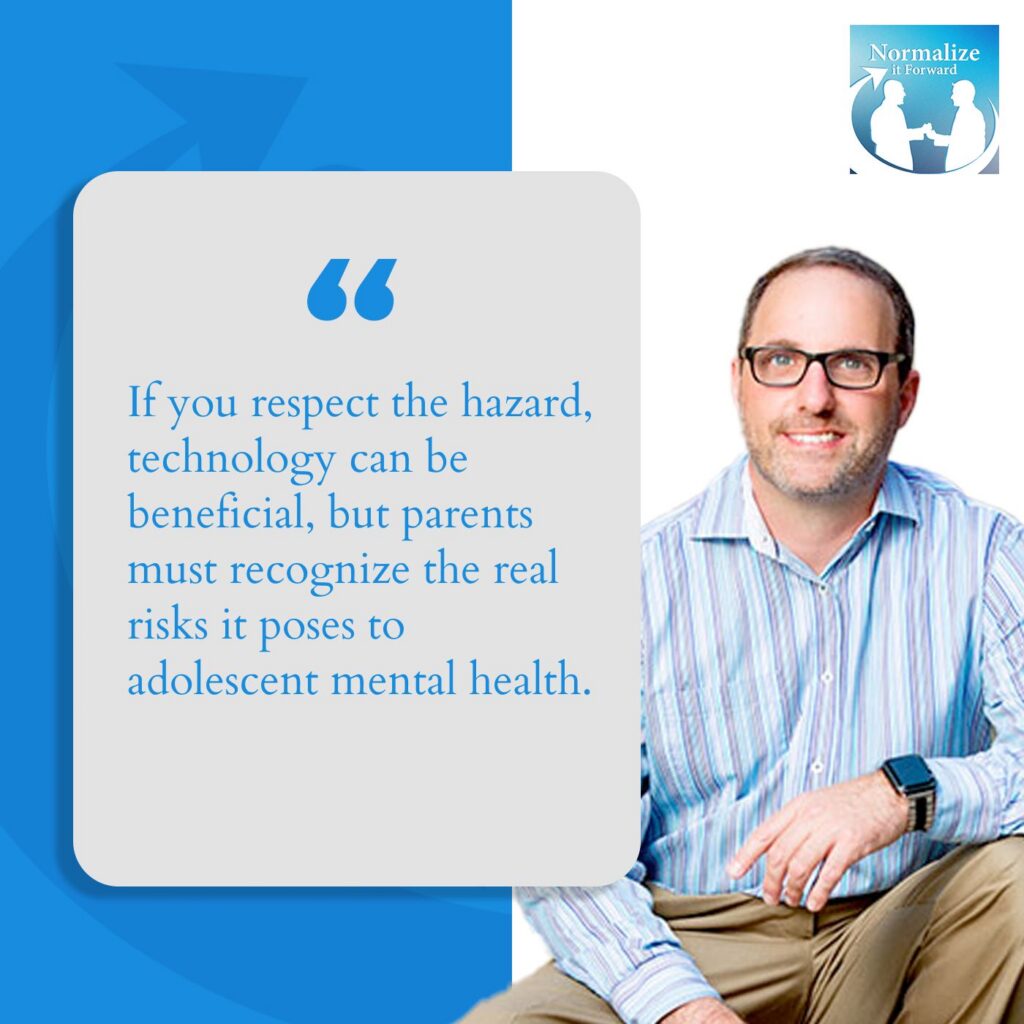
It’s like swimming in a swimming pool. If you respect the hazard, it can be so much fun. You have to respect the hazard and realize that there is a side to this that can be really detrimental if you’re not careful. To all parents, please heed our warnings, recognize that both Dr. and I treat patients on a regular basis, and we see kids with issues that develop as a result of all of these things.

We’re giving advice because we want parents to be able to walk away from this show, hearing this information, and using it and recognizing, “None of us are perfect. We’re parents as well. We’re working on these things with our own kids.” We’ve seen a lot in our offices, and we’ve seen a lot of things that do work, and being more involved and really recognizing there are some things you can do with tech, especially before you give your kids the technology, to lay that groundwork so that it does not run your world in a negative fashion.

Dr. P, as always, I am so happy to have you back on the show. For someone who was initially so nervous to be on, you’ve become a superstar on the show, and to those who haven’t seen your first show, please go back and rewatch it. It was awesome. We might have even discovered a third show while we were talking. Who knows? We’ll have to ponder that idea, and we’ll put our heads together. Thanks again for your time, your energy, and your experiences, super awesome and helpful. I appreciate you being here.

Thank you, Marc. I’m so grateful to be here.

Thanks again. I appreciate it. Have a great day. Talk to you soon. See you.

Bye now.


Important Links


About Dr. Mariela Podolski

Normalize It Forward - Marc Lehman | Dr. Mariela Podolski | Social Media Mental HealthDr. Podolski completed medical school at the Universidad de Costa Rica in San Jose, Costa Rica. As her first attending job, she worked as a general physician in a rural area in the south east corner of Costa Rica. Excellent clinical skills were a must, given the lack of resources in the area at the time. This experience strengthened her medical knowledge, and she still utilizes these lessons in her daily practice.

She pursued her Psychiatry Residency at the Institute of Living in Hartford, Connecticut. This was followed by a Child and Adolescent Psychiatry Fellowship at The Medical College of Wisconsin in Milwaukee, Wisconsin.

Dr. Podolski joined Eastern Connecticut Health Network after graduation, working in a Child and Adolescent Psychiatry Clinic in an underserved area from 2012 to 2015.

She has been working with Walden Behavioral Care, since 2012. Initially as a Consulting Psychiatrist for their Partial Hospital Program. In 2016, she assumed the role of Medical Director for their Inpatient Eating Disorders Unit at Rockville General Hospital. This role allowed her to expand her eating disorder knowledge, as she treated patients with extreme eating disorders that required specialized inpatient medical and psychiatric stabilization.

She continues to work hand in hand with Walden Behavioral Care as a consultant.

She has held academic appointments for the University of New England College of Osteopathic Medicine, and for the Quinnipiac University Frank H Netter School of Medicine.

Dr. Podolski is an active teacher and provides Eating Disorder lectures for psychiatry residents at The Institute of Living, University of Connecticut and for ECHN Family Practice Residency. She is frequently asked to present on the topic at different hospitals in the area.

She holds medical licenses in the states of Connecticut and Massachusetts.


Reading about mental health is hard. Let’s schedule a free consultation.


Normalize It Forward - Marc Lehman | Ben Gordon | Athlete Mental Health


Host Marc Lehman sits down with former NBA star and NCAA National Champion Ben Gordon to discuss the realities of athlete mental health and overcoming life transitions. Maintaining optimal athlete mental health requires honest conversations, intentional daily routines, and self-acceptance both on and off the court. Ben helped lead UConn to the 2004 National Championship before being selected third overall in the 2004 NBA Draft by the Chicago Bulls. In recent years, Ben has been open about his personal journey with mental health, using his experiences to advocate for greater awareness, understanding, and support. He candidly shares how early athletic mentorship shaped his perspective on the mental game, the challenges of navigating public pressure, and his shift toward holistic wellness practices like intermittent fasting and fascia stress therapy. Ben also offers crucial advice for young adults struggling in silence, emphasizing the power of self-surrender, intentional communication, and slowing down in a hyper-connected world. This powerful discussion highlights why true strength lies in accepting who you are and building a grounded foundation for lasting resilience.

Reading about mental health is hard. Let’s schedule a free consultation.

—

Watch the episode here


Listen to the podcast here


Navigating Mental Health, Growth, And Wellness Beyond Basketball With Ben Gordon

Welcome to the show, everybody. I am here to talk about mental health and wellness. I am joined by Ben Gordon of UConn and NBA fame. Ben, how are you?

I’m doing great, Marc. How are you doing, sir?

I’m good. I caught you right in the middle of a bite there. Ben is kind enough to join us and chat a little bit about mental health and wellness. Thanks for being here, Ben. I appreciate it. Ben is a former NBA star, NCAA national champion, and one of the most accomplished basketball players to come out of the University of Connecticut. Ben helped lead UConn to the 2004 National Championship before being selected third overall in the 2004 NBA draft by the Chicago Bulls.

During his eleven-year NBA career, he earned NBA Sixth Man of the Year honors as a rookie and became known as one of the league’s most dynamic scorers. In recent years, Ben’s been open about his personal journey with mental health, using his experiences to advocate for greater awareness, understanding, and support. He’s focused on helping others through wellness initiatives and by sharing his story to reduce stigma and encourage honest conversation about mental health and wellness. Ben, thank you so much for joining us. I really appreciate it.

That’s my pleasure anytime.


Normalize It Forward - Marc Lehman | Ben Gordon | Athlete Mental Health


As you can see, Ben is obviously into wellness. He is currently eating his watermelon and staying hydrated. I appreciate you doing that, Ben. Again, thanks for being here. I really appreciate it. I have to say, as a therapist, as a longtime Husky fan. One other thing before we jump in here. Ben, let me put this up.

What you got?

Let me put that up. You see that, Ben? That’s the shot.

It’s so far away. Bring it closer.

How’s that? Look at that. That’s the shot from that year, right?

The one we took to beat Duke.

Those of you who are listening who are UConn fans are well trained to dislike Duke, so that was quite a moment. Ben, you have created quite a few moments on the basketball court, and I want to talk to you a little bit about that. I want to talk to you a little bit today about wellness and young adults, and would love to get your opinions on things. Are you ready? I’m going to fire some questions at you.

I’m ready, man. Let’s go.

Ben, looking back, when did you first realize that your mental health really deserved as much attention as your physical health? What age?

Sixth grade.

At that time, what was going on for you?

I just joined the Boys and Girls Club in Mount Vernon. Where Lowes Moore was. I guess the director of the Boys and Girls Club. This was my first time, like, joining the club. It’s like YMCA, Boys and Girls Club type. This was my first experience with that as a kid. As a hooper, I remember I wanted these Olaf shirts. Anybody who’s from New York and grew up in the ‘90s, that Olaf was a store in Harlem where they had. These cool, like, basketball shirts. You would see all the guys, all the streetball players playing with them in Rucker and different tournaments and stuff. That’s where it started.

Lowes Moore, who was an alumnus of Mount Vernon High School. Also, had an NBA career. As I said, he was running the Boys and Girls Club, the programs and stuff. When I joined, I think pretty quickly he must have noticed something that stood out to him about me. We would have these conversations about development and skill training and the physical and mental aspects of the game of basketball.

Understanding the Mental Ninety Percent

That’s why I said sixth grade, because that was the first time I remember having a conversation with anybody about the mental side of the game. Lowes would always tell me how the game was like 90% mental and 10% physical. That was the thing that perplexed me right there as a kid was, wait, first of all, how is the game mental? Why is it such a big percentage mental as opposed to physical?

Sounds like he was a real mentor.

He was a real mentor, but he was also very cerebral. The way he would even ask you a question or tell you something, it made you just want to ponder on it a little bit more. I had actually had a conversation with him two days ago.

He’s remained in your world all this time.

Certain people in my life are like staples. Whether I talk to them every day or once a year, it’s still going to be the same type of vibe. Just because the things that we may have accomplished together were so polarizing. I share a lot of polarizing experiences with people.

Basketball taught me that performance is ninety percent mental. Taking care of your mind is the real key to lasting growth. Share on X

That makes sense.

It stands out to us. Remember this happened? I have a lot of moments like that where there are a lot of people, and then I hear people telling me all the time, “Man, you won me this. I won money with this.” I’m like, “There’s so many people that tell me they won money off me.” I’m like, “Nobody ever just came up and just offered me dinner. I’m like, “You’re making this money?

I have to say, I appreciate you making the time, Ben. If I’m ever in your neck of the woods, I’ll take you out to dinner. How about that?

I’m not too far, man. I’m not too far away. Be careful, I’ve been working up this appetite. That watermelon you told me to eat, that’s after fasting. That was just a little appetizer.

Tell me, I guess that leads me into like daily habits. Ben, you’ve been through a lot with basketball. Your career was very public and in the center stage in many ways, certainly in college and professionally. I guess I’m wondering, just shifting to like some of your daily habits, whether it be back then or even now that contribute to you being an athletic individual, what kind of daily habits do you incorporate?

I was eating a watermelon. I just cut off the end of a watermelon. My mom had a nice seeded watermelon, which seems like it’s hard to find these days.

It is.

It’s weird. I remember being a kid, and everything had seeds in it. Now if you even know that things are supposed to have seeds in them. There are probably some kids who do not even realize that this fruit has no seeds.

That’s true.

Just things like that. I would say I fast, intermittently fast a lot, just because I think growing up, I would just get up and like to eat. I had a schedule. Right now, I do not have a schedule as a retired person. My schedule depends on what things are going on in my life at the moment in time. That’s how I dictate my schedule. What’s going on in my life? Where am I at? What are my responsibilities at the time? Things like that. I have to compartmentalize things a lot. Because of my family situation, there are times when I might be by myself for a very long time.

Building Daily Rules Around Self Acceptance

I might have all my kids and be with all my other relatives and things like that. For me, something that’s helped me above and beyond is just one, accepting everything as is without trying to even fix anything. Just accepting myself for who I am. I do not think I did pretty good. I didn’t do that bad. After a while, I did pretty good. When you keep things, the more you make things simple, and you’re like, “How do I accept who I am? When I look in the mirror, do I accept who I am as a man?”

Everything in my agenda on a day-to-day basis just starts with that, is like, is it in line with who I see myself as a person? Meaning the things I am going to do for that day? Even down to eating, I am not going to get up and eat right away. To me, eating is something I have to build up to every day. This is just at this point in time, because you might catch me in the wintertime and I’m like, “Man, I just had the biggest breakfast with.”

It shifts and changes.

That’s the thing, it’s like there’s ebbs, and there’s different ebbs and flows in life. I’ve had to learn how to just be adaptable. A lot of people may not have to be learning how to be adaptable. Some people may not leave the site. I start off just intermittent fasting. It depends on my schedule. Like, “Am I going to work out that day? Am I going to train somebody that day? Am I going to stretch somebody that day?” It could vary. It might be a day where I do not have anything in the morning to do. I’m like, “This morning is just about me.” Starting my day off, getting off on the right foot.

Obviously, there are certain things I have to do every day, like errands. I’ve got to make sure my kids are eating. I have to make sure my bills are paid, whatever it is, whatever meetings may be, whatever updates I need to become privy to. There’s just certain things that are going to happen whether I want them to or not every day. I have to find a way to be an administrator to basically a multi-million-dollar or high net worth family office. I’m like the administrator because it’s my family, it’s my finances, my investments. That’s pretty much taking care of my life, my lifestyle.

That’s always out in the forefront, but a lot of those things become day-to-day things that are just. You can put things on autopay, and you can predict what your normal things are going to be. There are schedules with my kids. As I said, all that stuff depends. I would say my schedule depends. I’m truly retired. I’m not really a stay-at-home dad, because again, I’m a single father and I have three kids. My oldest son plays basketball, so I train him. I coached him.

Not like coaching him up like on a team or anything, but like if he has a game, I’ll go watch his game, and I’ll coach him up like just in the house. Talking to him about the game, the mental aspect, the mindset. Right out the bat. I understand very well the importance of mental health because I’ve struggled in that area. I’ve had to do things to bolster, not bolster, but I’ve had to do things and make changes in my life to make sure that when I feel myself having a bad day or what have you, that I’m able to just do my things, the routines that help me. It might be yoga.

Sounds like you have a number of different things on that list, Ben, things that you use to help you and remain stable. Let me ask you a little bit more about that, because I think you referenced passing along some of that information to your son, but also that’s information you’ve used over the years and gained over the years to remain strong. Let me ask you this. If a young person, let’s say a college student, is tuning in and they’re experiencing some of their own mental health difficulties. They’re telling everybody, “I’m fine,” because they just do not want to deal with it. What could they do? Any suggestions? What do you think?

Don't let your phone dictate your morning routine. Slow down and check in with yourself before you tap into the noise. Share on X

The first thing is they may really feel like they are fine. I feel like there are certain default answers that most young people give these days when you ask them, “How are you doing?” They all say, “Good. Okay. Fine.” That’s pretty much the baseline for how these kids are feeling. They’re just feeling like, “I’m good. Everything is so and so. It’s cool. It’s fine. It’s not a big deal.” I do not know how many times I’ve asked my child, like, “How are you doing? How was your day at school today?” He’s given me an elaborate answer. It’s a lot deeper than that. It’s not that hard. It’s not that easy these days to figure out how people are doing. Most people do not even know how they’re doing themselves because they’re not even taking the time to figure out how they’re doing.

Just slow down.

Breaking Free From Digital Automation

Everybody’s rushing. Everybody’s on their phone. I do not know how many people who used to wake up and like to kneel at the end of their bed and say a prayer at night and in the morning. I do not know how many people still do that because it’s a phone now. Before you can think about your spirituality or your mental health, it’s just easier to animate and just do this, something like that. It doesn’t require much thinking. What’s happening in that situation is, I feel like the parents these days have to be more emotionally intelligent. If I’m talking to my kid and every single day he gives me the same automated response, there’s something seriously wrong.

A parent who’s busy and doesn’t want to necessarily or doesn’t necessarily have the time to delve into something like, what does okay mean? I do not know what that means. I’ll just tell my son, “I do not know what this means.” Even though the word means one, it’s a deeper level. Like, “I do not know what insert hair stands for because it doesn’t feel like anything. It just feels like I had to say something. I said, “It’s okay.” As a robot almost. I do not know about people anymore. We lost the plot.

You’re accurate there in that lots of kids really avoid even thinking about how they’re doing. To be honest, so do adults on some level. If I’m hearing you right, one of the suggestions you’re making is to slow down and have some time for yourself.

I took my son to the airport. He has a trip planned with his mom, so I took him to the airport. A part of me was I do not want to just travel with him. He’s going to see his mom, but right now I have a swollen foot. What’s why I’m walking around, but I just wanted to just go somewhere else and just get some third treatment. It was at the last minute. We had talked about it a few days before, but he knew he was going to be gone.

I just forgot because I’m right now trying to help my foot. The couple of days when I had to walk with a cane, because there was so much inflammation and like my pinky toe, it felt like it was broken or whatever. Now I’m able to stand up. I’m moving around cause I’ve been soaking it, icing it, like just doing everything I can. It was a reminder when I got to the airport, and I was like talking to my son the whole time before the airport, all the way in the car ride, all the way to the airport.

I just find myself always trying to help him be better. I’m like, “I do not feel like he needs me to do that at this point.” That’s what I was thinking to myself when I was walking back to get a taxi or take an Uber or whatever. I was just like, because I feel like I’m having an issue with him now with communicating. Probably every parent in America whose kid has an iPhone or an Android is probably having the same issue.

I would agree. How old is he?

He’s fifteen, but I have the same issue with my 8-year-old and my 10-year-old. As far as this, like you’re trying to compete with a device that you pay for your kid’s attention for your kid. It’s very strange. It’s a strange dynamic.

Most parents understand, and it resonates with them. It’s something that parents are dealing with all the time now. Communication issues with their kids. Do kids, in fact, know how to have those conversations? When you say, “How are you doing?” Do they know how to go beyond the okay, or beyond the outline?

Great conversation is something that some of us face as yet, just because their brains are not fully developed. What does the average human do? Correct me if I’m wrong, but to have that brain develop in their 20s or like fully developed.

They are fully developed at 25.

At least I got you. At least that was what the number had in my mind. If you’re wrong, I guess we’re both wrong.

Ben, let me pivot for a minute and just ask. A lot of my listeners would want to know a bit about UConn, and you were on the UConn team in 2004 with Taliek Brown and Josh Boone, and who was on there? Help me. Charlie Villanueva?

Yes.

Obviously coached by the great Coach Calhoun. What was that like? Not too many people get to play for a legend like Coach Calhoun. What was that like for you?

It was a top-notch, first-class basketball experience. Everything you would expect more from a Hall of Fame coach. The thing that’s dope about the coach is he still checks on me. That’s something that’s very simple, but everybody does not do that.

That’s true.


Normalize It Forward - Marc Lehman | Ben Gordon | Athlete Mental Health


For someone like myself, I think because of my temperament, even if I do need someone’s help, people just look at me and be like, “He’s there, he got it.” My foot is swollen. People want to help me, but they do not know how to help.

Why is it so hard to help Ben Gordon?

Supporting the Strong People in Your Circle

I do not think you have to attach a name to it. Think about any of your strong friends that’s always there for other people. What happens when nobody’s there for that person who’s always there for everybody else? What happens when no one’s pointing to that person?

The great point.

The person starts to feel resentment for things that they naturally would want to do. When they feel drained and worn down and unappreciated, whatever they’re dealing with stress-wise, now that’s compounding an already difficult situation. It was hard for people to help me because they’ve always seen me as never needing help, seemingly. When I go through something, I’ve had people tell me, “This is watching a TV show.” Everything that we consume now is like a vicarious experience. It’s like through someone else.

Reclaiming Inner Peace Through Nature

We have to watch TV to see other humans doing stuff, or we just will not go outside and watch people doing stuff. I thought it was weird when I saw kids watching other kids play video games on TV. You can have your console on there, but they just want to watch someone else play. I guess that’s fun. It’s like an observation. Again, it’s a vicarious experience. It’s not them having a one-to-one experience with the person or the place or the thing or whatever it is. As you see, I’m conducting this interview outside in nature. I just think that’s the cure for everything right now, honestly.

Staying grounded.

It’s secure for everything. Like, “There’s a financial crisis, go back to nature.” “Finances, the market is doing great.” Good. Go back into nature so you can stay grounded, so you know what to do with all of this extra income, so you’re not doing things that are just frivolous. There’s a lot of illusionary and delusional people out here now. A large part of me, for me, addressing my mental health was just addressing the things that were illusionary in my life and my delusions of grandeur that at one point in time were what I needed to make it to that next step.

If I’m hearing you right, then it sounds like some of that was helpful. Some of that was really not helpful.

Designing a Career Around Personal Health

It becomes both. It’s just a spectrum. It’s the same thing that worked for me when I got into the league. I’m always just going to overwork, outwork everybody, and that’s going to get me my playing time, and I’m going to make shots in the fourth quarter. That’s when I was 21. At 43 now, I cannot. It’s not wise for me to do that. I’ve got to, like, recover more. I got to get more sleep. I got to drink more. I got a high, so it becomes more about how am I taking care of the overall machine? It was always about that. When you’re chasing something that’s great, you’re going to have a lot of nicks and bruises before you get to that finish line.

No doubt. I’m curious. How does having someone like Coach Calhoun in your world, in your corner, supporting you, checking in on you, how does that help?

It just reassures you like, “I’m still that dude. I was not that dude. Look at who’s calling me.” I was worrying about somebody who hasn’t done one percent of the things Coach Calhoun has done. He’s still there in my corner. Some people, when you do not hear from them, you expect it. It might be that they never wanted to, never were who you thought they were. They just showed you a facade because that’s what they needed to do at the time to make things comfortable for themselves. You just never know what someone’s worldview is. You do not know what their moral compass is. You do not know what day they’re having. You do not know if they’re balanced, hormonal, or you do not know a lot of things. We’re just taking everything at face value.

That’s a great point. I’m curious, are you still watching the Huskies?

Yes. I was at the final quarter too.

Nice. What are your thoughts, having played for a coach? What are your thoughts about Coach Hurley? He’s definitely a modern-day, different coach. What do you think?

I feel like he has a lot of similarities to Coach Calhoun. When I see the passion and the fiery energy, the enthusiasm, the moxie, the kahunas. It seems very familiar.

Very similar. Definitely have a winning mentality. What stands out to me about both of them is they really care about their players. I’m not just saying on the court. I feel like they both want their players to succeed in life.

That’s true.

I’m curious, while we’re on the topic of UConn, the 2004 national championship. Obviously there was a lot on camera. I’m wondering, what’s a moment from that year throughout UConn that fans never saw that meant a lot to Ben Gordon?

When anxiety hits or life feels overwhelming, step into nature and get grounded. Simple routines bring real clarity. Share on X

Have you ever seen the movie The Blair Witch Project?

Yes, sure.

When I was in school, my friends, my teammates, we always would have a Blair Witch at the time, is what we called it. That was just a camcorder. We would always record everything. Some guys would like to record certain things, like Shammond Williams was my roommate along with Emeka Okafor and like Scott Hazelton at one point in time. Williams was the type of guy that had his camcorder, and it’s like, about to go to the gym. I’m a film from here, like in the cafeteria. We walk over to the gym and get to the gym, and then somebody else that’s not playing probably takes over the recording.

He was ahead of his time then.

We would just do stuff like that every day. We have all this footage. We’re actually going to probably make a documentary out of it.

It’ll be fascinating.

Yes, it will be extremely fascinating. Obviously we have to have everybody approve certain scenes and things because it’s less like us in our candid moments in the locker room and the weight room, wherever we are. It’s great content. We’re in the age of that now where people want to see those types of stories and hear about them. I’ll keep you posted about that.

Sounds interesting. It sounds interesting. I’d like to see it then. You played against a lot of people. You were drafted by the Bulls. Remind me, Ben, where else did you play?

I played in Detroit for three years, Charlotte for two years, and then Orlando, my friend. Orlando, okay. I played in the G League, which is just like 25 games.

A lot of different people I would imagine over the years you played against. Who was one of the tougher players you played against?

Everybody was tough because we’re all at the highest level, but one of the toughest. Do you mean just like best overall? You mean like actual toughness, like.

You tell me one of the toughest guys you played against.

I’ll start with defensively, right? So when I think of like defenders, there’s like two or three guys that are just like pop right to the top of the file when I’m thinking about it. I got to go Ron Artest, Tony Allen, Bruce Bowen, and those three are the guys I remember like early in the league. Early in my career, like, “Damn, like Bruce Bowen.” He’s like 6’7″. I’m like 6’2″ or however tall he is. I had to play against guys that were specifically just long, lean athletes. That’s all they wanted to do was lock up.

There were so many great defenders. Any given night you could get locked up. Any given night, someone can go off for 50. That was the best thing. For me, like in the league, it is just like every night the possibilities are endless. Literally, you just saw someone last night had 40 or 50 or 10 dimes or a triple-double, or it’s always people striving to do something great.

As a kid, I remember Scott Burrell’s shot heard around the world, and I thought to myself, “Nothing like that will ever happen again.” Mullen hit the shot this year, but that’s athletics, that’s sports. That’s the fun of it. Ben, it sounds like since retiring, you’ve really blended wellness into your business. Tell us a little bit about what you do.

I have a website. It’s OOOEliteBasketballTraining.com. I got to talk to my web guy about it and see if he can just do OOO.com or something like that because OOO is like an umbrella and then underneath it is like everything that is lifestyle related. It’s basically a lifestyle offering. Honestly, a lot of the things that I’m doing that I’m transitioning into a business or putting myself out there. I do not necessarily need to be doing this. It’s more like a passion sort of thing. I created the website basically to address what would happen when I would be doing things for people just for the love of it.

The love of the game. What happens when you start getting drained, and you’re like, “I do not want to do this.” As I said, I do fascial stretch therapy. I’m a Level three therapist. There are only four. There are four levels. It’s just really giving myself something to do. When you do exactly what you want and what you were born to do, then you have to, you can survive. Everything is cool. You had fun. You traveled. I’m still only 43, and so it’s like, “What do you do now?”

“I got more to do.” Tell us what OOO stands for?

This stands for Of Our Own. It’s like there’s a sentence around it. You just pull that part out of the sentence. You can put things after it. Of Our Own Wellness. That was an LLC I had when I started my gym in 2017. It’s my wellness that I’m presenting to people who are inspired by me or are seeking me out or seeking something from me. It’s my offering to people. These are the things that the modalities that I’ve practiced throughout my life, the things I’ve learned on and off the court in regard to health and wellness.

Real progress starts with surrendering to what you can't change today. Give yourself grace and take small steps. Share on X

It’s something I want to share with people, but usually I do it just for friends and family. I’m like, “What happens when everybody is in pain?” The way my foot feels, if everybody in your household feels like that, now it’s not really for fun anymore. It’s like, “This is out of necessity.” Just like with the state of what’s happening from a mental health standpoint, I felt compelled to finish what I started. I like to continue the things that I started. As I said, I started this gym in like 2017, and I had it for like two years. If you remember all that COVID stuff around the gyms, it was all these restrictions.

It just wasn’t the right time. Now I do not have a brick-and-mortar gym, but there’s a lot of information up here. I know how to cope with myself out there without throwing myself out there. I can be a little more tactful. You’re not going to offer a virtual training session. There are only certain things where I might have to ask, like if someone wants to stretch, I have a network of therapists that want to get the lessons with me.

If I cannot get to a person in another state, I can refer them to someone. My business doesn’t have to be in a physical building anymore because a lot of stuff I’m doing is hands-on, or it’s consulting, or it’s advisory, or it might be virtual. There are all these different ways with technology where I can still spread health and wellness without compromising my own mental health.

I love it, Ben. There is a perspective out there on athletes that athletes do not have problems. Athletes cannot possibly have mental health issues. It isn’t until people like yourself get on shows like this and start talking about things that people start to realize people are people. You may have a better jump shot than me, Ben, but we put our pants on the same way every morning, and people are people.

Mental health is one of those things that, you said, you’ve accumulated a lot of knowledge and a lot of solutions and even a lot of good people around you that support you. To me, when I work with young adults going into college, they’re just starting their careers off early on, and they do not know some of these things. I really appreciate you sharing your perspective on this. I think you’ve been very open and honest about yourself and what you’ve been through and what you’re going through currently and how you’re helping people.

I appreciate that. I really do. Can I ask one last question of you, Ben? As you’re in the wellness space, you and I have talked a bunch, and I feel like one of the things that I’ve heard from you over and over again is that you’re constantly looking to grow and learn information. We’re this perpetual student and always trying to learn new ways to help not only yourself, but other people. I’m wondering, is there anything that you’ve been taught along the way, whether it’s the amazing coaches you’ve been working under, just people you’ve been around, getting attacked here.

I did not attack it. Just got to like, “I know. I just got to let them know.”

Is there any one piece of advice, like young adults and parents are tuning in, and I guess I’m wondering, is there any one piece of advice you’d like to offer that someone might have said to you when you were younger around management of mental health?

I would just say, like this, no man is an island. As soon as you start feeling like you’re drifting away mentally, and everybody knows what that feeling is like for them, just do not let it happen. Pull the reins in, and we do not all have therapists. We might not all know therapists, but we might not even know that some people in our lives are already our therapists. You just have to talk sometimes to somebody. That’s also dangerous, because there are people out there who manipulate people who are going through things. It’s like a slippery slope.

Find the right person.

Taking Small Daily Steps Toward Surrender

What I would say is the first thing for everybody is to try to accept something about yourself. Just one thing that day that you’re struggling, try to accept something about yourself that you didn’t accept the day before or that day. That’s easy, right? That’s just like, “I do not like how my feet look.” Maybe just start by looking in the mirror and making a joke about your feet to yourself. That’s it. That would be it for the day. What I found is that when I started to make steps in my journey, like real improvement, it started with accepting the things I couldn’t change. Now a lot of things could change.

At the moment when you’re so depressed that you cannot get out of bed, and in that moment, you cannot really change that. If you accept it like, “Man, I’m really depressed here. I really do not feel like getting out of bed.” “Let me accept it, man. I had a long, long year. Let me just stay in bed all day. Tomorrow I’m going to get up.” You’ve got to make these little goals and things for yourself while also showing yourself some grace. Just find one thing to accept about yourself that you maybe do not like, or maybe that other people do not like. Like, “Man, Ben has a hot temper.” As soon as I accept it, it’s like it’s a form of surrendering.

That’s great advice, man.

Once I surrender to the fact that I have a hot temper, now I’m able to look at myself outside of myself and say, “If you have a hot temper, that’s fine, but do not let people provoke you. Do not let yourself be around people who you know are going to trigger you.” Once I accept that I have a hot temper, now I can in good faith find things that’ll help me get better. The next day, if I didn’t procrastinate that day and pick one thing, then just do it the next day. I would just say slow down.

We’re in a society now where everybody wants to be gratified instantly. People do not even want to go outside and play anymore. They’re like, “Just turn the TV on. I can watch someone else play.” There’s been a lot of advancements in technology, but then there’s been a lot of de-evolution of humanity and learning how to live, learning how to just have a conversation with somebody.

I agree, Ben. Those are some really great pieces of advice. To those young people that are tuning in, really listen to what Ben had to say. Sometimes it starts with a daily step and that notion of, you were referencing the Serenity Prayer earlier. One of my favorites, just knowing the difference between what you can control and what you cannot. There’s a lot of stuff out there we cannot control, and finding a trusted resource, a person near you that you can open up to. That’s hard, especially hard for guys.

You’re absolutely right. I had a moment when I was taking my son to the airport because in my mind, I was like, “I’m just going with them.” My foot is swollen. There’s pain there. Really, I’m supposed to have my foot elevated because I have been doing my modalities the last few days. I’ve been soaking, I’ve been icing. The fact of the matter is the inflammation in my body is just going to take its natural way to wake itself up. I cannot poke a hole and then let everything pop out. It’s like, “No, it’s there to protect whatever has been bruised or infected or whatever. It’s going to take its time.”

Even if I’m icing it every day, it still might take till day seven for it to go down. It’s not a compound interest thing. We cannot be so quick to want everything right away. It’s like, “No, the beauty in life is the journey. This conversation, when we started, I was over there in the garden. I was over there, then I went through the kitchen. At the fort, I do not have to meet on the floor. I have the remnants of what I did. I made a full circle. Now I’m back here, and I’m looking at the garden from here. It’s like, that’s how life is.

You go around the block. It’s not going to be your first rodeo. You’re going to hear all these cliché terms. When you just realize, when you get to a certain age in life, you want to almost slow down a little bit. You realize how fast you’ve been going. I would say to young people out there and young parents, one, let’s all just today, let’s just start working on our communication. Every single one of us, we all need to get better at communicating.


Normalize It Forward - Marc Lehman | Ben Gordon | Athlete Mental Health


If you’re a great communicator, you need to take it a step further and help people articulate what they cannot communicate. Some people internalize things, and they cannot get it out. If you’re a poor communicator, go find a pretty girl and just say, “How are you doing? What are you reading?” Nothing has to come out of it. It could be completely platonic, and I do that sometimes. I’ll go to the gym, and I just see an old woman, a young woman, a kid, whatever. I’ll just talk to them.

I teach kids how to do that, believe it or not. It’s one of those things, Ben, that I think when we were younger, we learned how to do it because we were playing outside all the time. It’s not necessarily natural for young adults nowadays. Ben, listen, I have to say thank you so much for just taking the time, giving us your energy, your thoughts. It’s really fascinating. I feel like I could talk to you all day. I do want to continue to help you get your business off the ground and assist you in some fashion.

Just know that I’m here for that and can help in any way you’d like. It’s really been a pleasure talking to you. You and I have talked a little bit around Normalize It Forward and the concept of, we’re trying to bring the stigma down so people can talk about these important topics. I’d asked you offline for a recommendation or a nomination of somebody, and no surprise to me, you nominated Coach Calhoun.

We’re going to try to get Coach on and see if we can nudge him a little bit so we can pick his brain a little bit on this topic. It’s always good to talk to various people and get their opinions and thoughts. Once again, Ben, I really thank you a lot. I will make sure to get all of your contact information up on this so that when this show does come out live, everybody can reach you and find a way to connect with you on your website. How’s that sound?

Sounds good, man. I would like to upload it onto my website too. As we spoke about, a lot of what I’m doing is based on training, and we want to make it to the NBA. We want to be in the Hall of Fame. We want to win championships. If you look at what I’m doing, it’s for the full athlete, like the full gestation of the athlete from birth to retirement.

It’s a life cycle.

I want you guys to go through and just take your time, click on one tab a day, and just read everything. There’s a lot of information that’s on purpose because that’s what I’m basically covering. It’s my entire life, everything I’ve ever learned, everything I’ve been through, everything that I’m currently going through. It’s like a past, present, and future type of accumulation of everything I got going. If people want to come and click a button and select the à la carte menu, I want to like what we just did. There might be someone who is just right. I’m not a therapist, but I have so many hours of doing my own therapy that I know I understand.

Get a background.

There are a lot of different things. My website is still a work in progress as well, so I’m not rushing. I want people to be patient with me just as I’m being patient with myself and everyone else.

I appreciate it. The thing that stands out to me, then, in looking at it closely over the last few weeks is your total honesty. You’re sharing information that you picked up, and it’s not filtered, which is great. I admire that. I admire your ability to want to assist and want to help. Keep doing what you’re doing, Ben. I’m cheering you on from out on the East Coast here. As I said, next time we’re in the same neck of the woods, lunch.

I’m actually in New York right now. When you asked me earlier where I was, I thought you meant like living most of the time. I’m in New York with family and friends. I’m actually going to be in Connecticut for a golfing outing, the Legends Golfing Outing this weekend. Hopefully my foot will not be swollen, and I will not be limping around up there.

That would be great. That would be great. We should connect then. That would be awesome.

I tricked you, man. I told you I’m hungry, man.

A meal’s a meal. Where’s the Legends tournament? Where’s that being played?

I can send you the information offline, but if I’m not mistaken, I believe it’s at UConn or somewhere. It’s probably going to be in Storrs. It’s a flyer, and it’s just something I think I posted on my page. When I get off of here, I’ll take a look.

Send me the info. Thanks again, Ben. I really appreciate it. We’ll talk soon. Have a great day.

Thank you, too. Peace.


Important Links


About Ben Gordon

Normalize It Forward - Marc Lehman | Ben Gordon | Athlete Mental HealthToday’s guest is Ben Gordon—former NBA star, NCAA National Champion, and one of the most accomplished basketball players to come out of the University of Connecticut.

Ben helped lead UConn to the 2004 National Championship before being selected third overall in the 2004 NBA Draft by the Chicago Bulls. During his 11-year NBA career, he earned NBA Sixth Man of the Year honors as a rookie and became known as one of the league’s most dynamic scorers.

In recent years, Ben has been open about his personal journey with mental health, using his experiences to advocate for greater awareness, understanding, and support. Today, he’s focused on helping others through wellness initiatives and by sharing his story to reduce stigma and encourage honest conversations about mental health.


Reading about mental health is hard. Let’s schedule a free consultation.


Normalize It Forward - Marc Lehman | Russell DeRosa | College Student Routine


Establishing a solid College Student Routine is essential for navigating the overwhelming pressures of higher education and performance. Licensed Marriage and Family Therapist Marc Lehman welcomes Boston College Strength and Conditioning Coach Russell DeRosa to discuss how structure builds long-term mental and physical resilience. Russell DeRosa shares his twenty-four years of experience training elite athletes, revealing why daily habits reduce anxiety during high-stakes transitions. The conversation explores how both athletes and non-athletes can manage uncharted academic waters by taking personal ownership of their time. By replacing chaos with intentional habits, young adults learn to face adversity on campus without becoming overwhelmed. Parents and students alike will gain practical insight on shifting from passive survival to proactive growth.

Reading about mental health is hard. Let’s schedule a free consultation.

—

Watch the episode here


Listen to the podcast here


Building Athlete Resilience Through Daily Routine And Discipline With Russell DeRosa

Finding Balance Through Routine

Welcome to the show, everybody. I am super excited to welcome into the show, Russell DeRosa. Russ, how are you?

Very good. Thank you very much for having me.

Thank you for being here. I really appreciate it. Russ is in his 24th season as a strength and conditioning coach for men’s ice hockey at Boston College. In addition to his responsibilities through hockey, Russ is in his eighteenth season in charge of strength and conditioning efforts for all of BC’s Olympic sports. Prior to his promotion in 2007, he had served five seasons as an assistant strength and conditioning coach on the Heights.

DeRosa has worked with more than 50 BC players who have been selected in the NHL draft, including 22 first-round picks. Since his arrival, more than 55 players have gone on to compete in the NHL. That’s impressive, Russ. DeRosa joined the BC strength and conditioning staff after spending seven years in the mid-90s at Yale University, the last five as assistant director of sports conditioning.

In that position, he oversaw the strength and conditioning for 32 intercollegiate sports programs. DeRosa received his bachelor’s degree in health and fitness from Springfield College and earned a master’s degree in exercise science with an emphasis on exercise physiology from Southern Connecticut State University in 2001. DeRosa is currently a member of the National Strength and Conditioning Association. Russ, welcome.


Normalize It Forward - Marc Lehman | Russell DeRosa | College Student Routine


Thank you. As I said, I’m really excited to be on your show and looking forward to the conversation.

As am I. I got so many questions for you about what you’ve done and where you’ve been. I guess I want to jump in and just mention that I’ve been on my own health and wellness journey, I would say, for a consistent two years now. I know that so often I talk about with patients, with students, that I work with wellness and where that fits into balance and just overall health. You’re an expert in the field. Let me ask. Strength and conditioning, where does that play into balance and happiness overall?

One of the big roles that strength and conditioning plays is not only the ability to stay healthy, but when you’re coming in, and you’re on a structured program, and you have consistency, it develops a routine. Routine with the training, and obviously what you do is, whether it’s weightlifting along with cardio, that’s going to keep you healthy. Having a routine and being consistent, I think in the long run really helps to develop you more both physically and mentally.

This gives you that opportunity now to know that you have structure in your life, and that as you go through and you progress through the program that you’re doing, not only are you building in some opportunities to get better both physically with your strength, but also mentally. Knowing that you have this routine set up can help you to develop through all the other stuff that you face and the adversity that you face through everyday challenges.

I couldn’t agree more. The word routine is such a healthy word. I guess I’m wondering, because you see a lot of athletes and I see a lot of both athletes and non-athletes, how would you say a routine looks specifically for a college kid?

The Structured Day Of A Student Athlete

A lot of them, going through the course of the day, especially here at Boston College, you do have to go to school here. You’re going to your classes, you’re meeting with professors. On top of that, a typical day will work out at six in the morning. Most of the guys and women are in at about 5:30 in the morning, going to the training room, doing whatever they need to do to prepare before the workout. They’ll come in and will work out from six to seven in the morning. They’ll have their breakfast, they’ll do whatever rehab work they need to do with the athletic trainers and whatnot.

They go to class, and then they’re back in here usually by 1:30 or 2:00, and they do their pre-practice warmup. They go to 2:30, and it will be a team meeting. They do video, and then they come back, and we’ll do another warmup before they jump on the ice. They go out, they practice, they come back in the weight room afterwards. They’ll get their supplements, they’ll work on their flexibility, work on their mobility, work on any type of issues they may have had in the past, trying to prevent that for this season coming up.

They might have class at night again, or they have to go over and go to study hall. Especially our freshmen, they have to go through that through the study hall and stuff. Their day is really planned out. Especially once you get in season, a lot of the, it’s an old reference to a movie, but Groundhog Day. Doing that same routine day in and day out. What we find, and what I found as a coach, is that they need that routine and they need that structure.

Not only because it allows them to continue to get better, but what they do is they get a sense of comfort, and they know that, “I need to be here at this time. This is what I’m doing. This is when I could fit in some extra work with Russ, or this is when I could fit in some extra work with our learning resource center or whatnot,” and allows them to really plan their days, their weeks, their months.

It’s great. It sounds highly structured, and it sounds like there isn’t much wiggle room to sway. I guess I’m wondering, the non-athlete, from your perspective, who’s coming to school this fall. I find that so many freshmen coming in have a vision of what school will be like, and then they get there, and it’s a little bit different. It can be overwhelming, but I like the word you use. Routine.

Consistency builds confidence. Having a daily routine creates the mental and physical structure needed to handle life's challenges. Share on X

For so many kids, not only having a routine of when they get up, what they do after they get up, having breakfast, going to class, having some time to work out or some format of fitness, having that routine can be, I think, a lifesaver for so many kids. Can I push you on the topic for a minute? We’re on the same page with this. Why do you think that is, that routine? Why is that such a big deal?

Navigating Freedom In Uncharted Waters

The reason is that they are young and they have experience. Now all of a sudden you’re in uncharted waters. I’ll use my son as an example. He’s 21 years old. He’s going into his senior year at American University. As a freshman, he went to a really structured prep school for high school, and all of a sudden you’re in college, and it’s a Monday, and you only have one class, and your first class is at 2:00. Now, no one’s telling you to get up, eat breakfast. No one’s telling you to make sure you get lunch in. No one’s telling you to prepare for your class or anything like that.

Just watching him go through that and trying to help guide him through that a little bit, he realized that and he said, “All of a sudden, I felt like to have all this time, I felt like I was less prepared for my classes, less before what was in store for me that day, because one day I’m waking up at nine in the morning, another day I’m waking up at 11.” Freshmen coming in, even though you’re not playing the sport, it’s going to be a whole different situation. We have some athletes where they only have night classes. Once again, maybe their freshman year, they had classes in the morning or whatnot.

Every year, even though it’s structured in this routine, it changes, and they have to be able to adapt to that. Once you get all that freedom, that’s where you either learn to put yourself on a routine, or you have to seek help for someone to help you build that structure and that routine. This is true for whether you’re in college, whether you go to your first job or whatnot, people who I felt that I’ve met in my life and that I’ve worked with, people that had routine, people that have structure are usually people that can handle a lot of adversity in different situations because it doesn’t become a panic situation because all of a sudden all this stuff is being thrown at them.

A lot of our male and female hockey players have open ice during the day. Once you go out there and have a plan, make your own plan, “I want to work on skating backwards. I want to work on my wrist shot and I want to work on transitioning from one end of the ice to the other end of the ice as if it was a game scenario,” tend to develop better than the ones who go out there with a bucket of pucks and just try to wing it.

Coaches can help them with the structure, but the ones who really already go out there, already have that feeling, already know about that structure, and then some of them, they’re at the point where they’ll even take notes on their own, “I felt I did this. I feel I need to work on this. I got to talk to the coach about that,” they’re at another level. In a roundabout way, just getting back to the regular student going there, the more they can have an idea of what they want to do, what they want to accomplish. That’s the other thing. I think it’s tough.

A seventeen-year-old student who, for your whole life, you’ve been going to class every single day, Monday through Friday, and class starts at whatever, 7:30, 8:00, and you leave school at 2:00, and you’ve had a person telling you, “Go to this class, go here, go there.” It’s tough because, especially depending on the campus you’re on, BC’s campus is not a huge campus, but you still have different parts of the campus you have to figure out where your class is.

Even that alone, if you’re going to a place that’s a big campus, we travel, you go to UConn, you go to UMass, those places are massive. Those campuses are vast. That could kind of lessen some of the anxiety of being a freshman. Fortunately for an athlete, that’s already put in place for you. That’s where someone who’s not playing sports anymore could really benefit themselves by creating their own structure or at least having a plan.

It’s a great idea. I hear in my field, there are trends you hear lately. In the last couple of years, I’ve heard a lot of people talking about treating school like you have a nine-to-five job. I want to point out to the kids that are tuning in, and even to the parents that are tuning in, you’ve got two individuals that are professionals in their fields talking here today with over 50 years of experience. Both of us strongly feel like that routine is a game changer for many kids.

Those kids that are coming to school and they’ve got their five classes scheduled, but they do not know anything else that they’re doing, it may be helpful for parents to have that conversation. I have it in my office all the time with kids to say, “You have a nine, you have a 10. Well, what are you going to do after that 10:00? You’re done for the day.” What do you do because you’re going to have kids that are going to go back to the room, they’re going to take a four-hour nap, or they’re going to go and poop pot.

Sudden freedom without structure leads to overwhelm. Building your own routine early prevents academic burnout. Share on X

They’re going to do all sorts of things. You have got to decide what you want to do and what is part of your routine. Healthy eating, exercise, to me, is just a given. You have to consider that because you’re definitely going to feel better if you do that. I like what you said a lot about athletes. For my non-athletes that are listening, I think it’s helpful for them to understand why there’s such a structure with athletes and why coaches do that. Without that structure, athletes probably would not get done what they need to get done, right?

A hundred percent. The academics here are very demanding. If you let one thing slide, now all of a sudden that does affect. “I slept through class. I did not do this.” The problem is now you’re a couple of weeks behind academically. That affects you on the ice. I do not care what anyone says, because in your head, you’re thinking about, “I got to get off here. I should have read these chapters. I didn’t read them. I have a test coming up now.”

Staying Locked In Where Your Feet Are

Now, all of a sudden, where you should be able to focus, we want them when they come, and they walk into the locker room, or they walk into the weight room, your whole focus should be on practice, should be to be present. One of our coaches, our former coach here, Jerry York, who was a long-time coach, would kill me for saying this, but a legend in college hockey. He would have one of the players come up in front of the team and read the book, The Precious Present, and was constantly talking about being where your feet are and making sure that you’re locked into that.

You’re sitting in a classroom. You shouldn’t be thinking about what you’re going to do on the power play. You should be thinking about what’s going on. All these things that you do and that these kids go through at a young age really are lessons that they take on for the rest of their lives. You go play in the NHL, or you’re playing in the AHL or whatnot, or you’re going to work for a Fortune 500 business. These are all lessons and recipes for success that a lot of them do not understand that they’re getting while they’re here now, but as they come back, they really realize it.

Once again, that’s where I feel like it’s tough. 17 or 18 years old, you’re trying to handle all this hockey, and you’ve got your goals with hockey and then you’ve got your goals academically. It can really become tough to have those people around you to guide. Coach York retired, and Coach Brown has taken over and has done a phenomenal job in that culture and educating the young players on how to stay structured and how to really take care of the business you need to take care of that’s right in front of you.

It’s very well said, Russ. It’s funny, I feel like, to be fair, I’d probably think this as well at seventeen, but it reminds me of when a kid gets their driver’s license, and they look at the parent as though they’ve been driving for 30 years, like, “I got this, I’m good, I got it.” At my age, I’m still learning, you know what I mean? Freshmen in college get to campus, and they’re like, “I’m the exception. I do not need to do this, I do not need structure, I do not need routine, I got this.”

I guess I’m curious to ask because I deal with mental health so much, and I see the anxiety levels and the depressive levels with kids in particular in college, unfortunately, are really high. I guess I just wanted to ask from your perspective, beyond routine, what can kids do when they get to campus to avoid some of those pitfalls?

Building Resilience Through Campus Involvement

I truly feel getting to campus and then going to meet with your advisor, going to meet with professors, even if you’re not having trouble in a class or whatnot, going to their office hours and just really getting to know the professor that’s teaching you, being a part of campus, I think, plays a huge role.

Tell us more about that, because I agree.

I’ll give you an example. When I was at Yale, and I was coaching there in the ‘90s, I would speak to just as many pro scouts for whatever sport it was as I would to recruiters that were working for Goldman Sachs, working for these top 500 Fortune investment banking companies. I said to them, “How come you guys are so into our athletes?” The athletes here at BC and at Yale, they’re both very intelligent. What he would say, or she would say, is, “We can go out and get the person who’s been on campus.”


Normalize It Forward - Marc Lehman | Russell DeRosa | College Student Routine


All of a sudden gets that 4.0, perfect student and all that, but they showed up freshman year and basically were either in the dorm or in the library. You got the athlete, or you got a person that’s been involved with campus throughout the four years and has that academic background, is smart, but can handle adversity. That was the biggest thing that they liked about athletes. The fact that if you go and you lose a game or you have a bad play or a bad shift or something like that, you can move on. If you’re an investment banker, believe me, I do not claim to know about investment banking.

Neither do I.

You lost a lot of money or had a bad investment. That did not end you. That did not break you. You were able to figure out how to get past that, move on, and then continue, “How do I become more successful?” Whereas the other person who is very smart cannot handle that because they haven’t experienced it.

It’s a great point.

Whether you’re playing a sport on campus or you’re doing intramurals, or you’re going in, you’re just getting involved with a club, it’s going to teach you things that you’re not going to get in the classroom. I feel like the more you could be part of this campus, the more you could really get into, we are a Jesuit school. There is opportunity if you’re into religion and whatnot to really get involved with that.

The message that they have, if that’s something that you really enjoy, you can get involved that way. I truly feel that once you become part of the campus that you’re on, the comfort level becomes much higher. You do not have that situation of, “I can still go and be involved with this club or whatnot, which is also going to help you create structure.” It’s not that, “I feel like it’s me against the school.”

A great point.

Did I answer your question?

It does. It’s a great point. It’s a great suggestion for all incoming students, and a lot of schools are going to these activities fairs the first week or two of school. I always encourage students. I’m like, “Go check it out.” There are booths and clubs for everything. The involved student oftentimes has a better experience. What you just said about recruiting agencies and businesses and even athletic organizations is really accurate, and I think really important for students to hear that adversity happens. It’s part of the process, part of the journey.

My question is not, will it happen? My question is, what will you do about it when it does? As you said, I find myself saying this all the time. College teaches you a lot of things outside of the classroom. Some of those life things. Those are things that students take with them far past college itself. I will say, I think the typical student that underestimates, you were talking about the rigor at BC, underestimates the rigor of college can get behind rather quickly. I find that these things have created poor social skills for some kids. Even the commentary of going back and seeing your teacher or connecting with an advisor, all that stuff can be really challenging for kids.

Failure is part of the growth process. Getting involved on campus teaches resilience that classrooms cannot replicate. Share on X

I would say that from my perspective, they have got to figure out a way to do it anyway, whether it’s connecting via email, trying to find people. Professors that maybe are not as scary to them that they can connect with, whether it’s a TA or a particular personality type. I would say that, for students, in my opinion, students get behind academically. It can be a week or two. Before they know it, they’re now experiencing symptoms of anxiety, symptoms of depression when they’ve never experienced them before. I’m curious about your thoughts on that.

A hundred percent. What happens is that thing creeps into everything. That creeps into their social life. They have become more reserved, and as I said here, not only are we competitive athletically, but academically, this is a very competitive school. You get involved in a classroom, and you’re one of those kids who normally, “Coming from my high school, I was one of the top two percent.” All of a sudden you’re here, and you’re like, “I got a C for the first time.” I’ve been in this classroom, and these kids are. Some of these other students are answering these questions, and I did not know the answer to this.

Moving Beyond Parental Fixes

It just becomes that uncharted water. I know it becomes a little controversial, but I think parents have to do a better job of saying, you can give them guidance, but you cannot go fix it for them. You cannot be the one calling the professor. You cannot be the one calling the coach, anything like that. I got to say to my son, Andrew, “You’re struggling with this class. You need to go talk to this person. You need to go see if you could set up a time to meet with them and go over there and do that.” The fact of the matter is, like we just talked about, this is one of those learning situations outside the classroom. They need to go do that. You’re right.

A lot of them are so used to, “Mom or dad handled this for me.” Now this is where you have to go do that. Just the mental aspect of this and stuff, I think it’s great that there is so much more awareness. Along with that, I feel like it’s also been used almost as a handicap for the person involved. Whereas there are situations where wholeheartedly, 100%, we need to take care of. Just like in this is how it ties back into training. You have got to know the difference between what I’m doing when I’m working out hurting me, or is that just soreness?

Can I work through this? Is this something that’s really negative that’s setting me back and whatnot? Not to jump around on you here. That’s where I feel like a lot of what needs to be done has to be done by the student themselves. Outside of something really tragic or anything like that, I do feel like going and handling those situations is going to not only make them mature mentally, but also give them the tools they need to succeed once they leave here.

I agree. I have a couple of thoughts. I just want to call out, mean, you and I are also parents, and I think for parents, it’s hard. If you’ve got a kid at school and they’re away from home and they’re struggling to be able to guide them, rather than fix it is really hard because I think there’s that instinct for a lot of parents to just say, I could make this better. I do not think you’re teaching at that point. I think you’re fixing and solving. For students, it’s interesting, Russ. I agree with you on the concept that students really need.

Pushing Past Uncomfortable Boundaries

There are things they need to be able to do to be able to make life better. For example, if students are in a pattern where they’re missing class, they have to find some solutions, like get an alarm clock to get up early, create a new structure for yourself, try something new if what you’re doing is not working. A lot of kids I talk to, it’s amazing. They do not know what to do. They do not know what to try. They’re like a blank slate. I’ll have a kid come in, I’ll do an evaluation on them, they’re having this problem and that problem, and I start brainstorming ideas. It’s pretty common that I’ll have a kid look at me and say, “I have no clue as to where to turn. I have no idea how to fix this.”

I get into the whole concept of, like, what we’re going to do is probably going to be a little uncomfortable and may feel a little out of the box. That’s where the solution lies. A lot of kids are just looking in that comfort box. They’re not looking. To your point about lifting, there’s a difference between your aching muscles because you’re getting a good workout versus “I just hurt myself. I just went too far.” For kids, a lot of it is discussion with parents, discussion with allies in terms of coaches and staff on campus that they can set up for themselves.

The one thing I’ll just say overall, and I’m guessing you’d agree with me, Russ, is students need that support. When they get to college, I think most students are like, “I’ll just do it the exact same way I did in high school.” They find out that it does not work very well. College life is so different. Even the concept of what you said before. You said it brilliantly, to the all-star kid who gets into BC. They’ve always been the smartest kid in the room. Now there’s a lot of, I’m not even going to use me, because I was not that kid, but there’s a lot of Johns.

You’re sitting in a classroom with like 13 or 20 or 30 other kids that are just as smart as you. Now what? Now what do you do, right? There’s a lot to it. Quite frankly, the transition should not be underestimated. I love what you guys are doing at BC. I have to say, I mean, the one word that kept popping out to me as I heard you describing it is that there’s so much support. There’s so much support and structure.

Growth begins outside your comfort zone. Embrace the discomfort to unlock your true potential. Share on X

The funny thing is that our guys and women that go on to play pro hockey, they come back. They realized how much they had here that even at that level at the NHL or the PWHL, they got a lot of great stuff there, but they do not have that person. When practice is over, usually at those levels, everyone goes on. It’s a job. Here, they have access to whether you’re having trouble with academics. You have trainers here all the time. Something with that, myself, strength coaches, they come in.

We’re pretty much here from six in the morning to seven at night, plus on the weekends and whatnot. Those are things that they did not realize. Their whole support system here, both physically, mentally, and spiritually here at Boston College, played such a huge role in supporting them for their success, whether it be on the ice or in the classroom. That’s something that I give credit to our coaches here at Boston College. They do a phenomenal job of not only recruiting talented athletes, but also great character kids.

That’s great.

They’ve already had that foundation. Most of our athletes are just good people. You can build off of that and try to get them to understand, “This is the next step.” I do not work with a lot of non-athletes. I do not work with them at all, I should say. I see them around campus, and I see what they do in the community and all that. They already have that foundation. I think, as you talked about, they need to then find out who I continue to seek out and then lead me down that path to develop more and more, both as a student and as a person. They’re definitely here at Boston College, whether you’re an athlete or not an athlete.

There are opportunities everywhere for you. That’s where, as you said, they have got to take that leap of faith and “I’ve never done this before, get out of my comfort zone.” We always talk about that with our athletes, even just when we’re playing, “We were out running before this, had a dry land training session for our men’s and women’s ice hockey team there.” We’re always talking about it. You have got to be able to work outside your comfort zone here.

You have got to make sure that you’re continuing to accelerate, decelerate, and whatnot. That just carries over into everyday life. This is uncomfortable for me. It’s something I definitely have to do. Much like you said that you were not one of the top academics, neither was I. I know when I was transitioning from my undergrad to my grad, and our mutual friend there, Matt, can attest to this because I was going to grad school at night while he was there.

That was really uncomfortable for me, and trying to get that next level of academic success. You’re right. I fell into it myself. I was not sure who I should talk to about this. Who do I make sure I can continue to get this success and whatnot? It took me a little while, because I went back for my master’s degree two years after I finished my undergrad. You get back into that routine, plus coaching all day plus classes at night.

It’s exhausting.

Trying to get back in there. I remember taking it now with the kids. They laughed at me, but we had a notebook and everything. Everything here now is off of iPads and laptops and all that. I remember taking notes, and I was writing down everything the professor said. I was not in that routine anymore of being able to pick out what’s important, what’s not important, and all that.

Routine’s huge. I would just summarize because I want the kids tuning in to hear this. Getting involved is huge. I believe there’s support on every campus. You guys are doing a fantastic job with your athletes and your hockey program in particular. I hear these stories often from campus to campus. The fruit is there for picking for kids. They just have to reach out and get involved. As you said, even if it’s a little uncomfortable, I think there’s growth there in trying something new. Look, I really appreciate you spending time with us, Russ.


Normalize It Forward - Marc Lehman | Russell DeRosa | College Student Routine


I know you’re super busy. I have to say you are a super dedicated individual. You’re spending long hours with these kids and obviously having lots of success, and most importantly, helping kids really enjoy a sport that I’m sure you really enjoy quite a bit as well. That’s fantastic. I appreciate you spending time with us. One last question for you, as I mentioned before. Normalize It Forward, I set up a couple of years ago, more along the lines of getting kids and parents to understand how important it is to talk about mental health and wellness.

Really, that concept of, even if you’re that kid who’s never experienced it, you may experience it in ways that surprise you a little bit, especially in college for all the reasons we’ve talked about. In order to keep the conversation moving forward, I typically will ask my guest. Do you have a friend? Do you have a coworker? Do you have a relative? Do you have somebody that you know that you think would be good for me to maybe interview next? Any thoughts, Russ?

I do have to say, we have a team priest, Father Tony Penna. What Father Penna does, Father Penna and I, when we’re on the road, we travel together, so we usually drive to the games. Not only is he a good friend, but he’s really become a part of my family. He does a phenomenal job. It doesn’t matter what religion you are. He’s able to bring everyone together, bring them in. I also feel like he does a great job for the campus because he does his role. He does work with non-athletes also. He is definitely one of those people that I always talk to about seeking out and being able to look for guidance and whatnot.

He plays a huge role with our team and really makes it a comfortable situation, whether the athletes have to talk to and meet with him. They set up meeting times on their own. It’s not mandatory. The whole team does it. They could talk about anything and everything under the sun, whether it’s religion, whether it’s hockey, whether it’s, “How do I handle this? What you’re feeling on that.” He’s very down to earth, and I think he would be a great guest.

Thank you so much for nominating him. I’ll get the contact info from you offline if it’s okay. I appreciate you bringing his name up. Honestly, as you were talking, I was thinking, “I talk about mentors all the time,” and I feel like kids are lucky in high school and college to get a couple. You’ve had a couple of people that you and Father Tony are definitely two, I think, that stand out to me as kids would be lucky to have in their world. Russ, I appreciate all you do and really do. Again, your dedication is admirable. Thank you so much for your time, your energy, your thoughts. Have a fantastic rest of your day.

Marc, thank you very much. I really appreciate it. It was great speaking with you.

It’s great talking to you too. Take care, Russ. All the best.

Bye.

Bye-bye.


Important Links


About Russell DeRosa

Normalize It Forward - Marc Lehman | Russell DeRosa | College Student RoutineRuss DeRosa is in his 24th season as the strength and conditioning coach for Men’s Ice Hockey at BC. In addition to his hockey responsibilities, DeRosa is in his 18th season in charge of strength and conditioning efforts for all of BC’s Olympic sports.

Prior to his promotion in 2007, he had served five seasons as an assistant strength and conditioning coach on the Heights.

DeRosa has worked with more than 50 BC players who have been selected in the NHL Draft, including 22 first round picks. Since his arrival, more than 55 players have gone on to compete in the NHL.

DeRosa joined the Boston College strength and conditioning staff after spending seven years (1996-2002) at Yale University, the last five as Associate Director of Sports Conditioning. In that position, he oversaw the strength and conditioning for 32 intercollegiate sports programs.

DeRosa received his bachelor’s degree in health and fitness from Springfield College in 1995. He earned a master’s degree in exercise science with an emphasis on exercise physiology from Southern Connecticut State University in 2001.

DeRosa is a member of the National Strength & Conditioning Association.


Reading about mental health is hard. Let’s schedule a free consultation.