Tag Archives: mental health awareness

Normalize It Forward - Marc Lehman | Jake Miskin | Mental Wellness


Ever wondered how personal tragedy can ignite a powerful movement for change? Join us as we welcome Jake Miskin, the visionary screenwriter and producer behind the critically acclaimed film, Shattered Ice. Inspired by the heartbreaking loss of classmates to suicide during his own youth, Jake channeled his grief into a compelling narrative that tackles the unspoken complexities of mental health and community healing. In this profound conversation, Jake shares the deeply personal journey that led to Shattered Ice, a film designed to spark crucial dialogue, especially among young adults and athletes. Discover how storytelling can be a powerful tool for connection and why breaking the silence around mental health is more vital now than ever before.

Reading about mental health is hard. Let’s schedule a free consultation.

Watch the episode here


Listen to the podcast here


Shattered Silence: A Filmmaker’s Courageous Mission For Mental Wellness With Jake Miskin

I am so excited to welcome to the show, Jake Miskin. Jake, how are you, sir?

I am good. Thank you for having me.

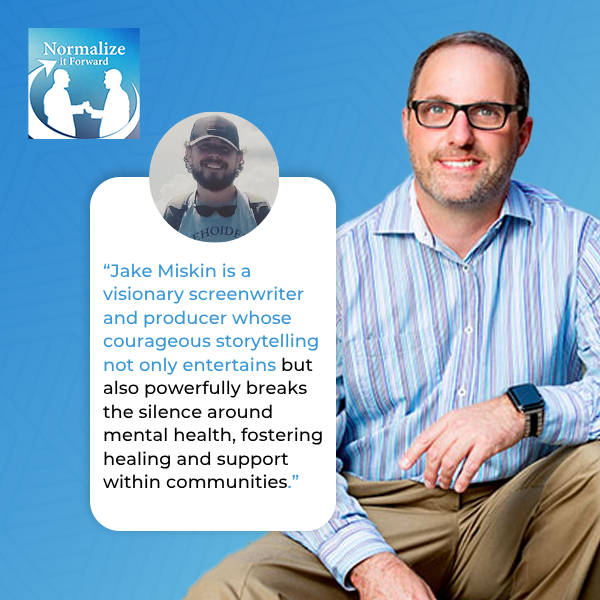
Thanks for being here, Jake. Jake is a Screenwriter and Producer, best known for his debut film, Shattered Ice. Born and raised in Needham, Mass., Miskin attended Needham High School, where he experienced firsthand the tragic loss of multiple classmates to suicide during his teenage years. These personal experiences deeply influenced his decision to create Shattered Ice, a film that delves into the complexity of grief, mental health, and community resilience.

Shattered Ice premiered at the Sedona International Film Festival and won the Most Impactful Film award. Through Shattered Ice, Jake Miskin seeks to break the silence surrounding mental health issues, particularly among young adults and young athletes, and to inspire communities to engage in a meaningful dialogue that fosters healing and support. Jake, welcome in. How are you?

I am good. What an intro that was. Thank you.
 

Normalize It Forward - Marc Lehman | Jake Miskin | Mental Wellness


I’m excited to hear about it. It’s so funny, whenever I read intros, everybody responds the same way. They’re like, “Is that me?”

I was like, “I don’t know if that was me they’re talking about.”

Why don’t we just jump in? Tell us a little bit about Shattered Ice, how it came about, and obviously, how we can view it.

Normalizing Mental Health Conversations Through The Power Of Storytelling

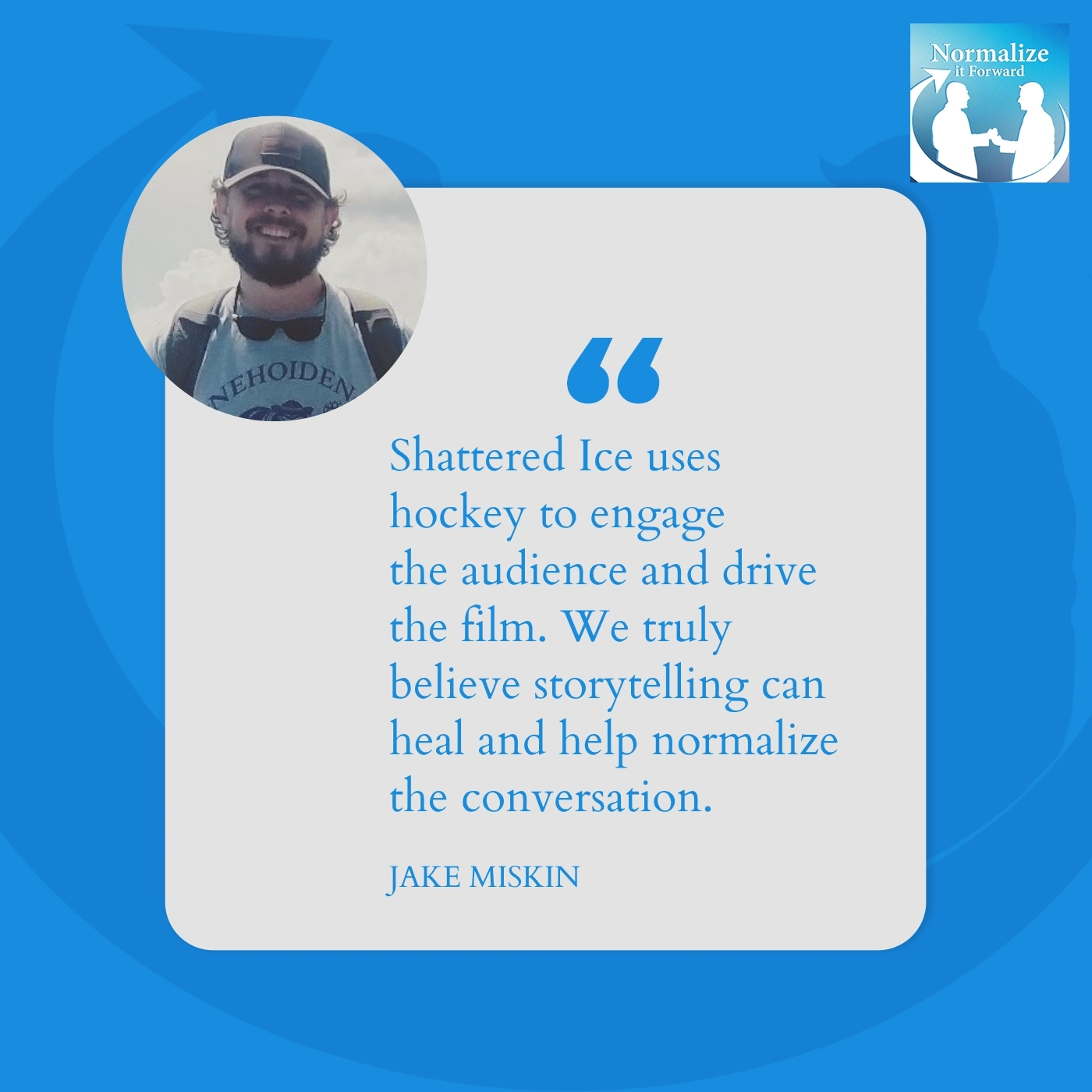
Yeah. Shattered Ice is a feature film. It’s about 100 minutes. It’s about the impact of losing someone to suicide at a young age in the conversations that young men, young boys in particular, are trying to navigate or questioning or wondering how to have these conversations. The journey it takes that it takes a village and a community to come together to realize communication really hopes that it normalizes the conversation. Shattered Ice uses hockey as the way of entertaining the film and the audience. We truly believe that storytelling could heal and again, normalize the conversation.

I love the concept. You guys, in many ways, you’re doing similar things to normalize it forward, just bringing topics out around mental health and wellness that are hard to talk about. Let’s face it, even the word suicide, people don’t like using that word. People don’t like talking about the topic. It’s one of those things that’s out there in our community, and we don’t have a choice whether we address it or we don’t address it. It’s still out there in our community. Let me go back for a minute, because your inspiration around this sounds like it had a lot to do with your own growth as a youngster in Needham. Tell us a little bit about that, Jake.

Personal Inspiration & The Avoidance Of “Why” In Grief

Yeah, when I was in high school, we lost multiple students to suicide, classmates of ours in the community and everything. There was just a real dark cloud over that time. Even after graduation, there was multiple deaths after that as well. It really hit our family hard, and me, personally. Writing this really helped with my grieving process and creating stories and characters and a world where this could be told. Friday Night Lights, the show, was a big inspiration as well of how deep they highlighted a community, and that’s what I want to do with hockey and highlighting my experiences and conversations that I was trying to have growing up.

Pay attention to those around you. Check in with everyone and have real, meaningful conversations. Share on X

Yeah. I’m, first of all, so sorry for all of the losses you endured. It sounds like your community was hit really in a severe fashion, and I can only imagine. One loss is one thing. Multiple losses, there’s that ripple effect. As a therapist, I’ve been around this so much, and when I hear about a loss on a college campus, for example, my first thought beyond what a horrible tragedy it is, is what about that ripple effect? Who else has this touched that we don’t know about?

Sometimes, students will share with me, and it doesn’t even matter if they know the person. It’s a contemporary. It’s a type of loss that just hits a person in a different way than, say, a car accident or any other type of loss. I can only imagine how that must have hit your community, it sounds like, in a very deep, long, sizable way.

The question that everyone always ask is why. Through Shattered Ice, I never wanted to touch upon a reason or anything, and I made sure that this story doesn’t touch upon that, because you never know. As soon as you put a reason on it, then audience members will be like, “That’s not my friend or my daughter, or my son or my teammate.” Make sure that you pay attention to everyone and make sure you check in on everyone, and you actually have deep conversations. It’s okay to have those conversations and don’t feel like my feelings don’t matter and that people don’t care when I’m telling someone else.

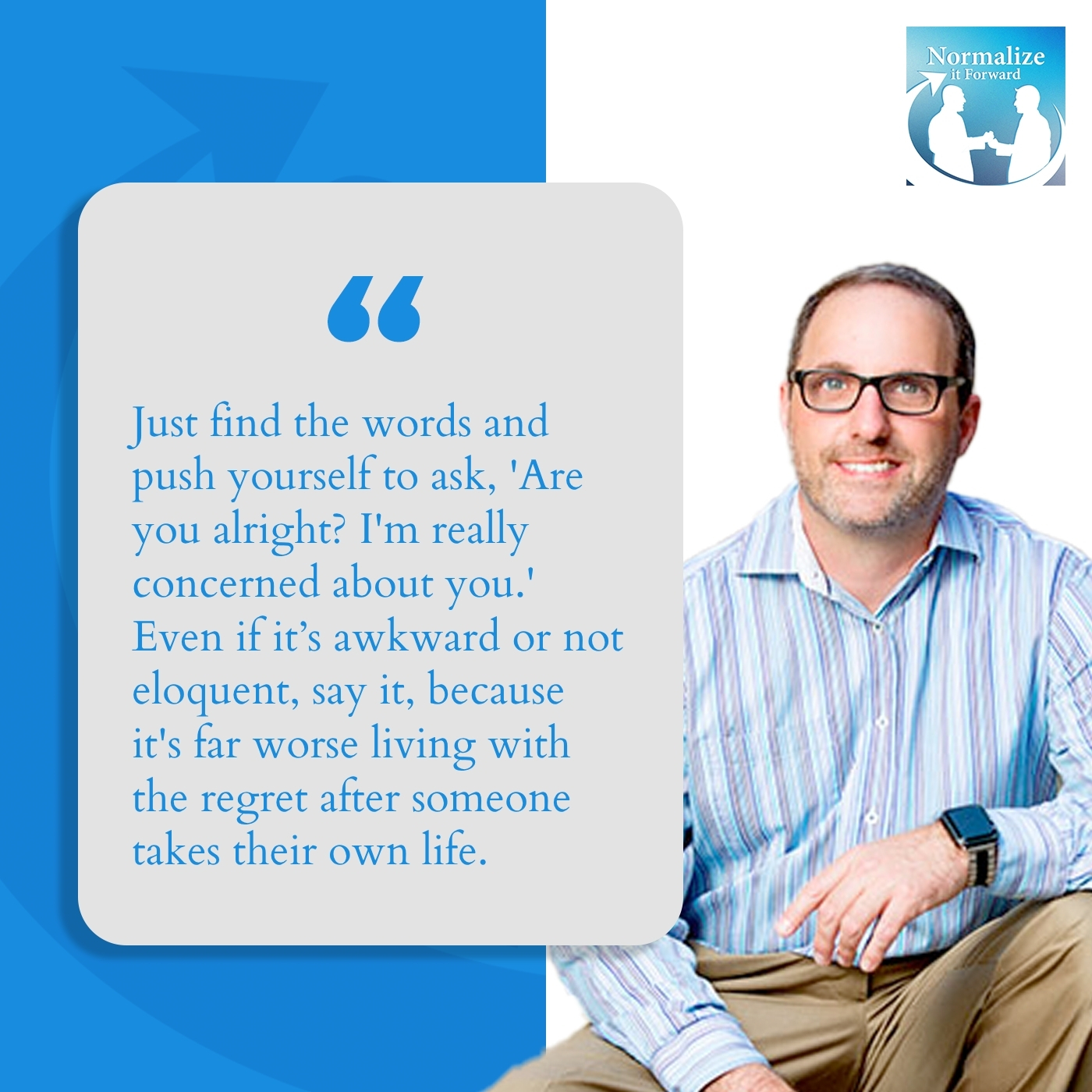
Yeah, it’s huge. I think as men, we have particular difficulty doing that, but I love your message, and I couldn’t agree with it more. Just finding the words, pushing yourself to just say, “Are you alright? I’m really concerned about you. Even if you’re awkward, even if it doesn’t come off eloquent, even if you don’t want to, believe me, it’s way worse on the other side when someone has taken their own life.

Maybe it’s someone saying, “I need help. I’m having these thoughts as well.” Whoever you tell, it’s okay.

Jake, thank you so much for putting this project together, because I think that message right there that you just touched on, for so many, when they watch something like this and they walk away with that message, that could be a difference maker for a lot of people.

As you said in the intro, we had our premier out in Sedona, 2,500 miles away from how I wrote this film and the world it’s in. Usually, at these festivals, you have a Q&A afterwards, and it’s usually all about the filmmakers and the cast and audience members wanted to find out about their stories. Instead, the room was lifted and people wanted to share their own story and how they related to a character, and how the feelings that were brought out on screen is how they were feeling. It truly was incredible. One of the actors turned to me and said, “Mission accomplished.” This is starting a conversation that people are relating to it, unfortunately, but it’s good that Shattered Ice is being a tool to help spark that.
 

Normalize It Forward - Marc Lehman | Jake Miskin | Mental Wellness


It’s resonating. I’ll give a shout out to my good friend, Eric, who runs a great organization called Same here Global.

I know him as well. Eric’s awesome.

He talks a lot about 5 and 5, and the stat out there of 1 in 5 people have mental health issues, and how really, all 5 of us, 5 and 5, we’re all susceptible. When a person thinks, “Not me,” or, “Not my kid,” or, “Not my partner,” that’s when they let their guard down. I truly believe that we all have life circumstances, that if they add up in the wrong way, we’re all susceptible to real struggles. Looking out for your friends, looking out for your siblings, looking out for your family members, looking out for your coworkers. Looking out for people. I think it’s our job in many ways.

Let me ask, I think that the topic of mental health is so broad and, as you were mentioning with regards to Shattered Ice, with Normalize It Forward, I noticed as I started having show after show, people began asking me more and more questions. They began sharing more and more about their own mental health, whether it was anxiety or whether it was depression or eating disorders or bipolar disorder.

So many people out there don’t have an actual diagnosis. They just feel terrible or they’re inundated with worry and to the point where their life is sometimes unmanageable. I find that when people share those stories, they share with other individuals and they find, “A lot of people out there are suffering.” Statistically, a lot of people out there are suffering.

One of the large populations that I work with on a regular basis is college students. The mental health of college students is awful. It’s moving in the wrong direction. Anxieties are up and depression is up. Unfortunately, the suicide rate is way up. You’ve been entrenched with this project and this topic, so I just wanted to ask your thoughts on maybe why. What do you think?

The Negative Impact Of The “Chase” & Social Media On Mental Health

The way that you said that as well, this has been an eleven-year journey creating this film, and the people that I’ve talked to are shared what I’m doing, because without the whole community coming together and making this happen, listening to stories, this movie would never been told, and the story would never been told.

Throughout that journey, it’s the same thing with you. People, for some reason, talking about a movie or a story, it brings down the guard. They ended up sharing more with them, with their own life with me than they haven’t done before previously. I get what you’re saying with that, when people are asking you more questions and all that, but in the reason why, honestly, I don’t know. It could be a lot of factors with how fast times are moving now.

I know a lot of people just throw up social media as a thing, but that truly is a factor with having a device in your hand at all times. The worry of you’re falling behind. There’s a quote in the movie that the father who lost his son says, “The hardest thing is that you always feel like you’re falling behind the village, that people are moving faster than you are, so your anxiety builds up, or your worries build up, and you’re not fulfilling what you’re supposed to be fulfilling.”

I think it’s just comes with how fast our life is moving now, how everything is connected. We’re feeling even sometimes more alone than usual. Sometimes, you’re trying to get in contact with your mom or your dad or your sibling, but it takes a day or two to call the person back because your life is so busy. I think it’s just a multiple of factors, especially with college students and the majority of the life they’ve been living in.

In a world that’s more connected than ever, life moves so fast that we often end up feeling more alone. Share on X

Yeah, it’s an interesting point, Jake, and I want to expand on it for a moment because it’s I think this will resonate a lot with my audience. There seems to be this chase. There’s this chase for something. I’m not even sure what it is. I think people think it’s happiness. I’m not sure it is. I watch young people chasing getting into a certain school, getting a certain grade, getting a girl to date them, getting a certain job. It’s funny. When you watch someone do that and they attain what they’re looking to attain, you would think that they would savor that moment and enjoy what they’ve achieved. Nine times out of ten, they’re onto the next thing.

I’m guilty of that, too, through this whole process. A lot of people have asked me if I’ve taken a moment to enjoy this moment. I’m always thinking about the next thing because I don’t want to fall behind. You truly do have to take the moment and take in what is actually happening with you on that day or that week and decompress it all, too.

No doubt. I found myself saying that a lot to young people when they’re approaching graduation, high school or college, and really stopping for a moment and just recognizing what they’ve done. This is a huge achievement. For so many kids, they’re just onto that next item. I think if there’s one thing, maybe we can, as adults, try to preach a little bit even through our own actions more as role models is trying to be in the moment.

Try to recognize, “I’m having a cool conversation with a cool guy tonight. This feels great.” Being able to recognize if we help one person through our conversation tonight, that’s one more person out there that has received some assistance from our conversation. I will say this. I’m impressed continually how open young people are in terms of talking about mental health.

I will say that’s a huge difference. A lot more younger people are open to talking about it, which is incredible.

I think movies like Shattered Ice, you put that out, kids view it, and all of a sudden, as you said, their guard is down and they’re able to talk about things that they wouldn’t have chosen to talk about, but they’re talking about it now, which is great.

That’s what I really think narrative storytelling and seeing it on a screen or a film, I think there’s a lot more. Ted Lasso is a great example. Shrinking is a great example. Adolescents that just happened on Netflix is big show. It’s how storytelling really sparks the conversation in people, because getting thrown numbers in your face can sometimes even be harder to look at or a documentary where you know it’s a real story.

Sometimes, it’s harder to take in and you shut down more because you don’t want to be a statistic or that person on that’s telling you a real story back. When it’s a fictional character, you can relate to a character, and you have that comedy and that real heaviness. My friends and I are talking about Ted Lasso all the time and his struggles and relate and you’re relating to it, or all the character arcs of Shrinking and how they all have real issues, but they use comedy as a way to highlight them. It’s just like any other family out there that are going through this.

Shrinking, in particular, was written brilliantly. They dealt with some really challenging topics, and they did that through exactly what you just said. Really remarkable. I highly respect your field in that. It’s obviously not something I do. I think it is a really interesting vehicle and way for people to be exposed to topics and as you said talk about them, which is really remarkable.
 

Normalize It Forward - Marc Lehman | Jake Miskin | Mental Wellness


Still be entertained by it too because that’s the other thing with the stigma, when you say the word suicide, you instantly you turn away or like, “This is going to be a heavy topic,” but like you said, normalize it so it’s like you are able to talk about it and have the conversation.

Tell us, Jake, if people want to view Shattered Ice, how do they get a hold of it?

Yeah, so right now, we’re doing the film festival circuit, so we submit to all the film festivals across the country. We’ve gone into Sedona and we just announced that we got into the Berkshire International Film Festivals out in Massachusetts.

Congratulations. That’s great.

That’ll be happening in May 2025. We have a couple more festivals that we can’t announce yet. That would be in 2025. We’ll be doing private screenings throughout New England, partnering with organizations and hosting screenings with them, and then also doing a high school and college tour. We’re going on 10 to 12 campuses across New England to show the movie, have a Q&A afterwards, have a panel, and basically have the conversation that we’re having now, how storytelling is important. Obviously, our audience is student athletes, and broader into the whole community at the school. That’s our goal for 2025, our social impact campaign, and then hopefully, it’s in theaters ne nationwide in 2026, and you are watching it on Netflix or a streaming.

I know you’re in the middle of that process, so good luck with the rest of the year. I’m really excited for you guys and certainly, anything we can do in Normalize It Forward, or any of our socials to advertise for you, we’d like to help in any way we can. Going back to what you mentioned about athletes, and honestly, I meant to ask you this earlier but wanted just to touch on this.

Athletes in particular, they’re an interesting topic, an interesting group of people in that I find that when I’ve worked with athletes over the years, they have not only a persona to maintain, but there’s also certainly, in particular in sports, there’s also a, “I’m not going to tell my coach I’m struggling because I’m going to get playing time cut,” or, “I’m going to have this, I’m going to have that.” Without knowing much about the movie itself, I’m curious just your thoughts on athletics and how mental health and wellness intersects with that topic.

Sports As A Vehicle For Mental Health Dialogue

It’s great that you brought that up because the biggest reasons why I used hockey as the driving vehicle in Shattered Ice and the world that I want to build is create more stories using sport as that vehicle and talking point because sport is when athletes receive their first obstacle, their loss, their first loss, maybe their first friendship, their first win, their ups and down is a rollercoaster. Their journey in sport really brings out that innocence in people and their natural environment that they want to be in.

Unfortunately, on the mental health side of things, it’s right away stigmatized that these athletes have such a perfect world because you know who is struggling or who is the premier athlete right away. You get put into this box and you feel like the person who’s the star athlete is okay all the time because they’re performing well.

The person who’s either not playing as much, they’re okay. They must be hurting, they must be frustrated, annoyed. All of them need to be open with each other in such a big world that it doesn’t matter what sport you’re playing. There are some sports that are more in your face and you feel, but even individual sports, you’re so alone all the time.

Just like with Jarren Duran on the Red Sox, you’re sitting out in the outfield for nine innings straight by yourself and you’re talking to yourself. I’m so happy you opened up about his struggles. A lot of athletes do that. I truly think sports is a perfect avenue where people are related because even as kids, like I said, where you might have had your first heartbreak, your first loss, your first struggle, or your first love in your first friendship, or your first coach, your first mentor. There’s a lot of intersection going on.

Sports are a powerful avenue for connection. As kids, many of us experienced our first heartbreak, loss, struggle, love, friendship, coach, or mentor through sports. There’s so much intersection in those moments. Share on X

It’s interesting because I pay attention to when things like those stories break like the Duran story, I heard reactions to it. I can’t believe that happened to him as though he’s inhuman. I hear that also in the entertainment world, musicians. When musicians cancel legs of their tour because they’re having mental health issues, I can’t believe that happened to them. That notion of we’re all human beings and we’re all susceptible. We all have things that happen and we all have our own journey.

For me, I would like, as much as possible, for young people to understand, it doesn’t really matter who you are. It doesn’t matter how much you make for a salary, who you married to, or what you do for a living. Everybody has things that they struggle with from time to time, and even Red Sox players and musicians. I think that message is really important for young people to understand.

I like how you’ve done what you’ve done with Shattered Ice. I think it really allows for the topic to resonate with people, I’m sure, on a number of different levels. I can’t compliment you enough about what you’ve put together here and how hard you’ve worked on this. Again, kudos to you, guys. Good luck with the rest of the journey. Jake, if I can put you on the hot seat just for a moment and ask. In Normalize It Forward, we typically ask all of our guests to nominate a friend, a coworker, a relative, someone that you know who might be helpful for us to interview next on the show. Any thoughts?

I do. He’s a mentor of mine, and honestly, I wouldn’t be without him, getting me through this journey and helping Shattered Ice get made. His name is Tamlin Hall. He’s out of Atlanta, Georgia. He runs a nonprofit called Hope Givers. Their mission is to normalize the conversation through storytelling. He does a great initiative with students creating short films and getting into the high schools and having these live events. He wrote and directed a movie called I Am Holding On. That’s why I reached out to him in regards to his journey. He’s just been a mentor ever since, and I think he would be a great person to talk to.

Thank you so much for that nomination of him. I will certainly get his info from you offline and reach out and connect and hopefully, we’ll have him on the show. He sounds like a really interesting individual. I love the work that both he and you are doing out in the community. Again, keep it up. Anything we’re able to do to support, we’d like to. When Shattered Ice is around, get out there and watch because it sounds like there’s a lot to the topic that people would benefit from. Jake, thanks again. I appreciate it.

Thank you. This was awesome.

Thanks for coming out. We’ll talk to you soon.

Sounds good. Thank you.


Important Links


About Jake Miskin

Normalize It Forward - Marc Lehman | Jake Miskin | Mental WellnessJake is the Founder/Owner of Nehoiden Street Films. Jake spent the early part of his career in the sport industry world, until he took his leap into filmmaking.

Jake resides in Massachusetts with his wife Lexi. Jake believes Nehoiden Street Films will be a disruptor in the Independent Film space by combining authentic New England stories and mental health to help create powerful conversations.

Shattered Ice, his first film premiered at the Sedona International Film Festival and won The Most Impactful Film award. Jake graduated from Springfield College with a BS degree in Sport Management.


Reading about mental health is hard. Let’s schedule a free consultation.
Normalize It Forward - Marc Lehman | Brian Talarczyk | Mental Illness


Ever wondered what it really takes to face your deepest mental health struggles head-on and emerge stronger? Tune in for a powerfully honest conversation with Brian Talarczyk, author of I Am Not Bipolar. Brian shares his personal battle with mental illness, offering crucial insights on the importance of seeking help, navigating psychotic episodes, and reframing stress as a sign of growth. Discover his unwavering commitment to authenticity and how giving back to the community is integral to his own mental wellness journey. This episode is a testament to resilience, vulnerability, and the strength found in open dialogue.

Reading about mental health is hard. Let’s schedule a free consultation.
Watch the episode here


Listen to the podcast here


Unmasking Mental Illness: A Bold Journey To Healing With Brian Talarczyk

I am here to talk openly about mental health and wellness. I’m super excited to welcome my guest, Brian Talarczyk. Brian, how are you?

How are you doing? Thanks for having me.

Good. Thanks for being here. I appreciate it. Brian is a writer, a mental health advocate, and a Management Consultant, and has a passion for promoting mental wellness in one’s personal life and professional endeavors. Brian is the Managing Director of the Kravit Group, a tech advisory firm, and a Cofounder of Colchester Cares, a charity foundation serving the local community in Connecticut, where he lives with his wife and two children and their golden doodle, Sally. Brian, welcome.

Thanks, Marc. Nice to meet you.

Why don’t we start things off? Brian’s book, an awesome book, I Am Not Bipolar, was recently written and put out. I guess I want to ask you a general question. How are you feeling about the book being out in public these days?


Normalize It Forward - Marc Lehman | Brian Talarczyk | Mental Illness


I feel pretty good. It was a little nerve-racking at first to think about exposing the private parts of my life openly to everyone, but enough time has passed since a lot of those events occurred that I have a lot of perspective on things. I’ve grown up a lot, and I think it’s okay. I’m feeling pretty comfortable about talking with people about it. The more I talk with others about it, and the more people tell me about their stories and their sisters and their brothers and their uncles in conversations I never would have had about mental illness had I not openly shared my mind. That was part of the point.

Number one, I want to thank you for writing this. I want to thank you for putting it out there. I think it takes a lot of guts to write about yourself and write about your journey. If you didn’t get the title, I Am Not Bipolar by Brian Talarczyk. Certainly look it up. It’s a great book. I think you were very honest and very open in this book. As a therapist, I put together this show to bring mental health out there to the community and to get people to understand that, number one, we’re all susceptible. Number two, many people out there are suffering with their own battles.

Sometimes they’re suffering in silence. I think your stance of writing this book, this show, all sorts of things that are being done out there are helping people. They’re helping people understand that it’s okay. As a phrase goes, it’s okay to not be okay. It certainly means that people are getting the help that they need and being able to survive, stabilize, and live their lives.

We appreciate you as therapists. Those of us who struggle appreciate folks to help us, guide us through some of the challenges that we have, and have somebody else to talk to in some cases when you don’t have anybody else to talk to. That’s part of my experience as well, working with therapists. I’m glad that people are talking about it more. That’s the one thing that I am certain about related to mental illness and bipolar disorder. For a lot of reasons, people are talking about it more, and that’s a good thing. A show like yours and others, that’s a good thing.

As I was telling you earlier, a lot of my audience is young adults, and young adults are struggling. The mental health stats out there are not pretty. Anxiety is up, bipolar is up, depression is up, and eating disorders are up statistically. What I find regularly working with that population is that, oftentimes, kids are struggling by themselves. They’re not bringing friends in or support in, or parents in or therapists in, and things undoubtedly get much worse for kids. I guess I’m wondering, when you made the bold decision to go see a therapist, for the first time you did that, tell us a little bit about that experience and what you went through, the steps that it took, and the obstacles that were sitting in front of you.

The Decision To Seek Therapy & Overcoming Initial Obstacles

I was 27 years old when I was first diagnosed, and it came on the heels of a more severe manic psychotic episode, following which was a major depressive period. To answer your question about going to see a therapist, the decision was born largely out of fear. I started having suicidal ideations. I was in a very hopeless state. Yale New Haven Psychiatric Facility had connected me with a doctor in Virginia, where I was living at the time.

At first, I ignored going to him, denying that their diagnosis was wrong. When I got into that severe depressive state, I knew I needed to see someone. It was out of that, and then I went and talked to somebody. From there, it was time that got me comfortable with talking with somebody else about it.

To your question, it was very difficult to put myself in a car and drive to a therapist’s office and then ultimately admit that my brain functioned differently from others. There was something to this diagnosis that’s not a comfortable place to be. It took many years to accept that and feel comfortable even talking to a psychiatrist about it. That’s what was going through my mind. It was more out of desperation for me after one specific event than a series of symptoms of feeling anxious and depressed, and those kinds of things.

I know a big theme in your book was the passing of your father. Remind me, how old were you at the time?

I was 27 and he was 55.

I know that was one of the major events that set things in motion for you. What I wanted to ask around that time period, and as a therapist, I’m on the other side of this, and so I’m fascinated by this process, is a person comes into my office for the first time and they’ve been newly diagnosed. Let’s say they’re right out of the hospital. I’ve been doing this for a while.

This is not my first meeting. This is their first meeting. I have to take into account that this is overwhelming and maybe a little surreal, like, “Is this really happening? Now my life is going to be different because I have this lens to look through,” but in many ways different and good. It opens up opportunities, and I can be honest with people about this is why this happens. I wonder how big an obstacle that was for you?

The Impact Of Suppressed Grief & Understanding Psychosis

A big obstacle. It certainly was at first, like we were talking about. For me, it came on the heels of my father’s death six months prior before I had my first psychotic episode. In that time, I suppressed the grief. I ran away, thinking everything was fine. Yes, he passed away, but we’re all going to be fine. I didn’t talk about it with anyone. I didn’t talk with my family about it. I ran away from it.

It was through that suppression that triggered my illness surfacing for the first time. Even though I was 27, there were no signs of bipolar disorder or anything. It exists in my family, but it did not exist no signs with me in any way that I would’ve known. To your question, I feel like that exacerbated the situation, and walking in and seeing that psychiatrist for the first time was not just an exploration into dealing with my diagnosis, but also beginning to realize that the cause of this was the suppression of grief. That all bubbled up, and eventually, chemicals went the right way, and I found myself psychotic, and it happens. I think that piece of it, I focus on a lot in the book, because suppressing our emotions in any form isn’t healthy.

It sure isn’t. I think it’s also avoidance. It’s a natural tendency when we don’t have that muscle built up in our body. It’s like, “I don’t know what to do, so I guess I’ll just avoid it.” A lot of people end up doing that. You’ve used the word psychotic, I’m familiar, but I guess I’m wondering for my readers, can you explain that a bit? What do you mean by that?

Psychosis, for me, I can give you an example of my first psychotic experience. I hadn’t gone home to visit my family after my father passed away. I was living in Virginia at the time. I hadn’t gone home and talked to them like I normally would. I avoided being there, suppressing that grief. I left Thanksgiving dinner, and a lot of memories swirled around being in my childhood home and that kind of thing.

I went back to Virginia, and I started doing a lot of activities, your standard hypomanic activities, like running more than I normally would, forgetting that I ran, so running again, working feverishly on things that I could never finish because I didn’t know why I was doing them. It elevated to manic behavior. The psychotic part of that was transitioning from reality and what was happening around me to an abstract reality that I was creating.

The narrative of my psychosis was coming to believe that my father was still alive, that his death had been faked, along with a whole bunch of other things surrounding September 11th, because that happened during that time period, a few months prior. I went on a search to find my father. I went up and down the East Coast, looking for clues. I heard voices inside me that he was talking to me and guiding me. I fell into an abstract reality, something that didn’t exist.

I was operating in the real world, but my world was filled with terrorists chasing me, and everything became a metaphor of itself. There’s a white panel van over here, driving next to me with an American flag. Is that a terrorist? It was an abstraction after abstraction. Going from reality, it’s not reality. For about a week period, not even longer than that, operating there. I don’t know if that answers your question. That’s an example of psychosis. I’ve only had two of those episodes in my life, but they were both as doozies as those are.

It sounds scary. I appreciate you breaking that down for us. A lot of times in my office, I talk about psychosis as it can be delusions, it can be paranoia, or it can be hallucinations. Sometimes they are a combination of all three, and they’re caused by a variety of things. The premise I keep coming back to when I run into it with patients is that we believe our reality. If we’re thinking it, we’re believing it. As you said, you become separated from what is real, and that’s scary.

That’s scary because you’re in that zone. You don’t know how to stop. I appreciate your candor around this and the pure honesty around what this was like for you. I’m curious. I tend to ask this question a lot in my interviews, because I think it’s helpful for my readers to know, if you’re speaking directly to a college student, which in many ways you are right now, and they’re struggling, they’ve got something going on that is clearly above their pay grade and they don’t understand it, but it is out of control. Whether it’s excessively restricting their diet or cutting themselves or having lots of anxiety that they cannot control, do you have any general advice for that student?

The Importance Of Talking To Others

The most specific thing that comes to mind was the struggle I went through, and it took me a very long time to understand what I needed to do. That was to talk to others. I know that’s very direct and probably easy to say. It doesn’t need to be a therapist. If you can talk to a therapist, that is extremely helpful because they’re looking at it from a professional clinical perspective and can help you in other ways. Talking with someone and taking a pause and a time out from whatever you’re doing in your life, and realizing that your life and your health are much more important than what’s in front of you right now.

Whether it’s an exam or a date you’re going on, or I don’t know anything, even a class you’re supposed to go to that you can’t miss because the professor might fail you, or whatever the case may be. Nothing is more important than your mental health at that time. When you come to that space, step away from what you’re doing and talk to someone.

Nothing is more important than your mental health in that moment. When you reach that space, step away from what you’re doing and talk to someone—anyone. Share on X

It’s great advice. It’s interesting. I’ve given that advice before, and so many people will say back to me that they don’t understand. If I miss this class, my professor won’t understand. You know what, 9 times out of 10, they do. You hear something back in an email like, “I totally get it. My daughter has excessive anxiety. My cousin, my niece, my brother, I.” People get it way more than we think because, by numbers, a lot of people are suffering.

The numbers are skyrocketing. You look at the effects of technology and other things that are pointing to anxiety and depression increasing in folks. You’re right. On the other side of that conversation, from a professor’s standpoint is they have a family. They understand the stress of the things they need to do in their job. They’re grading papers. They might themselves have anxiety over not being able to do much. There’s humanity on the other side of that, not a relationship that’s superior, inferior. In that case, I would encourage students to talk to their professors and/or their advisors and make sure they know what’s going on. They probably will more than understand and be there to help you.

It’s great advice. I’ll add to that, not only are all of those things going up, but so is the suicide rate. It’s so disturbing to me that every couple of months, I hear about another person who took their own life, and in most instances, needlessly. A lot of times, it comes down to people saying things like, “I had no idea they were struggling,” because they didn’t tell anybody. As you said, there’s nothing more important than health and safety. I don’t care what class you’re in, I don’t care what job you have, I don’t care what you’re doing. There’s nothing more important. Great advice

When you’re in that space, for me, I never attempted suicide, but in the two major depressive episodes I had, I had so many suicidal ideations, and they were derived from a feeling of hopelessness. I lived alone at the time. In both those instances, that made things much more difficult. Even if I wanted to talk to somebody, somebody wasn’t there. What I would say to any of the other readers out there and parents, figure out how to be present. As a parent, you can’t pull somebody out of the hopeless rabbit hole. You won’t be able to do that, but be there and make sure that they know that the line of communication is open. From there, try to be there to help them.

I always say showing up is half the battle. Probably the other half is listening, but being there for your young adult is important. I think you said it well. You can’t force them to share about all of these deep, dark things that they’re going through. Trust me, the fact that you show the fact that you’re there, the message that that sends, and the opportunity that they have now, they have a mom, they have a dad, they have an aunt, they have an uncle, they have someone there that they can share with is huge. It’s really big.


Normalize It Forward - Marc Lehman | Brian Talarczyk | Mental Illness


I had a friend of mine, during my second episode, who didn’t know what to do, and was very concerned about me when I was in the hospital during my second hospitalization. He didn’t know how to respond to it. I was living on the north shore of Boston at the time, and he was in Connecticut, and he drove to New Haven to get famous Pepe’s Pizza. He drove up to the hospital in Boston and sat with me, and ate a pizza. I’ll tell you, to this day, I still remember that conversation. I remember sitting there with somebody who went out of his way to do this, and it meant so much to me. For the parents and students out there, it’s that experience that those who struggle don’t forget.

That’s a great example. I would also say that can be uncomfortable. I’ve been to psych hospitals, but most people haven’t, and so to go and visit a friend and sit there and be there, and the message that sends is, “I care about you. You’re important to me. I care about you and I want you to know that while you’re struggling in here, we’re thinking about you.”

I push parents to understand that concept. I have parents say to me all the time, “That’s going to be uncomfortable,” so what? Going to a funeral is uncomfortable, too, but we do that. We do that for good reason. Sometimes, you have to push yourself and be in those spots. I’m a big fan. I have a good friend I interviewed a while ago on this show who lost his son, unfortunately, to suicide. Ever since then, he has made it a point to tell his friends how much he loves them. It doesn’t matter if you’ve known him for a long time or a short time; he tells you because it’s important.

I think some things come out of these experiences that are very important for us to pay attention to. I wanted to ask because I know a big part of this book, or the writing of this book, was for your kids. I know that through the note that you wrote to them in here, it feels like a vehicle for them to understand their dad a little bit more. Tell me a little bit about that.

It’s dual-purpose. The first is the discussion around mental illness in my family. On my mom’s side of the family, bipolar disorder existed in that generation in the ‘60s, ‘70s, and ‘80s. When I grew up, it wasn’t discussed at all. Manic depression was what bipolar disorder was previously called. It was something you didn’t talk about. While it may be hidden now, back then, it was hidden. We didn’t talk about it.

The first purpose of addressing the kids in the book is to say, “This isn’t right. We should pass these things down. This is a genetic illness. This isn’t something that I chose. I inherited this. By the way, you may, too, one day. We don’t know, but I want you to know two things. One is we’re going to talk about it well in advance of if that were to happen.” Neither of my children exhibits any behavior associated with a mental illness right now, but that could change for me. It didn’t surface until I was 27. That’s the first thing.

The second thing is, as parents, we put ourselves on pedestals to our kids to say, “I don’t have these struggles. My life has been perfect. I’m your dad. I should hide what things that have happened in my life.” My mental illness experiences have made me challenge that a lot and to be like, “I think you should learn from a bunch of mistakes that I made, and there are plenty. I want to tell you about them.” The short letters to the kids are in the book. That’s where it was derived from.

That’s not a literary device. My kids are young now, but in a few years, they’ll be in middle school. I hope that they choose to read the book. I wanted to be honest with them through the book, leave them some notes to say, “This is what’s going on, and this is my relationship with you. It extends through this book, too.” It’s those two purposes it serves. The biggest being, I think kids should learn from our own mistakes as much as theirs. That’s where I’m at, especially with my mental illness experiences.

Kids should learn from our mistakes as much as their own. Share on X

There’s a human quality to you that’s special. You’re able to talk openly about your flaws, which we all have, by the way. I think speak to them honestly with your children. To me, that is such a huge leg up for your children because if you think about our parents’ generation, that never happened. They were just as flawed, if not more flawed.

I think that for this next generation of young adults, whether elementary, middle, high school, or college, for those kids to understand the advantage of the openness of conversation around this stuff, the advantage is that it’s no longer in the corner. It’s no longer not being talked about. It’s no longer, “We don’t know what the statistics are.” We do. We know what the statistics are. They’re not great, but we do know.

Just like anything, heart disease, diabetes, we know that if you’re getting help for it, the chances of it beating you are much less. We want to grab that control and be able to manage our condition, whatever our condition is. Funnily enough, I’ve had asthma my whole life, and I always tell my patients like, “It’s my job to take my inhaler with me to be careful about certain environmental situations that trigger it. I have to manage my condition, and if I don’t, it has no problem managing me.” I think that’s true for most conditions.

Managing Mental Illness & The Concept Of Self-Care

It’s true. For me, I usually leave a lot of conversations like this saying, “I might come across to you as someone who’s been able to be open around my own experiences or might come across as someone who has tackled his past and is moving forward.” The reality is that there’s no cure for bipolar disorder or any other mental illness. There’s only the ability to manage it. There are ways that I work to manage that every day.

A big one for me is overworking. I’m self-employed, and I take on so much client work like yourself at a time, and I have learned over time to never take on too much that I can’t do, because then, I’ll try doing it all at once. That’s what ended in not-so-good circumstances for me. I think there’s a list of things everybody needs to do to manage their own mental health. That list is very different for everyone. Everybody’s circumstances, everybody’s genetics, everybody’s position in life are very different. The most important thing, like your asthma, is to say, “There is something I need to do,” and never wake up in the morning and say, “I don’t need to do this today.” Remind yourself of that.

I put it in the basket of self-care. As we get older, we’re making sure we’re getting our annual visits to our doctors and our eye doctors and our getting our teeth cleaned and doing all the maintenance stuff that we’re supposed to be doing. I think part of self-care, as young adults get into adulthood, is them recognizing this is an extension. If you belong on medications, don’t let them run out. If you’re seeing a therapist and you need to continue, keep going. Continue to do that.

The self-care aspect of it is so important. As basic as this sounds, self-care comes down to us. If you decided one day, “I don’t want to go see my doctor anymore,” then you don’t. You’ll suffer consequences, but that is your choice. The self-care piece, I feel like the decision comes down to the person. I think that I try to get people to understand I’m a human being as well as a therapist. It’s like I make decisions every day to manage certain things with myself. I’m not perfect. I certainly make mistakes. The same goes for you, Brian. Our journey is we try to manage ourselves as best we can.

I talk in the book a little bit about my therapist at the time was pointing me towards my inner self, working with me to come up with ways to manage my mental health, but more was forcing me to have a conversation with myself in any way that I could. One of those was keeping a personal journal from which this book eventually evolved, dealing with some of the PTSD disturbances that I had from my psychosis.

The way I approach it in the book is, as somebody who needed therapy, I was looking for external guideposts. I was traveling through the woods and looking for other people and other things and medication to make me well again. My therapist and others in my life were pointing me towards my inner self. Having the conversation with myself about self-care and those things I needed to do, and not necessarily do this and everything will be fine for you. That took a long time to grasp hold of and understand. For me, it’s over a decade, which was at least nine years too many, but it’s true. The concept of self-care is at the forefront of maintaining mental health.

A lot of wellness comes from doing for others, not just yourself. There’s real power in being selfless—it creates a positive spiral of helping others and caring for yourself. Share on X

I can’t help but notice the picture behind you. Colchester Cares. Tell us a little bit about that.

Colchester Cares was one of the 500 wonderful ideas that my wife has had. I had to give her a plug here. We live in Colchester, Connecticut, and Colchester Cares is a giving group. It was formed in the middle of COVID. To sum things up, there’s a group of people, all the members of Colchester Cares come together once a quarter, and you can team up with a couple of people if you want. It doesn’t just have to be you, but everybody throws in $100 towards a pool of money.

Everybody raises causes that are needed in the town. It might be a Boy Scout who’s looking to rebuild park benches at one of the parks. It could be the fuel bank that’s looking to raise money because it’s October, or whatever it is. Everybody brings up causes, and then we distribute out the causes and everybody votes, all the members vote. We pool our money together. The top three causes are ranked to get a third of the money pool.

We do this every quarter. They’re called giving circles. It’s not uncommon. It was my wife’s idea to center it on our town. That was the piece of it. We were part of the Giving Circle in Southeast Connecticut. It served all of Southeast Connecticut. We’ve centered all of it on our town. We’ve grown to about 60 members now, and we’ve given out about $65,000 in money to the town in four years. It was my wife’s idea. I went along for the ride after.

We’ll give her credit. What a great idea. I love it.

It keeps us centered on the community. We have a wonderful community here in town, and it has connected us to a lot of people who do a lot of philanthropic things and make the town run. It’s always the same group of people that are managing the ball fields and the same group of people that are putting on the carnival and stuff.

That’s nice. Out of curiosity, because I feel like there is a connection here. Giving and giving back and taking care of people in your community, can you connect that to wellness? Give us a sense of how they relate.

A lot of wellness is doing for other people and not necessarily myself. There are some good vibes and emotions that come out of being selfless and helping others. It spirals into a balance of taking care of yourself and helping others, kind of thing. We all have that in our relationships and whatnot. There’s a balance associated with it. Ultimately, Colchester Cares and other things like that, my involvement in the local community sports, I’m involved with coaching Little League, those kinds of things. Giving back is a big part of my mental health. It helps me focus on someone other than myself and get myself out of my own thoughts sometimes.


Normalize It Forward - Marc Lehman | Brian Talarczyk | Mental Illness


Brian, let me ask you this. First of all, I appreciate you spending this time with us. I know you’re busy. I know you’re doing a lot of different things. Your book, I Am Not Bipolar, by Brian Talarczyk. Go check it out. I read the book. It’s a fantastic book. A really good read, and full of information that will resonate with lots of different people.

Brian, if I could ask you, in general, because you’ve got people out there, parents that are concerned about their kids, or you’ve got young adults that are concerned about themselves, and I guess I’m wondering a general piece of advice or information to get past that notion of, “I’m paralyzed, I don’t know what to do, so I’m doing nothing.” What do you think?

There’s an image on the front cover of the book that’s a seesaw. To summarize it all, to me, it is to think of your life not as being on the swin alone, but a happy and balanced life is, pun intended, sitting on a seesaw across from the people that you love, that you can talk to about your own mental health, and know that it’s very natural for there to be ups and downs in your life. Nobody’s life is ever Steady Eddie.

Even if it may seem to you that it is, that’s not how it goes. A balanced life is talking with the people across from you and making sure that your health is in check. Maybe their health is in check, and that’s true for any relationship. Parent, child, spouse, teacher, student, brother, sister, whatever the case may be. Stay in balance on that seesaw.

Great advice. I would further that by saying I was blessed with a big mouth, probably why I became a therapist, but a lot of people aren’t, and a lot of people are shy. A lot of people, culturally, don’t share openly. They’re introverted. I always tell people, find a way. Find a way, find your person or several people.

As you mentioned earlier, Brian, it doesn’t have to be a therapist, but find a trusted individual to share with because they’re out there, and they’ll help you. One of the best parts about your story, Brian, is that you got the help that you needed. You’re still on your journey, but the sun is shining and the future is bright. I’m thankful for that. I’m happy for you for that. I appreciate you spending the time with us.

Marc, thank you very much. This has been wonderful. Good luck in the future.

I appreciate it. You take care.


Important Links


About Brian Talarczyk

Normalize It Forward - Marc Lehman | Brian Talarczyk | Mental IllnessBrian Talarczyk is a writer, mental health advocate, management consultant, and philanthropist with a passion for promoting mental wellness in one’s personal life and professional endeavors.

Brian is the Managing Director of the Kravit Group, a technology advisory firm, and the co-founder of Colchester Cares, a charity foundation serving the local community in Connecticut where he lives with his wife, two children, and their spunky goldendoodle, Sally.


Reading about mental health is hard. Let’s schedule a free consultation.
Normalize It Forward - Marc Lehman | Shi Eubank | Limitless Potential


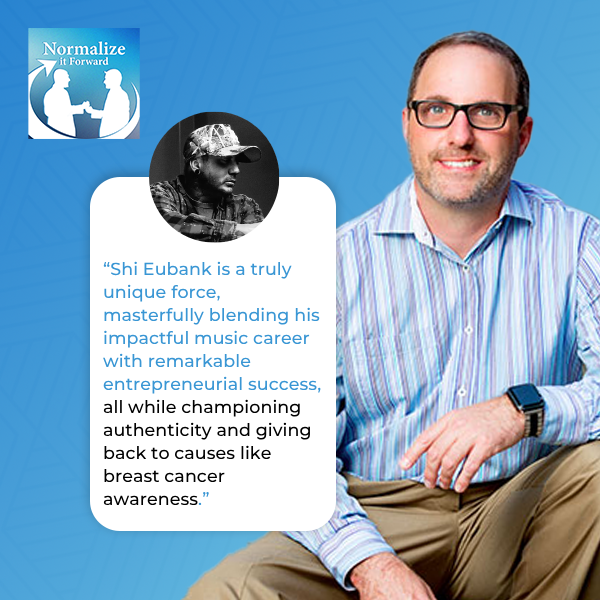
What happens when raw musical talent meets relentless entrepreneurial drive? You get Shi Eubank. This week, we’re thrilled to feature the multi-faceted country rock artist who’s not only captivating audiences with his unique sound but also inspiring with his incredible life story. From his early days fronting Savage After Midnight to building eleven roofing companies and a sunglasses brand, Shi’s journey is a testament to unwavering determination. But beyond the impressive resume, you’ll discover a man deeply committed to authenticity, mental wellness, and giving back. Prepare to be inspired as Shi shares his unfiltered insights on personal growth, the power of music, and why embracing your true self is the key to unlocking limitless potential.

Reading about mental health is hard. Let’s schedule a free consultation.
Watch the episode here


Listen to the podcast here


Journey To Authentic Living & Limitless Potential With Shi Eubank

I got a good guest. I know I always say I am super excited, but I am super excited to welcome Shi Eubank. Shi, how are you?

I’m doing great. It couldn’t be better to be on this with you.

Thank you for spending the time with us. I want to introduce you and tell everybody about you and some of the things that you’re doing. Shi is a country rock singer, songwriter, and producer from Memphis, Tennessee. He blends gritty Southern storytelling, hip hop cadences, and rock energy. He gained early recognition as the frontman of Savage After Midnight. He’s now a solo artist and has released independent singles, including Bar Back, None of My Business, and Sentimentals, which is a great tune.

His lyrics capture raw life experiences from growing up in poverty to personal resilience, rooted in authenticity and storytelling. Shi combines his raw musical talent with relentless entrepreneurial drive. He owns eleven roofing companies, a genetic testing firm, a river-tubing outfit, five cabins, a sunglasses brand, FAKE Apparel, and is collaborating on a distillery.

Charismatic and unapologetically bold on social media, Shi’s persona belies a deep respect for women. He emphasizes the powerful women in his life who guide and ground him daily. Beyond music, he’s committed to giving back. A forthcoming album will donate all proceeds to breast cancer awareness in honor of friends affected by the disease, which is very cool. With over 30 songs written, which I can’t wait to hear the rest of them, and new projects also underway, Shi Eubank is more than a country singer. He’s a multifaceted entrepreneur, artist, and survivor who continues to challenge expectations and live fearlessly. Shi, welcome. How are you?


Normalize It Forward - Marc Lehman | Shi Eubank | Limitless Potential


What a reception.

It’s good, right?

Yeah, it’s great.

You got your hands on a lot of different things. Honestly, I don’t know how you keep track of it all.

You go to bed writing down a list, and then you wake up every day and start checking things off the list and adding to the list. You keep going.

I love it. Many of my readers are young adults. One of the areas that many kids struggle with in terms of anxiety and depression is how to soothe themselves. I’ve found so many young people talking to me about music and the meditative quality and the spiritual quality, in some sense, of music. I wanted to know from an artist’s point of view how you see music and what kind of role it plays for you.

The Role Of Music & Storytelling In Memory & Healing

I suffer from short-term memory loss, so I don’t remember a lot of things. I’m constantly having to remind myself. Any of you guys that are out there that are feeling like you’re forgetful all the time, or you feel like less intelligent because you can’t remember things as well as other people, it’s a very normal thing. That’s why I go back to what I said. I make lists. Physically writing things down almost tends to work a little better than voice memos and things of that nature. As it transfers into music, when I hear a song, and I’ve always had this, it would jog certain parts of my memory and allow me to remember these things that I’ve gone through in my life. To be able to give that back to somebody is special to me.

I write my story as a way to remember them, but also to share those stories. Hopefully, if they impact somebody’s life, then maybe twenty years from now, when they’re riding down the street in a whole different state of mind, it can take them back to that place they once were before, whether it be happy, sad, or whatever, and realize that that was just a point in time. That didn’t have to be forever. That feeling didn’t last forever. It’s also good to be able to reflect. It’s good and healthy to be able to go back, take those things that you went through, those elements, and remember them to remember how you got to where you are now.

I love that. Your new song, Sentimentals, did that for me.

I went through some bad stuff with that one.

The outcome is awesome. I have to say, I love that song. I love your vibe. How would you describe it? Country Rock?

I don’t know. It’s Shi Country.

There you go. I like it.

I did rock for years. I went in to do the solo record. I was in the studio with my buddy Andrew Baylis. We were working on a couple of songs. I went in to track the songs, and I was like, “Recut that.” He was like, “What?” I was like, “My Tennessee is coming out.” He was like, “We’re keeping that.” I was like, “No, you’re going to recut that.” He was like, “We’re keeping that.” I was like, “No.” We did this back-and-forth banter. He was like, “You need to lean into this more and quit avoiding it like you have been your entire life.”

When I started doing music, country wasn’t the coolest genre to be in. Rock and roll was it, so you buried your accent. You buried your Tennessee, not shamefully, but you did. It wasn’t it. Fast forward to the future, and I had to understand that I’m at a different point in my life. I’m at a point in my life where I’ve got a lot of stories to tell, and I’ve got a lot of things to share. Country is a great outlet for that.

The way that country is written is more storytelling. It’s more fixated on the journey of whatever you’re going through. When I leaned in, I said, “I’m going to let these songs write themselves.” As we did that, I quit categorizing things. I quit putting things into a box and saying, “This is the way it’s got to be to be country,” or, “This is the way it’s got to be to be whatever it might be.” I started leaning in to tell the story and make sure it fits and suits your creative outlet.

It’s like what I said to you off here when we first started. I don’t like scripting conversations. I feel like they’re artificial. I don’t think they resonate with people. Your songs resonate with people. They resonate with me. Part of that is you’re leaning in, being honest, and being who you are. You could come off super polished, and I think that resonates less with people.

People have seen it for so long with all the gold chains, running around, and the exuberant things. I’ve obtained some of those exuberant things in life, but it’s not about the glitz, the glam, and the flash. It’s about the rawness, connection, and being honest.

Embracing Authenticity & Transparency

I appreciate it. Let me ask you this. I don’t get a chance to talk to artists often. Many of my young readers listen to the words. They listen to the music, and they’re soothed by it. I’m curious if you were to talk to your young adult self, your 18 or 19-year-old side, and offer some advice in terms of life. We’ve lived our years past that. I’m wondering what comes to mind.

The first thing I would say is, “Stop closing yourself off, boxing yourself in, and putting everything into this category.” Naturally, we do that as human beings. We’ve been taught as kids that everything is compartmentalized, almost. When you start to understand that there is life in the gray area and there is life in the honesty of “I made a mistake.” Be forthcoming with it because how you react to those mistakes is what creates the person you are. I would look back at myself and say, “Stop trying to hide as many things and start being more open and forward about your mistakes and about your journey. You’re going to be more respected for that honesty and transparency.”

Stop trying to hide so much. Start being more open and honest about your mistakes and your journey. You'll earn more respect through that honesty and transparency. Share on X

We always look at the past like it’s better than it was. We create this false sense of reality about the past that we’ve been through, because maybe we don’t want to go back through it emotionally, or whatever it might be. We always talk about, “The ‘80s were better. The ‘90s were better. The 2000s were better.” Today is better because I’m alive and I’m here.

When you’re doing that and you’re getting that pattern of not being honest and being real about the things that have happened, you create this false sense of reality. You also create this false sense of expectation of where you should be and what you should be doing. You’re like, “I’m not where I should be.” You are where you should be, but tomorrow’s a new day. How do you want to change that?

That goes back to being honest about the reality of where you’ve been. Stop trying to hide that piece of you. Don’t be ashamed. If you’ve been through something horrific, you don’t have to sit there and talk about it openly unless you’re asked, but you don’t need to shelter and hide it. It’s the reality of who you are and who you’ve become, and people will respect that.

I certainly do. By being honest about that and leaning into it, what you come to realize is that everyone has a story. You find that your story intersects with theirs somewhere. I appreciate that. It’s good advice for young people. I’m curious. The phrase mental health and wellness is a buzz phrase that’s being talked about a lot. The mental health of young people is not great. The anxiety numbers are up. The depressive numbers are up. I wonder. When you hear the phrase mental health and wellness, what comes to mind for you?

Mental Health As An “Exercise” & Reframing Stress

When you’re thinking about health and wellness, those two words, you’re usually thinking about something physical. It’s something you can feel and decipher through. You’re like, “It makes sense that I wasn’t feeling well.” For a lot of people, I don’t feel like they exercise their mental health and work on their mental health as they should.

I talk about this with a lot of young people in business that I coach. They can be older than me, but they’re young in business or young in whatever it is they’re going through. A few years ago, I had $1,500 in my name, and I was driving around in a 2004 Honda Accord with a headliner sagging over my head. I was laying tile on my hands and knees, making $12 an hour.

I went from that to deciding to make a change in my life and deciding to hold myself accountable. Through that accountability, I was able to decipher certain things and stop pushing blame off into other places, but put it back on myself. I didn’t let that blame swell and hold me down. I didn’t use it as a crutch. I looked at it and went, “I need to be stronger than that.” I identified it, exercised it, and worked on it.

I sold one of my companies for nine figures. I created this company to be able to afford to go and play music. In the same year I created this roofing company, I signed a record deal with Sony Red. I’m juggling this company, everything that I ever wanted, and this record deal, but I have no money. I was trying to figure it out.

Going back to the exercising portion, you have to take care of yourself physically for your health and fitness to be great. I feel like mental health is skipped out on in that aspect. I feel like a lot of people identify what it is, but they do nothing about it. I feel like it’s something that needs to be worked on for it to be strong. I feel like when people don’t work on it, they negate that piece of themselves.

Maybe working on it means surrounding yourself with people who aren’t going to put you down, and they’ll raise you up. Maybe working on it means positive affirmations to yourself. You get up in the morning, look in the mirror, and say, “I’m going to do this.” Maybe it’s creating small ways for you to win so that you gain the confidence that you need. You develop that mentality to grow, to move, and to surpass other things.

I don’t listen to anybody. If you tell me I can’t, I’m going to show you, but it wasn’t always that way with me. At some points in my life, it was, “Are they right? Am I a loser?” I grew up with nothing. I grew up in North Memphis in the hood, and we had nothing. I didn’t even know until I got older how much we didn’t have. I started to get outside of my neighborhood, as I was becoming a young adult, and I started to look at what everybody else had. I then started to feel bad about myself. I was like, “I’m poor.”

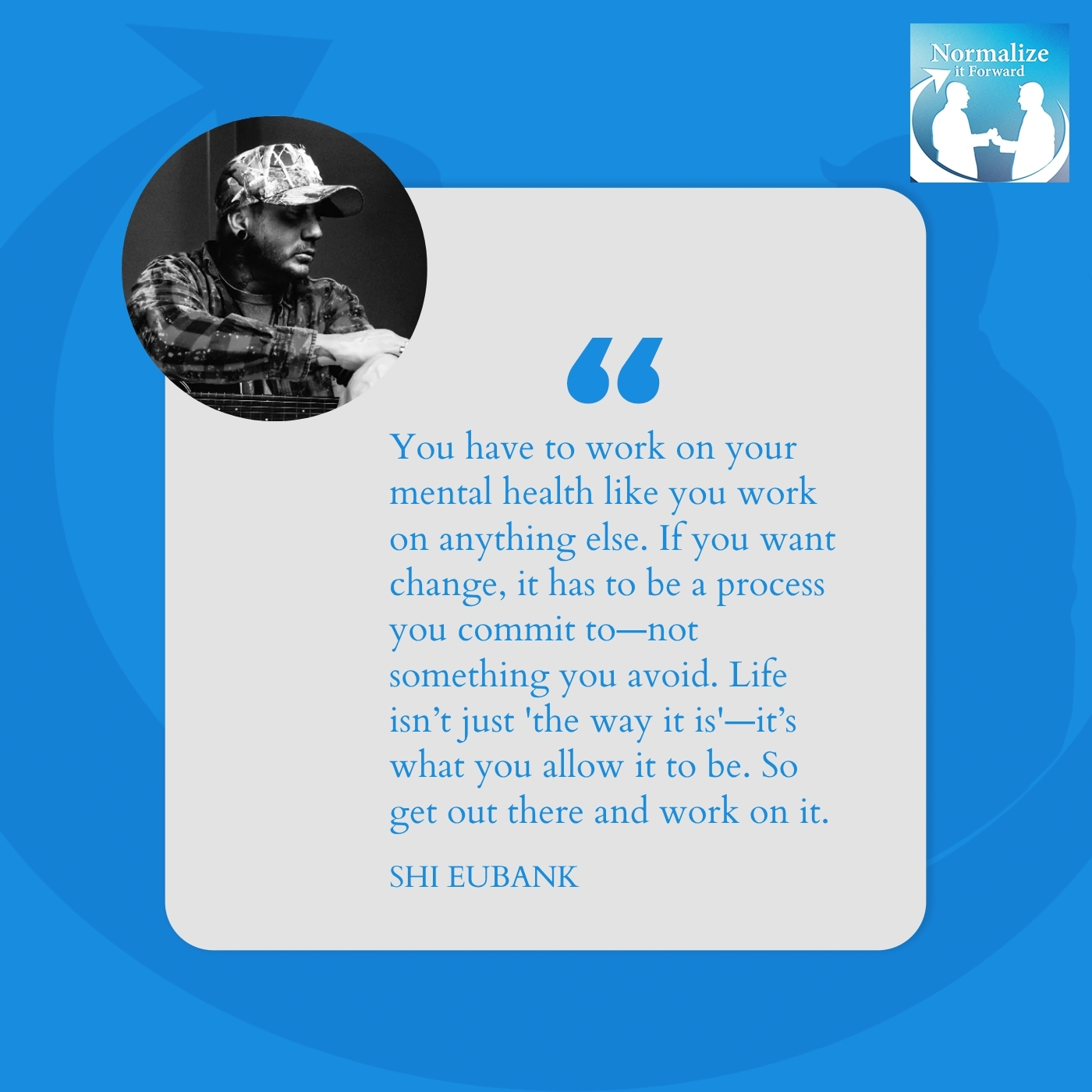
I started to go into this victim mentality and this crutch that a lot of people fall into. You have to work on your mental health like you work on anything else. Anything that you want strongly in your life, to me, needs to be a process that is worked on and needs to be something that you don’t avoid. You don’t just sit there and say, “This is the way my life is.” You are allowing your life to be like that. You’ve got to get out there and work on it.


Normalize It Forward - Marc Lehman | Shi Eubank | Limitless Potential


Well said. I have to pick up on something you said earlier. You were talking about building your self-worth, and that freeing you from judgment from other people. That is so important. You made it. There’s a transition from listening to everyone to listening to nobody and working on yourself. That’s worked out for you. It’s great advice. It’s quite a story. In many ways, your success should be a role model story for young people to recognize. One of the areas I talk a lot about in this show is social media. I find that so many young people are so obsessed with how they’re viewed on social media, who’s viewing them, who’s liking them, and who’s following them that they start to lose sight of themselves.

I agree.

I’m glad you brought that up. It’s a tremendous suggestion. The concept of how you internalize that and then shift it from listening to everybody to listening to nobody, and the change that comes out of that is huge for people. I appreciate you putting that out there. I’m wondering in terms of what you do as a musician. You’re around your businesses, and you’re around your music. You captured how they intersected when you sold a business, and it gave you the ability. I’m wondering. Where would you say your real passion lies?

The Drive For Music & The Fine Line Between Quitting & Resetting

100% music. Everything in my life is to be able to afford to play music. It doesn’t matter. It’s been a wild ride. We toured forever in a fifteen-passenger van. We toured around, playing with every rock band out there, from Sick Puppies to Shinedown to Papa Roach. You name it, we played with them. We shared the stage with them, as well as arenas.

We were driving around in a fifteen-passenger van. We were so broke. We were warming up raviolis in the motor of the van. It was going from that to going, “This isn’t it. I need to take a step back and punt.” That’s another thing. A lot of people are afraid to hit the reset button. They’re afraid that they’ve traveled this far down the road, and that if they let something go, it’s gone forever.

There’s a fine line between quitting and resetting. I had to take a reset. I was like, “Why is this not working?” My song sucked. We could get up there like Chuck E. Cheese and dance around on the stage all day long, but we weren’t connecting. I had to look at that, and then I had to look at, “How can I afford to push this music?” It takes money.

I was then like, “I want to be on the road. I know other artists out there are craving the same thing.” That’s when I built a roofing company. I built a community that was able to support each other. Guys would go out on the road. Other people would pick up their workload while they were gone and split commissions or whatever it had to be. I developed a system. It was selfishly made at first because it was so that my bandmates and I could go in, afford to be out on the road, and not be stressed out when we came home. Our lives were falling apart, and we were trying to pick them back up.

Good for you for doing that. It sounds like a rough way to live and a much easier way to live. It takes a lot of grit, I’m sure, to get there.

I would get up at 6:00 in the morning, get out there, and work construction until 3:00 or 4:00 in the afternoon. I would then get out, go to rehearsals, get out of rehearsals, take a nap, and go in at 7:00 or 8:00 at night to wash FedEx trucks until 1:00 in the morning. That was six days a week. The other days, I would pick up any odd work I could to build up the bank that it was going to take to start progressing.

Good for you.

You’ve got to have that drive. If you want to change, you can’t look at everybody else and what they’re doing because their path is different than yours. I went to 15 or 16 people, trying to get a loan. I was like, I can take $100,000 and turn it into $1 million. Loan me $100,000.” Nobody would give me the money. None of my friends was doing well for themselves. At first, I was like, “It’s because of my neighborhood where I came from, and where I grew up. It’s because I grew up in Raleigh. They don’t trust me. I’m some poor dirtball kid.”

You’ve got to have that drive. If you want to change, you can’t focus on what everyone else is doing. Their path is different from yours. Share on X

My aunt had told me this. She said, “If one person says something, it may or may not be true. If everybody has the same story, then it doesn’t make it true, but you should at least look into it.” Everybody was denying me. I had this victim mentality. I had to take a step back and go, “I’ve never turned $100,000 into $1 million. There’s no proof that I’ve done this or that I’m able to accomplish this. Why should they give me their hard-earned money?”

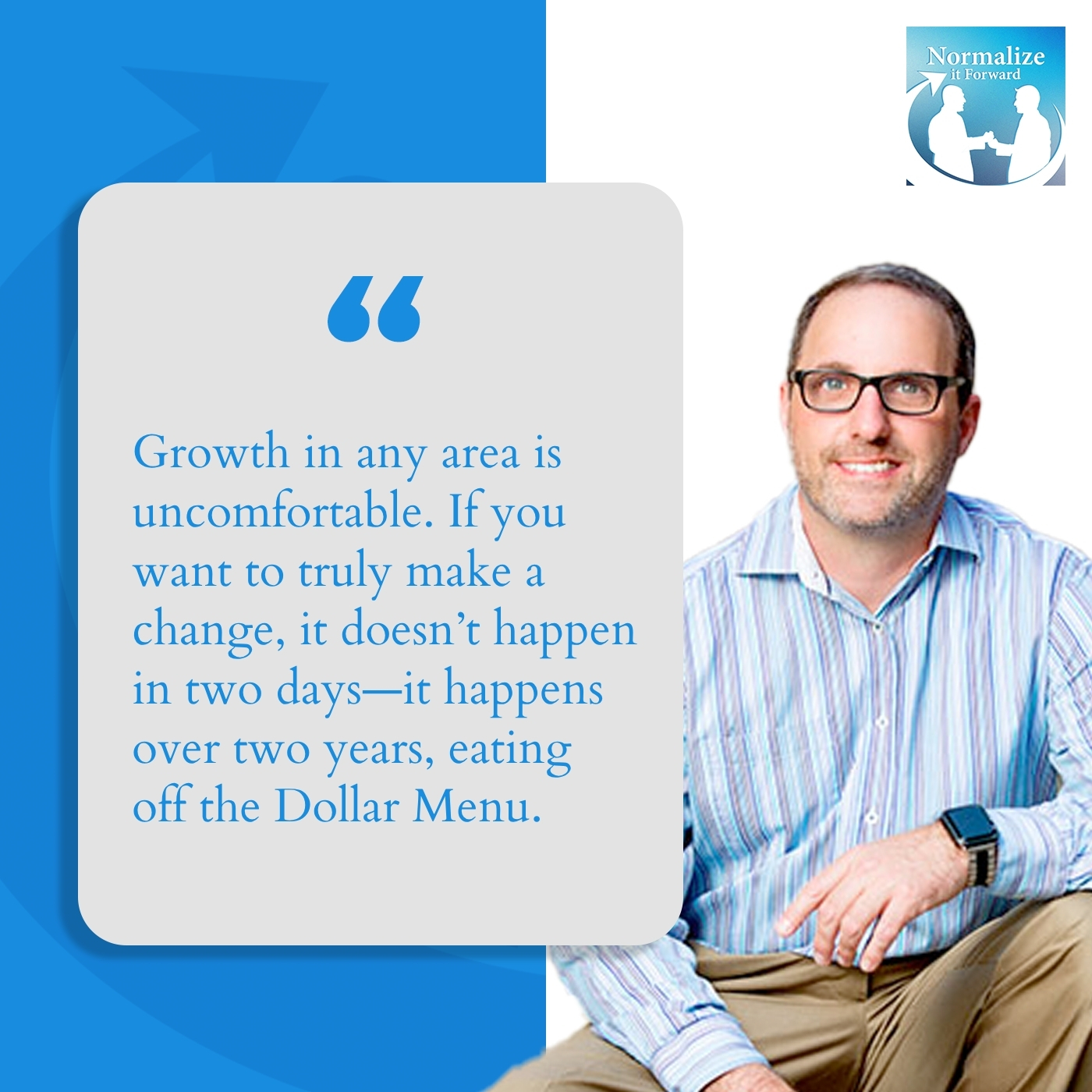
I went in and figured out, “How do I get a loan? What do I need to do for that?” I worked for two years to afford to do it. I put myself on a regimen. I ate off $5 a day at the same McDonald’s for 2 years straight. I did not falter from that. It was $5 a day, same McDonald’s off that Dollar Menu, same one every day for two years straight. Most people start their new year, new me thing. They work for about two weeks, and they let it go. You’ve got to dedicate yourself to change. Change isn’t always easy. It’s a change. It’s not always going to be comfortable.

They’re usually not comfortable.

This is something I tell a lot of people, too. I look at stress differently. The way I look at stress is I look at it as an indicator. When you’re a kid and your hands, knees, and ankles hurt, and you look up at your parents like, “My whole body aches,” your parents are like, “Those are growing pains.” It’s a physical stress. I can feel that, but I know I’m growing.

The way that I look at stress is if I’m stressed, I’m growing in some aspect. I’m watching this happen. I’m loading this plate. I’m putting the stress load on myself so that I can become something greater. I monitor it. That takes a little bit of that mental stress off me, being able to identify what I’m putting myself through. Does that make sense?

It makes a ton of sense. It’s a great explanation for young people. Growth in any area is uncomfortable. Your dedication and your story around commitment are admirable, certainly, but it also speaks to that’s what it takes. If you want to truly make a change, change doesn’t happen in two days. It happens in two years, eating the dollar menu. Let me ask you a question. You’ve been such a good egg about this. I created your intro through a lot of research I did on my own. I’m curious about breast cancer awareness. I felt like there’s a story there somewhere, and I’d be remiss if I didn’t ask you about that. Tell me a little bit about that.


Normalize It Forward - Marc Lehman | Shi Eubank | Limitless Potential


The Impact Of Women & Commitment To Breast Cancer Awareness

A lot of the most powerful people in my life that I’ve surrounded myself with are women. My best friend, Shannon Gunz, from Sirius Satellite Radio, when we didn’t have anything in our lives, we had each other. When nobody else believed in me, she was standing beside me the entire way. My previous manager, who is a great friend of mine, Tracy, was amazing in helping move things forward with me. My aunt committed suicide, but she was my best friend growing up. It is what it is. She was a huge part of my life.

I’ve been surrounded by all these positive women throughout the years. My right hand, Lisa Foster, I couldn’t operate without this woman. I could not function day-to-day without her. She is me. She knows more about me than I do. Breast cancer has been ravaging the lives of women forever. I want to do a record where all the features on it are all female features, and then we take all the proceeds from that and donate it all to breast cancer awareness.

I love it.

That’s in the works, too. We’re working on a ton of stuff, but that’s a passion project of mine that I’m not going to let go of until it manifests correctly.

Good for you. That’s awesome. That’s such a great description. You’ve had a lot of mentors, a lot of friends, and a lot of family in your world who are females. That’s a wonderful, charitable contribution to make. That’s an awesome story. You’ve mentioned your aunt. I’m curious. She sounded like an impactful individual in your world. Unfortunately, her life ended that way. I want to ask you a little bit about that. What can you tell us?

Learning From Loss

I’m completely open to talking about it. I have a song on the record called Juliet that’s going to be coming out, which speaks to it. My aunt was my best friend. She was obese. She lived with my grandmother. She only had sex once in her life. When she did, she got pregnant, and then that guy left her with a baby to raise. There was no father figure in my cousin’s life.

My grandmother and my aunt were more like sisters than they were mother-daughter. My aunt was always in my life. Everything that I did, she was my biggest cheerleader and biggest fan. In my failures, she picked me up, brushed me off, and stepped me back out there. She wasn’t the nicest at all times. Sometimes, she gave me that tough love, but it’s what I needed. She was my best friend.

Through the years, as you get older, you start to separate from your parents and some of your loved ones as you venture off. You’re becoming an adult yourself and figuring things out. She was having a hard time with that because my cousin was growing up, getting out of the nest. They were going through those tiffs, as mother and daughter do.

My grandmother got sick. She was in her later years of her life. The only asset they had was their house in Frazier, which is not the greatest area. They had to sell it to be able to try to take care of my grandmother. They moved into an apartment, and my grandmother passed away. My uncle also killed himself. That’s a whole other story. Her brother passed away. There was a lot of that going on and a lot of emotions.

After my grandmother passed and my cousin was out, she was by herself most of the time. Life was splitting things apart, and she was lonely. We’re young, and we’re growing into the adults that we are. She didn’t say anything. She held it all internally. She kept it to herself. We had no idea that she would do what she did. I feel bad that we didn’t check in more. That has been in my head. I don’t allow myself to beat myself up about it, but I can’t lie and say that it hasn’t emotionally struck me, feeling like I could have done more.

She started driving a short bus for handicapped kids. Due to her obesity, she had diabetes. That was the only thing that kept her going. It was the fact that she would get on this bus and help all these little kids through their elements. These were kids who were getting picked on at school. She coached them and said, “It’s okay.” She had a huge heart.

Since the diabetes kicked in and they took over, she started to go blind. She could no longer drive the school bus. She overdosed on her insulin and killed herself. It was pretty tragic. It taught me something. I didn’t go away from that with nothing. Everybody out here is looking at these Instagram people, and they’re like, “We have to be like this.” It’s messing with them mentally that they’re chasing this possibly unattainable goal in their heads.

Everybody out here is looking at these Instagram people and thinking, 'We have to be like this.' It’s messing with them mentally. They're chasing a goal that might be unattainable. Share on X

You also look at the other side of things. Maybe people are hiding things that they shouldn’t be, like my aunt. I’m getting chill bumps. She was one of the best human beings in my world and one of the most impactful in my world. I didn’t let her passing go in vain. It’s taught me a lot. Those are the things that I carry forward, like you show. I’m appreciative of being on this show. Thank you for letting me voice this.

We’re appreciative of you being here. She sounds like an amazing person. Suicide is a topic that comes up all the time on this show. I feel like so many people have been impacted by loss, and so many people have gone through their own story and their own journey. There needs to be learning. There needs to be a conversation.

One of my biggest pushes to create this show is to get out there and talk more about mental health issues. The fact is, most people have something they’re dealing with. To me, there’s no shame in talking about it, connecting with people, and letting people know, “I’m human. I have flaws.” We all have flaws. I’m so thankful you had the years you had with your aunt. We would’ve loved more, but I’m thankful she was such a wonderful human being in your world.

A lesson that we can all learn is to check on people even when you’re not sure if they’re all right. It could be throwing them a, “Are you all right? You don’t look good. Is everything all right?” We’ve got to get more comfortable with that. If someone is not all right, they have to get more comfortable with saying, “Shi, I’m not in a good spot. Can we grab a coffee or something?”

People will be there for you. I find it remarkable that I’ve heard stories over and over again over the years about that. People call a friend, and immediately, they put the brakes on and are like, “Let’s go. Let’s meet right now.” To me, there’s nothing more important than your safety and your health. I appreciate you telling that story. I’m hoping that young people read it. I know it is a little cliché when you hear people say, “You’re never alone.” You’re not. You shouldn’t be. There are good people out there, like you, who can help, listen, and be there.

I appreciate you spending time with us. I know you’re super busy. One thing I’ve learned by talking with you and me as a music listener is that you have this image of music artists and athletes, in particular, for me, and I don’t know why, that they’re not human, and they don’t have problems. You then come to find out they have as many problems as we do. I appreciate you being so down-to-earth about it.

In that vein, I wanted to ask. Part of the conversation of normalizing it forward is me continuing to push the conversation forward and continuing to try to have good people like yourself on the show that people will be interested in. People want to hear your story. They want to hear your background. They want to learn from you. I always ask people to nominate a friend, a coworker, a relative, or someone that you know that you think my reader might want to know. What do you think? Any thoughts?

I have a business partner of mine who has a very interesting story. He comes from the streets, drug dealing, and all that crazy background. His dad was part of the cartel. He has a very interesting story and would be amazing for the show, so that people could see that there’s a way out. He has gone on to do incredible things. He’s got multiple businesses running. I got him when he was 23 years old. He’s a multi-millionaire now.

I would love to talk to him. If he’s willing, I would have him on the show. It sounds amazing. It sounds like he has his own story, as we all do.

He’s got a wild story. It’s super relatable for people. There are a lot of people out there who hide what they’re doing or what they’ve done. It goes back to that sheer honesty, and then understanding that the road you’re on now isn’t the road you have to be on forever. Only you can change that.

I appreciate those words. That’s a good place for us to end our conversation. That’s great advice. It was super talking to you. It’s great to listen to all your new music. Honestly, you have a huge fan up in Connecticut here. I can’t wait for the rest of the songs to come out so we can all listen to them.

Let’s go.

Thanks again. Have a great evening.

Take care.


Important Links


About Shi Eubank

Normalize It Forward - Marc Lehman | Shi Eubank | Limitless PotentialShi Eubank is a country‑rock singer-songwriter and producer from Memphis, Tennessee. He Blends gritty Southern storytelling, hip-hop cadences, and rock energy.

He gained early recognition as the frontman of Savage After Midnight (S.A.M.)—-he is now a solo artist, and has released independent singles in 2025 including “Bar Back” and “None of My Business.” His lyrics capture raw life experiences—from growing up in poverty, to personal resilience—rooted in authenticity and storytelling.

Shi combines his raw musical talent with relentless entrepreneurial drive—he owns eleven roofing companies , a genetic-testing firm, a river-tubing outfit, five cabins, a sunglasses brand, FAKE apparel, and is collaborating on a distillery.

Charismatic and unapologetically bold on social media, Shi’s persona—belies a deep respect for women. He emphasizes that the powerful women in his life guide and ground him daily. Beyond music, he’s committed to giving back : a forthcoming album will donate all proceeds to breast cancer awareness in honor of friends affected by the disease.

With over 30 songs written and new projects always underway, Shi Eubank is more than a country singer—he’s a multifaceted entrepreneur, artist, and survivor who continues to challenge expectations and live fearlessly.


Reading about mental health is hard. Let’s schedule a free consultation.
Normalize It Forward - Marc Lehman | Rob Thorsen | Shoulder Check Foundation


In a world where genuine connection can feel scarce, understanding the power of empathy and vulnerability becomes essential for mental health and wellness. In this episode, we dive deep into the transformative work of the Shoulder Check Initiative with founder Rob Thorsen, who shares the deeply personal story behind its inception and its mission to encourage authentic human connection. Rob explains how the foundation, inspired by his son Hayden, works to dismantle barriers to vulnerability and promotes checking in on one another as a powerful tool for mental well-being. Discover how their innovative approaches, including a unique emoji and community events, aim to create a world where “making contact” is not just a tagline, but a way of life. Join us as Rob reveals the simple yet profound message that everyone has a hand to give and everyone might need a hand, inspiring listeners to embrace vulnerability and build stronger, more supportive communities.

Reading about mental health is hard. Let’s schedule a free consultation.

Watch the episode here


Listen to the podcast here


The Shoulder Check Foundation Story: On Loss, Inspiration, And Making Contact With Rob Thorsen

Welcome, everybody, to the show. This is the show that talks openly about mental health and wellness. On our show, we’re joined by Rob Thorsen, founder of the Shoulder Check Foundation. Welcome, Rob. How are you?

Excellent. Thanks very much for having me. I appreciate it.

Kicking Off The Conversation: Rob Thorsen & The Heart Of Shoulder Check

Thanks for being here, Rob. I would love to start things off if you could maybe tell us a little bit about the Shoulder Check Foundation that you run.

For sure. It’s just the reason that puts us together here. I give you the context for what we’re up to. Our program is called The Shoulder Check. We’re more formally the HT40 Foundation, where we started, and we’re on a mission to help young men and women make contact with one another. It’s pretty straightforward. The best way to say what we’re trying to do is you never know who might need a hand, but we all have a hand to give. Our thought was that the more people we can get checking in on one another, the more likely we are to catch someone who needs some support and give them the space and permission to say they need it.

What a great way of saying all of that. That’s fantastic. I’ve definitely looked into, on my end, a little bit about your foundation. I’m so impressed with what you guys do and all of what you just said. I agree 100% with absolutely everything you just mentioned. Tell us a little bit about how it came together.


Normalize It Forward - Marc Lehman | Rob Thorsen | Shoulder Check Foundation


Unfortunately, a lot of things sometimes take their inspiration in moments of tragedy, and that thing. My son Hayden Thorsen he’s the HT40 and the HT40 Foundation. His number was 40. He was a hockey player. He died by suicide in May of 2022. When he passed, of course, the world turned upside down, and you don’t know which way to go.

As we were navigating that, there were a lot of conversations that were happening at the time, whether it was parents related to us or kids asked us directly, they said, “Who’s going to do it?” Hades did for us now that he’s gone. It just took not very long to realize that what he did was put his hand on people’s shoulders. That’s what he did. He was a hands-on shoulder guy. I happened to be walking down the stairs in my hallway, just like everybody else.

You got all the pictures from babies all the way up to the current moment in time. As I scanned them one day, I looked across them. Since Hayden was three years old, there wasn’t a photograph where he didn’t have people around him within his arms. That’s literally what he did. He put his hands on people’s shoulders.

That became the point of inspiration for what we’re doing here, which is nothing more than I like to think Hades would have been doing himself if he were with us, which is just look after people, put hands on shoulders. What was so striking about that for so many people was like, “There’s a big guy.” He was an athlete, he was all that stuff. He was sixteen-year-old, 6 foot 3, 200-pound guy. He had a presence that most people didn’t have.

You would notice him, but you remembered him because even though he was the big guy in the room, he was the one who was just aware of where other people were. That made an impression on a lot of people, and obviously on me and in my life. He is then, in turn, the inspiration for what we’re doing here. He was the check-in guy, and we’re trying to help spread that and teach other people how to check in.


Normalize It Forward - Marc Lehman | Rob Thorsen | Shoulder Check Foundation


First of all, so sorry for your loss. Really, a tragedy. He sounded like an absolutely amazing human being who, in so many ways, as I talked to parents, Rob, reminds me of that adage of like kids teach parents so much. He sounds like he was an inspiration. I heard you say on an interview once that you guys are working at bringing vulnerability and connection closer together, which I think is awesome. I think it’s such a great way of saying.

Selling Kindness: How Shoulder Check Is Shifting Mental Health Awareness

Thank you. I appreciate that. That’s what we started by saying, like there are a lot of great organizations in the world working to help bring mental health and wellness to the fore, and helping in moments of crisis. By career, I’m not a practitioner. I obviously couldn’t identify a moment of crisis when it was right beside me. I’m an advertising guy. My background is in marketing and advertising. I used to run an ad agency.

That’s the path that led to how we got to this idea, and why it’s built the way it is, and what we’re trying to do with it. Another thing that happened around the same time, we were going through the first few months of this, I happened to be working with an organization in my professional life, a national organization that is about health and wellness, empowerment, so on and so forth. I was having a conversation, just looking for what should I do.

The person I was talking to said to me, it sounds harsh, but it took me a second to turn a harsh statement into a positive thing. She’s like, “You need to leave this to the professionals.” I was like, “What does that mean?” I reflected on it, and it was like, “You’re right. I am not a mental health practitioner. That’s not my profession. I’m a marketer, I’m an advertiser, a brand builder.” We just pivoted, and we thought like, “What if we could build a program or a brand that was based on selling kindness and empathy,” for lack of saying it.

There are a lot of organizations out there, and you know the language, it’s starting to come into play, breaking down stigmas and all that good stuff. Saying things like “You are not alone,” or “It’s okay to not be okay.” The thing we realized is that a lot of that messaging is still putting the burden on the person who is struggling to raise their hand and break through that and say, “I need help over here.” That’s that vulnerability thing.

Our thought was that if we could enlist everybody into the conversation, get more people checking in, it’ll make it that much easier for the person who is struggling to hopefully say or to answer that question honestly. How many times in my life, if you’re just saying about “How you’re doing today” like 99 out of 100 times again, “I’m good, man.” There have been a lot of times where I’ve not been good over the last few years, and very seldomly would I ever actually share that. Even that was a personal experience with it, just creating space.

Now I find in doing this like that’s what the Shoulder Check is there to do is get everybody involved to help give permission to be vulnerable. Every time I go somewhere and have a conversation, now I’m amazed by the conversations I find myself, whether it be like between you and I, between me and adults, peers that I’ve known my whole life, or even more powerfully with the young men and women that we’re building this program for. It’s been pretty incredible.

It’s amazing, Rob, and you’re touching lives. I think you’re being vulnerable. I’ve always said, know, “Vulnerability breeds vulnerability.” When you put that out there. I have to clarify, too. I am a practitioner, and I’m the first one to say. The amount of people out there that are suffering is up here. The amount of us was down here. Not enough of us. Guess what? Maybe people disagree with me on this. I don’t really care, but we’ve got to band together.


Normalize It Forward - Marc Lehman | Rob Thorsen | Shoulder Check Foundation


There are things you can offer. I cannot. There are things I can offer. You cannot. I think together, we’re stronger. What you’ve tapped into here, and I’m so glad you have, is that notion that’s being overlooked. Especially men, how many men, when they’re approached, how are you doing, just give that canned response. When the harsh reality is that if you look at the statistics, most people are dealing with stuff.

That tracks back to that it was in 2021 or spring of 2022, then the surgeon general published that study said, “We’re dealing with this crisis of loneliness and isolation.” That’s where we anchored our idea. I think about it in terms of being like pre-intervention or upstream from intervention, trying to catch a few more folks before they slip through the next level. I know it’s been more in your professional parlance than in mine, but like this notion of like paths of despair.

That’s their first step. There’s the sympathy of starting to feel alone or depressed or suffering from anxiety that then manifests itself in different paths. Anything you force in is going to come out one way or another, whether you want it to or not. That could be behavioral. It could be an addiction. It could be all those types of things. God forbid, suicidal ideation, thoughts, so on and so forth. Our thought was if we could just maybe try and lend a hand, for lack of a better way of saying it.

Anything you force in is going to come out one way or another, whether you want it to or not. Share on X

A little bit further upstream and hopefully just maybe clock a few spots where people could use a hand. Of course, the job to do there is to bring in a professional or to get a parent, a teacher, or to get somebody on the phone, all those kinds of things, because we’re not qualified to solve the problems. If we could identify a few of them before they get worse, I think that would be a positive contribution.

Reaching Out Before It’s Too Late: Making Contact & Building Connections

Life-saving, huge. I think you said it well, Rob. For so many of those kids, they’re alone and they’re alone with some monstrous ideas that are way above their pay grade. My feeling is that you said it best when we first started talking, any individual is able to lend a hand. I’ll tell you, when you reach out and you have somebody look back at you and go, “Nobody’s ever asked me that, or I really appreciate talking.” Anything like that. It feels good to help. Many individuals out there all they need is an ear. Someone to listen to them.

Just get that conversation started. Our mission, we would give ourselves as the HT40 Foundation, that of course gave rise to the Shoulder Check, is to create as many ways as we can come up with and put them out into the world to help people make contact. We say, “Reach out, check in, make contact” is our tagline. Making contact is like the most important language we have in what we’re up to.

If we give that as our mission or our brief to ourselves and a very fortunate in all the people that have come out and helped build the Shoulder Check so far, whether it’s my son’s world of hockey, which we’ve got support all the way up to the NHL there to my and my wife’s professional network where we have our previous organizations, ad agencies who’ve been giving themselves to this pro bono for years now. Everybody is just pitching in to create ways to help people make contact.

It’s awesome. Can I ask, because I’m interpreting that phrase, make contact, and I’m thinking in my head, in some ways, both for adults and for kids. I know you mean literally touching base, but I guess I’m wondering, tell us a little bit more about where that space is, make contact. Tell me what you mean.

When this idea first started, I literally had made some notes in a notebook and a little tiny bad sketch because I couldn’t draw anything.

Me too.

There are just two people sitting side by side. One person had a hand on the other person’s shoulder. On one side, it said, “I need a hand.” The other side said, “I have a hand to give.” That idea, that we are both always in both of those roles. We are capable of extending a hand, but also always in need to whatever extent. This idea of a hand on a shoulder, I think, is really powerful and universal. Insofar as a hand on a shoulder can be everything from like, congratulatory, and celebratory, without having to say a word, to encouraging and motivating.

We are capable of extending a hand, but also always in need to whatever extent. Share on X

Pat it back like, “You got this” without having to say a word, to also in a moment of consolation, without having to say a word, meaning I’m here for you. Much can be conveyed in such a simple way without ever having to search for the words, but saying everything that needs to be said in that simple moment. I mean that literally, but also figuratively, of course. Social media, it’s of course a hot topic, and there are so many things that are wrong with it.

There are so many negative, detrimental impacts and effects, but at the same time, surely there’s a way to build a positive community in that space. We can use it to do that. Maybe they’ve built platforms with bad algorithms that take you down rabbit holes that you shouldn’t be going down. Let’s not do that. Let’s find a way to make it turn in a positive way and build a community that way.

Last year, we launched an emoji that we created, which was the make contact emoji, which was just a hand with a little blue heart that would let you start conversations that you could read and see it. It means like, “You’re thinking about me in a more meaningful way,” than a thumbs up or, let’s give that meaning and let’s use that as a way to start conversations.

We’re working on new things now with our creative partners, where we hope to launch new things again this year. We have our flagship, which is coming up. Our flagship event is called the Shoulder Check Showcase. It’s in Stanford, Connecticut. We have about 2,000 people come out, and we have 30 NHLers and PWHLers who come out. We play this charity hockey game, but this whole thing came together originally.

This will be our third year now. The first year, we invited 2500 people in, and it was an experiment. Before the main game started, our host, or MC, was Dave Maloney’s former Raider Great came out and we created this moment where we asked all 2500 people to put their hand on the shoulder of the person next to them and do like a call and repeat. I promise to reach out.

I saw the video. This was great, powerful.

It was. It was a bit of an experiment, but it was a learning for me. We all experienced it in real time together because no one knew that that was going to happen. It changed the mood in the building. Incredible. Even people walking out, they were like, “What?” It was palpable. I think it just proved to just the power of genuinely connecting with someone. Mostly strangers talking to strangers. I cannot tap your shoulders. It was a cool moment.

That’s what we try and replicate in everything we do. As I said, both figuratively and literally. As the check spreads and we’ve touched, I don’t know. I was just making a list because you’re always updating your stuff and you’re emails and website and whatnot. I’ve got a hundred entries now of different programs and organizations. Every one of those programs is touching between a hundred or a thousand people. A lot of people are putting a lot of hands on shoulders.

A lot of shoulders, Rob. That’s great. That’s amazing. Let me just, let me just ask before I skip over it, how can people get involved? You mentioned you’re big.

Our website is just ShoulderCheck.org. We’ve got a section in there. It says, “I want to bring the Shoulder Check to my community, to my team, to my organization, to my school.” Everything that we’ve done is archived there. You can see what everyone’s done in the past. That website is just meant to be a place for inspiration. You can see how other people are using it. There are some downloadables and instructions.

You could bring it to, like I said, whether it’s a team, whether it’s a town, whatever. I say this a lot, like the Shoulder Check, it’s an interesting place to operate. My one point of reference for what I hope the Shoulder Check can be, aim high. It’s my number one. Everybody knows the month of October, the world turns pink and Susan G. Komen raises hundreds of millions of dollars annually for cancer research and health issues.

The other guys from November who took the lead there and said, “Let’s do that for men’s health initiatives in November with the mustache and the color purple,” or whatever that is. Our thought was like, “What if we could turn the world’s blue aqua color of ours in September and let that stand not necessarily for raising money for kindness, but raising awareness for one another.” The Shoulder Check should be the thing where it’s an ingredient, and you can use it however you see fit. Like, “I could bring that to my band. I could bring that to my part-time job.

I could bring that home and talk about it at dinner.” It can go anywhere anyone wants to take it. I talk about it a lot. A story has a beginning, middle, and an end, and an idea has a beginning in that it evolves. This is an idea. It’s not a story. It’s to evolve based on whoever gets involved in it. It’ll go where people are compelled to take it. It’s our job to help support that, not tell people what to do, but rather, hopefully inspire them to see ways they can use this in their own way.

Beyond Words: Emojis, Vulnerability, And Teens Talking It Out

What a great concept. What an amazing concept. I want to go back to one thing you mentioned, Rob, that I think I want to highlight just for a moment for my readers. You talked about creating an emoji. I had the thought when you said that, I’m like, “Many teenagers are worried about their friends.” Yet they’ll come into my office and they’ll tell me about it. I’ll say to them, “Have you told anybody?” “No, you’re the first one I’ve told.” There’s that awkwardness.

There’s that notion of like, “We’re two teens and I’m worried about Rob. Do I say anything to Rob? I don’t want to upset Rob. I just don’t say anything.” Yet an emoji is such a great way to communicate care and concern. I just want to highlight that for my readers that teens clearly communicate differently than we do. You guys have figured this out. In many ways, it doesn’t matter how you communicate. As long as you’re communicating, as long as you’re letting that person know, “I’m here and I’m concerned about you.”

I came to this line of thinking for myself and for what we’re doing here. There’s that duality that exists. You can think your way into a new way of acting, or you can act your way into a new way of thinking. Sometimes I just find myself here doing this, or people asking questions, or like, “Could you come speak to XYZ?” It’s not my goal to be any speaker or to be in front of this, but I do understand that there are times when I have to maybe help people take the first step. That’s cool.

You can think your way into a new way of acting, or you can act your way into a new way of thinking. Share on X

I’m there for that. I had the chance to go speak to a high school about two weeks ago or so. There are about 1200 kids there, which is great. I’m thinking to myself, “What an opportunity to inspire people with this idea.” It also had me thinking, of course, like, “This is a slightly different room than we’ve brought this message.” We’ve done it all over the place, with large groups and small groups and that stuff.

This was the first time it was in this type of high school setting. I got to thinking a bit about like, “What’s different here?” I think the point you were just making is like anything else, communicating in this way or being able to broach this topic, it takes practice, and you have to learn how to do it again. I was thinking, “Now this is a, a learning environment. Let’s practice this. Let’s learn how to do this.”

They had this cool thing going on where I just had 1200 kids turn to one another. I was like, “Repeat after me, but don’t say it to me, say to the person next to you. I could use a hand, like say the words out loud, like practice it, build this skill, and the strength. Just like we study for a history test or we go to a sports team practice or band practice or whatever, like we have to learn these skills.” Of course, for a lot of us, the ability to express oneself is innate.

Just go back to the three-year-old on the ground in the supermarket who wanted the Fruity Pebbles and could not have them. Nothing is holding that kid back from it, just all coming out. Obviously, that’s what we lose over time when we become more self-aware. We worry about what other people think. That’s where this notion of being guarded, not allowing the vulnerability, and that stuff. I was just thinking like, “We just got to relearn those skills. We’ve got to practice them.”

We have a lot of stuff in our toolkit now. We have these little cards that we bring with us everywhere. “Did I check in my loved ones?” This was something we did with PWHL sirens, but now we do this virtually everywhere we go. It’s just another way for people to practice, like saying these things and using these words or getting comfortable stepping into those moments, like you’re saying, like, “Are you okay?”

Like, “I have a hand to give.” Give people different ways, tools, and access points to relearn the skill. That was a bit of a breakthrough moment for us because this idea of like having to relearn something that we intuitively understand, but lose time. Even now, for us, more self-actualized adults, like you, come through that, and you become a little bit more comfortable with who you are and expressing yourself. Even there, it doesn’t always come back easily for everybody.

As you said, it is a skill. It’s something you build up. As a therapist, I’m practicing every day talking to people. I have to periodically remind myself, “Everybody is in a different space when it comes to this type of stuff.” Probably one of the best compliments I’ve heard and it meant a lot was when I first started this show, I got an email from a mom and she was thanking me that we had done a show and she expressed in the email that she was able to talk about the topic of mental health with her fifteen year old because they listened to it in the car on the way to practice one day.

I thought, “How cool is that?” We’re normalizing the conversation. We’re helping people understand the importance of instead of avoiding the subject, let’s talk about it. Let’s talk about it in a comfortable way. Maybe talking about it means reading this blog. Maybe it means practicing some skills so that they can give a presentation that you did. To me, it can be nothing because life keeps moving, and kids are dealing with a lot of stuff nowadays. They’re just dealing with a lot.

That’s what I think, too. I see it each time we have the opportunity to go and talk to people or share the message. It’s the kids that are carrying our idea forward. Of course, there are a lot of great supportive adults and coaches, and administrators along the way, but equally like I’ve had people in those roles say, “No, we’re not going to do this.” It’s been a kid, not to me. It’s been a kid who’s brought it forward to a coach or an organization, and they’ll know, “No, we’re not going to do that. No, we’ll have to take that to our board next year.” I think to myself, “Wow.” I’m sure that’s not just as it relates to Shoulder Check, but kids who are like stepping forward and saying like, “Here’s this positive contribution I want to make, and there are people stopping them from doing it.”

Imagine that.

I cannot get my head around it. That’s why every time, 99 out of 100 times, I default to wanting to speak to the young men and women who I know will spark to this idea and carry it forward. That’s how what we’re doing will grow, but it’s not meant to be our idea. As a matter of fact, not only was this idea, as I mentioned, inspired by my son, but in the aftermath, we had 40, 50 kids at a time over our house, and we worked on this idea together. I went to I’m in Darien, Connecticut. We have a place called the Depot, which is a place for like community. We’ve been there together and working on ideas and incredible moments that we’ve had, where we’ve just built this idea together pretty powerfully.

Reflections Vs. Regrets: Learning From Loss & Lifting Each Other Up

That’s awesome, Rob. That’s amazing. Rob, can I ask a tough question around this topic? I’m imagining my listeners might be thinking to themselves, unfortunately, you guys have been through a tragedy, and through that has come this amazing, as you said, idea. That has just touched so many. Parents might be wondering when these things do happen or when a child is starting to slide. Whether it be, let’s say, a type of depression or a mild type of anxiety, what are some things that they can look for? What are some things that they can be aware of in their world? Probably most importantly, are there some things they can do?

As you say, that is a tough question. Of course, I can only answer that. I say this all the time from my own personal experience. I don’t know better than anyone else. What is the right answer to that question? Look, if 50,000 people, young men, women, walk a path that leads to that final decision, they’ve walked 50,000 different paths. In my instance, if you made a list of 50,000 people, I think Hayden probably would have been 50,001 on that list, which is its own specific instance.

I suppose it’s also, there are commonalities or archetypes of these types of things. Certainly, vastly better than I. There is that person who struggles in silence and from outward appearances appears to have it all in control, but ultimately is dealing with something that they cannot find the space to articulate, or it’s weighing them down in some way. That was our path with it, just as blindsided as any human beings could possibly be. I’m still left searching for those very answers.

What would we have looked for or done differently? Was there something that we didn’t see? Was something that seemed totally normal at the time, not normal? Again, for us personally, there is no resolution to that question. That might not be the answer that anyone would want to hear, but it is the truth of our experience. I guess, to reflect on that, I think it just means that the thing I would say is that there, you could just never assume.

When things first happen, people send you things, and you get cards, or people find things on social media, which is even them finding ways to reach out. They’re looking for ways to make contact and support, but don’t have the words themselves. Someone at some point sent me this, like a little, maybe it’s an Instagram tile or whatever, said, “Check on all your friends, even your happy friends.” At the moment, it made me really angry.

I was like, “We cannot even trust that people are happy.” I’ve reflected on that enormously. We just cannot assume. I know certainly as will happen. I’m now part of this. I live in a world with this. This is incredible. A lot of people seek support groups, and they go to things like that. I have five personal friends in my life that I’ve known that are having the same experience they were having lost a child, that I’ve just known in my life. We were not brought together by this happening. We were already in each other’s lives. We have this support group amongst ourselves, and each of them has walked their own unique path with it.

Some folks had children who were more overtly struggling. They were on a path towards treatment, and some folks had children who were maybe on paths to addiction and those kinds of things. Every individual that have their own experience with it and my personal experience falls into the, you can never assume camp. Here’s the thing, I know as much about what to look out for as anybody else would have read an article that told them to look out for those kinds of things, or would be counseled by a professional as a parent. My learning and my experience are just, you can. There are some things that you will simply never be allowed to know.

I appreciate you sharing that. I think it really speaks to, I remember watching a documentary years ago called The Mask You Wear or something like that, Mask You Live In or something like that. It was really about males. It was really about how often we probably, as you were mentioning, like toddlerhood, we grow into this sense of not telling people how we’re doing. It’s one of the reasons why I, as a therapist, and even personally, push people to share more, not less.

If it makes a person uncomfortable to say, “How are you? Are you okay? Everything all right?” If it makes them uncomfortable, I’d rather they be uncomfortable than not cared for. That’s my attitude toward it because I feel like we’ve strayed so much the other way that we’re just going to pretend and ignore, and not pay attention to. Sometimes things happen, and you have regrets about not just having the confidence to just say, “Is everything all right?”

That’s a piece of my presentation, or talk track, or whatever you want to say, because when I try and share, like, “Here’s how you would do the Shoulder Check and draw this distinction between a reflection and a regret.” There are times where we’re just not going to get it right. Knowing that we tried means we get to reflect on that and we get to learn from it. Whereas the other side of that coin is maybe not having tried or not having done the right thing.

That’s the path to regret. Regret is heavy, man. Regret is something that’s hard to put down, because I think that’s part of what Shoulder Check is about. Again, I’m probably borrowing. In the marketing and advertising sense, we would talk about behavior change. It’s usually meant to buy a different product as opposed to we’re real behavior change, but ultimately, even if you want to just say Shoulder Check is you, if you need to put it in a box, you could call it like an awareness campaign. It’s ultimately meant to just the smallest bit, change behavior or perception or an idea to get to exactly what you’re saying to make it okay to answer that question or to ask that question.

I had the experience personally when we were going through the worst of it. A friend of mine had reached out via text, and he’s like, “I’m just checking in. Hope you’re doing okay.” You receive lots of those every single day. At this one moment, I needed to put something down, and I gave him back a text. I saw the three dots come up. Three dots come up, go away. Never got a reply. There’s no way this gentleman expected the level I put back on him. I like respect.

He gave me permission to just air some stuff. It was great. It was more than he knew was coming at him. I’m sure what am I supposed to do with that? He didn’t have to do anything. Even there. In the moment of an incredibly acute moment where we were having trouble having that dialogue, but I’m sure it’d be your experience as well. I’m on the other side of that divide, so to speak, now. I live in a different place with respect to my emotionality, my willingness, or my ability to express it.

If only because had I not found a way to do it for myself, like I was saying before, I’m sure you know, like anything you push down is coming back out somehow. This is not the thing that you can suppress what was our instinct in the immediate aftermath. Embrace is not a great word because it sounds positive, but you know what I mean? You just have to do what this is and accept what this is. It’s not easy to do, but I think that’s part of what the Shoulder Check is to us.

Of course, a bit of therapy for us. It’s figuring out your hand to see positive outcomes, or to just like you’re saying, occasionally receive some anecdotal feedback that says, “This gave me permission to speak to my child, or this gave me permission to reach out to a teammate.” That’s the hand back on our shoulder, knowing that that’s some contribution.

The Ripple Effect: How Kindness Touches More Lives Than We Know

It’s amazing, Rob. I have to say, through our discussion and just hearing about Shoulder Check, I, too, hope that perhaps it is September one day. Look, as you said, maybe it isn’t about funding, maybe it’s about awareness, because here’s something that I put out a lot, and I want parents to hear this. Sometimes I’ll hear from parents, whether it be a post that someone responds to, or someone will say in my office, “Why all the attention? Why all the attention to mental health? Why are we even talking about it?”

I thought about that a lot one day, and the difference between our generation and theirs. One of the ways I draw that line is I say, “If you have friends that are 40s, 50s, and 60s, you ask them. If you’re at a gathering one day, ask them. When you were in high school, did you ever know anybody or hear about anybody that took their own life?” More often than not, they’re going to say no. You ask a kid that nowadays, not only will they say yes, but they have a list. That’s how much it’s changed.

I guess both, as it relates to obviously an upswing in total numbers, but then even more so, the ability to talk about it now. My parallel on that one is I think back to the same deal, same generation, when we were younger, and I had a cousin who had cancer. That wasn’t something you talked about as much. Certainly had an amazing family around him.

I’m not suggesting that he suffered in silence by any stretch, but we were not standing up to cancer. We were not championing people who have fought, won, or lost that battle. Now we do. We honor them for what they’re going through, for the heroism that is facing down something like that. That’s where we’re at with that conversation. That’s exactly the parallel for where we’re at with this conversation.

It’s been there all along, but now we’re recognizing it, and we are honoring the people that are struggling, and we need to champion them as well. We need to make them feel comfortable, supported, and all those things. I’m sure ten years hence, our show, The Check, started in the world of hockey. It’s all my son’s network. He was a good hockey player. Hockey as a community is a great community that comes out and supports one another. The NHL has a program called Hockey Talks. It started with one franchise out on the West Coast, and now, like twenty of the NHL franchises participate in it.

It’s about exactly that, breaking the silence around the stigma. We’ve participated in them with a lot of the NHL franchises, the Capitals, the Rangers, the Bruins, so on and so forth. We’re just working up bit by bit. People saying like, “Hold on a second, there is strength in being able to talk about this.” That’s the right way to say it. The strength to talk about it is far greater than the strength to talk about it without saying something. We start to honor that champion that bit by bit. The conversation will just be brought more and more to the fore in a positive way.

The strength to talk about it is far greater than the strength to talk about it without saying something. Share on X

No doubt. Whether this or not, I’m going to say it, Rob. The ripple effect Shoulder Check creates, you probably don’t even know how many people you guys are touching and supporting, and helping. I commend you for all you do, all the energy you put forth. I also commend you for taking this tragic situation and flipping it, and putting a scenario out there to help many others, not only today, but also in the future. Thank you for all that you do. Please, those of you that are reading, please look up Shoulder Check, get involved.

Rob’s a wonderful human being, and there are a lot of other people involved, I know. Please do your part and do what you can to support a wonderful organization. Rob, thank you so much for your time, your energy. One last question. I’ll put you on the spot. Normalize it forward. We’re set up so that we want to continue the conversation, and part of continuing to do that is as I ask people to nominate a friend, a coworker, a relative. That’s how we got connected, actually. Would love to put you on the spot and ask anybody in your world or your network, you think would be helpful for me to interview going forward.

Storytelling For Change: Filmmaker Jake Miskin & Shattered Ice

I’m going to point you towards a gentleman by the name of Jake Miskin, who is a filmmaker. They just recently premiered their film called Shattered Ice. The film is about set in a fictitious town, but it’s based on the town that he grew up in, Needham, MA, that about 10 or 15 years ago went through having lost five of their community members.

He made this film to both tell the story of what happened, but also to deliver on the exact same mission that we’re on, which is to show people how to use the arts, to use film as a means to help people talk about these kinds of things. That film just got reviewed a little bit ago, and it’s off to a really good start. He’s a thoughtful guy who he Shoulder Check is doing stuff partnering with. He would have a cool, different perspective on using, we’re anchored in sports, he’s anchored in sports and arts and film, all trying to just bring the message out.

Love it. I’ll get his info from you offline, but I cannot wait to connect with him. Sounds like he’ll offer a great perspective for my readers. The more we get to talk about this, the better. Keep doing what you’re doing. I appreciate and support you.

I got to say thank you to you for what you’re doing here, and giving us the space and the platform to be able to share our message with you and with your audiences is an incredible opportunity for us. I’m grateful for it. Thank you, bud.

I appreciate it. Thank you, Rob. Thank you. Have a wonderful rest of your day. We’ll talk soon.

Right on.

See you.


Important Links


About Rob Thorsen

Normalize It Forward - Marc Lehman | Rob Thorsen | Shoulder Check FoundationRob Thorsen is the founder and executive director of The #HT40 Foundation and the creator of the Shoulder Check initiative. Following the tragic loss of his 16-year-old son, Hayden, to suicide in May 2022, Rob channeled his grief into a mission to combat loneliness and isolation among young people. Hayden, remembered as a compassionate individual who wore jersey number 40 as a goalie at Darien High School, inspired the foundation’s name and its commitment to fostering kindness and connection.
The Shoulder Check initiative encourages simple, meaningful acts of support—such as placing a hand on someone’s shoulder—to let them know they are not alone. This movement aims to inspire a culture of peer-to-peer engagement and social connectedness.

Rob’s professional background in marketing and advertising has been instrumental in promoting the foundation’s message. Under his leadership, the Shoulder Check Showcase, an annual charity hockey game, has grown significantly, attracting NHL players and expanding its reach to raise awareness for mental health.

Through these efforts, Rob Thorsen continues to honor his son’s legacy by advocating for mental health awareness and encouraging communities to support one another through simple, compassionate actions.


Reading about mental health is hard. Let’s schedule a free consultation.

NIF - Normalize It Forward - Marc Lehman | Melissa Bernstein | Mental Wellness


Just as we prioritize physical health, it’s equally important to invest in our mental wellness. In this episode, Marc Lehman talks with Melissa Bernstein, co-founder of Lifelines, about the importance of mental wellness for young adults. Melissa discusses the societal pressures that can lead to an existential crisis and emphasizes the importance of authentic connections for a fulfilling life. She offers practical tips for parents and educators to support young people’s mental well-being through self-care, meaningful connections, and pursuing passions. Whether you’re a college student, a supportive parent, or prioritizing your mental health, this episode offers valuable guidance and inspiration.

Watch the episode here


Listen to the episode here


Nurturing Mental Wellness In Adolescents: Melissa Bernstein’s Guide To Supporting Their Growth

Lifelines

We will be meeting with Melissa Bernstein. I’m excited to talk to Melissa about adolescent mental wellness. I hope everybody is doing well. Melissa Bernstein, welcome. I’m very excited to talk to you. I thought maybe what we could do to kick things off a little bit is talk a little bit about Melissa and Doug and then give us a little background on that. Also, certainly a little background on Lifelines, what that is and what you’re currently doing. Is it okay if I put you in the hot seat?

No, it’s fine.

Maybe just tell us a little bit about Melissa and Doug, Lifelines and what you’re doing. I’ll throw a little bit of information in about U Are Heard. I do have some questions, so certainly afterwards we’ll get into that.

Doug and I, I think when we grew up the conventional path for your livelihood was to go business or law or medicine. It was very pre-professional and we both went that path. Not because it was what our soul wanted us to do but because society was like, “Go that path.” He went into advertising and I went into investment banking of all things. After a very short time, we were both miserable. He was more suited for what he did but I am a like white space creative who loves words and notes. Numbers don’t do anything for me.

I became disillusioned and fell into an existential crisis like, “What am I doing each day?” Doug, thank goodness for him, we were dating. I was probably 21 and he was 23 at the time. We’re like, “There has to be something better than this.” We went away for a weekend in the Berkshire Mountains of Massachusetts and we decided we’re not leaving until we decide what can get us out of bed each day. We decided that we wanted to do something that involved children. Without him, I never would have had the courage to leave even though I was so miserable. I think I might have stayed there if he had given me the courage to leave with him.


NIF - Normalize It Forward - Marc Lehman | Melissa Bernstein | Mental Wellness


Awesome story and taking from that, Melissa, for all of the young people that are watching or re-watching this, pay attention to your passion. It’s important.

It’s so true. We were told, “Don’t listen to your passion. Follow what gives you a solid stable career.” When you do that, when you deny your soul, it’s going to sneak up on you and you won’t have a choice. We were just dating. We weren’t in any position. Nobody started companies back then but we pulled our meager savings and decided to make products for children.

That’s awesome. You’re very humble. Your products are and were amazing. Most people I know when I mentioned to them Melissa and Doug, they know exactly what I’m talking about and always have a story. I’m sure you’ve heard millions of them. Many amazing things that you guys created and so many homes that you impacted with a variety of things that you guys made over the years. Now, this was when, Melissa? Give me a time frame.

This was in 1988. How crazy is that? We just celebrated our anniversary.

Congratulations. That’s awesome. An amazing accomplishment and amazing business. As I said, impacting families and children everywhere. I’m curious, out of that, you’ve developed Lifelines. When did Lifelines begin?

It began in 2020. It mirrored my own personal journey because Melissa and Doug had been the most magical experience ever but it was no longer an entrepreneurial venture. It wasn’t no longer a white space innovative company because we were 1,000 people. It became like a pretty big business. We didn’t know how to do that. We weren’t good at doing that and we didn’t want to operate a big business that was beholden to a lot of different things but it happened.

We still would have stayed there. I’m sure, but it so happened that we knew that there were better people to run the company. I was also going on my own mental health journey that led me to develop Lifelines. It wasn’t meant to be another company. In fact, the one thing Doug and I said is we will never and we put never in bold caps and underlined it. We will never start another company. The fact that we are doing this again and now have like 40 plus people on our team is insane. We both are insane.

It’s passion driven and experience driven. Sometimes when you get involved in these things, that’s how they develop. Let’s talk a little bit about what Lifelines is.

Lifelines was my chapter two. My chapter two was that I had been harboring a lot of mental health issues. I am creative and that came with a very stigmatizing personality that made me hypersensitive in many different areas. My whole life, I was ashamed by those hypersensitivities because if I was allowed to do what I naturally do. I be muttering to myself like a headband in some corner because I’m an idea person. I see ideas, words, and notes in my head but I trained myself because I got a message very early.

I also ponder dark things. I go very low and have had meeting crises and fall into a nihilistic tendency, which we can talk about. It’s part of my imagining in being able to ponder higher realities. I think about meetings and deep things like that a lot. When I got the message early on that like, “Do not show that dark side to the world because nobody wants to hear it, Melissa. Go out and play and be like the other kids.”

I remember even as a toddler thinking like, “Don’t they realize I want to go out and play and be carefree?” I can’t. I’m feeling this despair that’s raging through me and nobody seems to care. I worked myself into a person that would be acceptable by societal standards. That involved three Ps. It involved pleasing, which I became the ultimate pleaser. Putting myself not even on the list and becoming a martyr serving to the extent that everyone needed me and loved how I supported them but never asking for anything in return. Which leads you to martyrdom which is a deep undercurrent of resentment.

I became a perfectionist who felt like I had to be perfect in everything, my performance, behavior, and looks. Anything short of exemplary was a failure and that leads to an otter breakdown because perfectionism is inhuman and we are imperfect as humans and then performance. I became the ultimate actress who could put on a show and convince people that I was happy, go lucky and carefree when inside I was very much the opposite.

I was able to put on that façade through my 20s and 30s. That was who I was. I didn’t even realize I was putting on a façade. That became my persona but in my 40s, right around like 2018, probably. I started feeling that cry of my authentic soul to be seen. I kept saying, “Shut up, Soul. You’re going to stay out there.” It wouldn’t listen to me. It kept saying, “I need to become authentic and I need to express my truth.” It got so loud that I ultimately went on a show and expressed this.

I started to have these revelations that I suffered from something called Existential Depression, which is like a crisis of meeting which we can talk about and I bared my soul. That led to the beginning of Lifelines because Lifelines is my memoir that I wrote after I did the show and received hundreds of the most powerful soulful letters, I’d ever gotten in my life of people saying, “Oh my gosh, you gave voice to something I’ve experienced my whole life. I’ve never had the courage to share.” I thought if I could show people they’re not alone and let them see that someone who on the face of it and looks like she has everything is still struggling every single day, even now. Maybe I can help them to find their light in the midst of a lot of darkness.

I applaud you over and over again. Number one, when you and I first met, Melissa, one of the connections I made as well, “This is such an authentic person.” I know you’ve done a lot of work in your own journey to get there. You talked about the mask that you wore or wore in the past. I think that Lifelines as well as many other things that are out there for young people are so important for individuals to recognize that we can do two things in life. We can pretend all the time or we can become our authentic self. When a person works and a lot of times goes through therapy to get to that place, it is extremely powerful. I applaud you for being as open as you are about your own journey and certainly, appreciate all of that.

I have no choice now. I’m so glad I did it. You don’t realize how exhausting it is to live a lie. People I speak with who are in a state of despair always use the same word which is exhausted and it was. It’s exhausting because you’re putting on a show to hide your truth. You have to keep yourself quiet with all your energy.

Mental Health Challenges

You know a bit about what I do and with U Are Heard, me and my stuff are constantly working with the young adults. That’s a good segue into talking about wellness because to me, one of my big motivators when I first started many years ago was looking at the statistics of how many young adults don’t get help. I was shocked at this huge gap and then started to look into why. You’d come up with things like this stigma which makes sense, a person’s stigma and the community stigma. You look at access to care and all of the things that probably don’t surprise you.

You look at the concept of it’s easier to just keep moving on or at least people say it is. I know over the years, thousands of kids that have taken a step, whether it’s an email or phone call or gone to a counseling center and they haven’t had a good experience. What do they do? They do nothing and they keep trudging. As parents, providers, and adults in the community, we’re looking at this huge population of young adults that need services and aren’t getting them.

Again, I come back to your ability to be so authentic. It’s a role model on many levels for people to say, “We’re all human beings. We are all susceptible.” I tell people all the time. I’ve been to therapy myself several times. I’ve done my own work. The second we get to a place where like, “Not me.” We’re wrong. We’re missing something. We’re all susceptible.

Moving into that topic, I’m curious to ask you. We’re living in a complicated time as you know and the suicide rate for young people has gone up tremendously statistically ten years ago is number twelve. It’s now number two in terms of leading cause of death for young people. Anxiety and depression as you know, since COVID has exponentially gone up. I’m curious to ask you, when you think about the biggest stressors that you notice for young adults. What comes to mind?

This is directly related to Lifelines because our inaugural partner is Barnes & Noble College. We’re part of their Be Well, Be You initiative which is exactly about wellbeing and tools for wellbeing. They shared a whole bunch of stats with us from inside higher Ed. They did a lot of surveys and 83% of students are saying that stress is negatively impacting their college experience.

According to that survey, they say that pressure to perform is number one. Now, I see another stat that talks about money and other things, but the pressure to perform is a scary one. When did learning become secondary to performance? It’s so insane that they’re so worried about grades that they can’t even enjoy learning about new things. It’s sad.

I know. Somewhat rhetorical I know when you said it but I’ll answer you by saying when I look at middle school and high school kids, it starts way back then. Where there’s this concept of, if I’m not taking 5 million AP classes. When you and I were in school, straight As was a 4.0. That’s like average now. It’s like I get a 4 or 6, weighted, and unweighted. There’s all this terminology. To me, we live in a bit of a world where good is not good enough.

It’s so true. We’ve gotten so caught up in the extrinsic that the extrinsic, the things we do for joy in meeting are completely lost. I have six children. I have had the children experience. We had a bunch of six graders over. I remember they were like sitting in a circle and they were talking about the pressure they felt to get into college.

They’re in 6th grade.

I was like, “Oh my Gosh, are you guys feeling that?” They were like, “Yes, we’re so terrified.” They’re like, “First, you got to get in the honors classes then you got it.” They already had the path and it looked more terrifying to them in 6th grade. In Melissa and Doug, I talked a lot about play and how play became something that parents didn’t believe in because it wasn’t a skill that you could put on a resume and this idea of making these children adults.

When they’re now little kids, we’re professionalizing everything they do and making it into these route scheduled activities. We’re basically taking the joy out of life. By the time they get to college, they’re burned out and exhausted. A lot of them are depressed because they don’t even know who they are and what they want to do with their lives. They have no passion for anything.

It’s funny you should say that because I often thought in my town, when I was younger in 6th grade, we went up to the junior high school and then recess was gone. People would say, “How was school? How was junior high school?” I said, “It stinks because I miss recess. That was like my favorite time of the day.” Back then, you’d ask kids and that’s what they’d say. They’d say recess, gym or lunch. Nowadays, it just gets absorbed.

I’ve met kids in Junior High School, 7th and 8th grade where they’re not taking lunch. They’re taking a class. The concept of, I like how he said that it’s very accurate, we’re taking away the fun. I worked hard as a therapist when I’m talking to kids. We do four things. There’s a formula I developed when it comes to college. There are four things that all kids need to do in order to succeed and have a smile on their face.

It’s funny, Melissa, two of the four things are so social. When I talked to parents about that, they’re aghast like I’ve got academic in there. That’s one, but I want kids to have fun. I want kids as human beings. We need to find a way to let the steam out and enjoy ourselves. Otherwise, we become anxious, depressed or both.

One of the most profound things I’ve read is the surgeon general’s report on loneliness. It came out a few months ago and said that loneliness is an epidemic. If you read his report, I suggest everybody read it. It is so mind blowing. The group that is the loneliest is 18 to 24 year olds in the throws of college. There’s a whole process and I’ve written a practice for myself called practice makes purpose, which talks about you can’t even make those authentic connections until you begin to discover who you are.


NIF - Normalize It Forward - Marc Lehman | Melissa Bernstein | Mental Wellness


One of the problems with college students is even though there are among thousands of peers because most of them have never had a childhood. They’ve been resuming their whole lives. They’ve never done that inward journey to discover who they are, what they love, and what their passions are. Their friendships and connections are also inauthentic and are filling them up in the way that true connections are. They may not be alone but they’re still lonely in the midst of having all these superficial inauthentic connections.

Role Of Parents

It’s a great point. That’s the exact word, superficial. They may have people around them, but they’re not actual friends or deep friendships with those connections. I see that all the time with kids. It’s funny, for the high school kids transitioning into college, all they want is to have that group around them. In some ways, kids don’t necessarily even care if they’re deeply connected friendships. They just want those people around them so they’re not feeling that loneliness. That’s a fascinating comment about loneliness. Let me ask you this, as a mom of six, what can we do as parents? What can we do to assist our kid’s mental Wellness? What do you think?

It’s the hardest thing to do ever, but Young said it many years ago. He said the biggest threat to children are their parents’ unrealized dreams. The best thing we can do is allow our children to be who they truly authentically are. Try hard not to pressure them to be something that they can or don’t want to be. When you allow your kids to flourish, and I’m not saying you give them gentle guidance. You don’t let them do whatever they want but you let them follow their passions.

You don’t push them into hockey because you were a hockey player who didn’t get their due. You don’t force them to play year-round sports if they don’t want to. That’s hard for parents and it was hard for me. I learned by screwing it up a lot of times. That’s why I joke, we had to have six children because I messed up so many times that we need to keep having more to fix the problem.

That’s how we learn.

The last two, I’ve become much better at allowing them to be who they are. It’s giving me such joy. They’re not traditional learners. They don’t go to the high-pressure school but they’ve found their people and a place where they belong. It makes me feel so gratified to know that I got my ego out of it and allowed them to do what they wanted to do.

Very well said. I feel like I say this all the time because I watch staff members in high school, families throughout middle in high school. I watched them helping their kids tour schools and pick schools.

Doing their work for them. How many parents are doing their kid’s papers for them? A lot.

Very rarely do they ask the basic question, are you happy? The answer for most kids, they’ll say, “Probably not.”

It’s because the parents aren’t happy. As much as I went into parenthood saying, “I want the best for my kids. I want them to be who they are.” I had so many expectations. I’m shocked when I thought about it and I saw the way I was pushing my kids in ways that I wanted them to be to de-validate my ego. It was horrifying.

I had an experience with my very first one where I pushed him. I was a classical guitarist who thought about playing professionally. I ended up giving it up to go to college and I was pushing my son to play classical guitar not realizing it. Totally unconsciously. One day, I noticed he wasn’t practicing at all. I’d take him to his lessons and he’d be hanging his head one day. He came up to me and said, “Mom, I have to tell you something.” I was like, “What, sweetie?” He looked so depressed and started crying. He said, “I’m a baseball player. Not a guitar player.”

I didn’t even hear it the first time. I was like, “What did you say?” He said, “I’m a baseball player. Not a guitar player,” and my heart broke. I was literally like, “Oh my gosh, me.” I’m the play advocate and I messed up my kid. I pushed him to do something that he hated. We ended at that day and he did love baseball. Baseball, by the way, also became professionalized. By the time he thought about playing in college, he was so brutal over making it a job that the same thing happened. We messed up our kids and it’s inadvertent. We love them. We’re trying to do our best but it messes with their head when they’re trying to live out our dreams.

We love our kids, and we’re trying to do our best but it messes with their heads when they’re trying to live out our dreams.

I take so many things from that but one of which is we’re going to make mistakes. It’s important for us to learn from them. I also think that it’s important for us to listen to our kids because a lot of times our kids will give suggestions. They may say it once and as you said, “I didn’t hear it the first time.” It’s very important to listen to our kids because they’re going to talk a little bit about what their passions are and their passions may be very different from ours and that’s okay.

The funny thing is we want this homogeneity but the truth is, the weirder and more different they are, like the more exciting it may be. My kids that have had the strangest passions are the ones who are, I’d say the most authentically, that they themselves and have done the coolest things in life.

They’re interesting also because it’s like something that maybe we don’t know about.

Also, if you understand creativity. It’s about collecting ingredients in very diverse domains and mixing them into a recipe that becomes this like secret sauce. You think like, “My kid’s interested in that. What good is that going to serve them in life?” Inaugural to them being a truly innovative and creative person. Unfortunately, you go into parenthood with no skill. Zero training.

We have to do more than to adopt a pet then have a kid. Trust me, I’ve adopted a lot of pets, the rigor. What’s our house going to like? With kids, you don’t do anything. You’re a flawed person. I’m speaking of myself. I’m a flawed person so, of course, I’m going to make all these mistakes with my kids. If I had known some of these things, I’m sure I would have been better served.

Life is a journey and part of our process to learn from all those things. If you think about it way back when we learned math, spelling, and handwriting and all those fun things. The only way you learn is by making mistakes.


NIF - Normalize It Forward - Marc Lehman | Melissa Bernstein | Mental Wellness


Trial and error.

Addressing The Routine Of Young Adults

Why would parenting be any different? I’m curious about your thoughts. Wellness is a topic that I’m around all the time and I talk to students about all the time. It’s one that I find the treadmill of life talking about before. Kids are just in this routine. They’re doing everything they can to get the best grades they can get and open up the best opportunities they can get, but they’re not thinking about their wellness.

They’re not getting enough rest, not eating, and not hydrating. They’re not seeing a counselor when they need to and not exercising. They’re not doing the basics. I know one of the philosophies behind what you guys do in Lifelines is wellness. I’m curious, when you think about young people and the easy things that some of them may be able to do that maybe they’re not. What comes to mind?

In my journey, I realized that I can’t just wing this. I’m too much at risk of going low or going high and not coming back like to Earth. I created a framework for myself that’s in the form of a practice called Practice Makes Purpose. That’s what I’m talking about when I go to speak to college students. It’s basically four branches in the metaphor of a tree that helped nurture your physical wellbeing.

Practice makes purpose.

It’s self-care. It’s your mental wellbeing through grounding, detaching from thought, and coming back to the present moment. It’s emotional wellbeing through connecting to yourself first. Only once you have connected and can love yourself, can you connect to that greater group. We call it our grove because it’s trees. The last piece is our spiritual well being, which is a combination of two wings of a bird. One is play and one is purpose. To sore like a bird, you have to have pretty equal measures of play which leads to joy and purpose which leads to meaning.

It’s through being able to satiate your physical needs, being able to get out of the past and the future and come home to the present moment. It’s being able to understand who I am. What are my unique gifts I want to share with the world? Connect to people who want to be your tribe in that and then ultimately, how do I take that gift I have transcended myself to engage in purpose? Also, how do I measure that with ample amount of play that brings my life joy and doesn’t give me empathy fatigue from too much purpose.

I love that. What a great framework. Wonderful. It captures a little bit of everything. As I’m listening to it, I’m noticing not once did you say cell phones or social media, which is good. Number two, I’m thinking the word balance. It comes through as you’re talking about all these things and trying to strike that balance. Very often do I see young people playing too much or not playing enough. I know students that are in the library way too much 8 or 9 hours a day.

I think that’s why when they’re in high school, when you’re seeing them before they go to college. This is what happened to me because I had a complete breakdown in college and so are a few of my kids. The reason is because they go to college without any practice at all. It’s becoming all about social and academic. If one or both of those fails, then they’ll fall into an abyss of nothingness because you don’t know. It’s hard if you don’t schedule it and create a very deliberate practice. It usually doesn’t happen and then you wonder why you’re falling so low. It’s like because I’m not sleeping, as you said. I’m eating horribly. I’m not doing anything that’s bringing me joy. Everything is extrinsic and you can start to see.

It’s a great point. For those parents that are reading, I want to make the point added on to that, Melissa. There are some basic things in high school before they get to college they can begin to do because these are all things, whether it’s self-care, eating, sleeping, exercise, journaling, learning about nutrition, or organization, checking your email each day, or having a good system going into college. I love how you said scheduling time, whether it be time to get productive things done. Even scheduling time to have fun, I know that sounds weird but that way, you know it won’t go anywhere. You know it’s there.

I even tell that to my kids because they get very panicked about all the stuff they have to do. I’m always saying, “Break it into bite-sized chunks and reward yourself. Say, ‘If I finish these first two pages of my paper, I can go for a walk. I can even watch a show that I like.’ Make it a reward system,” which doesn’t make it overwhelming and allows you to give yourself the breaks that you desperately want.

Also, motivates you. Let’s face it, kids need that. I like what you said earlier, the commentary around the surgeon general’s thoughts around loneliness. In college, the stakes are high. I don’t think parents recognize that going in. There’s tuition, grades and everything’s new. Kids that I work with, as you said when they fail something, their first thought is, “My life is over.” My first thought is, “No, it’s just beginning. This is an opportunity,” but nobody’s ever said that to them because it’s just push.

What they’ve done to get into college, they’re already exhausted. They basically pulled out all the stops like postering themselves to get to the space and now it’s only just beginning, the competition. Everybody’s at that level and suddenly it’s like, “I have four more years of this?” It could be overwhelming to some.

It’s funny, I had a very similar story. My son is a junior in college. When he was in 6th grade, he took a math class that he qualified for. It was a 7th grade math class. I find myself sitting in this presentation in 6th grade. The parents are all in 6th grade. All of a sudden, the presentation which was the PowerPoint shifts into AP and honors like their life. I’m like, “We’re still talking about eleven-year-olds. What’s going on?”

I went up to the presenter afterwards and I said to him, “I’m a little blown away,” but that’s an indicator. That happens in a lot of towns. There’s a track that gets set up and until the parents say, “I don’t want my kids playing six sports every season or doing every activity under the sun.” I met a kid who told me he had done every activity offered at his high school. How does he even have time for that?

That’s the other thing that I tell so many kids. They missed the point. Colleges don’t do that. They want you to show that you are passionate about something and get into it. They much rather see that than act like you’re trying a little of everything because that shows that you have no passion and you’re stopping. It’s much more important. If we stopped thinking about the goal and lived in the verb. We’re living in the now like what college you’re in as opposed to realizing that the journey is the path.

In Buddhism, the journey is supposed to be the path. This journey is awful. Everybody is suffering so much to get to something that’s going to spark more suffering. We have to say to them, “I get that you’re in a system that is valuing this.” Some would say, when you have children, a lot of play experts Peter Gray, one of my favorites says, “Before you have children, you should think about the community you want to raise them in and what their values are.”

As my daughter said to me many times, “In the community we are in, Mom, we can’t not care.” Every time I said, “Don’t worry about your grade. They don’t matter.” One of my daughters said, “We have like three streaming apps of GPA at our high school. Literally, it’s telling you your rank on every test you upload. I can’t not care. This is the town I’m in.” Which horrified me. Those decisions, if you want to make them, you can make them early earlier on. Visit your schools and see what messages they’re giving. Choose a different path because it is hard. If you’re in a community, that’s the path every single kid is on. Yes, you could be like, “It doesn’t matter. I’m fine with whatever you do,” but it’s harder.

It’s a great point. As graphic as this commentary is, I can’t tell you how many kids that are number one in their class over the years that I’ve hospitalized for severe eating disorders, severe depression, and severe anxiety.

I was there. I was one of those kids. I was a complete and utter mess. I had a horrible eating disorder because that stuff just makes you feel like the bar keeps getting higher and you can never reach it.

Looking at ways in which parents can help kids enjoy life, have fun, put a smile on their face, and not be so intense. Maybe take a break from the treadmill that school creates. All of those things are important and a lot of it’s done through role modeling.

I was going to say the exact thing. If we are showing ourselves to be uptight, intense and worrying all the time then what are we showing them? We do have to model that. It’s okay to mess up. One thing my husband has done well. Not what one of many things but one thing he’s done especially well is he was a horrible student. He always shared stories and his mother would get so angry because they lived with us for a while.

As parents, we do have to model that it’s okay to mess up.

He would always when he failed stuff and got C’s. He’s been so successful, but I always love those stories because he was showing them like it’s okay. He went to a very average State University and he’s done anything he ever dreamed of and having gone to a different school wouldn’t have changed that at all. I always love the fact that he was that voice of reason like, “Look at me. I didn’t mind.

A good example. Again, sometimes families and kids will merge the concept of success and happiness. The kids will say, “I have to go to a certain school. I have to get a certain GPA. I have to do this. I have to do that.” I have to say to them, “That’s just school. That’s your education. That’s not life. That’s not success. Your life, your occupational path starts after that.” A lot of that comes down to hard work and passion. How passionate are you?

Your point, Melissa, from earlier is a great one. Students in the family are finding that their passion is going down and down as they are taxed and stressed through college. That’s not helpful because then they hit the working world with no energy toward what they want to do. It’s important for families to put some energy into that.

I was going to say there’s this amazing graph in meaning logo therapy which has scaling two through meaning which has axes. One is happiness and despair. The other is success and failure. It shows that they’re separate completely separate axes. It’s all about how you perceive it because many of the most successful people, the number one in their classes, are utterly miserable. Many people who’ve experienced failures learn from them and they’re the biggest gifts ever. If you’re thinking that they’re on the same plane, they’re not. It’s important to realize that because it frames that when we say we’re trying to strive for success. It means that we might get there and we will be happy at all.

I can’t tell you how many examples I’ve seen of that in my career. I’ve seen so many adults that are surprised by that. They are successful but they’re so unhappy. For families, it’s important to acknowledge and to recognize we’re living in a bit of a different world. Not only is success, as you were saying, in a lot of communities top of the list. There’s a competition. We’re also living in a world where mental wellness isn’t great.

We haven’t rebounded since COVID the way I don’t think anyone’s wanted to. It’s important for families to be thinking about that. As a therapist, I’m biased but for kids, if they’re sparking symptoms and having difficulty, letting them know, “Not only is there help out there. There’s help that looks differently than it used to.” It used to be, I’m going to go and speak to a 110 year old person with a huge long beard. I’m being a little extreme, but you know what I mean.

The way in which helped looks different. Giving young people that ability to say, “It exists. You just have to decide if that’s something you want.” In so many instances, Lifelines being a great example of this. Help doesn’t necessarily mean sitting down with a counselor in an office to talk through things. A lot of help is acknowledging that there’s a journey that needs to occur and you’re deciding not to right now but it doesn’t mean that you can’t.

Exactly. It’s about the tools that are there. A lot of times kids aren’t ready or they don’t think they want it. I believe you can lead a horse to water but you can’t make a drink having been a parent for somebody years, but having them know that these are the tools and they’re right here when you need them is one of the most important things we can do as parents and not stigmatize them saying like, “I went to therapy. Here’s some tools. This is a great place to go if you need it. Please, let me know if you need something. Don’t suffer in silence.”

I’m just looking at the time, Melissa and we had talked about seeing each other for twenty minutes. I feel like I could talk to you forever on this topic. I want to thank you for your time and acknowledge that you took some time out of your day-to-day. I appreciate it. For those that are out there that have interest, please educate yourself and look up Lifelines because it’s an amazing program out there that Melissa is working hard at developing. Thank you so much.

What you’re doing it U Are Heard is so amazing. From the time I met you I knew Mark is going to change the world one person at a time and that’s the best way to do it. Please support him as well.

Thank you so much, Melissa. We’ll talk to you soon. Be well.

Take care, everyone. Thanks for reading.


Important Links


About Melissa Bernstein

NIF - Normalize It Forward - Marc Lehman | Melissa Bernstein | Mental WellnessMelissa Bernstein is the co-founder of Melissa & Doug, a leading toy company renowned for its educational and creative products. As an entrepreneur, inventor, and author, she has dedicated her career to inspiring creativity and play in children through the toys her company produces. Beyond her success in business, Melissa is also an advocate for mental health. In 2020, she launched Lifelines, a platform focused on supporting mental well-being, inspired by her own lifelong struggles with existential depression and anxiety. Through Lifelines, she offers resources, tools, and community support to help others navigate their inner challenges and find meaning.