Normalize It Forward - Marc Lehman | Jake and Joe Sharp | Men's Mental Health


Men’s mental health takes center stage as we hear a story of turning pain into purpose. Marc Lehman welcomes identical twins, fitness coaches, and mental health advocates Jake and Joe Sharp, who turned the tragedy of losing their younger brother Sam to suicide into a powerful mission to help others heal. They speak with incredible honesty about the impact of grief, the darkness of depression, and overcoming the isolating grip of shame and perfectionism. Their raw, real, and deeply human conversation explores the life-changing role that community, physical wellness, and finding hope played in their journey, showing listeners that true healing means connecting and growing strong together.

Reading about mental health is hard. Let’s schedule a free consultation.

Watch the episode here


Listen to the podcast here


Healing Doesn’t Mean Hiding: Fitness, Shame, And Men’s Mental Health With Jake And Joe Sharp

We are here to talk openly about mental health and wellness. I have two awesome guests, Jake and Joe Sharp. Welcome, gentlemen. How are you, folks?

Amazing. Thank you for the invite.

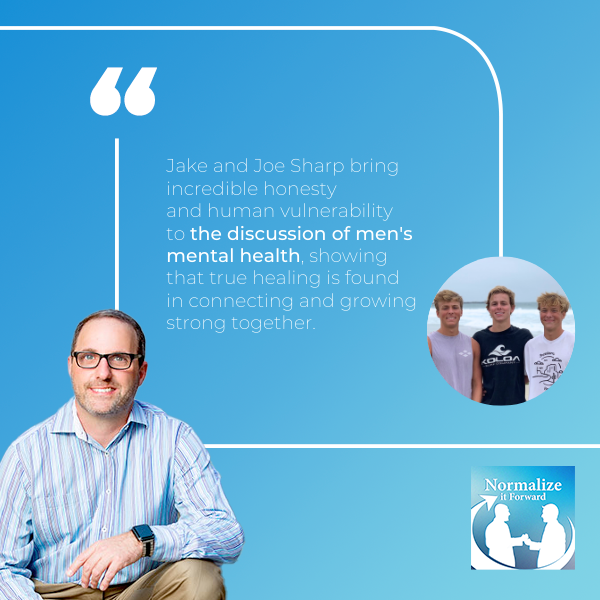
Thanks for being here. We are joined by Jake and Joe. Their stories embody strength, vulnerability and purpose. Jake and Joe are identical twins, fitness coaches and mental health advocates who have turned their unimaginable loss into a mission to help others heal. After losing their younger brother Sam to suicide, they made a powerful choice to speak up, share openly and to help people know they’re not alone in their struggles.

Through their coaching, podcasting, and advocacy, Jake and Joe are breaking down the stigma around men’s mental health and showing that healing doesn’t mean hiding. It means connecting, feeling and growing strong together. They’re journey is raw, real and deeply human. It’s one that continues to inspire a ripple effect of hope. Jake and Joe, welcome to the show.

I appreciate it. I love the introduction.
 

Normalize It Forward - Marc Lehman | Jake and Joe Sharp | Men's Mental Health


Thank you.

We’re super grateful to be here.

I’m super happy you folks are here. A good place to start if you don’t mind. I’m sure you’ve told the story a bunch but my readers, I want to just give some contacts and give them a sense of where you folks have been and where you are now. Where would you like to start? You tell me.

Turning Pain Into Purpose: Our Men’s Mental Health Origin Story

We give you folks the context of why we started all this, why we started on social media and created a platform of mental health advocacy and why we do Fitness coaching and all that story. It’s powerful to hear someone about their purpose and maybe the darkness that they came through and the light that they share. Jake, if you want to start sharing that.

Did you want to start with Sam? I feel like our main reason and you shared a lot in the intro. It was to create a safe space for mental health. For us, that goes back to losing our little brother Sam. He struggled a lot with his mental health, depression, OCD and shame. We lost him back in 2020. Both of us were in Mexico for church missions. We were not in the State of Arizona, where our family lived. After losing him, we woke up to the mental health world.

It took us a while because it shook us badly. It put us both in a tough spot mentally as well with depression and anxiety in trying to deal with grief. We were struggling a lot with coping with his loss. I feel like a big part of our purpose was turning that pain of losing him to our purpose of trying to help others with their mental health and how they manage their life.

There’s so much purpose behind why we do what we do. We run a group. We run coaching and we help people create healthy lifestyles in the physical aspect. We’re coaches that also focus on mental health as well because we know Sam is with us as we go about our work every day. We’re always thinking of how we could help just one person or someone that may be in the same place that Sam was in. Where he felt that he had to hide or he wasn’t enough or that he made too many mistakes that he couldn’t come back.

All the things that people wrestle with or the darkness of suicidal ideation like me and Jake. We’re constantly driven by, “How do we help that person? How do we give them just a little bit more hope?” That’s what drives us every day, running our group, our coaching and posting about mental health advocacy. It’s showing the individual that there’s hope, there’s light for them and they’re needed on this earth. Also helping and giving them a couple tools to help them.

Grief just comes in ways and hits you out of nowhere. Some days you seem fine, and then some days, you're just wrecked again. Share on X

That’s beautiful. I have to say, first of all, you have a huge fan in me. I follow your Instagram. I’m seeing a lot of what you folks post.

Thank you.

Very inspirational. I’m serious. Awesome stuff. What’s your Instagram handle? Throw it out to my readers.

It’s @JDuoFit and it’s on Instagram, TikTok and YouTube.

Follow these folks. Their stories are amazing. I love what you’ve done here. I have to say I find you folks to be incredibly honest, incredibly down to earth, and incredibly human. For three men to sit around and talk about this type of stuff is rare. There has to be more of this and for you folks to tap into that. I’m on my own fitness journey so I’m vibing with you folks. This past year’s been awesome.

For you folks to recognize when someone’s having a tough moment or a tough day, just saying to them, “We got you. We’re here for you. We’re supporting you. We understand.” That’s huge. I’m looking at that sign behind you. Even just being nice to people. I don’t know why it’s so overlooked but it goes so far to just be kind and say something nice. I’m moved by what you folks are doing and I’m sure of the many people that you’re assisting. Thank you for what you folks do and the work and energy you’re putting out there.

You’re welcome.

Thank you.

I appreciate it. It’s important for my readers to understand, folks. First of all, let me ask. How old are you?

24 but basically 25.

I’m a twin, by the way, so I want to ask you folks these twin questions. I’m fraternal and not identical. I’m sure you folks get those different questions people ask. I want to know. You lost your brother a few years ago and I’m sure it rocked your world. If you don’t mind, folks. Can you tell my readers a little bit about the impact? Any corner of the story that you think would be helpful for my readers to know about death, loss is one thing. A loss to suicide is a whole other level. What do you think?

The Unexpected Impact Of Suicide Loss And Grief

I would agree. It’s a sucky club to be a part of, but we’ve been blessed in a way to know a lot of people that maybe have lost family members to suicide or loved ones to suicide It sucks. It’s the worst. There’s no beating around the bush with that. It’s made a change in her life, not only because it’s premature. He was sixteen years old. We’ve talked to many people that have lost loved ones of suicide and it’s super out of the blue. It’s super unexpected for a lot of them. To give you some backstory. We knew a couple members of our family, especially my mom. She took my little brother Sam to a lot of ketamine treatments, therapy appointments, and medications. They did a lot of different things.

I struggled with depression a lot in high school and I knew a lot. My little brother Sam and I experienced a lot of the darkness of depression and struggle throughout high school. When we’re in Mexico and he died by suicide, it was like it hit us. It’s unexpected. The impact it leaves on someone is it’s time heals. Jake and I are in a different place a few years from death, but there is not a day we go by where it doesn’t hit us and it’s not something that we think about how life could be different. Even with a good time and family.

Sam’s Struggle: Overcoming Perfectionism And Shame

We’re just with family all night and it was the best. You just go back to that and it’s like, “Why can’t Sam be here?” It’s the worst. It’s just the constant nagging of like, “He’s supposed to be here.” It’s a long lasting impact. We’ve come to know grief and all the weird things about grief. It comes in waves and hits you out of nowhere. Some days, you seem fine then some days, you’re wrecked again. It turns you upside down. It’s tough. I would say for the readers, Sam struggles a lot with perfectionism and a lot with shame. He was feeling like he wasn’t ever going to be enough. He stressed so much about the future and it left him deep into depression. Even suicidal thoughts because he thought he had to be perfect.

He thought things had to go a certain way or he was not enough. I know that’s such a big thing, especially now men or young adults. They don’t feel enough at times. It’s my message or Sam would tell us now, “You’re always enough.” He would tell us, “Your human. We’re not supposed to have everything together,” and to hold on to the present, what we have. Continue to work through those paints and those mental health struggles and the future does look bright. It is going to work out as you keep working through it.


Normalize It Forward - Marc Lehman | Jake and Joe Sharp | Men's Mental Health


That’s what I want to share and I think Sam would share because that’s one of the main issues he struggled with, his professionalism. It’s okay to struggle. It’s okay. That makes us human. That makes us real people. That helps us connect with others. When we struggle and open up about it, when we’re in pain and we can tell someone and try to work through it. That’s what makes us human and leads to the great moments of life. If it’s hard to see the future now and if it’s hard to feel enough. I want you to know it’s okay to struggle and there is a brighter future.

Something that came to my mind very quickly that is super impactful for me. I’ve had a couple conversations with a good friend and maybe he gets on the show because he just came to my mind. He lost his sister to suicide just a couple years ago. We’ve had a couple deep conversations. He’s such a great dude. His name is Nate and I’ve had a conversation with them at the gym. The reality of grief, the loss of suicide, and just the deeper pain that brings on family and parents. We talked a lot about how losing someone to suicide has changed us individually in some way of blessing.

Being more empathetic. Jake and I didn’t know the side of empathy and also just knowing some of the pains and the darkness and part of life, just the hurt of life. Jake and I grew up in a home that didn’t have a lot of trials like taking care of financial usually. We’re pretty well in the home, but it showed us that life sucks sometimes. This loss both showed us empathy and I got to talk to Nate about that. We got super deep. Maybe that’s the person to get on this show.

I would love to have him on, Joe. It’s a great idea. There’s so much here, folks. Again, I appreciate your openness about this. For a lot of men, it’s just so hard to talk about some of these deeper issues. Especially the perfectionism you were talking about earlier, where they have that pressure on us. The irony is that it doesn’t exist. We’re chasing this thing and we’ll never get it because it’s not there yet.

I like what you said earlier and it’s important for my young adults to take this in that whatever they’re going through will pass. It’s a matter of giving it time and having hope. Your brother went through a lot. It sounds like you went through a lot of treatment and I’m sure a lot of pain. I’m sure there isn’t a day that goes by where you folks don’t wonder what it would be like if we were here.

I know this is a horrible statement to hear but I hear it a lot. I hear kids in my office sometimes saying things like, “People wouldn’t miss me if I wasn’t here.” Nothing could be further from the truth. I want my readers to understand that pain because it’s like that’s a whole that will never be filled and it’s hard to describe, but I appreciate you folks opening up about it. Honestly, the more we can tear down some of those walls and the more we can have conversations. I feel like that’s the use of this show.

I want people to understand like, “If it means listening to this show in the car with your kids so that you folks can have a conversation. Go for it. Have that.” Everyone we help creates a little bit of a ripple. I appreciate you folks. I do appreciate where you’re coming from. I’m curious if we could pivot to fitness and wellness for a minute because I know that’s your main focus these days. Where did that come from? How did that come out of this pain?

From Grief To Growth: The Pivot To Fitness And Wellness

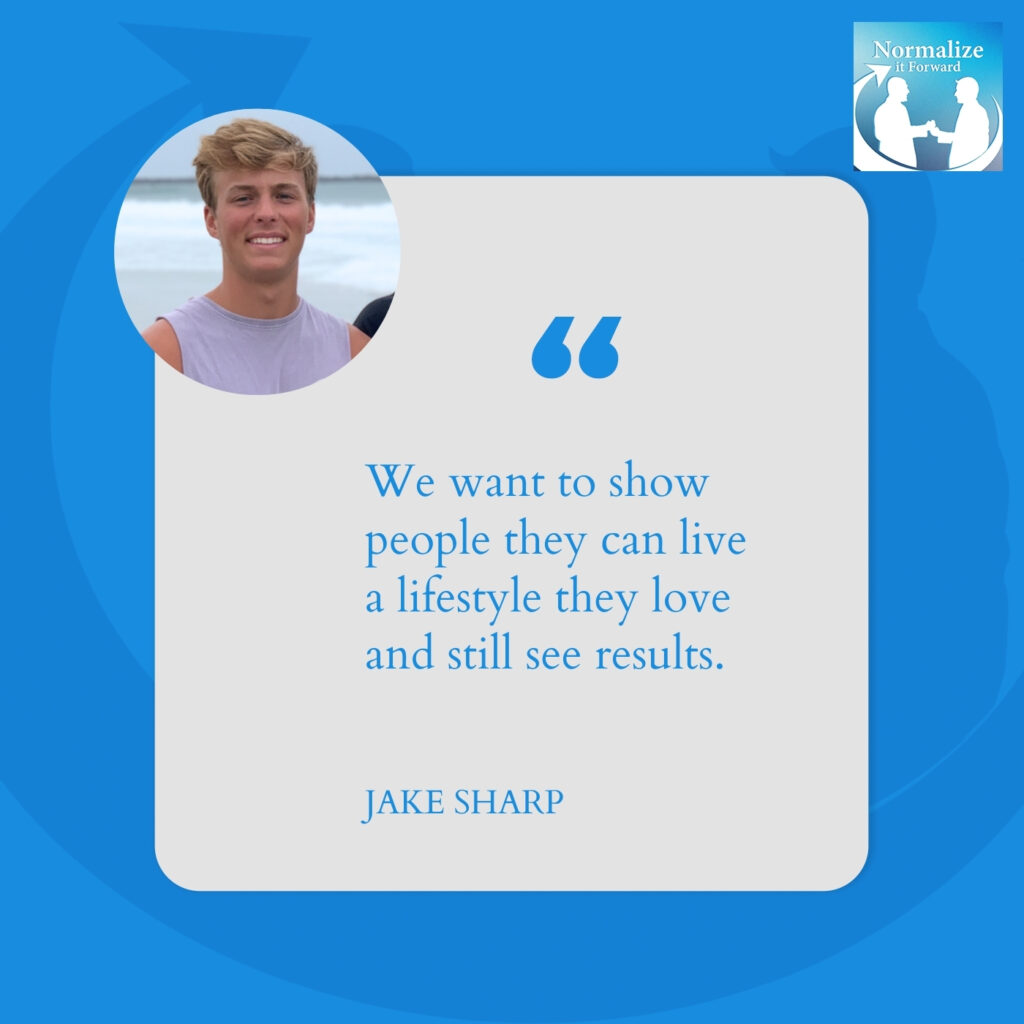
That’s a great question. That’s what we are focused on, to make an effect on the mental health space and all. A lot of people again fall into that perfectionism. That they have to be perfect. They have to be extreme athletes or extreme bodybuilders in order to look better, feel better, and feel enough. We disagree. We want to show people that they can live a lifestyle that they love and see results. It honestly comes out of losing Sam that kept us motivated, inspired and driven to make it happen. We want to help the mental health space. That directly correlates to what we do in physical health.
 

Normalize It Forward - Marc Lehman | Jake and Joe Sharp | Men's Mental Health


Joe and I, with our own struggles, the second part of that. We had a lot of low self-confidence as we grew up, especially in high school. We were not confident at all. We were chubby, skinny fat kids and no muscle. We were slow. We didn’t have a lot of confidence in ourselves. In our senior year, we dropped a lot of the skinny fat and got lean and gained a little bit of confidence then we left our missions. We gain like 50 to 55 pounds in a few short months coping with overeating.

We’ve always had a binge eating habit even through the skinny fat days, but on those church missions, we coped a lot with overeating. When we came back, losing Sam and being fat, those two came together. We were driven and it took a lot of failures. It took a lot of lessons. It took a lot of moments where we did over time and time again, but we learned different lessons. We learned how to build a lifestyle that we love and that’s what we’re focused on. Our whole brand is lean and confident because we do care about your confidence and your mental health. That’s part of what we do. It’s building a lean and healthy lifestyle for you with consistency with something that you love.

I would add to that. We focus on shame and helping people identify shame. We want to make it clear. We’re not professionals. We’re not therapists or counselors that talk through one-on-one with individuals that come to their chair. We know their importance because we’ve done the work with therapists ourselves for our own struggles around things like pornography, food, and all things that we use to cope with throughout the great process.

We imply that in our coaching and our community. Our group focuses on that a lot because we know that shame blinds us. It keeps us stuck when we shame ourselves and attack our identity and think, “We’re discussing. We’re broken. We can never figure this out.” We’re always talking about our identity and shaming ourselves. We can’t move forward. It was my therapist back in the day who said shame is blinding us. You can’t move forward when you have shame there first. That’s what we help a lot of our clients do and our group. We help them identify and begin to tear down that shame and start building new beliefs.

Shame blinds us. It keeps us stuck when we shame ourselves and attack our identity. Share on X

It’s awesome, folks. I completely agree and I hear about it all the time in my office. It is one barrier that keeps people stuck in the mud and from changing. I’m curious. You folks find the gym and your own mental health impacted by lifting and wellness. Can you take us through that a little bit and help us understand where that came from? It sounds like you folks had your own struggles with that at one point.

The Best Antidepressant: Exercise, Lifestyle, And Emotional Management

I struggled big time in high school with my own depression and it was dark. There was another battle after losing my little brother and coming back then dealing with grief and feeling like I was lost. There’s days like when people talk about when you feel that depression or anxiety and it feels physical. It’s like you can’t get out of bed.

I had multiple days after losing Sam like that or it was physical. I couldn’t seem to get out of bed, so I fully empathize with people. I know the darkness that depression can bring and just being wrapped up from shame. Shame from different habits that I want to kick, binging pornography and repeating that cycle and just beating myself up even more. The depression just swallowed me, then finding the gym. We constantly talk about the studies showing exercises are one of the best anti-depressants. What you eat, how much you eat, and the nutrients you get do matter for your mental health. We stress that with all the people.

We truly believe mental health is improved by your lifestyle. Get therapy. Maybe even medication is something that you look into. That’s a tool but without lifestyle, without you changing what you do, how you think, how you believe and what you believe about yourself, your mental health is not going to change long term. That’s what we truly believe with what we’ve seen with ourselves, our journey being not confident, struggling with overeating, pushing heavy weight, pushing our intensity, whether that’s weights, basketball or walking. Learning those tools, those lifestyle changes, overcoming, overeating help our mental health.

They help our anxiety and depression when we learn to manage our physical health. Those two are directly correlated in our eyes. Focus on the lifestyle. Again, therapy is probably one of our favorite tools to build out emotional management skills and work through our grief and our coping skills. If therapy is something you’re looking into, amazing. The same thing with medication. If you can’t seem to get moving, get momentum, medication is a great thing to look into but focus on long term change with lifestyle habits.

What Is Step One? Taking The Smallest Move Forward In Men’s Mental Health

I agree, folks. It’s funny. As you’re talking and you’re talking about a gym or a therapist or eating habits or meds, it’s a matter of trying to figure out where to start. As you were talking earlier, Joe, about getting out of bed. For some, it’s just like putting on pants. It’s like, “I can’t even get dressed,” and just figuring out step one. I have to say too I’ve worked out at a lot of gyms over the years.

Finding the right gym that you can be comfortable at, don’t feel judged and people are welcoming is huge. I’d say the same thing about a therapist. I’d say the same thing even about friends. One of the things that is big is when a person in high school is struggling and going through things like you folks have. Trying to figure out where to start is like step one. What was your step one, folks?

In high school, one of my first steps was to get into therapy. My mom was super good about that. I got into therapy when I was like seventeen years old. Going through the grieving process, I got it to therapy pretty quick just to process the trauma of losing Sam, suicide and all that. That was another good first step but just when it’s hard to get out of bed.

I heard something from someone that was contemplating suicide what helped him when he couldn’t seem to even do anything or think about doing anything that day. It’s just to take the little step possible. Go brush your teeth and take a shower. Celebrate that as a win and celebrate like, “I’m taking one step forward.” It ties so much and that’s why I love fitness, the gym and nutrition. It’s like we have to stop thinking it’s all or nothing or I need to be perfect.

We have to stop thinking like it's all or nothing or that we need to be perfect. Take the pressure off and take one step forward, whatever gets you moving in that direction. Share on X

A lot of things with mental health. It’s like taking that pressure off of you. Quit comparing. Take the pressure off you and take one step forward. Whatever gets you moving in that direction. You don’t have to do something huge that day, but focus on the small little steps and the direction you want to move. That’s what I would say.

My first step honestly would be finding someone I could talk to that’s safe, won’t judge and that will literally just listen to you. I find that after losing Sam, that was probably seriously how I got moving. How I got better from my grief or improved my anxiety was just talking about something that I was struggling with to someone else. That was a big win for me. It’s just connecting with someone and it didn’t even need to look like a conversation that led to a lot of action in that moment. It was the act of me just opening up to someone kept me trusting things can get better. Finding that hope was my first step.

It was me then realizing it’s okay to be where I’m at. It’s okay to be a beginner in the gym. It’s okay to be a beginner with this mental health journey. It’s okay to be where I’m at. That doesn’t make me any less of a human. That doesn’t mean someone else is a better person than me at all or I’m weak. That doesn’t mean that at all but being okay to be where I’m at. It’s like I’m going to learn key things that help my life get better where I’m at, and then find someone to open up to. That’s my approach to that.

It’s huge. We’ll say, folks, I’ve seen my own therapists over the years but many more patients have visited me over the years. I’ve thought a lot about what it is like for a first meeting when a young adult comes in. They don’t know me at all and they’re probably feeling a bunch of different things walking in. What was it like for you folks the first time you saw a counselor or even not a counselor? Jake, as you said, an adult to talk to. What was that like?

The Courage To Seek Help: Trusting The Uncomfortable Process

It can be a little bit uncomfortable. You’re trying to dip your water, dip your toes into something new and it can be a little bit uncomfortable. I feel like again that’s where real progress or real change happens. It’s like, I’m going to trust if I am a little bit uncomfortable. I tell a therapist or someone the truth of where I’m at, the struggles and the things that are hard in my life that maybe I can find some hope. If you don’t find them empathizing or listening, that’s okay.

Real progress or real change happens in the uncomfortable. Share on X

That doesn’t mean you’re wrong and doing that. You talk to someone else or you get a new therapist. That’s okay but it can be a little bit uncomfortable. That’s human nature. It’s having faith or saying, “This is what real change does look like or real progress does look like. I got to be willing to be uncomfortable or sit in that. I got to trust this process.” That’s where it starts.

That’s huge, Jake.

Jake and I both opened up to our parents about the things we were struggling with or depressive thoughts or anxiety. Our parents were very loving, especially her dad growing up. We battle with our own shame around different things but we grew up in a loving family. Stepping into our therapists, Travis’s office, for the first time when we’re younger, like seventeen. It can be very awkward and weird because they are someone that is just here to listen and here to maybe guide your thought process to give you some tools. That’s all the therapist there.

They know how to listen and how to give you the right tools. When I think about that when I first started therapy and then went into therapy for grief, my marriage is like three different things. I’ve learned different things every time and it’s so cool to build skills of emotional management of, “This is why I might be doing what I’m doing or how can I listen better? How can I be that safe space for someone else?” Looking back to embracing not being perfect but embracing the uncomfortable of, “This is me learning and I’m going to this process to learn tools.”

 

Normalize It Forward - Marc Lehman | Jake and Joe Sharp | Men's Mental Health


It’s very well said, Joe. I use the baseball mentality of like, you got to open your glove up. You got to come into the open. You have to come into it realizing you’re going to learn stuff and that stuff can be applied if you choose to apply it. Jake, use the important word hope. When a person is depressed, they know what the word means but they haven’t felt it for a long time. I would just paraphrase your words by saying take that bold step. Whether it’s a therapist, a coach, a teacher, a parent or another adult. You take that bold step because you want to create some hope.

I applaud everybody who does it. It takes a lot of courage. I’ve got plenty of people break down in my office over the years with all that emotion. I would say to anybody reading, if you’re in that spot, have that courage, find that person and reach out. It’s interesting, folks. I’ve now done enough interviews over the last couple years to talk to several different people about the topic of depression and suicide. Everybody eventually says the same thing, find somebody. Find somebody to connect with, find somebody to be open with and this too shall pass.

It’s all of the same phrases that get said. The more we’re able to spread that gospel and help people understand, it’s tragic and my condolences to you, folks, for your loss. There’s nothing I can say to make it any better other than I’m sorry. Certainly, you folks have figured out a way to turn your loss into something positive. For that, I’m amazed. I am inspired. I’m sure my readers will be as well. I’m sure you folks have your moments. You’re good in your current moments but we appreciate all of what you’re doing. I just want to cheer you on from over here and say keep doing what you’re doing folks because it’s good stuff. It’s helping probably more people than you realize too. It is.

Thank you. A lot of times, it’s when we post or we run our community, sometimes you get those doubtful thoughts and be like, “Are you changing anyone’s lives? Is your content helping?” We appreciate that and we won’t ever stop.

Normalize It Forward: Nominating A Future Guest

I’m pleased to hear that. In the spirit of Normalize It Forward, Joe, you touched on this earlier but typically I asked if there’s a friend, a co-worker or a relative that you want to nominate to have someone come on the show next. Let me know and I’ll do my best to wrangle them in and have them on at some point. Any thoughts, folks?

I’ll send you over Nate. I’ll talk to him too and I’ll send them over and see if he’ll be available doing this.

Thank you, Joe. I appreciate that. I want to thank you for your time, your energy, and everything that you. I want to keep telling you keep doing what you’re doing because it’s inspiring me and that takes a lot. I’m moved. Know that the wellness that you’re spreading is helping lots of people out there. I appreciate it. I do.

Thanks, Marc. It means a lot.

Thank you. We’ll keep doing our thing.

It’s good to talk to you.


Important Links


About Jake and Joe Sharp

Normalize It Forward - Marc Lehman | Jake and Joe Sharp | Men's Mental HealthJake and Joe are identical twins, fitness coaches, and mental health advocates who have turned unimaginable loss into a mission to help others heal. After losing their younger brother, Sam, to suicide, they made a powerful choice — to speak up, to share openly, and to help people know they’re not alone in their struggles.

Through their coaching, podcasting, and advocacy, Jake and Joe are breaking down the stigma around men’s mental health, showing that healing doesn’t mean hiding — it means connecting, feeling, and growing stronger together.
Their journey is raw, real, and deeply human — and it’s one that continues to inspire a ripple effect of hope.


Reading about mental health is hard. Let’s schedule a free consultation.


Normalize It Forward - Marc Lehman | Shock | Mental Health


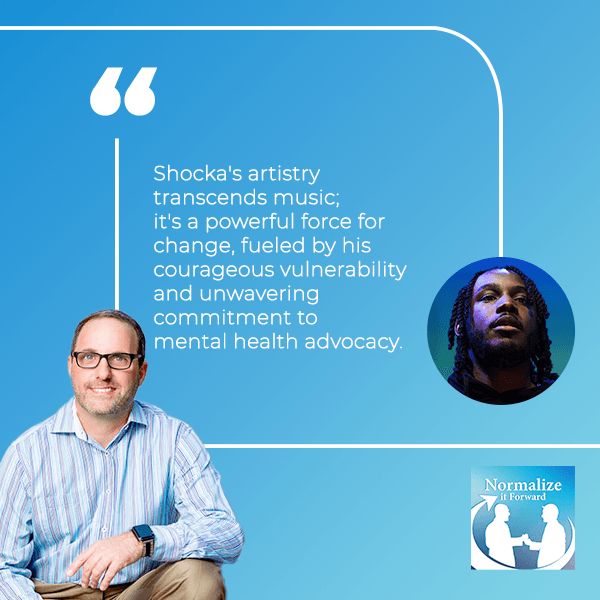
Mental health advocacy takes center stage in this compelling episode, where host Marc Lehman welcomes rapper Kenneth Erhahon, better known by his stage name, Shocka, a force within the grime scene and a passionate voice for this crucial cause. When rhythm meets reality, powerful voices emerge, and Shocka’s is one of them. Beyond the beats and rhymes of his music, Shocka shares his deeply personal journey, revealing how his own experiences ignited a mission to advocate for others. This conversation uncovers the raw honesty of Shocka’s artistry, his impactful efforts to raise mental health awareness, and the transformative power of using your voice for change.

Watch the episode here


Listen to the podcast here


Using Music For Change: A Mental Health Advocacy Journey With Shocka

I’m super excited to welcome in our guest Kenneth Erhahon, better known by his stage name is Shocka. Shocka is a rapper and mental health advocate from London. He gained recognition by being one third of Grime collective Marvell, alongside Double S and Vertex. Yes. After dealing with mental health issues himself, Shocka became a mental health advocate to help those with their own problems with his music. If you haven’t heard his music, look them up. It’s awesome. He has since aimed to raise awareness of mental health issues. Shocka, welcome. How are you?

I’m good. Thank you so much for having me. It’s our honor.

Thank you for being here. I really appreciate it. It’s so tricky. When I do an intro, I feel like I’m telling just a bit about a person, but I know there’s so much more. Tell us a little bit about your background.

There is so much to it. First of all, the name Shocka because everyone always says, “That’s an interesting name. Where did they get that name from?” The name has two meanings. First of all, two positive meanings. The first meaning was because I wanted to shock my friends, my family, and the world in a positive way. I wanted them to look back on my life’s story at the end of it and be like, “He really did something amazing.”

The second meaning is actually an acronym for what Shocka means. Shocka stands for spiritual healer others can know is around them. What does that mean? That means the more I’m open about my story, the more I’m vulnerable. Other people around me can see that and decide to emulate that if it works for them and brings them to their place of healing.


Normalize It Forward - Marc Lehman | Shock | Mental Health


That’s why I do what I do. Healing is actually a big theme of what I do. I was just talking to my manager about this saying like, “Healing has played a major part.” You know about the Marvel characters, right?

Sure.

The X-Men. Wolverine was my favorite character. It’s so crazy that I subconsciously picked him because his power was like he could heal himself whenever he gets injured. It started from there because people used to call me Wolverine because I used to have like long sideburns, which I still have now. I used to have fixed sideburns and people used to name me Wolverine. He has always played like a little theme.

A Transformational Book: You Can Heal Your Life

There’s been a thread throughout my whole life. The name and then when I went through my mental health difficulties, which I’ll get into, the book that actually changed my life was a book from a woman called Louise Hay, which you might have heard of. She’s American. She’s passed on now. I don’t if you know who she is.

I haven’t heard of her, no.

She’s incredible. She’s got a book called You Can Heal Your Life. I discovered that actually changed my whole life around, but a bit into going into my journey. I was in a group with Marvell, as you mentioned in my bio. There was three of us, me, Double S and Vertex. I was the Nigerian one. Another one was Ghanaian and another one was Ugandan.

We formed this group and we just had big dreams to take over the world and just do something positive from where we came from because where we came from is really negative. I’m from a place called Tottenham. I don’t know if you know about football. I don’t know if you watch football, if you’re into it. There’s a team called Tottenham, which is the area I live in. One in the football teams are called Tottenham, but there’s a little place in Tottenham called Broadwater Farm. That’s where I’m from.

That place had two riots. One was in 1986 where police officer’s head got chopped off. That’s how severe the riots was. There’s always been problems between the community and the police. There was another riot in 2012 where someone from my area got shot down by the police. There’s a hostile relationship with the police and my area was so terrible that Princess Diana, I’m sure you know who Princess Diana is. Princess Diana came to my area to make peace, to tell us to relax. That’s how bad my area was.

Now my area’s extremely positive. There’s a guy from my area, I don’t think you know who he is, but he went to number one in the charts and he brought a lot of positive attention to my area. You’ve got people like myself doing really positive things here. Things are changing. Anyway, the group called Marvell, the other two guys in the group, they’re round the corner from me. They’re from Northumberland Park, which is like ten minutes away. We all got together, formed this group called Marvell and we did amazing things.

In 2010, we met Drake really early. We were one of the first artists from the UK to bump into Drake. We literally bumped to him. We met Drake before he became a megastar. I still have the footage of it. When I see Drake, I’m going to show him this footage and hopefully he remembers me because he’s done so much since then. He’ll never forget the first time he came to London. That’s when we saw him.

He came with Rihanna, which was the distracting part because he came with Rihanna. Rihanna’s already a big star. He wasn’t. We forgot about him and focused on Rihanna. We met both of them and it was amazing. We did some incredible things. We toured us some huge acts over here. That was in 2010. This is where it gets interesting.

We brought out our first single on the 10th of the 10th of 2010. We picked that date because we believed that our lives was going to change forever on that day. We’ll look back in twenty years and be like, “That was the day that we became millionaires and changed our family’s lives.” The complete opposite happened. That day came and our song didn’t even do well. It wasn’t even the top 200s of the charts. That’s when I went into depression for the first time. I experienced isolation.

I always say to people, “There’s a difference between isolation and solitude.” Solitude is when you willingly depart from the world and take some time for yourself willingly. Isolation is when you’re forced into hiding where you force yourself into hiding because you can’t face the world or face people. That’s what I went into.

There's a difference between isolation and solitude. Solitude is when you willingly depart from the world and take some time for yourself. Isolation is when you're forced into hiding. Share on X

I went into isolation. I started like hiding from my friends due to the fact that we lost our record deal and our song didn’t do well. I was talking to a lot of artists now and I realized a lot of artists has been through that similar situation of having problems with their record. It’s a common thing. Even Liam Payne from One Direction that passed away. The news broke out that he was having problems with his record label just before. It is a common thing. I went into deep depression. We got signed in 2010. The song came out 10/10/10 then we lost our record in 2011. I went into a mental health hospital for the first time in 2012.

That’s when everything really changed because now, I’ve been introduced to a world that I knew nothing about. I used to just hear about this world. I don’t know what they call it in America, but in the area that I’m from, they call it like, “He’s gone crazy. He’s lost his mind. He’s a cycle.” You know the words that they throw around. I had to deal with that thing, that big mistake when I came out of hospital the first time. I feel like just sweep it under the rug and pretend like nothing had happened, which is wrong. I was meant to speak and verbalize it and get help. As you can imagine, the stigma was so fake. I came from a family that wasn’t educated on mental health. Even they was advising me not to tell no one.

That’s what we’ve been used to. That’s the programming throughout all of these centuries and centuries, don’t speak about it. That’s what I did. What happened was when I came out hospital in 2012, the group that I was in, Marvell, we got some investment from someone and they moved us out of our area. This is where the problem came.

Every Christmas, we will come back to the area to see our family, to spend Christmas with our family. Christmas time, I had to come back to this house where I had the breakdown and other mental health issues. That trauma will resurface. I end up getting sectioned again and putting a mental health hospital again for the second time. It used to be every two years. Every two years I would relapse and end up in hospital.

From 2012 to 2014, two years later, in 2016, I went to the hospital again. This time is where everything changed for me. The doctor said to me before he discharged me, “You’ve been sectioned,” because that’s what it’s called, sectioning. I don’t know what they call it in America when you get put in mental health hospital. In the UK you’re, it’s called being sectioned. They’re allowed to keep you there for 21 days.

The third time I got sectioned, the doctor said something just before he discharged me. He said, You’ve been sectioned three times. You’re 27 years old. You need to figure something out because you don’t want to keep coming in and out hospital for the rest of your life.” When he said that to me, it’s like a light bulb just went off in my head like, “You’re right.”

It reminds me being 50 or 60 and I’m still being sectioned. That’s when I discovered the book. That’s when I found the book. Whatsapp stories was just being introduced. I didn’t want to use whatsapp stories because I felt like there was copying. Instagram, I avoided it for so long. When I came out hospital, I started checking people’s stories and a girl had this book on her story from Louise Hay and I mentioned it to her. I said, “Ashley, is that a good book?” She said yes. I bought the book and it completely changed my life. I’m not really an avid reader, I’m more a visual person. Stuff like this is perfect. What I did after I read the book, I tagged her name into youtube to see if she’s got any videos that I could watch.

She had tons of videos. I studied all of them. What changed my life was she spoke about self-love in a way that I never heard of before. She said self-love is not about bubble bath and massages and getting your toes and your nails done. She said self-love is about how you speak to yourself, your internal dialogue. She said, ‘If you could get that conversation right, everything will change. You’ll know it will change because your reality will begin to reflect back to you, the conversation you’re having in your mind.” She was completely right.

“Self-love is not about bubble baths, massages, and getting your toes and nails done. Self-love is about how you speak to yourself.” Share on X

As soon as I got in that conversation right, everything started to change. I did my first sold out show in 2017. In 2018, I made a song called Self Love based on everything she taught me. That song ended up getting signed. Snoop Dogg posted that song on his Instagram. Snoop Dogg has 26 million followers. It was worldwide. In 2019, I got offered to do a TED Talk.

I’ve seen it.

I did the TED Talk 2019 and then I did two shows in New York. I actually came back to America, did two shows. At the end of the year, in 2020, we all know what happened. COVID. We had to go into lockdown. I was pissed off because I started getting trauma about what happened with my group. We were just at the door and then we started record deal. Now I’m at the door again and COVID has come. I’m getting trauma and then my life’s about to change even more.

Losing His Mother & Coping With Grief

My mom comes home one day and tells me she’s just come from the hospital and they said she’s got cancer. She’s got a year to live. It devastated me. I’m my only child. I grew up with my mom my whole life. As you can see, there are pictures of my mom on the wall. I don’t know if you can see that there. I’m in the same house that she told me the news. She had a year to live so we had to fly away to Nigeria to see our family because she has to say her goodbyes to the family, which was devastating.

In 2022, she passed away on the 2nd of February. I had my headline show on the 27th of February. I had my mom’s funeral on the 8th of February, like a week later. Everything was just happening so fast. I ended up being back in hospital again. After all of that pressure, I ended up relapsing going back in hospital again after six years. Remember, I said it was every two years. I broke that two-year curse and it was six years. Don’t forget now, in between that six years, I’m a full on mental health advocate now because I did TED Talks and talks in school. I knew exactly what to do when I’m at hospital.

I had my phone with me this time for the first time. My auntie gave me my phone because all the other times I’ve been sectioned, my mom never gave me my phone because she wouldn’t want me to talk to every anyone because Nigerians are extremely private. This time when I got sectioned, because my mom had passed away, my auntie didn’t really know what my mom does, so she gave me my phone on a visit.

When I got back to my room, I remember looking at my phone thinking, “What am I going to do with this?” Everything just came to me. It was like, “Take videos while you’re here. Show people what it’s like,” because people don’t know what it’s like in there, what it even looks like. I took pictures, I took videos. That’s where I got the idea for my book, A Section of My Life. That’s where I wrote most of it.

When I came out of hospital, I ended up getting a book deal. Everything’s just been amazing since then. I got the book deal. The book came out. I performed at a place called the National Gallery. I don’t know if you’ve heard of it, but it’s a place called the National Gallery over here. I’m the first artist to ever perform there. That place is older than me and you. I did a documentary with ITV. There’s a big channel called ITV over here. I did a documentary that I was screened on that channel. It’s just been amazing ever since. That’s my story in a nutshell. I hope I didn’t take up too much time.

Generational Divide: Perceptions On Mental Health

Shocka, you could take up all the time you want, number one. Number two, I thank you so much for being open and sharing all of that. I know my readers. Something in that will resonate with them. I’m listening and I’m thinking a few things. Number one, I want to talk a little bit about how mental health is in London and how it compares to say the United States. There are some differences. Certainly, I want to talk to you more about your shift that you made, it sounds like since this last hospitalization and even a little before, to become advocate. I think that there’s clearly something in you that wants to heal and help others.

Let’s talk a little bit about the comparison because I think that out here in the States, I would describe mental health as an epidemic with young adults in particular. The anxiety and depression levels, eating disorders, substances, ADHD, etc., are just skyrocketing. The suicide rate is higher than it’s ever been. Yet at the same time, there’s more and more discussion about mental health I would say compared to years ago.

It’s way more open. I’m constantly amazed when I talk to young people how comfortable some people are talking to each other about it. It’s a journey. It’s a process to help people understand that there is definitely healing that takes place when you open yourself up and recognize that what you are going through, a lot of other people are too. Does that make sense?


Normalize It Forward - Marc Lehman | Shock | Mental Health


Yes, definitely. What I want to say is that mental health has always been there. What has happened was my parents’ generation, so the older generation, they didn’t deal with it. They didn’t deal with it not because they didn’t want to, but they didn’t have the luxury to deal with it. Their life was so fast paced. My mom came to the UK at such a young age and had me at a young age. I haven’t even had my first kid yet. By this age, my mom had had me and I had a full-on life. They didn’t have time. When people would die in her time, they would just get on with it. They would mourn for like a day and then just go back to work and get on with it.

I remember when my mom first got her cancer diagnosis, she worked for like a week or two until we told her like, “No, you need to forget work and deal with this at hand.” That generation was so used to just like sweeping it under the rug. What’s happened with this generation is that now we’ve got the luxury to actually look at things. We’ve got a lot of time to talk to each other and do podcasts. That generation couldn’t do podcast. Sitting down and talking at a podcast?

There’s racism. They’re trying to kill us. That generation was the it is what it is generation. It is what it is. Just continue. This generation is just keep moving forward. That was it is what it is generation and this generation is the let’s finally deal with it and put us up to a generation. If this generation doesn’t deal with it, what we’re going to do is we’re going to lay out enough blueprints and enough information for the next generation to have all the tools they need.

That’s a great segue. I want to ask you about that because I think that my audience, some of them are going through their own journey and those that maybe aren’t have people around them that are, and you just talked about your journey. Let’s talk about where music fits into that, the healing side of your lyrics and your performances and your music. Talk to us about that.

Using Music As Therapy & Finding Purpose In Lyrics

As you can see me nodding my head, music played a major part because I’ve never gone to therapy and people are so surprised. They’re like, “You’ve been sectioned four times and you’ve never seen a therapist?” I’ve done similar things to therapy but not actual full on therapy because my music has served as therapy for me.

My music was so deep at a point that I forgot it was music. My friends started telling me like, “You’ve got to start putting choruses and picking nice beats because it still is music because it isn’t becoming full under depressing.” That’s how much I use it as a tool for healing. Now I’ve got the perfect balance. Now I’ve got a perfect balance of having a beautiful message using it as therapy and still something that you can listen to and vibe to. It took years to get to that balance.

Before, I used to just dump. I don’t know if you’ve listened to my albums, but the first one I have was called Vent. I’m on vent four right now. The event started by me just venting. That’s what vents are about. If you listen to every vent, it’s a reflection of where I am in my life. My last vent is me speaking about my mom’s cancer because that’s what was going on.

This vent, vent four, that’s on this new album, Vulnerability Is The New Cool, I’m talking about the money I’m making and what life is like. I’m talking about Palestine. It’s always a reflection of the time. I look forward to my next vent five whenever I do it. I’m so happy I’ve got something like that. Having something like that is important. Even if you don’t have a recorded vent version like what I’ve got, you should have a diary vent version. Every month, vent out.

You read my mind. I talk to a lot of young people about journaling and some of your lyrics remind me of journal entries.

They are, definitely.

By the way, you’re a fantastic songwriter. I’ve listened to a lot of your music. You’re an excellent songwriter. I think there’s so much passion in your words. I listen to a lot of different music and I feel like as a listener, sometimes you can feel the passion and sometimes you can’t. Do you know what I mean?

Definitely.

It sounds like you’ve gotten a lot of therapeutic value out of songwriting and, as you said, venting.

Yeah, definitely venting is extremely important. There’s one thing about seeing your words in a paper, then there’s another thing about hearing your voice, saying what’s in your mind out loud for the world to hear it. That’s what I love. I love like certain things that’s bothering me in my head and then recording it and then listening to it and then dissecting it and realizing that it wasn’t even that big of an issue. Our biggest fear is that if we say it to someone, how are they going to respond? In most cases, they respond in a way that you generally not thinking they’re going to respond.

That’s right. In our head, it feels bigger, right?

The Power Of Vulnerability & Encouraging Open Conversations

Yeah, it feels bigger. That’s why I made Vulnerability Is The New Cool because like Jay-Z’s got an amazing saying that he says you can’t heal what you don’t reveal. It’s true. If you don’t heal it, you can’t reveal it. It’s like if I can make vulnerability cool, it can give people more of an initiative or incentive to want to reveal and realize that there’s nothing really there when they reveal it. What they’re afraid of is not really that scary when they reveal it.

There’s so many ways to be vulnerable. I always list five ways. You’ve got the spirituality where being vulnerable, where you can talk to your creator in the place of your comfort. You’ve got therapy, which we all know about. We’ve got venting to our friends or our partner. If you’ve got a wife or a husband or best friend, you’ve got that way. You’ve got journaling. You’ve got your art like drawing. I can see paintings behind you. That was obviously therapy for that person. You’ve got the way that I use, which is recording. There’s so many different ways. People think there’s only one way which is talking to a person. That’s actually the hardest way.

That’s the most difficult. That’s the last option I’ll pick out of the six. There are so many other ways, but the whole point of it is getting it out of you. You can burn it. That’s another way. You can put it on a paper and burn it. You just have to get it out your system and just see it. The problem is it lives inside of us. I think the longer it stays inside you, the more chances it can turn into poison and start to poison you, the more you keep it inside you. When you keep it out, when you get out of you, you can look at it and you can play with it.


Normalize It Forward - Marc Lehman | Shock | Mental Health


What’s fascinating, Shocka, is so much of your music, the stuff you write about when you do get it out and you do put it in song resonates. At least I found listening to it, I can understand those things because either I’ve experienced it or know people that have. I definitely think that’s one thing that music does. It really brings us together more because when it’s up here, it’s only in our head we feel like we’re the only one experiencing it.

Some people’s voices have healing components, genuinely.

I’ve been told mine does not.

There are certain voices that need to be spreading across the world. It’s actually good for humanity. There are certain voices that you need. There was a woman over here called Jenny Francis. She used to be on late nights. There’s a radio station called Capital Xtra and Jenny Francis. It’s called Capital Xtra now, but it used to be called Choice FM. Jenny Francis used to be late night at Choice FM. She made a name because we all know her for how soothing her voice was on late night.

Everyone remembers Jenny Francis’ late night show. There are certain people that have gifts like that, their voices are just healing. It’s meant to be spreading across the world. I feel like if you’ve got that voice, you should use it. You should do voiceovers. You should talk to people more. You should become a motivational speaker if your voice is healing. There are certain people that they just talk to you and it just lights up your day.

The Influence Of Social Media & Mental Health In Young People

You’ve been so passionate about the topic of mental health. I think you’ve figured out, and many artists have now, that when you speak, people are listening, you know.. People admire artists. People admire people in the entertainment industry. I can’t tell you how many times I’ve seen video clips or been at concerts myself and the musician stops for a moment and lets people know that it’s okay. Shocka, let me ask you this. In the States, the scene with young people is in terms of statistics is moving in the wrong direction. Anxiety and depression is up. I’m assuming that’s the case. Where you’re from as well?

That’s the exact case.

Let me ask you, because I think everyone has an opinion on this, why do you think that is?

I think it’s social media. It’s something we’ve never had before throughout history. No one could have given us advice on what to do. This is unique to our time. We’ve never had Instagram like this. Like we’re dealing with a new problem. They’ve got to give us time to figure it out. We’re going to have problems. There’s going to be deaths. Unfortunately, there’s going to be anxiety, depression, suicides and there’s going to be all this stuff. We have to figure this out. Unfortunately, some people are going to be casualties until we figure this out. It’s not always going to be like this. It will come down when we start to really figure out and get a hold of it. Right now, it’s the Wild, Wild West. It’s new to all of us.

We’ve never had like our follow accounts. People with 1 million followers, getting 1 million likes. Going viral., you can trip over in the street and next thing you know, you’re on to news. Everyone’s talking about it. Imagine how that person feels like. Imagine how Will Smith must have felt like seeing a mistake he made with the slapping. It’s everywhere. You’ve been healing in public. It’s a new territory that we’re in, so we’re dealing with it

I really feel like there’s a positive edge to it and a negative edge to it. As you said, we’re still trying to manage the negative edge.

If it’s a lot to deal with for adults, imagine for kids. When I was in school, we didn’t even have phones in classrooms. It’s a whole different world we’re living in.

They’re plugged in all the time. The term influencers is used a lot in the States and there are positive influencers and there are negative influencers. To your point, when I was a kid, we were exposed to certain things on the news or the TV. Now kids are exposed to like, you know Yes.

Information is important, especially positive ones because they’re the ones that’s going to bring the control back because where else are the kids going to get the information from and how to deal with all of this? Kids aren’t really listening to their parents, which is sad, but it’s the truth. These influencers have more power than some of the parents of these kids. We’ve just got to make sure that our kids are listening to the right influencers. It’s so important because what put me on this path is that I had the right reference points. I don’t know if I can show you this, but on my shoulder I have a Bob Marley tattoo. Can you see that?

Yeah, sure.

I see that every morning and it always slaps me into gear of the positive impact he had on the world and like the messages he put in his songs and the life he led. It’s like your reference points and your influencers are so important. They just put you in line. Whenever I do something that’s distasteful, dishonorable, obviously he wouldn’t care, but it’s just a thought of would he do something like this? It’s just a respected act. It snaps me back in line. Pick the right reference points because 95% of the time, you do become your reference points as well. You actually turn into them. If you’re listening to them every day and study it, you’re going to become them. Pick the right ones.

I admire his career and everything he stood for and all of the influence he had certainly down in Jamaica and around the world. Certainly, I say to you, Shocka, you are an influencer. You are a person who is creating a full effect with your lyrics and your message. Keep doing what you’re doing. We appreciate it. I appreciate it. I just want to let you know that. Thank you.

You’re welcome.

Passing The Torch: Who Shocka Recommends For The Next Interview

I want to put you on the spot for just a sec. Part of what I do in the show is I ask that people nominate a friend, a coworker, a relative, because I want the conversation to keep forward. Do you have any in your world who you think would be helpful for me to interview next?

I do. There’s a guy called Ben West. He’s a mental health advocate too. Give him a DM or message me afterwards. I’ll send you his Instagram. The same way you reached out to me. Hopefully he sees it. If he can’t get Ben West, there’s a guy called Hussein Manuel. He’s amazing too. He’s a poet. He’s amazing. He’s got mental health books. He’s amazing. He helped me out a lot. I’ll send, so hopefully we keep the conversation going forward.

Thank you. Let me give you a little bit of space for a minute and tell our readers about your new album.

Shocka’s Upcoming Album

My album is Vulnerability Is The New Cool. If you haven’t heard that album, please listen to it. It’s an album that could heal you. You’re going to hear topics that you’ve never heard rappers talk about before. I’m speaking about them as such a beautiful way. Please listen to it. Reach out to me on Instagram. As you can see, I’m very accessible. I try to get back to all my messages. The day I don’t get back to my messages means that I’m a full-on superstar and that is too late. Before that time comes, I’m trying to hang on to what I’ve got left. I’m trying to respond back to everybody. Yeah, let me know your feedback on the album and we can talk about it.

You’re a grounded, honest and open human being, Shocka, and for that, I appreciate it. I, too, tell everybody to take a listen. I’ve listened to your new album. I think it’s great. Thank you for your time and your energy. I really appreciate you being so open and honest with everybody.

Let’s do it again.

I would love to. Shocka, have a great day. We’ll talk soon.

Pleasure.

Thank you.


Important Links


About Kenneth Erhahon (Shocka)

Normalize It Forward - Marc Lehman | Shock | Mental HealthKenneth Erhahon better known by his stage name Shocka, is a rapper and mental health advocate from London.

He gained recognition for being one/third of Grime collective Marvell alongside Double S and Vertex.

After dealing with mental health issues himself, Shocka became a Mental health advocate to help those with their own problems with his music.

He has since aimed to raise awareness of mental issues ….