
Rising rates of anxiety and depression among teens and young adults aren’t just statistics—they’re real stories playing out in families every day. Dr. Mariela Podolski, a Connecticut-based child, adolescent, and adult psychiatrist, joins host Marc Lehman to explore the forces behind this trend and what parents, students, and communities can do about it. With more than 20 years of clinical experience, Dr. Podolski breaks down how instant gratification, phones, and “toxic positivity” affect mental health; why delayed gratification and frustration tolerance matter; and how parents can model wellness through sleep, nutrition, movement, and purpose. Packed with practical tips on managing devices, scaffolding self-care, and normalizing help-seeking, this conversation empowers families and young people to build the resilience they need for school, college, and beyond.
Reading about mental health is hard. Let’s schedule a free consultation.
—
Watch the episode here
Listen to the podcast here
Practical Mental Health Tips For Teens And Parents With Dr. Mariela Podolski
We are here on this show to talk about all things mental health and wellness. I’m super excited to be joined by my friend and colleague, Dr. Mariela Podolski. Mariela, how are you?
I’m doing great. Thank you so much. Thank you for having me.
Thanks for being here. Mariela is a Connecticut-based licensed clinical psychologist with over twenty years of experience helping individuals and families navigate emotional wellness. Known for her compassionate, thoughtful approach, Dr. P specializes in trauma, anxiety, and life transitions. Working with adolescents, young adults, and parents alike, her work blends evidence-based therapies with a deep belief in the power of connection and storytelling. As a strong advocate for normalizing mental health conversations, she brings warmth, insight, and authenticity to every interaction she has, making her a perfect guest for the show. Welcome, Mariela. How are things going? How are you?
Thank you so much for having me and for those kind words. One correction, though. I’m not a clinical psychologist. I’m a child and adolescent psychiatrist and an adult psychiatrist.
My apologies. I read it, and I was like, “That doesn’t make any sense.” I knew you were a psychiatrist. Thank you for the correction. That’s very helpful. I will share with my audience that you and I share a number of patients, and have for years. Honestly, you’re one of my favorite colleagues to work with. Mariela is a super-talented doctor who is always very down to earth and considerate of her patients. Parents, in general, would be lucky to have you as their practitioner and have you treat them.
Thank you so much. Right back at you. I enjoy working together.
The Rise Of Anxiety & Depression In Young Adults: What’s Driving It?
I appreciate it. We’re putting our heads together on our favorite topic, which is mental health and wellness. The vast majority of our patients we work with are in high school and college, aged 14 to 23-ish, somewhere in that age bracket. I’m curious. I’m going to throw you a few questions. I want to pick your brain. My audience would be interested in hearing your thoughts on this.
First, let’s ask this. A lot has changed in our careers with young adults. Early on, when we began working with patients, things like social media were different. Even phones themselves were different. I’m curious from your point of view. The levels of anxiety and the levels of depression among young adults are on the rise. Even though we’re living in a world where it’s being talked about more and kids, in general, are more comfortable talking about it, the statistics or the numbers are moving in the wrong direction. From your point of view, why do you think that is?
That’s a loaded question. To answer that in the next 30 minutes will be impossible, so I want to try to summarize it in one. There are many factors. Social media and access to our phones are big contributors. I don’t want to diminish or dismiss it because I do think it’s the source, but for me, the bigger contributor to the rise in mental health is the immediate gratification. It’s not only in terms of social media.
Social media alone brings immediate gratification to the table. Kids or individuals in the world are looking for the likes, the sharing, the comments, and everything that has a little dopamine hit in our brains. It certainly causes that immediate gratification. I consider myself guilty of this, too. If I need shoes for tomorrow’s party and I don’t have time to go to the shoe store, I will order them online. They’re going to be at my house in less than 24 hours, guaranteed, and so on and so forth. That immediate gratification extrapolates to every aspect of our lives.
It’s not only about consumerism. It’s also about relationships. We want that immediate gratification with relationships. We have a very hard time being let down. There is this movement, to say it in some way, that I dislike a lot, which I named toxic positivity. There is no room for distress. We’re setting ourselves up for failure with this new way of living, which means everything needs to happen right here and right now. Two, everything has to feel good.
School & The Challenge Of Delayed Gratification For Teens
Well said. You did great with that answer. That was a great answer. It was a tough question. I agree. Along those lines, there’s one huge thing that we deal with all the time that is anything but fast and instant, and that is school. Kids are in school for a lengthy period of time. We see it all the time. Kids want things to happen fast for them. There’s no speeding up school. Here they are. They’re having to study for hours, or they’re having to do lots and lots of work. That goes against the grain in some ways in terms of what you’re describing. Everything is fast. Everything is immediate. Everything is moving super fast.
It’s hard to be a psychiatrist or anybody in mental health. I always joke about this, but it’s not a joke because it’s a true fact. Nobody comes to my office telling me how great they’re doing. Everybody who comes into my office has something to share that is not going well. With that in mind, what I see in my office is a lot of anxiety related to school.
Two things are tied together. It requires extra effort, patience, and learning those skills to be frustrated over and over again. Our world is less set up for that than it used to be. I work a lot with little kids and adolescents. I’m a mom, too, so I’m guilty as charged here. We have learned to save our children more and more. We email the teacher, and it’s like, “That wasn’t fair.” We do all of these things to save the day. We don’t allow them to get frustrated and tolerate the distress that comes with that.
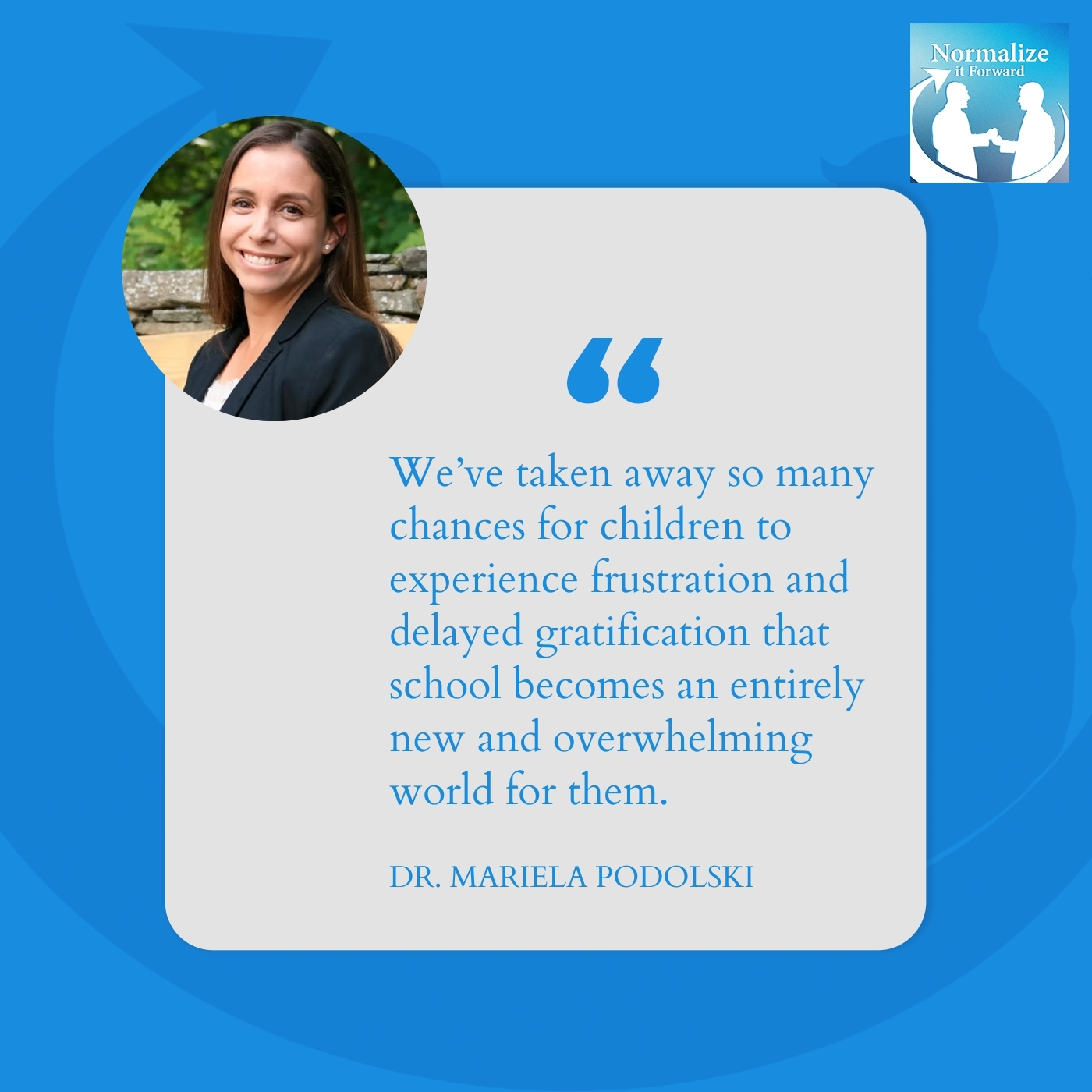
Going back to your question, which was about school and how difficult it is for them because it’s a long process, we have removed from their experience of growing up so many opportunities to experience frustration and delayed gratification that school becomes a completely new world, in which it’s very overwhelming. They come to our offices with this powerlessness. They don’t know the how-to. They can’t get through. It feels so important and so drastic if they make a mistake because they have not experienced that before. That’s my answer.
It’s a good answer. I read somewhere, and this is accurate, that as parents, we’re stealing their opportunities to grow self-worth when we jump in and do that. I understand why we do it. We do it because we want things to be smooth, we want things to go well, and we want our kids to be happy. Parents, oftentimes, when they do get involved in those scenarios, are impacting their kids negatively and disrupting the growth opportunity for them.
Parenting In The Digital Age: Managing Phones & Social Media
I see that a lot with college. When kids go to college, they make that jump. Parents aren’t allowed in, so kids have to do it themselves. It’s challenging. I’m curious. Talk to my parents for a minute, if you would, about phones because you have a sound viewpoint on this. I’m wondering. As a parent, let’s say, of a middle schooler and even a high schooler, what suggestions would you have in terms of management of these devices?
This is something that I have invested a lot of time in learning how to deal with in my practice because it is such a big problem. The first piece of advice that I have for any parent is to delay. Hold off until the very last minute before you provide them with a phone. When you do so, as a parent, I want you to think about that phone not as the child’s property, but as your own property. It doesn’t belong to the kid. They don’t pay the bill. They don’t know how to handle it. It’s the parents’ property.
With that said, before you give your child a phone, sit down and establish X number of rules that you’re willing to follow together. I learned this from a friend, not a patient or anyone. He told me that when he was thinking about giving a phone to his son, he came up with a contract. It was a contract with twenty items. He didn’t want to have all the power. He wanted his son to come up with some ideas in there, so he gave him the opportunity to come up with 3, 4, or 5 things that he wanted to have in the contract.
I did this with my own son. My daughter doesn’t have a phone yet. My son is a teenager. I did this with my own son, and it worked beautifully because we could negotiate. His first statement was, “I can use my phone for five hours a day.” I immediately was like, “That’s not going to happen. Let’s move it back.” We could negotiate a time that seemed to be right for communication with his friends and whatnot. He also put in there that he wanted to have a warning whenever I’m going to remove the privilege of having a phone, so he could tell his friends, “I’m not missing in action.”
That’s reasonable.
It’s a text message, like, “My phone is being removed. I’ll see you next week,” kind of situation. He has a heads up of, “You have five minutes to send all the texts you need to send, saying everything you need, and the phone is going away.” We developed this contract, and it has worked well for our family. For my patients, I started doing that, and it works very well. I have more advice for parents.
Please. I want to hear it.
I don’t want to make this a monologue because I could talk about this forever. In those rules, remember always that the phone is a privilege, not a need. It isn’t a need. Nobody needs a phone to survive. I didn’t have a phone growing up. You didn’t either because we’re in a different age group. Remembering that the phone is a privilege at all times is very important and helps you with that mindset. You have to decide what you are going to allow the kid to have on that phone. What apps are you going to allow? Are you going to have parental controls or not? For me, research is very clear.
Remember always: the phone is a privilege, not a need. Share on XSocial media is not helpful in the developing brain. There are a lot of risks that come with having access to social media, particularly for girls. What we know is that there is a higher risk of eating disorders. For boys, there is a higher risk of getting into pornography. There is a risk of gambling as well. For both groups, there is a risk of anxiety and depression. We can’t deny that.
What I tell parents and kids is, “This is not my opinion. This is what we know from research.” As a clinician, I can say that I am a firsthand witness to this being accurate, so I don’t doubt myself when I have to give this recommendation to the families. As a matter of fact, my son asked me, “Can I have whatever social platform is like, ‘When you’re sixteen, we’ll talk about it.’” It was like, “It’s not going to happen no matter how many times you ask because I know the danger. I see it here.” The constant comparison is not good for a brain that is not developed.
Remember, it is a beautiful thing how science works. When you’re an adolescent and you’re developing your brain, your limbic system is in overdrive. It’s all about emotions. You want to feel good, so you’re going to be seeking behaviors that are dangerous and have high reward. Your frontal lobe is underdeveloped, particularly because that’s the only way that could happen.
Those risky behaviors keep us alive. Back in the day, exploring, finding a better place to build a fire, or finding a better place for water required a lot of risk, less frontal lobe, and less rational thinking. That’s the way that we have allowed our species to survive. Adolescents have that. They have an overdrive limbic system in a very underdeveloped frontal lobe or executive functioning.
Introducing social media at that developmental stage is dangerous, because one bad decision can go online and stay there forever, harming someone for the rest of their life. Share on XWhen you introduce social media in that developmental stage, it’s a dangerous place to be because you can make not smart decisions that go out on the internet and are there forever, harming somebody for the rest of their lives. Maybe they have very poor impulses when it comes to seeking that dopamine hit, like the likes, the comments, etc. Be careful. My summarized advice is that.
Beyond Screens: Essential Wellness Habits For Young People
It’s great advice. I know I’m pushing you to comment on these things. I know we could talk for hours about them. There are a couple of things you mentioned that I want to highlight. You and I have both seen in our practice over and over again the effect of some of this. For parents, it’s not like you can resist and give your child a phone when they’re 25. They’re going to get a phone at some point. The management post giving them that phone becomes our responsibility as those parents to stay involved.
Parents will ask me all the time, “Should I look at my child’s phone?” The answer is absolutely. You’re going to find things on there that will surprise you and shock you, and that allows you to have a conversation. There’s a lot out there. From our generation to this one, it is the ultimate comparison and harsh criticism that kids will get from pics, follows, likes, and all the other stuff that comes with it.
I’m curious. To segue out of phones for a minute, I want to ask this. One of the things we deal with all the time is general wellness for young adults. I know I’ve been working on better hydration, drinking water all the time, trying to get some movement in, and making sure that I’m taking care of my body and my brain. I’m curious. When you think about wellness with young people, what are your thoughts and suggestions? What do you think?
It has been maybe one month since I started using this term in my practice called “the boring things.” When patients come and tell me, “I have anxiety. I can’t do this,” and they tell me all of this rollercoaster of emotions, I stop for a second, and then I look at, “How are the boring things going in your life?” What I’m referring to with that phrase is, “How is your sleep? How well-hydrated are you? Are you moving your body? How much screen time are you using? How are you eating?” Nutrition is so important. I’m like, “What are you eating?” Last but not least is, “What purpose do you have in life?”
If we’re not connected to our community, it’s a big crack in our defense for depression and anxiety to come in. If somebody who doesn’t have a purpose is not connected in the community, is not a student, or is not working, they are not going to feel good about themselves. I call those the boring things. I have started to put a lot more importance on those in my life, too, but with our patients.
Inevitably, this conversation is going to lead back to some screen time. If you’re on your phone until 2:00 AM in the morning, your sleep quality is not going to be good. It doesn’t matter what you tell me. It’s not only because the timing is not right or it’s not within your circadian rhythm, but also because it is very clear that it’s not only that it’s postponing our sleep. It’s also that we’re changing the architecture of our sleep when we are on the phone for so much time, particularly before we fall asleep.
Also, we can’t say it enough. It’s a bigger conversation. We would have ten episodes that would last ten hours each. The quality of her food is not the same as it was before. We have to make a conscious effort to look for the food items that are going to nourish our body, but more importantly, our brain. A malnourished brain is a brain that doesn’t function well.
A malnourished brain is a brain that doesn't function well. Share on XThat is the concept of integrative psychiatry. You know that these are some of the things that I do. We pay attention to the micronutrients. What are the things in your brain that are missing in order for us to supplement those and provide you with better brain chemistry? All of that comes from Food Mart. That statement that we are what we eat was right. It’s from years ago, but some people still use it. Wellness is important.
The beautiful thing that we have in front of us is that it has never been easier to access things that can help you. Social media is not all evil. I don’t want you to think that. There’s access to so many people who have good advice and bad advice. Be careful. You can also find a lot of information at the tip of your fingers on what are good things for sleep, how you can meditate before bed, and other things that you can do.
I’m glad you said that. Let me go back to integrated medicine for a minute. One of the things that makes you special as opposed to other providers I’ve worked with is that your scope is larger. You look at these things, and there are things you’ve caught with my patients that I know other doctors would not have.
I want my audience to understand the difference between integrative medicine. We’re looking at other things. Other things involve wellness. Other things involve our nutrients. Other things involve our levels within our systems. If they are off or they are depleted, we are going to have issues. How many patients have we seen together who have had low B12 issues and whose energy levels have plummeted?
The other thing you mentioned that’s important to put out there is that there are positive sides to technology. We’ve got smartphones. We’ve got smart rings. We’ve got smart water bottles. We’ve got all of these things that allow us to measure stuff that helps us. When families are thinking about what you call the boring things and I call self-care, it is our basics of eating, sleeping, and exercise.
To me, one of the coolest parts about it is that we have access to changing these things. If we’re young people, we have a choice when we open the pantry. What do we have in there? What do we choose to eat? We have a choice as parents. What do we choose to buy in the grocery store? What do we bring home? We have a choice to be active or not be active. There are certain things in life that we don’t have a choice in. This, we do. Our wellness, if we’re wrapping our arms around it and letting our kids know, “That’s a message I am paying attention to as an adult,” we’re teaching that.
It doesn’t matter what type of parent you are. With all of the good, the bad, and the ugly of being a parent, because it’s not an easy job for anyone, our kids are going to learn what we teach them. There’s school and whatnot, but the foundation of our children is going to come directly from their most immediate circle, whether that’s their parents, their grandparents, or whomever it is that is taking care of and raising them. Making those choices is very important, and also acting by example.
I also work with eating disorders. One of the things that I teach families all the time is, “Before we talk about Susie or Johnny’s relationships with their own bodies, what is your relationship with your body? Are you a parent who is constantly cutting calories on their plate or is constantly talking about how they dislike their arms, their thighs, or whatever it is?” Kids learn by example, so we have to be mindful of what we do, good and bad.
Please ask for help before it is too late. Share on XMy parents never exercised in their lifetime, so exercise never came that easily to me. It’s something that I had to dedicate a lot of time to. Since I have been very mindful of that, it’s easier for my children. They do not imagine a world in which they’re not moving their bodies. We have the power of change, too, which is a beautiful thing. We, as parents, have the power of change to break cycles that we didn’t like from before and to normalize them forward. We do that for our children to get them in a better place.
Navigating The College Transition: Wellness & Responsibility
In many ways, we have. I see so many families normalizing the concept of mental health and general health. I’ve seen that, heard that, and witnessed that, which is great. There’s always room for improvement. Your point is a great one. We’re always teaching, and kids are often listening.
Let’s pivot to college for a minute. Many of my readers are either in or going to college. I’m curious. You see students, as do I, transitioning from high school to college. I am sure you have a lot of tips or suggestions. Any larger tips or suggestions that come to mind that may help kids with the jump into a college environment? What do you think?
I never experienced college. I’m not from the US. In my country, we don’t go to college. Culturally, we’re different. I went to medical school, but I lived with my parents, so it was completely different. I never had a “college experience.” From what I learned from my patients, when they are in college and in that transition, it often is very individualized. There are kids who go with a mindset of, “I’m going to have a lot of fun. It’s going to be great.” For others, it’s very anxiety-provoking.
Individualizing that transition is important. Understand that everybody who goes into this situation is living their own journey. It’s completely different than yours, but also, at the same time, it has a lot of sameness. It’s a new environment for everyone who’s there. Everybody is a little anxious, even though some of them show it more than others.
Where I see kids stable in college is when they are not able to do the boring things. They’re not able to have regular meals. They’re not able to sleep well. They’re not able to stay away from drugs and alcohol. They’re not able to take care of their wellness. That’s where I see them stumbling and not being successful. They get into trouble in one of these areas.
Their schedule got off, so they’re sleeping all day and are up all night, so they miss class. That snowball goes forward. Maybe they stopped eating at the cafeteria because of XYZ, and then they lost a lot of weight. They have to come home. Maybe they started drinking too much. That scaffolding of wellness will carry you through more than it’s evident to them. Hopefully, most of them had it at home, so it’ll be new for them not to have it. They have to be responsible with their sleep, diet, exercise, contributions to society, and everything else.
There is less awareness around mental health, and we, as mental health providers, need to do a better job of distributing this information. Share on XYou mentioned it. Do they have it at home? Some do, and some don’t. For those parents who are reading that don’t have that structure and aren’t working on that, that might be something to consider. When a kid does make that transition, whether someone shakes their hand and tells them all of this, they’re granted the responsibility of managing all of that. Some kids don’t do a great job. From your point earlier, that keeps them moving in a positive direction.
At 11:30, when their friend approaches them to watch a movie and they’re like, “I got to get my rest. I’m going to take a pass. Maybe we’ll do that in a couple of nights, but right now is not the right time. I’m going to go to sleep,” to me, it is that simple decision, which all kids have the ability to do. They say, “I’m going to take care of myself.” To your point, that keeps kids in a position to fend off things, in many ways, like anxiety and depression. Those are good suggestions.
I can’t leave this conversation without saying to please ask for help. If you’re struggling, please ask for help. Hopefully, you can ask for help before it is too late.
Breaking The Silence: Why Asking For Help Matters In College
That’s a great point. Let me ask you this, because it’s a huge issue. I research this all the time, and I see different numbers. I was looking into it, and it said that something like 60% to 70% of kids who need help in college don’t get it. In your opinion, why is that?
There is still a lot of stigma about mental health. Being vulnerable is not necessarily a strength for many. Also, there is this pressure of not wanting to be a disappointment to their parents. There’s that kind of narrative they have, like, “If I ask for help, it means I’m failing.” Quite the contrary, we want to help you before you fail. Ask for help early so we can keep that going.
There’s a lot of awareness in your world and mine because this is what we do, but for college kids who are getting there, they don’t even know their struggles, so there is less awareness. They might not know that the fatigue that they’re feeling, why they do not want to hang out with their friends, or why they have no interest in getting to know somebody might be a little bit more than just missing home. It may be depression. There is less awareness. We, as mental health providers, need to do a better job of distributing this information, like in this show, for them to have that.
That’s a great point for all of those reasons. I can only say to the young adults reading that your words are very wise. Sometimes, kids start to struggle, and they don’t necessarily recognize where that’s going to lead. It reminds me of swimming. You start to have trouble in the pool, and you don’t necessarily think you’re going to drown. You’re like, ‘Maybe I’ll be fine.” Maybe you won’t.
To me, my advice would be that the wise person, as they’re growing, recognizes we all need help. Think about it. We’ve got a lot of years in our careers. You and I talk to each other all the time because we need some advice, some direction, or some assistance. To me, parents need help, and kids need help. We all need help. The difference is admitting it.
It’s that fear of being vulnerable, which ties to one of my first statements. It is this idea that we have to live in the positive all the time.
That’s right. That’s in our lives.
It’s not. Having anxiety, fear, sadness, and all of these emotions are what make us human. We need to normalize them. We need to allow ourselves to be vulnerable and ask for help when it is needed.
The more young people tune into shows like this, the more they’ll hopefully realize that those are human emotions, and we all have them. It’s okay to struggle, but you’re not alone. You don’t have to struggle alone. In my opinion, it is pushing through some of that uncomfortability and saying, “I’m not sure exactly who to ask, so I’m going to try to talk to an RA,” or, “I’m going to try to talk to a professor,” or, “I’m going to call a therapist, a psychiatrist, or whomever and ask, ‘I don’t know if you work with this or not.’” I’ve had those conversations with patients over the years. It’s so valuable when young people do that because they get the answers when they ask. That’s important. Can I put you on the spot for a minute?
Sure.
I didn’t warn you about this. With this show, usually, what I ask of people who come on is a recommendation to keep the conversation moving forward. That’s where the name comes from. Give us a recommendation of an individual that you might know in your world, whether it be a friend, a coworker, or a relative, who would be helpful for me to interview next going forward on the show. Any thoughts?
Yeah. I have a great person for you. Her name is Rebekah Bardwell.
Who is Rebekah?
I met her years ago when we worked at the same institution. She is an LPC by training and had some more administrative roles at the time. She’s an eating disorder expert and a fabulous clinician. She has her own company called Bardwell Behavioral. She’s the lead there. She does psychotherapy. In particular, she does what I love, which is accelerated resolution therapy. She has clinicians working with her. She’s a fabulous person to talk to.
That’s fantastic. I’ll get her info from you offline. I appreciate the recommendation. I appreciate your time and energy. I know you’re super busy. I know you wanted to come on, and I wanted to have you on. We finally did it. We made it happen. This is great. Thank you for being here. I appreciate it. Have a great rest of your day.
You too. Thanks so much.
Thanks.
Important Links
About Dr. Mariela Podolski
 Dr. Podolski completed medical school at the Universidad de Costa Rica in San Jose, Costa Rica. As her first attending job, she worked as a general physician in a rural area in the south east corner of Costa Rica. Excellent clinical skills were a must, given the lack of resources in the area at the time. This experience strengthened her medical knowledge, and she still utilizes these lessons in her daily practice.
She pursued her Psychiatry Residency at the Institute of Living in Hartford, Connecticut. This was followed by a Child and Adolescent Psychiatry Fellowship at The Medical College of Wisconsin in Milwaukee, Wisconsin.
Dr. Podolski joined Eastern Connecticut Health Network after graduation, working in a Child and Adolescent Psychiatry Clinic in an underserved area from 2012 to 2015.
She has been working with Walden Behavioral Care, since 2012. Initially as a Consulting Psychiatrist for their Partial Hospital Program. In 2016, she assumed the role of Medical Director for their Inpatient Eating Disorders Unit at Rockville General Hospital. This role allowed her to expand her eating disorder knowledge, as she treated patients with extreme eating disorders that required specialized inpatient medical and psychiatric stabilization.
She continues to work hand in hand with Walden Behavioral Care as a consultant.
She has held academic appointments for the University of New England College of Osteopathic Medicine, and for the Quinnipiac University Frank H Netter School of Medicine.
Dr. Podolski is an active teacher and provides Eating Disorder lectures for psychiatry residents at The Institute of Living, University of Connecticut and for ECHN Family Practice Residency. She is frequently asked to present on the topic at different hospitals in the area.
She holds medical licenses in the states of Connecticut and Massachusetts.
Reading about mental health is hard. Let’s schedule a free consultation.
 Sports reporter Brandon Saho battled depression and suicidal thoughts for years before finally asking for help in 2022. After beginning therapy and checking in to a hospital, he found a new purpose in life to help others.