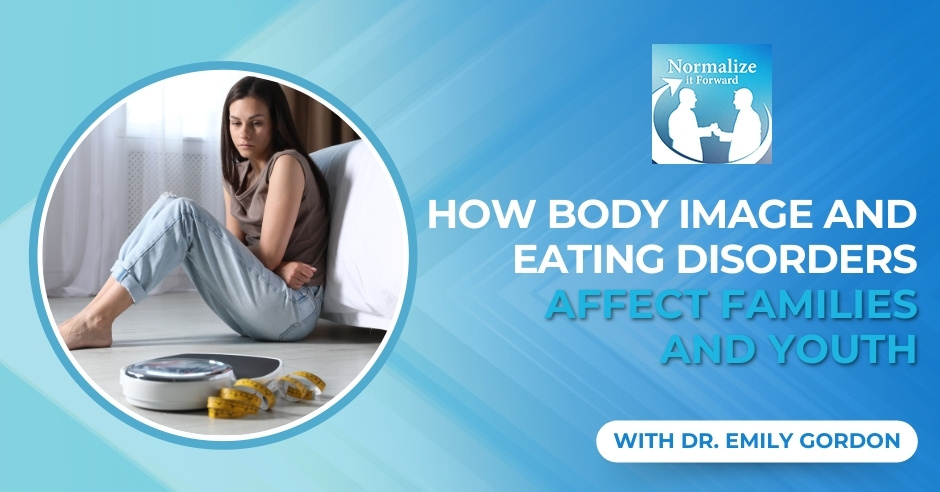
Normalize It Forward - Marc Lehman | Dr. Emily Gordon | Eating Disorders


Body image and eating disorders aren’t just clinical issues; they’re lived realities shaped by culture, technology, and family life. Drawing on nearly 25 years in private practice, licensed clinical psychologist Dr. Emily Gordon explores how perfectionism, social media, and comparison culture amplify these struggles — and how parents can support teens and young adults without adding to the noise. She mixes practical strategies with warmth, showing how boundaries, honest dialogue, and tuning in to one’s inner experience can become powerful tools for resilience and healing.

Reading about mental health is hard. Let’s schedule a free consultation.

Watch the episode here


Listen to the podcast here


How Body Image And Eating Disorders Affect Families And Youth With Dr. Emily Gordon

I am super excited to have Emily Gordon join us. Emily, how are you?

I’m good. Thanks.

Let me read a quick intro, and then we’ll dive right in. Emily is a licensed clinical psychologist with almost 25 years of experience. Dr. Gordon maintains a private practice in Natick, MA, where she provides therapy, supervision, consultation, and psychoeducation. She specializes in treating eating disorders and body image disturbances in adolescents, young adults, and women of all ages.

Emily often works with people navigating life transitions and parents looking to better understand and support their developing teen, and better care for themselves along the way. She enjoys speaking and writing about topics relating to eating disorders and body image, adolescent development, young adulthood, and parenting. In addition to our work with teens and families, Emily is also a parent to three teenagers. Emily, welcome. How are you?

I am good. Thanks. I’m glad to be here.
 

Normalize It Forward - Marc Lehman | Dr. Emily Gordon | Eating Disorders


From Practice To Parenthood: Dr. Gordon’s Journey And Expertise

Welcome to the show. We’re excited to have you. First, I’m going to flip-flop and start with the last thing I said. Three teens. Tell me. How old are we talking?

Two are young adults. I don’t know if I can say teenagers anymore. Teenagers are so much easier. I have 2 in college and 1 in high school.

Like me, you’re around this personally and professionally. This age bracket, that is. You and I treat similar-aged individuals. We treat middle school, high school, college-aged, and beyond. Why don’t we start off with you telling us a little bit about your practice?

I have an office here in Natick. I have a lot of experience treating adolescents with eating disorders. I work with people in a dynamic, relational, IFS-informed way. I integrate CBT and DBT. I try to take a perspective of trying to understand what is going on for someone and how they tune in to the inside and tune out all of the outside. I’ve increasingly been working on supporting parents and people navigating mid to older life challenges. I’ve enjoyed doing that as well. I’m working on a range of issues.

It sounds like you cover a lot of ground in your office and see a lot of different people for a lot of different things. Eating disorders are such a fascinating specialty. I have that as a subspecialty of mine as well. My background is in family therapy. I was drawn to it because there’s such a family component to every individual who suffers from an eating disorder. I’m wondering if we could start with the basics. Can you tell my audience a little bit about what an eating disorder is?

With eating disorders, part of what’s so interesting about them is that they’re so complex. They impact so many different areas of life and functioning. An eating disorder is a focus on food, body, and preoccupation. What truly categorizes an eating disorder is a fear of fatness or gaining weight and an inability to maintain one’s health, however we are defining health.

There is a lot of talk about what is disordered eating versus what is an eating disorder. There are a lot of people on diets. There is all sorts of noise out there about what’s the right thing to do, what’s the healthy thing to do, what we should be doing, what we should look like, and what we shouldn’t look like. There is certainly a preoccupation in our culture. An eating disorder marks itself as this intense preoccupation in a way that gets in the way of health and healthy functioning.

That’s a good definition. That’s a challenging question I asked. That’s a good way of saying it. Having worked in hospital settings in the past, where I’ve eaten with patients who are severely impacted by eating disorders, meals take on a whole new level of intensity. I have seen patients being tube-fed and so forth. I don’t think people understand how impactful an eating disorder can be.

That’s very well said and important. What we also have to know and recognize is that eating disorders are incredibly serious. They have one of the highest mortality rates of all mental illnesses. That’s because it affects your mood and also your health, like your physical body. It is incredibly serious. We can’t talk about eating disorders without talking about this cultural piece. When you sit with somebody, whether you are treating them, or a friend, or a family member, it’s a brain-based illness. There’s something that happens in the brain that feels irrational sometimes. That’s what you’re speaking to.

Social Media’s Shadow: Impact On Body Image And Mental Well-being

I’m glad you brought that up. Maybe that’s a nice segue to talk about our culture and how that impacts things. I have a funny feeling that you and I can talk about this for hours. I promised I’d only take a little bit of your time, though. When it comes to this, social media has had a major impact on what I’ll call the competition amongst people.

I’m on Instagram and TikTok regularly for my business, and even LinkedIn to some degree. What I see in the social media world from young adults and what they post is disturbing and sad. It’s been a little bit since you and I were young adults. I often wonder what that would be like for us because we didn’t grow up with social media. Young adults have this interesting perspective. They don’t know anything but social media. I’m curious. I’ll ask you a huge question.

That’s a huge question, and I’ll try to answer that or speak to some of the themes and things that come up.

It’s perfectly fine. It’s a big one. How do you feel social media impacts body image?

There’s the larger issue first of social media and our culture, even before we get to eating disorders. I know your audience here is the college kids and young adult population. We have this culture of achievement, perfection, and having to be successful. There is all this pressure on all of us. Adults and parents are stressed. College kids and young adults are stressed. High schoolers are incredibly stressed.

One thing I want to say when I go on these shows is that we’re talking generalities. I understand that for each individual identity or population, it’s hard to come up with these generalizations, but we’re going to do that anyway for the purposes of this episode. There is this larger culture of achievement and perfection, and then we get into social media, appearance, looks, body image, and what we call diet culture. You said competition. I think what also happens is comparisons. Biologically, we compare ourselves to other people. There’s competitiveness.

When we talk about social media, what you and I may have first encountered with social media, however many years ago that was, the social media of today is very evolved and different. What’s driving social media now are the algorithms. That has added a whole new layer of danger, quite honestly, when it comes to all sorts of things.

What we know is that social media platforms get paid. They make their money by keeping your eyes on their platform. They’re competing with other platforms. How do they do that? They do that by making you feel bad about yourself. That’s the marketing industry. That’s the diet industry. That’s the cosmetic industry. The forces that we’re up against are these financially deep ways that these companies have of making us feel bad about ourselves, and then pushing us to more and more extreme content.

I know we’re here to talk about body image and eating disorders, but that has other risks in terms of truth, facts, and politics. This feeding us of more and more extreme information keeps us on the platforms. It keeps us feeling bad about ourselves. It keeps us feeling like we’re not okay the way we are and that we need to change. The magic bullet is, “If I look better, or if I eat this and not that, everything will be great. I’ll feel good. I’ll be happy. I’ll be able to compete with that other person.”

You probably have heard this. In the eating disorder field, we say that it’s about the food, but it’s not really about the food. It’s about something deeper in the way that people are using the behaviors around food and body to help them feel better. That is a valid and essential piece of how we feel good about who we are in this world, where it’s always in front of us. There’s always something more. There’s always something better. There’s always something coming at us. There are all these messages. We’re afraid to put it down. Teenagers are afraid to put it down because they want to be connected to their friends. They’re afraid that they’ll miss out on something, or they’re not there. It’s challenging.

Eating disorders are not really about the food. It's about something deeper, in the way that people are using behaviors around food and body to help them feel better. Share on X

The “Fast, Cheap, And Easy” Trap: Social Media’s Influence On Youth

It is, on so many levels. I feel like we could talk about this for months. I have a theory that I call fast, cheap, and easy. When I look at young adults, I feel like they’ve been groomed for fast, cheap, and easy. If things aren’t brought to you fast enough by Amazon, they create Amazon Prime so that everything’s fast. The kids that I work with love to eat fast food because it’s fast, cheap, and easy. They don’t care if it’s unhealthy. They love to eat that.

There are certain things in this world that aren’t fast, cheap, or easy. I try to point out to kids that most things in life that are fruitful take time, like school, for example. School is not fast by any means for kids. One of the loops that social media ends up teaching kids, whether it’s on purpose or not, is, “You can do this thing. Take this pill. Drink this. Do this. Do that. You’ll feel so much better.” Kids will order those things. Kids will buy those things. They’ll take those things and then, after the fact, find out, “That’s not the case. I ordered an item from a business, and they’re trying to make product.” In this world, if we want to feel better about ourselves, it takes time.

It takes time, depth, and tolerance of being able to tolerate discomfort, feelings, and disappointment. You’re right. There’s this fast, quick, and easy mentality. We can’t fault teenagers for that because that is the world in which they have grown up.

Agreed.

I don’t know why this moment stands out to me, but I had a baby in my arms, and I was pushing the button on the Keurig coffee machine. I had this moment of like, “We’re screwed if my kid thinks that all you have to do is push a button and the coffee will come out.” Not to mention the whole farming industry and what it takes to get a coffee bean, but all you do is push a button, and you get a cup of coffee. That’s the world in which they’ve grown up, and it looks like everybody else is doing it. It looks like everybody else is happy and successful.

I had a fascinating conversation with someone who was talking about their feed. It made me think about not only the fast, quick, and easy, but also what is real and what is not real. There is this way in which when you spend so much time on your device or on whatever platform, it feels real, and yet it’s not real. It’s also not always true, and yet it’s very easy to think that it is. That’s another obstacle that we are up against.

When you spend so much time on your device or platform, it feels real, yet it's not always true. It's very easy to think that it is. Share on X

I’ve had lots of conversations with my teenagers. It depends on how long they’ve been intertwined with technology that they can understand some of these concepts, like when you talk about privacy, companies having your data, or where a screen belongs and where it does not belong. To me, the screen does not belong in the bathroom. Some people look at me like I have five heads when I say that. It depends on how old the kids are, what their experiences have been, how old they were during the pandemic, and what the family attitudes are around technology.

I agree. In many cases, I feel like when I talk to teens, these are what pacifiers are like to babies. They’re self-soothers. When you take a pacifier from a baby, it usually screams bloody murder. That typically will happen when a parent takes a phone from a kid. To me, that’s a little concerning because they’ve convinced themselves.

One of my ideas or something that I built my practice on and I fundamentally believe is that teenagers are pretty awesome. That’s why I love doing what I’m doing, and I love talking about what I’m talking about. It’s fascinating to me when you give a teenager an opportunity. I use the word teenager, but I mean teens slash young adults. To review, we know that teens are still developing. Their brains are still developing.

One of my supervisors once framed this for me in such a beautiful way. Even though somebody is 13 years old or 15 years old, they’re not 13 or 15 in every single way. Somebody who is 18 has some skills of a 9-year-old, some skills of a 12-year-old, and some skills of a 25-year-old. We’re talking about this wide range of skills and abilities.

We went away one time, and I kept saying, “We’re going to do a family day with no phones.” They finally looked at me and were like, “Do it already. Stop talking about it. We’re fine. Do it,” but I felt like I needed to prepare them. When you can ask them questions about what their experience is, what they notice, and what they think, it’s pretty awesome what they can come back at you with. I try to encourage those kinds of conversations.

Getting back to body image, I’m like, “What do you feel like when you open your feed? What’s in there? Who are you following? What are your friends posting?” We have a lot of rules in our house around what is okay and what is not okay. I’ll get a question, like, “Is it okay if I do that?” I’ll say, “What do you think? What do your friends think?” They’re like, “Is it okay if I ask my friends and I do this?” We’re having lots of conversations that are asking them to think and reflect.

Redefining Self-Care: Inner Wisdom In A Fast-Paced World

The theme of what you’re saying is so important, and that is parents need to be involved. They need to be having conversations with their kids. Whether it’s social media or phones, or both, they’re so impactful on kids. Sometimes, even picking their phone up and taking a look at their feed as to what’s in there can give you a sense of what they’ve been looking up and what the algorithm is sending them. That’ll tell you a lot. Let me pivot away from the topic of social media for a minute and ask this. Self-care is a buzz phrase that’s been talked about a lot in our field for many years. What do you think of self-care?
 

Normalize It Forward - Marc Lehman | Dr. Emily Gordon | Eating Disorders


Self-care is tuning in and knowing yourself. In order to do self-care, you have to know. You have to be able to identify and label your own feelings. One of the things I’ve been working on is neurobiologically with our nervous systems and regulating ourselves. Whether we’re in the world, on social media, or dealing with conversations, we get activated.

It is being able to regulate our nervous systems to identify feelings, to be able to tolerate feelings, to be able to know what relationships feel good and are benefiting us, and what relationships are not working so great, to be able to have boundaries, and to speak up for ourselves. It’s nice to go for a walk or have a massage. Those things are important, too, but it’s way deeper than that. Self-care is building relationships so that you have them when you need them, and being able to make decisions about keeping yourself feeling good and healthy.

That’s a great answer. I’d love for my young adults who are tuning in to take heed to what you said. There are lots of ways to do what you suggested. Probably one of the most important things I heard is paying attention to yourself and asking the question, “Am I happy?” You could be lying to the rest of the world if you want.

In order to answer, “Am I happy?” you have to say, “What does this feel like to me?” Sometimes, as teens are developing, they may not be able to have the words that go with a feeling. It is like, “Where do I feel that in my body? What am I feeling? What am I not feeling? What’s happening in terms of my behavior? What are my goals, and how am I doing at meeting those goals?”  It is asking yourself, “If my goal is to plan a soccer game, do well on a math test, or try out for a singing competition, am I taking the steps and making progress towards those things that I have identified as of value and meaning to me?”

Great point. What I was getting at was those teenagers who deep down know they’re not in a good place and are walking around with a mask on. Your point is very important. I would also point out the simplicity that we all have the ability to take those steps. Some kids may say, “I don’t want to,” or, “I’m feeling a little lazy,” or, “I’m not in the mood.” That’s fine, but we all still have the ability. I’m curious. I would love to put you on the spot. You seem like someone who could handle being put on the spot. I’m thinking of doing something new for my Instagram, and I would love to test it out on you. How about that? Can I do that? Is that good?

As long as you handle the technology part, because I tried something new on Instagram, and I failed at the technology.

College Transitions: What Parents Wish They Knew

No tech here. I’m just reading a question. I wanted to ask you a question as a mom. You’re stepping out of your therapist role and into your mom role. Having had two kids of my own go through college, I’m fascinated by what we learn as parents. Each year, there seems to be a good amount of learning. Let me read. As a mom who had kids go through college or even a couple of years of college, what’s one thing you wish you knew going into their first year?

My kids will tell you I can never take the psychologizing out of being a mom.

My kids tease me about it, too.

One of my friends had given me this advice, and I didn’t appreciate it at the time. As they’re getting ready to go, you feel like they’re leaving forever. The advice or feedback was that they come back, and you are building a new relationship. That has been important to remember. It’s also a lesson that’s related to something else I like to talk about, which is that change doesn’t necessarily mean bad. It’s different.

Change doesn't necessarily mean bad. It's just different. Share on X

One of the things I talk a lot with the kids I work with who are going to college is that there is a loss and a change. One of the things that we do a disservice to our aspiring college students is that we talk so much about, “These are going to be the best four years of your life,” or, “Aren’t you excited? You got into the school of your dreams.” We don’t talk about what it feels like to experience disappointment and what it feels like when we miss home. Those things are normal and okay. That’s something I wish I knew.

Those are good points. As you were talking about the transition and the loss, I think growth is hard. I also had a friend give me some advice, and it helped a lot. It was that they’re supposed to do this. As simple as that is, you forget that. You’re right. As a parent, there’s that loss and that sadness. It’s harder for families in some ways because our lives are the same, minus our kids. Their lives are new and exciting.

You’re on this precipice where you don’t know what’s coming. With a lot of things in life, we can look back and say, “It was okay. I got through it. I made it.” When we’re facing a precipice and we don’t know what’s coming, it can be scary. It’s also super cool to watch kids figure things out.

I agree.

It’s cool to watch them become themselves and find things. That is not to say that it’s always easy or that it’s always a smooth road, but to see them navigate, meet challenges, and find people and things that are so awesome is cool.

Empowering Students: Mental Wellness For College Life

I have one more question. This is more clinical, though. That was more for the moms. From our counselor backgrounds, when you think about kids that are reading this who are going off to college and their mental health and wellness, is there a suggestion you have for a kid that can help keep them balanced and managed heading off to school?

That is a great question and an important one. My advice would be similar to what I said, but tailored to a young person. It is that there are going to be ups and downs.

There will be ups and downs, and that is normal and expected. You're going to learn a lot about yourself. Share on X

No doubt.

That is normal, expected, and okay. I remember doing a semester abroad. I will never forget standing in the post office in a foreign country. At that time, we did not have cell phones or social media. I was trying to mail a letter home. I was in tears, and nobody would help me. Yet, those 3 or 4 months were the most amazing experience, not because they were easy, but because I saw, learned, grew, and did.

What I would say to students is, “There are going to be ups and downs. You’re going to learn a lot about yourself. You can do it.” Also, there’s so much support and help out there. It’s pretty amazing. There’s so much going on at these schools. There are so many people like you and me. It’s okay to want or need help. Everybody else doesn’t have it as together as you think they do.

That’s well said. I’m hoping my young adults are taking notes of your words. I would further that by saying I can’t tell you how many kiddos I’ve worked with that go off to school with maybe no anxiety or very little anxiety, and they come back with some challenges because growth is hard. The challenge can be high for some kids, but what you said makes so much sense and is so important. They need to realize there are people out there who can help and support.

In all different ways, whether that’s social, academic, health, or mental health. There are resources and support.
 

Normalize It Forward - Marc Lehman | Dr. Emily Gordon | Eating Disorders


Kids have to be willing to ask and realize, too. If you don’t believe us, look it up on Google. Statistically, there are a lot of kids out there struggling. Homesickness is, to me, a pretty natural thing that most kids will encounter. I love what you said in your comments. “You’re going to do this. You’re going to get through this, and you’re going to grow as a result.”

I always tell kids, too, “If it’s not working for you, that’s okay. Let’s figure out what will.” Sometimes, we have to go and try things. Sometimes, we need to change our roommate. Sometimes, we need to change our school. Sometimes, we need to change our major. Sometimes, we need to change our path. We can deal with anything.

I transferred when I was in school, and I’m so thankful that I did. It brought me to UConn. When I was at UConn, I met one of my mentors there who opened up the whole world of counseling.

I know you’re trying to wrap up, but that’s another thing. We do this to kids. They feel like they have to know their path and that they have to have it figured out. I don’t know why we need to have kids applying to majors.

It’s a little crazy.

How do you know it’s seven? You don’t know things until you try to do things. There’s this pressure to know and to be sure. We can’t know things. All we can do is make one decision at a time. We as parents, as professionals, and as a culture can try to take the pressure off that you have to know and figure everything out, and trust that one thing will lead to another. It may not be the path you thought. That’s okay. Maybe it’s a more meaningful path or a more satisfying one.

Finding Your Path: The College Journey And Beyond

I completely agree. When kids come into my office at seventeen, they’ll go out of their way to tell me, “I’m majoring in Neurosurgery.” I’m like, “That’s cool.”

Some people know. Somehow, I knew I wanted to be a psychology major. I don’t know how I knew. I didn’t know that I was meant to be a psychologist, but it worked out for me. It doesn’t always, and that’s okay, too.

Let’s face it. When kids are in college, they’re pursuing something that they’re going to do for the next 40 years. To me, it seems like a decision we should take our time making. Some of my readers might be wondering because I often, at the end of interviews, ask you to nominate a friend, a coworker, or a relative to keep the conversation moving forward. I want to let everyone know that Emily and I have chatted offline. She has made some amazing recommendations that I do intend to follow up on. I appreciate all of the suggestions you made and want to thank you for your time and your perspective. It has been wonderful connecting with you.

Thank you. I agree. I somehow had a feeling we would have lots to talk about. Maybe we can continue the conversation someday.

I would love that. Thanks again. You have yourself a wonderful evening. You take care.

You, too.

Thanks.


Important Links


About Dr. Emily Gordon

Normalize It Forward - Marc Lehman | Dr. Emily Gordon | Eating DisordersEmily Gordon, Psy.D., is a licensed clinical psychologist with almost 25 years of experience. Dr. Gordon maintains a private practice in Natick, Massachusetts, where she provides therapy, supervision, consultation and psychoeducation.

She is licensed to practice in the states of MA, FL and VT. Emily specializes in treating eating disorders and body image disturbances in adolescents, young adults and women of all ages.

Emily often works with people navigating life transitions and parents looking to better understand and support their developing teens and to better care for themselves along the way.

Dr. Gordon graduated from Northwestern University and earned her Psy.D. in Clinical Psychology from Ferkauf Graduate School of Psychology at Yeshiva University in New York.

She completed a Postdoctoral Fellowship in Child and Adolescent Psychology at McLean Hospital in MA, and was part of the team that started the Klarman Center for Eating Disorders also at McLean. Dr. Gordon has since supervised psychology trainees at both McLean Hospital and at the Boston Institute for Psychotherapy.

She enjoys speaking and writing about topics related to eating disorders and body image, adolescent development, young adulthood and parenting. In addition to her work with teens and families, Emily is a parent to three teenagers. You can find more about her practice at www.dremilygordon.com or on Instagram at www.instagram.com/dremilygordon.


Reading about mental health is hard. Let’s schedule a free consultation.
 

Normalize It Forward | Penny Jarrett | Young Adults


Depression and anxiety are among the biggest mental health challenges being faced by most young adults right now. Wellness coach and therapeutic art practitioner Penny Jarrett is here to discuss how they can look after themselves better through self-care. Joining Marc Lehman, she discusses how social media and the internet greatly contribute to young people’s toxic self-comparison and limiting beliefs. Penny also underlines how positive affirmations and addressing unresolved dreams and trauma can unleash your greatest potential.

Watch the episode here


Listen to the podcast here


Young Adults And Mental Health Care With Penny Jarrett

Welcome to the show. This is a show that talks openly about mental health and wellness. We are here to welcome Penny Jarrett. Penny is a mental health and wellness coach, a writer, a speaker, and a therapeutic art practitioner. She’s passionate about helping people overcome their challenges so that they can begin to live fulfilled lives, joy, and free of pain and confusion in the negative effects of trauma.


Normalize It Forward | Penny Jarrett | Young Adults


Penny, welcome. It is very nice to have you here.

Thank you. It’s a pleasure to be here.

Thank you. I don’t know if that intro did you justice, if there’s anything you’d like to add, or if that covered it well.

It was lovely. I was feeling good listening to you describe me. I was like, “Thank you.”

It certainly seems like you’ve done a lot of different things.

I was about to say that.

Self-Care

You sound busy, which is great. Busy is good. Certainly, everybody that comes to the show comes with a different perspective and a fresh view of things. Our main thrust is to try to talk more openly about health and wellness and try to get a good sense out as much as we can to role model for our young adults out there how important it is to talk openly. When it comes to mental health and wellness, there are a number of offshoot topics that, if it’s okay, I’d love to ask your perspective on, beginning with the topic of self-care. I’m wondering. When you hear the phrase self-care, what does self-care mean to you?

Self-care, to me, is an extension of true self-love. When everyone talks about self-love and self-care, there can be loud opinions when people express things and we cling to it. We don’t dig deeper and personalize it for ourselves all the time. Even the topics being talked about loudly are great. If we think about the fact that love is a verb and it’s something we do and it’s not just something we feel, it’s a beautiful feeling when you feel all that love.

To love ourselves is not always going to be a feeling. It’s not always going to be, “I’m finally accepting myself for my flaws. I love myself. I feel all of this warmth, compassion, and fondness for myself.” Having those feelings towards ourselves is amazing. It improves our self-esteem. It helps us take opportunities and believe in ourselves, but it’s not always the case.

There’s a huge amount of people who don’t naturally feel those ways about themselves. We might feel sometimes that the reasons behind that can be vanity so we feel ashamed to talk about it. It could be something that has happened in our past, a mistake we’ve made, or the way that we view our family. This is coming from my own personal experience, and everything I’m saying here as well.

When you don’t have those natural feelings of fondness for yourself, the least you can do is love yourself because you are yourself. People often go to confidence classes. They want to love themselves. They want to feel a certain way. The way you do it is by loving yourself because it doesn’t always come naturally. I feel like self-care is a way to love yourself, and there are ways to do that.

I speak a lot at different events and stuff. We say, “Self-care is not just face masks, but a big portion of it is.” I, at one point, was completely like, “With self-care, forget the face mask.” As my self-care and my own wellness journey have come I wouldn’t say 360 because it’s not back where it was but has gone a 180 and then loads of sparkles and glitter, I’ve had to come back to the face mask, chilling, looking after my physical body, and resting.

Before, self-care, to me, when I was at the beginning of my journey was setting boundaries, saying no, quitting people-pleasing, and doing all of these things that were showing me that I was always trying to fill everyone else’s cup up and not my own. As time has gone past and those things come second nature to me, and I’ve changed, I’ve had to come back to make sure I’m loving myself with long walks, time alone, time connecting with people if that’s the season I’m in, and spending twenty minutes to do something for my skin and put that first. When you struggle, those are the things that are neglected. In a nutshell, and I am the least nutshell-y person because I’m always going off on tangents, self-care is the act. It’s an extension of self-love.

Self-care is an extension of self-love. Share on X

I talk to a lot of young adults. When it comes to things they can control versus things they can’t control, there are so many things they engage with in life that they can’t control. Self-care is one of those things that you can choose to do. You can choose to get enough sleep. You can choose to take those walks. You can choose to be good to your physical self. Setting boundaries is a topic by itself. We could talk about it for hours. It is protecting oneself, making sure that you’re not around toxic people, and you are saying no to people, which is okay to do. I love that. It’s such a big topic.

I try to promote the concept with young people of, “You have these choices. They’re not chosen for you. These are choices you have that you can do.” I’ve done the same throughout my own journey. We’ve learned a lot, and we’ll continue to learn. For young adults, in many ways, they’re almost beginning that journey and trying to figure that part out. Self-care, what a rich topic. I love your tangents. They’re great.

Thank you.

Mental Health

Mental health is such a weird topic. I feel like some people talk about it very openly and some people avoid the topic. Mental health, to me, is something we all have. Wellness is one of those things that fits in and, in some ways, is a solution or something that helps us that we can choose to have. Even seeing a therapist is a choice for many people. I don’t know how much of this you’re aware of, but with the population of young adults that I see in college, the anxiety levels and depression levels are through the roof. I wonder. In your viewpoint, what seems to be causing that?

Everybody who existed in the time when the internet didn’t, you don’t have to be a genius to point it out. If we think about anxiety and depression as an example and get really basic with it, I know it’s not basic or surface-level. I’ve experienced both at varying degrees, at times when I knew what they were and at times when I didn’t. That’s why these conversations are so important because going through something like anxiety and severe depression, not knowing what it is, is wild. These conversations are so important because you get to hear what people describe your experience. You can begin to come out of it.

If you think about anxiety, it is fear, and it’s not always warranted. It’s not always come from something. We often have difficult things we’ve been through or difficult experiences we’ve witnessed or endured, aka a pandemic, trauma in the household, stress, or different things we’ve gone through. We can then become protective and fearful about that happening again when it’s gone. For some people, they don’t. Some people are like, “That’s over. Let’s live.” Some of us become very hypervigilant and protective. We can’t move past that. We don’t always dig deep. That’s why therapy is amazing because your therapist asks you questions that help you to realize, “This fear that I’m holding, I am afraid of losing someone again. I am afraid of losing myself. I am afraid of dying.”

When you get down to it with anxiety, there’s a fear. It’s like, “I’m afraid of failure. I’m afraid of not living up to my own expectations or expectations of my parents,” but it’s never that loud. It’s always at the back but it steers the behavior and causes a constant knot. The truth is wellness is a solution but it’s also a destination. It’s a state. It’s a state of wellness, a state of well-being, and a state of joy, which we all have innately but don’t always access.

I go back to talking about the internet. When we’re over flooded with and over inundated with other people’s lives, other people’s successes, or other people’s smiles when we’re not happy, all of these things we compare naturally. We’re not sitting there saying, “Her life is better than mine. His girlfriend’s prettier than mine. His grades seem to be higher than mine.” You’re not doing it loud. It happens because we’re taking in all of this information so naturally. What that can cause is a constant fear that you will never live up to all of these things that you’re seeing. That’s one of the things.

Don’t get me wrong. I suffered from anxiety for years and it came from living in a traumatic environment, living in a dysfunctional home, and experiencing a lot of violence. I knew it was over. I knew nothing would make that lifestyle come back to me but I could not live freely. I had to really speak life over myself. I had to tell myself, “I am free,” regularly. I knew I was free, but my mind didn’t and my nervous system didn’t. I was as tight as a clenched fist for about six years. There are different sides.

If you think of what depression is and you break the word down, it is depressed. You pressed it down. What makes you feel heavy? What makes you feel like you are pressed down? What are these things? A lot of the time, when we dig deep and we get to some of the emotions attached, there’s a lot of bitterness, unforgiveness, and anger. There’s also a lot of grief and resentment for things that didn’t happen, things that we haven’t done yet, or talents that we’ve got inside of us that we’re not bringing out.

There is a lot of grief and resentment for things that did not happen or the talents we are not bringing out. Share on X

I coach people. A funny story is I wanted to be a counselor but I found out that I wouldn’t be able to hug anyone. I thought, “I can’t have someone crying in my office and I can’t hug them.” I was like, “I’m going to be a life coach,” at the time. It was like, “You can’t hug and you can’t tell anyone your personal life? Forget it. I’ll be a coach.”

I’ve hugged plenty of clients.

I know. Whenever I tell my friends this story because I’ve got friends that work in the therapy field, they are like, “You can so hug.” I’m like, “You should have told me that in uni.” I work with a lot of people who have ADHD. Common symptoms are depression and anxiety. They go hand in hand a lot. Whenever I dug a little bit deeper in the first few sessions, I’m not kidding you that over the past couple of years, maybe 70% of the people that I’ve worked with that are being treated for depression or have obvious depression have something inside of them that they are not bringing out. It’s usually a hobby that could have turned into a career, a talent, or a skill that they didn’t think would make them money so they pushed it aside, or a dream.

It’s not all the time, don’t get me wrong. I know there are chemical imbalances. I know life happened. I know this stuff. A lot of them are ashamed to even admit that they’ve got this dream. Why? It’s because of the fear of not ever doing it or not ever realizing it. If I was to answer your question after that massive answer in a nutshell, crippling fear from unrealistic expectations and comparison contributes towards a lot of anxiety that isn’t like an anxiety disorder, which can come from trauma. I know sometimes things come out of nowhere and then are related, but this is in my mind and my experience. A lot of depression comes from unforgiveness. That includes not forgiving yourself for your mistakes and also dreams, talents, and gifts that haven’t been explored, played with, practiced, or used.

Normalize It Forward | Penny Jarrett | Young Adults
Young Adults: A lot of depression comes from unforgiveness, and that includes not forgiving yourself for your mistakes.


I’m thinking a lot about that answer because I see that a ton in my office.

I’m not saying these things cause all of it, but a lot of the intensity and severity of the amount of anxiety and depression people are experiencing would be less intense if those things were paid attention to.

I hear that.

They contribute massively.

Young Adults

To take it a step further, I find myself advocating for young adults to get assistance when they need it. What’s fascinating about the age bracket of 18 to 22, which are the college-aged kids, is it’s the lowest age bracket out there in the US for people getting assistance. When you look at statistics, in many cases certainly with anxiety and depression, they’re the highest individuals that have anxiety.

You’ve got this huge disparity. A lot of things can cause that to happen. When I’m working with a young person and they’re heading off to college, talk about ambiguity. They don’t know what’s coming. You really got me thinking about that unresolved idea of, “I have a thought, a talent, or something inside that I’ve been too afraid to go after.”

It could even be an identity.

They’re like, “I’ll move it to the side and not tell anybody.” What a concept. It’s tough being a young adult.

If I am honest, a lot of the people that I’ve had those conversations with are usually a little bit older because time is getting on and that causes more pressure. Even though we know that you are as young as you feel, you can start fresh anytime you want, life begins at 40, and all of those things, there is still that tick-tock that goes on in the back of the mind that time is getting on, they’ve missed the boat, and stuff like that. It does apply. It’s the feeling that you are not living out who you really are. It’s not behind all depression.

As much as I love the internet, with people seeing how quickly someone gets famous, how quickly someone gets this change in life, and with lots of young people being completely addicted to these apps, it’s also like, “That would never happen for me,” or, “That isn’t happening for me.” It’s stuff like that as well. Feeling that sense of purpose and getting an understanding of why you are here or what you want to do while you are here is part of it.

I’m with you on that. A lot of times in therapy, I find myself drawing some of those inner thoughts out from my patients around, “What is it that you want to do in life?” I always feel blessed that I found counseling because I really like helping people and I like coming to work. I work a lot but I enjoy what I do. I want that for all of my patients whatever field they choose to be in. I see so many people who are unhappy with their career choices. To your point, for young people to be thinking about if those things that they’ve pushed to the side are causing symptoms, whether it be anxiety, depression, or both, that they could be considering as an option to take a look at and go after.

Social Media

The internet is an interesting one, Social media in particular. It has certainly had its bad publicity and good publicity. I certainly use it plenty for advertising my services and so forth. For a lot of people, that has become a way to connect with services and try to figure out who’s got what out there. There is so much comparison that goes on, especially for young people. The comparison is never like, “I feel great about myself because I’ve looked at social media.” It’s always negative. It’s always like, “Now I don’t feel as good.” You said the individuals that you work with are a little bit older. I don’t feel like there is an age where that stops.

I don’t.

At 14, 18, or 25, there’s this comparison piece that doesn’t make people feel good about themselves. It makes them feel less. It makes them chase, want more, or feel really bad about themselves. There’s a piece to social media that, to me, is so unhealthy and not helpful for people.

That’s so true. It also breeds this automatic expectation that you are supposed to do things in order to receive validation or an opinion. If you’ve got a social media account and you depend on likes and comments for engagement and that’s all it’s about, then how do you separate that into real life? How do you then say to yourself, “I want to be a singer. No one in my family was a singer. Everyone was a doctor. It’s an easy route for me. I’m already in school, but I want to be a singer. The truth is, my family already thinks this.” It’s not like, “Let me try and maybe I’ll fail.” People aren’t even fully afraid of failing. They’re afraid of people saying bad things about them and not liking them.

Back in the day or not too far back in the day, you’d have to send a demo to an agent or a record label. You keep doing that and see if you’re good enough. Now, before you even get to that point or before you even gather the bravery or the contact to reach out to someone who could help you with your career, you’ve got the whole of the public that have access to you possibly telling you you’re not good enough. These people, you haven’t even got proof whether they can hear or not. They might be a robot who sends the same comment to 100 people a day. That could ruin everything for you. Growing resilience around what people think of you is so vital but so hard.

Growing resilience around what people think of you is so vital but also so hard. Share on X

It’s important to remind ourselves about the false sense that we get from social media. It’s great when someone feels good about those likes and that engagement. That’s wonderful, but it’s such a roller coaster. It’s not real. This is not real life. This is not Mark saying to Penny, “You’re a wonderful person.” That’s real life. That’s a conversation. It’s computers. It’s robotic. With AI, you don’t even know if it’s real.

If someone listens to a type of music I don’t like and they say my song is bad, I’d be like, “I don’t even like the same music as you so it’s bad to you. We don’t even like the same music. Our ears aren’t tuned the same. Talking in that sense of singers, I was saying that as an example of hobbies, it can be something like that. It is thinking that people are going to have opinions about something you are interested in or feeling that you have to post about it anyway. There are certain age groups or certain groups that are like, “You post about your stuff.” You don’t have to.

Exactly. There’s an option.

People don’t have to know every single thing about you. While you explore, try different things, get to know yourself, get to know what you like, and turn down the opinions of others, which is a big task and I know it’s not easy, try everything. Try all the things you’re interested in to see which one lights you up. You don’t have to share it on the internet and see which other people like before you decide.

That’s a great point. That’s the nice connection between mental health, wellness, and social media. Social media is all about other people’s opinions. Pick a topic. You’re going to find plenty of people who agree with you and plenty of people who disagree with you. That tug of war never ends up feeling good. We don’t get self-worth from that. It’s not real as opposed to finding people who care about you, finding friends, or finding people who would say to you, “If that’s an area you want to explore as a person, you should do that. I’m really proud of you. I’m happy for you. I’m this. I’m that.”

Your point about posting is so good. When I say that to young people, they look at me like, “I hadn’t really thought I had the option to not post.” There are certain things in this world that should remain private, in my opinion. When we talk about wellness and mental health, unfortunately, the numbers for young people are pretty ugly. The suicide rate is high. The anxiety rate is high. The depression rate is high.

The one big thing I’d love for people to walk away reading this episode thinking is, “We might need to do things a little bit differently. The way we’re approaching wellness might not be working.” Especially for young people, it might not be working as well as it could be. Maybe we need to have some parameters around social media. Maybe we need to be digging in a little bit deeper and exploring more with self-care. Maybe we need to be doing things a little bit differently to get a better effect rather than saying, “I’m depressed. That’s the way it is. Things will eventually get worse.” There’s a better way. That’s a thought.

I’m dealing with college campuses on a regular basis. I have 2 kids, 23 and 21. From my perspective as a parent, it becomes a little overwhelming to think there are so many kids out there with so many difficulties in the realm of mental health. I would love to help all of them but I can’t. Certainly, I would love for them to be able to take some information about things we’re talking about. I’ve had mentors in my life who along my journey have made suggestions and helped me improve things. I really feel that as much as I love listening to elderly people because I feel like I can learn from them, young people can learn from us and some of the things we’ve been through.

Advice To Young People

Let me ask you in that vein in terms of mentors you’ve had or in terms of suggestions that have been made to you or things that have been said to you along the way that you think would be helpful. Let’s say you were talking to a young person and you wanted them to know something that you’ve learned over time that you think would be really helpful. What would that be?

There are a couple. The first one that had an impact on me during my own mental health journey and moments of crisis was, “Don’t believe everything you think because not everything you think is real. It’s not because it’s a predominant loud thought in your mind that it means it’s real.” It sounds basic, but if you are having a moment where you are catastrophizing everything, where tomorrow feels scary, where your hope for your future spouse and whether you’re going to get married, whether you’re going to do well in your exams, or whatever it might be, whatever’s causing you to get out of this present moment and into the future and start ruminating the worst case scenario, landing somewhere, deciding that’s it, and struggling because of that idea or that thought, catch yourself and say, “Not everything is real.”

That is huge. That’s like half the population of young adults out there. What a great, simple, really important concept for people to know because it is, number one, so truthful, real, and simple.

How many times have we wasted weeks, years, or months worrying about something, looking down on ourselves, or even so much as not enjoying ourselves on vacation because we feel like we don’t look nice? We see the pictures and we look wonderful. We think, “If I knew I looked like that, I would’ve been having a great time.” This is what we go through.

Being present at the moment and saying to yourself, “Not everything is real. The catastrophe that I’m imagining for next year might happen or it might not, so I’m going to live like it won’t,” is powerful. It is that shift. It’s a really present thing to do. It’s not always easy, but there are things that can help. Another thing I would also say is we are not taught enough about the power of our words. Don’t believe everything you think because not everything you think is real. Also, your word is your weapon.

We are not taught enough about the power of our words. Your word is your weapon. Share on X

Tell me more about that.

I say that because we’ve all heard of positive affirmations. That’s one thing. They have the power to rewire your brain. I’ve got loads of stuff on this. If you’re struggling with low self-esteem or you’ve got some options to make based on your future and you don’t know where to go because you want to do all the things that people your age are doing where you want to have a relationship and you want to have fun but you also want to stay in because you don’t want to be judged or anything to go wrong, have a few phrases that you say to yourself about yourself which are true.

A lot of the stuff we’re worrying about are lies that we’re believing. A lot of them are, “We’re never going to this. We’re never going to that.” It’s always something that has no evidence. Say a few things to yourself, and it doesn’t always have to be at the same time. It’s not a ritual or anything like that. You say, “I’m capable of amazing things. I believe in myself. I love myself.” They’re simple.

You say, “I’m not saying that to myself. I’m going to feel stupid because I don’t love myself. I don’t believe in myself.” Keep saying that to yourself. Do you know why? It is because what you say affects what you hear, what you hear affects what you think, what you think affects what you believe, and what you believe affects how you behave. It is not woo-woo. It is not spiritual. It’s facts. Your words are so powerful. If you keep saying, “I’m never going to be able to,” then you’re not.

This is an example. I had a friend who used to be self-conscious about her weight. Every time we got on a bus or anything like that when we were teenagers, she used to say, “Watch out, fat girl coming through,” to be funny. She wasn’t ever sad. She’s got a good personality. She’s a really funny girl. She used to do that all the time. I thought, “She’s only doing that because she doesn’t want anyone else to think it. She’s saying it.” She was saying, “Fat girl coming through,” to the point where I believed her. I thought she was fat. She wasn’t.

It took for me to see pictures of us as teenagers for me to realize, “This girl used to speak so much badness over herself.” I’m not saying that being a certain weight is bad because it’s not. People are trying to put on weight. People are trying to lose weight. Some people like to be bigger. Some people like to be smaller. I’ve been both and I’ve enjoyed both at different times. It wasn’t because she said it in a bad way. That’s not even relevant. I believed her. She’s a friend of mine. I trust her. I believe her. I know she doesn’t lie to me. When she says that she’s fat, I believe her.

If you were to say to me, “Tell me about your friend so-and-so,” I would say, “She’s lovely. She’s a little bit on the chubby side and a bit overweight. She is beautiful.” I would describe her because it would be what’s in my mind. When I looked back on the pictures, she was as thin as a pin. I believed her. Even walking side by side, I felt like I was walking with a big person. I never was. Her words were so powerful that they convinced me, and I have my own set of eyes.

Words are very powerful, whether it be our inner words or our external words.

Everything. They’re formed. When they leave us, they have energy. They have activity. There was a professor or scientist. He’s a Japanese guy. When I talk about this to people, they’re like, “You have to really believe it.” I’m like, “It would help if you believe what you’re saying because that energy also has a transformative power regardless.” It doesn’t matter who it is. Your words are powerful.

If you want to get down to the basic science of it, this guy was trying to figure out why plants grow better when you sing to them or talk to them. He took all the elements over time. He took all the elements of a plant, put them under a microscope, and spoke. He said loving words over the particles of the leaf, the soil, and the water, figuring out why this is true and why when you talk to or sing to a plant, it grows better.

They get to the point where they put water under the microscope. When they said horrible things to the water, made horrible sounds, and said nasty things, the particles in the water were all jagged. They were spiky. They were bouncing off of each other in a non-peaceful way. When he said lovely things like, “You are my favorite plant. You are growing so beautifully. Look at you,” and sang, the particles were all smooth and they flowed like a wonderful dance with 70% water.

If you don’t want to believe in the power of having to really get into it, look in the mirror, and get all meditative, which you don’t, to speak life over yourself, you don’t have to do that. You have to make a decision. You’re like, “I heard on a podcast that if I want to improve my anxiety, I need to start speaking life over myself. I know it’s not going to change everything but I’m going to try.” If you say, “I am free from fear,” every morning ten times, the strength that rises up in you, you’ll feel it. If you don’t, remember that the water in you, which is loads, will change physically because of that. If your waters are like that, then you are like that.

It’s a great point. I love that. I like simple things, and young people typically do as well. Anything that they’re able to glean from this conversation is beneficial. Anxiety and depression are complex things, but there’s a simplicity to how we view ourselves and the things that we do. It is not hard. Those are not difficult things to challenge yourself with. Wait and see. Do it for a week. Try it.

That’s what I was going to say. They’re not going to solve everything. Don’t get me wrong, I know this. I was diagnosed with ADHD, CPTSD, anxiety, and depression. I was even told there could be other things. I was like, “I’ve had enough. I’ll stick with these ones and keep it moving.” I get it. I’ve had the intrusive thoughts I’ve had. There have been times when if I weren’t alone, I could have gotten sectioned. The way I was feeling and the things I was saying, it was by the grace of God that I didn’t and I was out of it before someone came along.

Episode Wrap-up

I’m so glad that’s the case. I appreciate your honesty and your genuineness. You’re a very kind human being and a caring and considerate individual. Honestly, I feel like in the bit of time we’ve talked, you’ve given us a lot to think about and a lot of really great suggestions. I truly appreciate you taking the time. Can I put you on the spot one last time?

Of course.

As part of the show, I like to ask individuals I interview to nominate somebody, whether it be a friend, a coworker, or a relative, to be interviewed next to keep the conversation moving forward. I wonder. Is there somebody in your world that you think would be helpful to have on the show?

I would say my husband because he has a health management company. It all started because his son fell ill and was going through a mental health struggle. That made him leave his job and put all his time into his son. He could be someone great, but I could list loads.

We’ll get that information offline. I appreciate the suggestion. I look forward to meeting with him. I really appreciate your time and your energy. Thank you for spending some time with us. I appreciate it.

It’s a pleasure. Enjoy the rest of your day.

You do the same. Take care.

Bye.


Important Links


About Penny Jarrett

Normalize It Forward | Penny Jarrett | Young AdultsI’m Penny and I am a woman on a mission to help heal the world by spreading as much joy as possible and encouraging people to truly understand and love themselves.

I am a wellness coach, therapeutic art practitioner, Content Creator, Podcaster, Writer, Speaker and all round Lover of Colour. Attached to each of these titles is an avenue I use to go about my mission.