

Life’s biggest hurdles often leave us feeling stuck, but understanding the path to trauma recovery can unlock profound personal transformation. In this insightful episode, board-certified clinical psychologist Dr. Jaimie Lusk joins the conversation to explore how we can break out of avoidance loops and build true mental resilience. Drawing from her experience as a US Marine Corps Combat Veteran and VA PTSD clinician, Dr. Lusk shares powerful insights on navigating complex grief, moral injury, and life transitions. Discover why struggle is a normal part of the human condition and how embracing vulnerability can lead to wisdom. Tune in to learn practical strategies for cultivating resilience and accepting support when facing life’s unexpected setbacks.
Reading about mental health is hard. Let’s schedule a free consultation.
—
Watch the episode here
Listen to the podcast here
From Combat To Healing: Trauma Recovery With Dr. Jaimie Lusk
Understanding Trauma Avoidance Loops
We are here to talk about all things mental health and wellness. We are welcoming Dr. Jaimie Lusk.
Jaimie, thank you for being here.
I’m excited to talk. We do different things in the field, but there ends up being a lot of overlap.
No doubt. For my audience, Dr. Lusk is a board-certified clinical psychologist and also a United States Marine Corps Combat Veteran. She has fifteen years of experience as a VA PTSD clinician and is a national and international consultant and trainer on moral injury interventions. Thank you for your service. Dr. Lusk specializes in guiding high-performing and sometimes reluctant clients through trauma, moral injury, and complex grief. Her approach blends evidence-based therapies with creative imagination and spiritual exploration, making therapy an adventurous, deeply relational process.
In her previous chapter, Dr. Lusk taught at a high school and a middle school. She has a great affinity for teenagers who are the development and research wing of the human race. Dr. Lusk is known for her direct, playful, and fearless style, helping clients and organizations unlock transformation and even the most challenging physical terrain. Dr. Lusk, welcome. Thank you for being here.
Thanks for having me.
From our little discussion thus far, I’m feeling a good interview coming. I feel like your work is awesome and interesting. 1) I want to learn more about it. 2) I want to touch on some meaty topics from one therapist to another, so that our parents and young adults that are tuning in can benefit from it. Maybe a good place to start is telling us a little bit more about what you do on a day-to-day.
I’ve worked in the VA system for the last couple of years. I’ve also had a private practice where I get to do some of the same work. My focus is helping people who experience traumatic events and find themselves stuck. There are a lot of ways to get stuck after trauma. Every diagnosis could be related to getting stuck after trauma. You and I talked about how, whether it’s anxiety, depression, PTSD, moral injury, or substance abuse, something happens, and it’s overwhelming.
Every diagnosis could be related to getting stuck after trauma. Something happens, it's overwhelming, and we try to escape or avoid it. That becomes the problem. Share on XWe feel a lot of stuff and maybe judge that feeling. We judge it like, “I’m a sucker or something’s wrong with me or I can’t handle this. This is too much or this is not fair. Why me? I’m a loser kid.” Whatever we do, we judge it, and then we try to escape or avoid it. That becomes the problem. Whether it’s depression and we get stuck in this loop of maybe being sedentary, not doing the things we love, avoiding people, and isolating, that then backfires and gets us even more stuck.
With PTSD, a horrible thing happened. I’m avoiding that. I’m avoiding thinking about that and reminders of that at all costs. My life gets smaller. In fact, that traumatic event gets bigger. Substance abuse is similar. I have a craving. I have a desire to change my state. Maybe I judge the crap out of that. I’m like, “I can’t handle this. This craving is too much. Something’s wrong with me.” The best way to escape or avoid it is to take more substances, so now I’m in that loop. It doesn’t matter what our diagnosis is. We get stuck in this loop. Both of our job markets are to help people break out of that loop.
No doubt. You got me thinking when you said that. I’ve been knee-deep in marketing to parents. What we do on our end for you, I heard, is we work with students virtually all over the country in college. An area of specialty of ours has become this transition from high school to college. Often, parents will say things to me online like, “My kid is fine now. Why would they need support when they go to college?”
I try to quickly explain to people all of the newness that comes their way. Kids can find themselves behind in a hole in many ways for the first time within a week. It doesn’t take long in college because of all of those things. It made me think of what you were saying. For young adults, there’s an underestimation that goes along with some of these things.
Whether it be an acute event or a slow drop for a young person, these are things that I find, and I’m sure you do as well, as a therapist, that there’s a critical point at which they’re going to be willing to get support and a point where they’re very unwilling to get support. We’ll get into that more later. I’m curious because you and I see that so much, I’m sure, with the people that we work with. Not just young people, but certainly older adults as well.
Navigating Unexpected Setbacks And Accepting Care
I’ve been humbled a bit. You can see this nice thing on my forehead. I got hit by a car on my bicycle. I’m not used to being the patient, as you can imagine. I had a particularly angsty night where I was feeling angry about the ways people were trying to care for me. I have a wonderful partner. I was like, “I am nothing like my dad.” He said, “That’s an interesting statement. I wonder if it’d be helpful to journal on that and reflect on that.”
When did this happen?
Not long ago. You’re going to have setbacks. As a young person, maybe you’ll get hit by a car on your bicycle, but also, maybe you’ll walk into a room and feel extremely insecure. It doesn’t matter who you are or how old you are when you walk into that room and don’t necessarily have belonging yet. Your mind immediately fills in the blanks. “I’m not like these people because blank. These people would never accept me if they knew blank. I can’t fit in here because blank.”
Our minds are meaning-making machines. They can fill in those blanks easily. We’re going to have these setbacks. If our mind hasn’t encountered the challenge yet, it won’t have the tools to navigate it. One definition of trauma I like is that the unthinkable occurs. Our worldview cannot yet contain this event. Trauma is the unthinkable. Young people going to college are going to have moments where the unthinkable occurs. How do we have the tools to stretch our worldview and our capacity to handle this new event?
Luckily, since we do this for a living, when I got in this bike wreck and I’m dealing with all this irritability, I have some tools to think about my thinking and to work through any barriers that are keeping me from getting support. One of them that night when I was angry was reminding myself, “You can accept care. No human on the planet is going to give you perfect care. These people are trying to care about you. The way they’re trying to care about you isn’t perfect, but that’s what they got, so take it because you need it.”
When we first talked, I knew there was something about our conversation. I was also hit by a car in 2010.
On a bicycle?
Yes. I’ve been through it as well and the trauma associated with it and all of that. Number one, I hope you heal up well. I’m wishing you comfort certainly through that. My point is that with some vulnerability comes some connection. You’re 100% right. I love what you said. Letting people care for you is hard sometimes, especially for caregivers. One thing that I found when I went through the trauma that I saw across the board is that we all need it from time to time.
Social Media And The Illusion Of Struggle-Free Living
If you haven’t been there, eventually, you will. We all need care. That’s what makes the world go around. I appreciate you sharing that. I want to pivot to a topic, social media, for a minute. I don’t know if I’ve done an interview where social media hasn’t come up. It’s such a big part of our world. For young people in particular, when you were talking about some of your work with young people, you had referenced working in schools before the tech got to where it is.
Nowadays, kids and adults are holding phones that are extremely powerful. We’re connected to every little bit of information that comes into our world, real or imagined. It is a little bit of both. The question I developed, and I’m curious about your thoughts on, is in terms of social media, do you think social media has convinced young people that struggle is evidence that something’s wrong with them rather than a normal part of being human? What are your thoughts?
I love Kristin Neff’s model of compassion. What she says is that it has three parts. You’ve got to notice your suffering, you’ve got to notice it’s human, and then you’ve got to do what you can to relieve it. The trap here is that social media that notices its human part, it convinces you it’s not human to struggle. Your mind is going to go 1 of 2 places. It is either, “I suck. Something’s wrong with me or it’s not fair. Why me?” It is that pity story that you’re uniquely set up, cheated, or uniquely at the mercy of these forces. Either way is a trap. The self-pity or the shame. Compassion says, “This is human.”
The trap of social media is it convinces you that it's not human to struggle. Share on XOur brains, in some ways, did better when we were in little tribes, and we had 12 to 100 people to compare ourselves to. We could navigate that because we saw them live their lives. It’s not like social media where we see, “That person has a perfect life. They’re beautiful and smart. They’re having a lot of fun. They always seem connected.” You’d know this person in your tribe was full of crap if they were telling you that story. You can see their life. You can see how their marriage is and their kids. You’d be like, “That person doesn’t see themselves accurately,” or they’re selling something we don’t buy.
On social media, you don’t get that data. You don’t know who this person is. You don’t see them live their life. We’re getting all this data that we can have a life that’s not possible. The existentialists say things like, “You’re going to die. You’re going to have sickness. You’re going to have fewer choices than you think you do. You’re going to face a meaninglessness and difficulty finding meaning. You’re going to feel alone.” Social media isn’t telling us those things.
That’s for sure. To simplify it, it tricks us. Many kids lead into a conversation I have often that first month of college where kids are like, “Am I the only one who struggled?” Not only are kids going to college and they’re presented with all this newness, but then they’re looking at social media and are like, “Hold on a second. All of my friends are integrating perfectly. What’s wrong with me?”
That can make things much worse for kids. For students, it is important to listen to Jaimie’s words here around this concept. It will get us thinking on an adult level that everybody goes on vacation every week and get us on a young adult level that everybody is happy all the time. The harsh reality is we know that’s not true.
I like what you said, too. Earlier, we were chatting a little bit about the difference between achievement versus wisdom. A lot of students have achieved to get to college. That achievement got them there. I’m focused on this a bit when we’re talking. What happens when the typical kid who’s getting As and Bs in high school goes to college, and they struggle sometimes for the first time ever?
Hitting Limits: Transitioning From Achievement To Wisdom
If they’re anything like me, they take a Calculus exam. I got a seventeen on my first Calculus exam. I’ll admit it. I was not a long-term math person. That was not my thing. To me, there’s a struggle that can happen for some of those college students. They have to take a look at the difference between achievement and wisdom. I’m curious about your thoughts on how you see that going for a young person.
We all hit those limits. I was a Math major. My limit was in partial differential equations. I didn’t get it. I didn’t understand what the point of them was. I still don’t. I don’t think I learned anything that whole class. It was over my head. It doesn’t matter how smart and talented you are. You’re going to hit a limit. I work with people who didn’t hit their limit until sometimes very late.
They were Special Forces, and they went out and did all these special things. At some point, your body and mind can’t do what it used to do. I often am working with people who didn’t hit their limits until later. That’s almost trickier. Somebody once told me, “You’re either winning or learning.” That’s what it is for us humans. If you’re hitting limits early in college or high school, it’s a skill that you’re going to take with you the rest of your life.
I have seen people who didn’t learn that skill coming into my office in their 40s and 50s. They are not only struggling, but not keeping all the balls in the air in a way that’s terrifying. I don’t have a vision for that second half of life where we only get to get better at compassion and wisdom. Our bodies and our minds are not going to cooperate with other goals. If you’re hitting those limits early, it’s a great time to learn that skill.
That’s a great reframe and something we all need to do. As we get older, we have no choice. That’s where we’re headed. I like that a lot. One thing to take away, for young adults tuning in, is that a lot of the lessons that you’re hearing about and maybe have experienced both in high school, college, and beyond are life lessons that lay the track for adulthood. You may not see it right now. You may not see the entire picture, but those lessons can be hugely beneficial down the road, so embrace them. Embrace them and see the positives in them because they’re there. No doubt about it.
I’m sure this is true for most people who work with college kids. I’ve never seen a kid go to college for four years and have a perfectly smooth path without any complications or challenges. Most of the time, kids have a challenge the first week they’re there. Those challenges are oftentimes filled with growth opportunities.
I’m curious about something else. You had mentioned something I talk about all the time. I’m curious about your thoughts on this, mentors. Parents will send their kids to school. Whether it’s high school or college, I don’t think it’s a surprise to most parents that kids are around other adults, whether it be teachers, professors, trainers, therapists, coaches, or whomever. Even RAs and RDs. There are lots of opportunities for mentors in the kids’ world. How do you see mentorship with young adults? I’m curious about your viewpoint on that topic.
The Vital Role Of Mentors For Young Adults
Parents have the unfortunate position of having poured their heart and soul into raising this kid, and they get to a certain age and their friends are cooler, their friends’ parents are cooler, their teachers are cooler, and their coaches are cooler. Everything’s cooler than their parents. That is a developmental stage that’s so important for humans that we need other versions of adults. We crave other versions of adults because that’s developmentally what we need. I could take a chapter out of some of our developmental models where this is how it is.
We all hope that our kids find good peers and role models. They’re taking in data about who they want to be and who they’re going to be. We said that they’re the research and development of the human race, so they’ve got to try on a lot of things to figure out what’s going to work for these new problems that are emerging in the world. They’re the ones that are going to have to fix them, not us. I only have solutions for the problems that I encountered in my life. They have new problems. I can’t say what they’re going to do with those problems and what the solutions are going to be. It’s exciting to see how young people do that thing.
Young people are the research and development wing of the human race. They have to try on a lot of things to figure out what works. Share on XI agree. I find myself often saying to students, “You’re going to go to this place called college. You’ve got 2 or 3 people there that are going to be meaningful. You haven’t met them yet.” To me, that’s exciting. Those are people that can steer you in a certain direction and guide your journey. You said an important word, and I don’t want to jump over it, which is willing. You are willing to meet with somebody or willing to advocate or go out of your way to connect with those people.
That word is extremely important because they’re going to come in contact with all of these individuals in their lifetime, whether it’s college or beyond. They don’t necessarily know which of them are going to be super impactful, but they’re going to have a few. Most adults our age, you can ask them and say, “Who are the impactful individuals that you met?” Usually, people have a couple of people on their list. Does anyone come to mind for you when I say that?
I had this mentor. He died of Parkinson’s. He, other than my parents, was the most important person in my life. The way he went through the world, he had a lot of wisdom and a lot of compassion. He had this funny way of finding humor in most situations. There was a time in my early twenties when I had suicidal ideation, and he said, “Good. A part of you needs to die.” I’m like, “What?”
I don’t know that I would ever say that to somebody, but it shook me up in a good way. I was like, “I don’t need to die. A part of me could die. A story could die. My idea of seeing the world could die. I don’t have to die.” It was a pivotal point in my life. I can’t say if I would have gotten to the point where I attempted suicide, but I can say that he helped me pivot my worldview significantly. I am grateful for that.
Now that I’m in my late 40s, what I would want to say to young people is if you think an adult is scary, doesn’t like you, or doesn’t care about you, it’s probably because they’re insecure. Now that I’m in my late 40s, I’m like, “Young person, I hope you don’t think I’m weird, old, and not cool.” It’s interesting being in this 40s body knowing that a young person might be intimidated by me, but I’m intimidated by you, too.
If you think an adult is scary, doesn't like you, or doesn't care about you, it's probably because they're insecure. Share on XNo doubt. That is very well said. That’s important for young adults to know. The honest truth is when a person, whether it be the young adult or the older adult, takes that risk to get to know them, they find out, “This is a human being. This person may have some wisdom, experience, and knowledge that can help, but at the very least, maybe they’ll be supportive and kind. Take the risk. That’s an important tip for students to know.
I’ve had my mentors as well. One of them in particular, I met because I did not like communication sciences. I went to see my advisor, who was a family therapist. I thought it’d be a twenty-minute conversation. It was a three-hour conversation. The rest is history. It turned me into what I do now. I’m super thankful for her guidance.
You never know when those mentors pop up and how impactful they could be. It requires a little bit of give and take, a little bit of vulnerability, and a little bit of acceptance. Those individuals’ words and their guidance can be life-changing in many ways. It is certainly cool to hear about one of your mentors as well. That’s awesome.
Building Multi-Dimensional Resilience In Mind, Body, And Behavior
I’m curious to ask you about another one of my favorite words, which is resilience. Resilience is one of those things that I feel like some people seem to have a lot of and some people seem to not have a lot of. How do you see resilience in others? I know it’s a very broad, general question, but how do you see resilience coming out in some of your patients?
The way I think about resilience is we’ve got these little hearts, and they’ve got two chambers for receiving and two chambers for giving. If we have these hearts working well in a nice flow state, we are receiving as much as we are giving, and then we are patching up any holes. I think about resilience as that tank of vitality. Are we able to fill it up? Are we able to direct our energy where we want it to go? Are we able to patch up any holes? To the extent we’re doing that, we’re resilient. It never stops our need to learn new skills to keep growing in resilience.
That’s a keyword. Growing. When I talk to some younger people, there’s an odd expectation of, “I won’t be challenged in life.” When they do get challenged, because we all get challenged in life, it takes them by surprise. That concept of like, “I got to claw my way back from this thing,” requires some of what you’re talking about in that resilience piece for kids. I agree with you. It’s something that’s worked on and something that’s worked at.

It’s something that you probably need to accept and realize we’re going to have to pull our resilience card periodically and make our way back from a challenge. Whether it be a bike accident as you and I have been through or any other much smaller challenge that people endure. It’s pretty uncommon that a person is simply never challenged and never needs to go through that process. I like what you said with the chambers. That makes a lot of sense to me. It encourages a person to recognize that there are two sides to it. There’s the giving and the receiving. I like that a lot.
I also work with people who are either pro endurance athletes or former endurance athletes. They often have a ton of physical resilience. In other words, they can handle extreme amounts of pain in their bodies, but they may not always have resilience in their thinking. A lot of times, looking at different facets of resilience can be helpful. I think of it as there’s resilient thinking, there’s resilience in terms of our body, and then there are resilient behaviors. How do we make sure this profile of resilience is working for you?
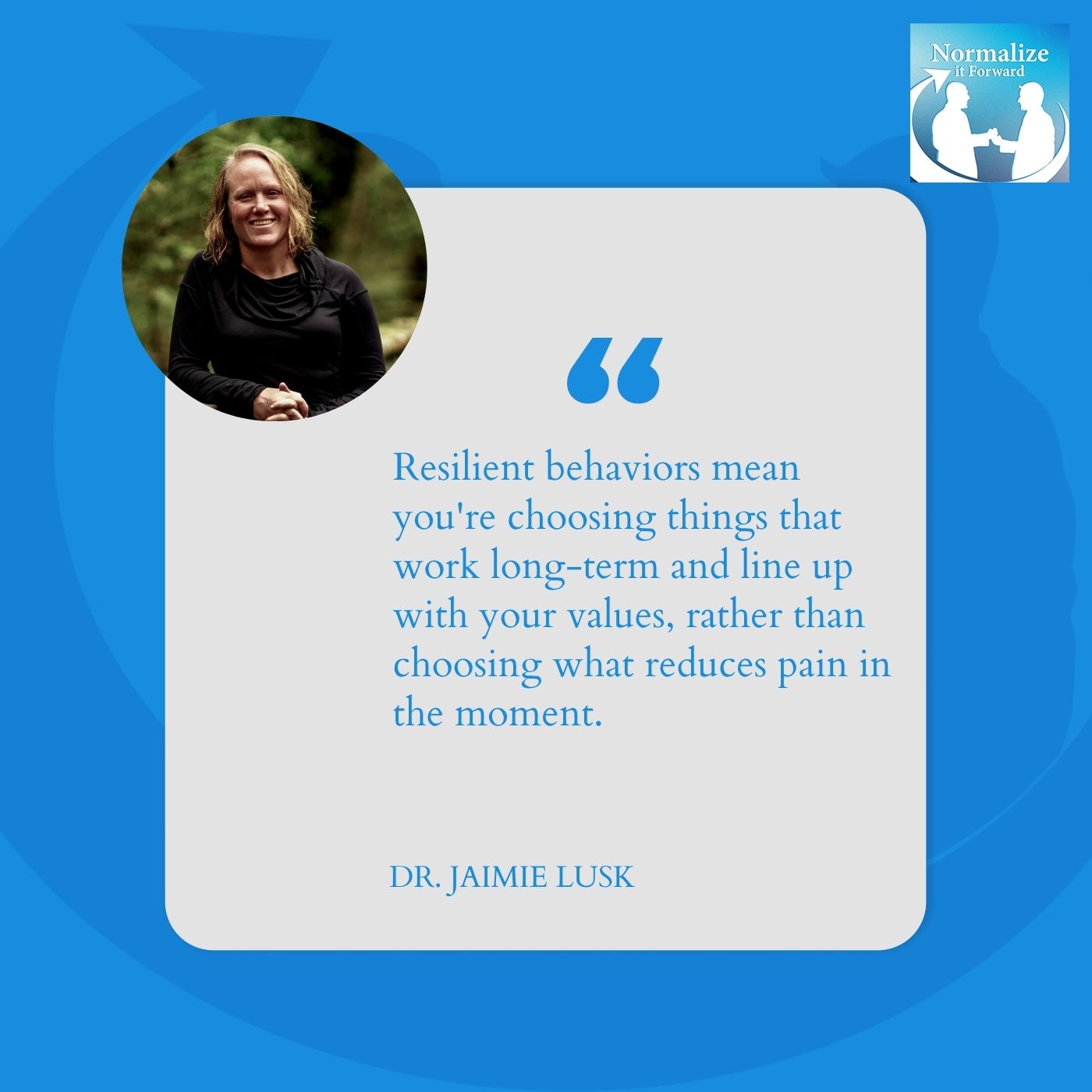
You and I both go down the rabbit hole of growth mindset and some of the ways that we can think about our thinking and choose mindsets that work for us. That’s resilient thinking. Resilient behaviors mean you’re choosing the things that work long-term for you and line up with your values rather than choosing the thing that might reduce your pain in the moment but is going to cost you long-term.
That’s huge with the onset of recreational marijuana use but it’s a whole other topic. I see that happening so much in young individuals where they’re going for that short-term fix rather than the actual solution. I’m a big fan of exercise. I feel like other than pulling a muscle, there’s not a lot of downsides to exercise. You get an actual solution from it versus something that gives you a whole bunch of side effects. Your point around how an individual, whether an older adult or a younger adult, deals with it is excellent.
It’s funny that you say that about pro athletes. You’re the 3rd or 4th individual that I’ve interviewed that’s worked with very high-level athletes that have said the exact same thing. I’m thinking of one in particular who worked with pro baseball players. He was saying their endurance ability was off the charts, but many of them had to work hard at creating more mental resilience. If you’re a pitcher, for example, what do you do when you falter a little bit? How does a person come back from that?
Those behaviors are easily translatable to everyday life. It sounds like some of the work that you do crosses over with some of the work that I do as well, which is interesting. I’m curious. For those that maybe don’t understand PTSD and what it encompasses, you had mentioned at one point PTSD being a disorder of avoidance. Tell me more about that.
Unpacking PTSD As A Disorder Of Avoidance
You can’t get a diagnosis of PTSD right after the trauma because we expect after trauma, you’re going to have certain symptoms. We expect that after a horrible thing or the unthinkable occurs where your life was in danger, your body integrity was threatened, or you witnessed something where somebody’s life or body integrity was threatened, you are going to have upsetting symptoms. Your body is going to replay that scene over and over in your mind.
You’re going to feel strong emotions like fear, anger, horror, guilt, and shame. You’re going to have thoughts that are confusing and sticky. You’re going to have hyperarousal. That means hypervigilance, irritability, trouble sleeping, and startle response. We expect that after a trauma. In the diagnosis of PTSD, you have to be a month out of the trauma before you can even get the diagnosis. If that didn’t go away over time, something got stuck.
What we know from research is that what happens is people start to avoid thinking about, talking about, exploring, and feeling anything about that trauma, and that ends up keeping those symptoms firmly in place. In avoiding that event, and you can avoid it in many ways, you could avoid by overworking, by distraction, by drugs and alcohol, or by isolating. We have 10,000 ways to avoid. That keeps those symptoms in place, which are those difficult feelings, difficult thoughts, re-experiencing symptoms, and hyper-arousal symptoms. People are stuck in this loop.
I do two types of treatment that are evidence-based trauma-focused treatments. Truly, the point of both of them is to slowly, carefully, and systematically approach the thing you’ve been avoiding. I’ve done this treatment with thousands of veterans. Seventy percent of them have significant improvement. PTSD is something that many people recover from. One thing that’s interesting that goes into your life is that the greatest predictor of combat PTSD is childhood trauma. Whether or not you get stuck in that loop of avoidance depends on the skills that you developed early on to manage things that happened as a kid.
I will say one more thing. Two populations that are at risk for PTSD later on are people who had a very difficult life with tons of difficult events that never were able to get the support, and people who had such an easy and sheltered life that they never learned how to deal with hard things. Both of those groups are at risk. For these young people that you work with who are having hard things happen, and they’re having to work through them, they are at the least risk potentially for developing PTSD later on because they’re learning those skills that are going to help them not get stuck in that avoidance loop.
That is a great way of looking at it. I appreciate you breaking that down. It’s a complex topic a lot of people don’t know about, and a lot of people associate only with veterans and individuals that have been in the Military. I appreciate you breaking that down. It makes more sense to me. I’m hoping it makes more sense to my audience as well.
I want to say one thing. Even with horrible combat traumas, only about 30% of people develop PTSD. With sexual trauma and interpersonal trauma, it’s closer to 70%. With men, it’s closer to 90%. It is interpersonal trauma that puts us at the greatest risk of PTSD. We have statistics that show people in college are as likely to have sexual trauma as somebody in the Military.
Truly, it’s not just people in the Military who experience interpersonal trauma, especially sexual violation. That’s to say that a lot of people come to me with sexual trauma and say, “I didn’t have combat. They didn’t try to kill me.” Yet, we know there’s greater risk when those interpersonal boundaries have been violated in that way.
Facing Uncomfortable Conversations: Interpersonal Trauma And Suicide Prevention
I feel like that’s such a hard conversation for some parents to have, but it’s one that I push parents on. I say, “If your kid is going away to school, this is a known entity that does happen way too often. You have to have these conversations.” Information is powerful, but after the fact, it’s a little too late. It’s important to push yourself.
You and I talk about lots of different things on a regular basis, so we’re pretty comfortable. Not every parent is. If they’re not comfortable, find somebody who might be to have that conversation with your student before they go to college. It’s a very real thing that happens on college campuses way too often and can cause some real enduring trauma and difficulty for your student.
I’m not a parent, and I do feel like that’s a hard job. It’s harder than mine, for sure. One thing we know in suicide research is that a very important question to ask is, “Are you thinking of killing yourself?” I was talking to a parent, and they said, “I could never ask that.” I love this parent. They’re a good parent. I felt a lot of compassion for them, but at the same time, I said, “You have to ask it. Do not ask it like you want to ask it, like, ‘You’re not thinking of killing yourself, are you?’ Do not have that conversation. It is, ‘Are you thinking of killing yourself?’ You need to ask that question.” This parent specifically did.
Whether or not you get stuck in a loop of avoidance depends on the skills that you developed early on to manage hard things. Share on XIt’s a tough one. I am a parent. It is the hardest job I’ve ever had. Around that topic, I always say to parents that I’ve been to funerals of kids who have completed, which is way harder than asking that question. Not even close. Ask the question. It’s uncomfortable, but these are things that can be lifesaving for young people.
It’s not about, “Do I feel comfortable doing it?” It’s about, “My kid needs it.” We do lots of those things. I appreciate it. You have covered so much in our brief period of time. I appreciate all of your comments and your thoughts around the range of topics we talked about, from social media to wellness to mental health.
I’m hoping that there are a lot of takeaways for my audience. I appreciate you taking the time and putting the energy into our interview. One last question for you. The way I have this show set up is I have each of my guests nominate a friend, a coworker, or a relative. Maybe you have somebody in mind who you think might be good for me to interview next. Any thoughts? Anyone come to mind?
One of my favorite friends who’s a high school History teacher. He’s had me come and talk to some of his classes. He’s a great history teacher, but he’s also an incredible community builder. He gets what it takes to create community. He’s the reason I have a lot of my friends. He also is a community builder for young people. I would love to have you guys talk about his instincts around that and the ways that he consistently connects people to themselves and other people. His name is Patty Croasdaile. I’ll get you in touch.
I appreciate it. I have to tell you that I love your vibe. I love your thoughts. I love what you do. I hope we can stay in touch. Honestly, I think you are a valuable resource in our field. Thank you so much for your time, your energy, and all of your thoughts. I appreciate it.
I’m always willing to consult for free as a public service. If you feel like something is important for you to understand better, or you need to get connected to resources that are specific to PTSD and moral injury, feel free to email me or find me on my website. I am available.
I appreciate it. Thank you so much. Have a wonderful rest of your day.
Thank you.
Take care. Bye.
Important Links
About Dr. Jaimie Lusk
 Dr. Jaimie Lusk is a board-certified clinical psychologist, is a USMC combat Veteran 15 years of experience as a VA PTSD clinician and a national/international consultant and trainer on Moral Injury interventions, Dr. Lusk specializes in guiding high-performing and sometimes reluctant clients through trauma, moral injury, and complex grief.
Her approach blends evidence-based therapies with creative imagination and spiritual exploration, making therapy an adventurous, deeply relational process. In a previous chapter of life, Dr. Lusk taught at the high school and middle school level, and has great affinity for teenagers who are the “research and development wing” of the human race.
Dr. Lusk is known for her direct, playful, and fearless style—helping clients and organizations unlock transformation in even the most challenging psychological terrain.
Reading about mental health is hard. Let’s schedule a free consultation.
 Rebecca Lobo is a basketball icon, broadcaster, and advocate for mental wellness. She was a standout at the University of Connecticut, she led the Huskies to their first national championship in 1995 and was named the NCAA Final Four’s Most Outstanding Player. She went on to play professionally in the WNBA, becoming one of the league’s original stars with the New York Liberty.